
Need a Pichia CDMO?
Choosing the best pichia CDMO is not simply a matter of finding a company with a yeast-expression platform and an available fermenter. A capable pichia CDMO must connect molecular design, host biology, clone selection, fermentation engineering, downstream recovery, analytical control, cell banking, quality systems and technology transfer into one coherent manufacturing programme.
That distinction matters because Pichia pastoris can appear deceptively straightforward. Insert a gene, select a clone, grow the yeast and recover the protein. In practice, each of those steps contains choices that can alter titre, folding, secretion, glycosylation, degradation, product activity, purification recovery and commercial economics.
A weak provider may demonstrate expression. A strong pichia protein production service must establish that the product can be made reproducibly, characterised appropriately and transferred into controlled manufacturing. The best pichia CDMO for one molecule may therefore be entirely unsuitable for another.
This guide explains how to evaluate a pichia CDMO, Pichia CRO, Komagataella phaffii service provider or integrated recombinant-protein manufacturer. It covers the history and chemistry of the platform, methanol and methanol-free expression, secretion, clone screening, oxygen transfer, fermentation scale-up, purification, glycosylation, analytics, cell banking, GMP readiness and technology transfer.
The central principle is simple:
Do not choose a provider because it claims to specialise in Pichia. Choose it because it can explain precisely how your molecule will behave inside the platform—and what it will do when the biology refuses to follow the original plan.
From methylotrophic yeast to recombinant-protein platform
The organism still widely known in biotechnology as Pichia pastoris attracted scientific interest because of its ability to metabolise methanol. In 1969, Koichi Ogata and colleagues described yeasts capable of using methanol as a carbon and energy source. That metabolic feature later became the foundation of an unusually powerful recombinant-expression system.
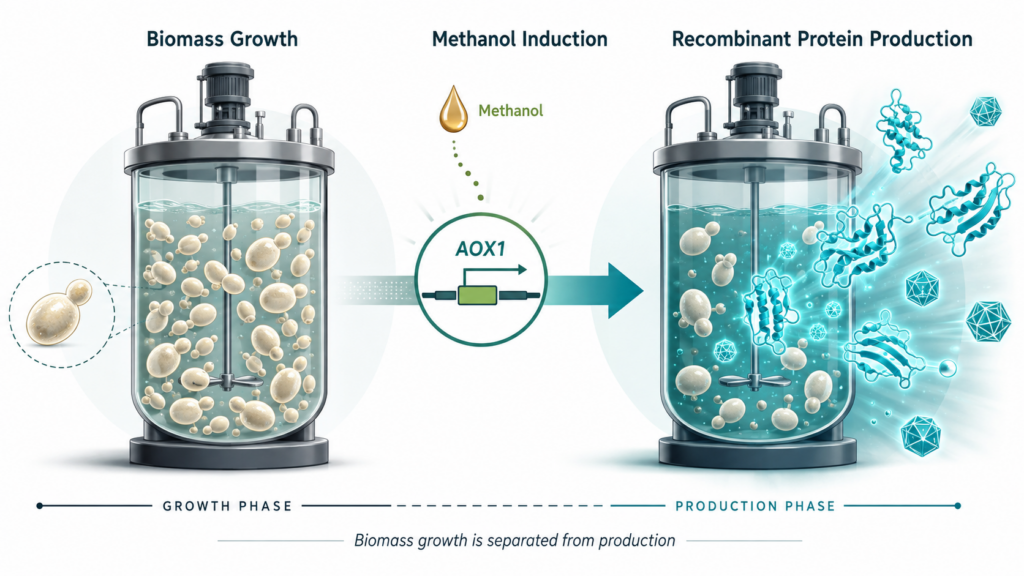
During the 1980s, biotechnology researchers adapted the organism for heterologous protein production. Its methanol-utilisation pathway offered something highly useful: a promoter associated with alcohol oxidase 1, usually called AOX1, that could drive strong recombinant expression after methanol induction. The process could separate biomass generation from the production phase. Cells were first grown to high density using a conventional carbon source, then shifted into methanol induction once sufficient biomass had accumulated.
This architecture gave Pichia a distinctive position among expression hosts. Like bacteria, it could grow rapidly in defined media and reach high cell densities in fermenters. Like other eukaryotes, it possessed endoplasmic-reticulum and Golgi machinery capable of protein folding, disulphide formation, secretion and post-translational modification. These features helped establish the organism as a widely used platform for recombinant enzymes, antigens, cytokines, antibody fragments, membrane proteins, industrial proteins and selected therapeutic products.
The terminology has changed, although industry language has not fully caught up. Many strains historically called Pichia pastoris are now classified as Komagataella phaffii. Scientific publications increasingly use the newer name, while sponsors, procurement teams and search engines continue to use “Pichia” as the more familiar commercial term.
A technically accurate article should therefore use both:
Komagataella phaffii, historically and commercially known as Pichia pastoris.
The distinction is not merely taxonomic. Modern genomic work has revisited the provenance, accessibility and licensing of common production strains. The OPENPichia project, for example, developed a licence-free K. phaffii chassis after analysing the ancestry of widely used commercial hosts. That work illustrates why strain ownership and commercial-use rights should be examined during CDMO selection rather than treated as obscure legal details.
Pichia is also no longer confined to laboratory-scale production. Regulatory records document insulin glargine manufactured through recombinant Pichia pastoris, demonstrating that the host can support regulated product development when the expression system, purification process, analytics and quality strategy are appropriately controlled.
The history therefore teaches an important lesson. Pichia did not become valuable because it was yeast. It became valuable because a specific metabolic pathway, a strong promoter, high-density cultivation and eukaryotic protein-processing machinery could be organised into an industrial production system.
A CDMO must understand that system at the molecular, cellular and engineering levels.
What a Pichia CDMO actually does
The term pichia CDMO is used loosely. Some organisations provide only cloning and small-scale expression. Others can develop fermentation and purification processes but do not operate under GMP. A smaller number can connect strain engineering, upstream development, downstream processing, analytical development, cell banking, quality systems and clinical or commercial manufacturing.
Understanding the difference prevents a sponsor from buying the wrong service.
A pichia CRO usually concentrates on early experimental work. It may design constructs, transform strains, screen clones and produce milligram quantities of protein. That can be useful for feasibility, assay development or lead selection. However, a result produced in a shake flask or microplate does not prove that the same clone will perform under high-density fermentation.
A pichia protein production service may go further. It may operate bench-scale fermenters, purify gram quantities and supply research-grade material. Yet the provider may still lack formal cell-bank systems, validated analytics, controlled raw materials, GMP documentation or commercial technology-transfer experience.
A full-service Pichia CDMO should be able to support the manufacturing arc:
Sequence → construct → strain → clone → fermentation → purification → analytics → formulation → cell banking → GMP manufacture → technology transfer
At the beginning, it should review the molecule and identify platform risks. During development, it should convert those risks into structured experiments. At scale, it should show how oxygen demand, heat generation, mixing, feeding, secretion and purification will be controlled. Before manufacturing, it should establish documentation, methods, banks and raw-material strategies that allow the process to operate consistently.
A useful distinction is:
A CRO asks whether the protein can be expressed.
A CDMO asks whether the protein can become a controlled product.
That second question includes yield, but it also includes activity, impurity burden, stability, comparability, cost of goods and long-term process portability.
An integrated organisation such as Sophia CDMO can support this process through platform-fit assessment, Pichia expression strategy, fermentation development, purification, analytics, cell-bank planning and manufacturing coordination. The value lies less in treating Pichia as a universal answer than in determining when it is the right answer—and when another host would be more defensible.
Begin with the protein, not the expression platform
The most common mistake in recombinant-protein development is selecting the host before defining the molecule’s actual manufacturing needs.
Pichia can be an excellent platform for many products, but it is not neutral. Its secretion machinery, intracellular environment, glycosylation patterns, protease activity and metabolic demands all influence the product. A credible Komagataella phaffii service provider should therefore begin with a molecule-specific manufacturability assessment.
That assessment should examine molecular weight, domain architecture, disulphide bonds, glycosylation sites, oligomerisation, protease-sensitive regions, aggregation propensity, required biological activity and intended route of administration.
Commercial requirements matter as well. A diagnostic protein produced at tens of grams per year has a different process target from a feed enzyme requiring tonne-scale economics. A veterinary injectable, oral bioactive and research reagent may use the same host, but they do not require the same purity, potency, endotoxin, formulation or documentation strategy.
Pichia may be attractive when a protein:
- requires eukaryotic folding or disulphide formation;
- expresses poorly or only as inclusion bodies in E. coli;
- benefits from extracellular secretion;
- does not require fully mammalian glycosylation;
- needs microbial-scale productivity;
- would benefit from avoiding an E. coli-derived endotoxin burden.
Conversely, a mammalian system may be more appropriate when the protein requires tightly controlled human-like glycosylation, mammalian proteolytic processing or a structural environment that yeast cannot reliably reproduce.
Pichia has demonstrated broad utility precisely because it occupies an intermediate space. It offers some of the speed and process economy of microbial fermentation while retaining eukaryotic protein-processing machinery. Reviews of the platform emphasise its ability to achieve high cell densities and support protein folding, secretion and post-translational modification, while also noting that product-specific limitations must be addressed experimentally.
The best pichia CDMO should be willing to recommend against Pichia when the product does not fit.
That willingness is a sign of platform competence, not commercial weakness.
Expression-system experience must be molecule-specific
A provider may have run hundreds of yeast fermentations and still lack relevant experience for a particular molecule.
The key question is not:
Have you worked with Pichia?
It is:
Have you worked with proteins that fail in the same ways mine might fail?
Different protein classes impose different demands. Secreted enzymes may face proteolysis. VHHs and nanobodies may require correct disulphide pairing and preservation of binding activity. Fusion proteins may suffer from truncation or linker cleavage. Cytokines can be unstable, aggregation-prone or toxic to the host. Membrane proteins may burden cellular machinery. Glycoproteins may require detailed glycan control.
The provider should be able to discuss relevant failure modes, not merely successful examples. Useful anonymised case information includes the starting titre, the dominant problem, the experiments performed, downstream recovery, product activity and scale achieved.
A provider that claims experience only in litres and grams may be hiding the more important variables.
For example, a process producing 4 g/L of total protein is not necessarily better than one producing 1.5 g/L. The higher-titre material may be partially degraded, inactive, aggregated or expensive to purify. True productivity must be measured as recoverable, functional product.
The relationship can be stated simply:Usable output=Fermentation titre×Purification recovery×Active fraction
A high titre multiplied by weak recovery and low activity can create a poor commercial process.
Modern strain-engineering research reinforces this point. Recombinant secretion can burden the cellular secretion machinery, and genome-level modifications may improve production only when they address the specific bottleneck.
Expression experience should therefore include an understanding of:
- transcriptional load;
- protein-folding stress;
- secretion capacity;
- unfolded-protein responses;
- protease activity;
- metabolic burden;
- copy-number effects;
- product-specific toxicity.
The best pichia CDMO is not simply the provider with the most historical batches. It is the one that can interpret how its previous experience transfers—or does not transfer—to the molecule under evaluation.
Methanol-induced expression: powerful, established and demanding
The AOX1 system remains one of the defining features of pichia biotechnology.
AOX1 encodes alcohol oxidase, an enzyme involved in the first step of methanol metabolism. When methanol becomes the principal carbon source, the AOX1 promoter can drive strong expression. In recombinant systems, the target gene is placed under this promoter so that protein production rises during methanol induction.
This arrangement offers a practical advantage. Biomass accumulation and protein production can be separated.
During the growth phase, the cells use glycerol, glucose or another carbon source to build biomass. Once the culture reaches a desired density, the process transitions into induction. Methanol is then fed under controlled conditions, activating the promoter and shifting the culture toward recombinant production.
This can be particularly useful for proteins that burden or harm the host. If expression were active throughout the growth phase, the cells might grow slowly, lose productivity or select for less productive variants.
Methanol induction nevertheless creates process complexity.
Methanol is flammable and must be stored, handled and fed under suitable safety systems. Its metabolism also generates substantial oxygen demand and heat. In a high-density culture, insufficient oxygen transfer can reduce productivity, alter metabolism and increase the risk of methanol accumulation.
Too little methanol may under-induce expression. Too much may create toxicity, metabolic stress or process instability. Feed strategy therefore becomes a central control variable rather than a routine operational detail.
Studies have examined how methanol concentration, temperature and feeding profiles alter productivity and product quality. Recent work has also shown that methanol concentration can affect glycosylation patterns in glycoengineered Pichia, demonstrating that induction conditions may influence not only quantity but also critical quality attributes.
A capable Pichia CDMO should explain:
- how methanol concentration is controlled;
- how the feed responds to oxygen demand;
- whether off-gas analysis is used;
- how accumulation is detected;
- how cooling demand is managed;
- how the strategy changes during scale-up;
- whether the facility is designed and authorised for methanol handling.
The provider should also distinguish between different methanol-utilisation phenotypes. Mut⁺ strains metabolise methanol rapidly, whereas Mutˢ strains use it more slowly. Those phenotypes can alter oxygen demand, induction kinetics and feed strategy.
Methanol is therefore neither inherently superior nor obsolete. It is a powerful process variable that must be justified molecule by molecule.
Methanol-free and mixed-feed systems
Many sponsors now ask whether methanol can be avoided.
The reasons are practical. Removing methanol may simplify facility safety, reduce oxygen and heat burdens, lower operational complexity and support facilities not designed for large-scale methanol storage. It may also be advantageous for products or programmes in which methanol-associated stress complicates quality or consistency.
Methanol-free Pichia systems can use constitutive promoters, derepressed promoters or modified regulatory pathways that activate expression without traditional methanol induction.
The GAP promoter is among the best-known constitutive alternatives. It drives expression during growth rather than separating biomass and production into distinct phases. This can simplify the process, although continuous expression may impose a burden if the target protein is toxic or difficult to fold.
Other systems seek to retain elements of AOX1-like regulation without depending entirely on methanol. Researchers have demonstrated methanol-free or methanol-independent induction strategies using alternative carbon sources and engineered regulatory circuits. One reported system used dihydroxyacetone to activate AOX1-associated expression without methanol, while other approaches have explored derepression and engineered promoter control.
Mixed-feed strategies provide a middle course. Methanol may be supplied alongside sorbitol or another substrate, potentially reducing methanol demand while maintaining induction. Such systems require careful optimisation because the secondary carbon source can influence repression, oxygen uptake and metabolic allocation.
A sophisticated provider should not present methanol-free expression as automatically better.
Instead, it should compare:
- promoter strength;
- transcriptional control;
- biomass formation;
- specific productivity;
- oxygen demand;
- heat generation;
- protein quality;
- proteolysis;
- process safety;
- scale-up complexity;
- facility fit.
The best pichia CDMO should support multiple promoter and feeding strategies or be able to coordinate access to them. More importantly, it should explain why the selected system fits the molecule, facility and commercial objective.
Secreted or intracellular expression
Pichia is often selected because it can secrete recombinant proteins into the culture medium.
Secretion can simplify downstream processing. Instead of disrupting cells and separating the target from a dense intracellular mixture, the process may begin with clarification of the fermentation broth. Pichia normally releases relatively low levels of endogenous protein into the medium, which can create a cleaner initial purification environment than intracellular expression.
However, secretion is not a universal advantage.
The signal peptide must direct the nascent protein through the secretory pathway. Processing must occur correctly. The protein must fold, pass cellular quality-control systems, avoid retention and resist extracellular proteases.
Common problems include incomplete signal-peptide cleavage, heterogeneous N-termini, proteolysis, aggregation and poor secretion despite strong intracellular expression.
Signal peptide selection should therefore be experimental. The commonly used Saccharomyces cerevisiae α-mating factor can work well, but it is not optimal for every product. Native signals or engineered alternatives may improve processing or secretion.
Intracellular expression can be preferable when the product is unstable in the extracellular environment or when secretion is the principal bottleneck. It avoids some secretory-pathway constraints but introduces a different process burden.
Cells must be disrupted. The resulting lysate may contain high concentrations of host-cell proteins, nucleic acids, membrane components and particulates. Viscosity can complicate clarification, while the target may be damaged during lysis or prolonged processing.
The choice is therefore not simply between “easy” secretion and “difficult” intracellular recovery.
It is a comparison between two complete manufacturing routes.
A provider should evaluate final recovery, product quality and process robustness rather than choosing secretion because it sounds more efficient.
Construct design and strain engineering
Successful pichia manufacturing begins before the first fermentation.
Construct design influences transcription, translation, secretion, folding, stability and purification. A strong provider should review the sequence rather than treating it as a fixed input.
Codon optimisation can improve translation, but maximising codon adaptation is not always desirable. Translation rate can influence folding, and repetitive or highly structured sequence elements may create instability. The review should also identify cryptic cleavage sites, problematic glycans, unpaired cysteines, aggregation-prone regions and sequence motifs that may affect expression.
Promoter selection must match the product. AOX1 may provide tight induction; GAP may simplify constitutive production; other promoters may offer intermediate or condition-specific behaviour.
The expression cassette also includes the terminator, secretion signal, integration sequence, selection marker and any fusion tags or linkers. Each element can affect productivity and product quality.
Gene copy number deserves particular caution.
Additional copies can increase expression, but the relationship is not linear. High-copy clones may impose metabolic stress, overload secretion machinery, increase aggregation or become genetically unstable. Research on K. phaffii has repeatedly identified gene dosage as one of several variables affecting recombinant output.
A good clone-screening strategy therefore tests performance rather than assuming that the highest-copy clone will be best.
Strain engineering may target:
- protease deletion;
- secretion-pathway enhancement;
- chaperone expression;
- unfolded-protein-response regulation;
- glycosylation pathways;
- methanol metabolism;
- redox balance;
- product-specific toxicity.
These modifications can improve performance, but they also add development, characterisation and licensing considerations.
The sponsor should also confirm the strain’s pedigree, ownership and commercial-use rights. These issues can determine whether the resulting production strain can be used freely, transferred to another manufacturer or commercialised without additional licensing restrictions.
Clone screening must predict fermentation performance
A clone that performs well in a microplate may fail in a bioreactor.
Microplates, shake flasks and production fermenters differ in oxygen availability, mixing, feed delivery, pH control, temperature uniformity and metabolite accumulation. Those differences can reorder clone performance.
A reliable screening funnel should become progressively more process-relevant.
Initial screening can identify clones with correct integration and detectable expression. Later stages should evaluate productivity, stability and quality under conditions that approximate the intended fermentation process.
A robust programme may include:
- genotype and integration confirmation;
- copy-number evaluation;
- microplate expression screening;
- deep-well or shake-flask confirmation;
- microbioreactor testing;
- bench-scale fermentation;
- product-quality analysis;
- genetic and productivity stability across generations.
The analytical readout should include more than concentration. For a VHH, binding activity may matter more than total protein. For an enzyme, catalytic activity is essential.
For a glycoprotein, the glycan profile may distinguish useful clones from unsuitable ones.
Researchers have explored oxygen-transfer-rate monitoring as an early screening tool for Pichia producers. In one study, online oxygen-transfer measurements in microtitre plates helped differentiate clone behaviour and identify high producers.
This research points toward a wider principle:
Clone screening should measure physiology, not only product concentration.
A provider should explain how its screening methods predict performance under the intended induction and feeding strategy.
The top clone is not necessarily the one with the highest early titre. It is the clone that retains productivity, quality and stability when exposed to realistic process conditions.
Fermenter capacity is not scale-up competence
Large stainless-steel vessels look persuasive in presentations. They do not, by themselves, prove that a provider can scale Pichia.
Scale-up changes the physical environment experienced by cells.
At small scale, mixing is rapid and oxygen transfer may be relatively easy. At larger scale, gradients develop. Cells may cycle through regions with different oxygen, methanol, pH and nutrient concentrations. Heat removal becomes more difficult. Foam behaviour changes. Carbon dioxide can accumulate.
A Pichia process may therefore behave differently at 1 L, 100 L and 10,000 L even if the recipe is unchanged.
True scale-up competence requires an engineering rationale. Common scale-up criteria include constant power per volume, tip speed, mixing time, oxygen-transfer coefficient or gas-flow relationship. No single criterion is universally correct.
A provider should be able to describe:
- its demonstrated Pichia scale, not only installed vessel volume;
- impeller and sparger configuration;
- agitation range;
- oxygen-enrichment capability;
- back-pressure capacity;
- cooling limits;
- off-gas monitoring;
- foam-control strategy;
- feed accuracy;
- scale-down modelling.
The phrase “up to 20,000 L” is almost meaningless without this information.
The best pichia CDMO will show how the process was translated across scales, which variables were preserved, what changed and how comparability was evaluated.
A direct leap from a shake flask to large-scale fermentation may occasionally work, but it is not a defensible development strategy for an important product.
Oxygen transfer: the hidden limit in Pichia fermentation
Oxygen transfer frequently separates competent Pichia manufacturers from those that merely own microbial fermenters.
The culture consumes oxygen, while the fermenter transfers oxygen from gas bubbles into the liquid phase. The basic relationship is:OTR=kLa(C∗−CL)
Where:
- OTR is the oxygen-transfer rate;
- kLa is the volumetric mass-transfer coefficient;
- C* is the equilibrium dissolved-oxygen concentration;
- CL is the actual dissolved-oxygen concentration.
As cell density rises, oxygen uptake can increase dramatically. Methanol metabolism can intensify demand further. If cellular oxygen consumption exceeds the transfer capacity of the vessel, dissolved oxygen falls and metabolism changes.
The process may respond by increasing agitation, gas flow, back pressure or oxygen enrichment. Each intervention has consequences.
Higher agitation increases power and heat generation. Additional gas flow can increase foaming. Oxygen enrichment adds cost and safety considerations. Back pressure can improve oxygen solubility but changes equipment and operational requirements.
The CDMO should understand the difference between nominal dissolved-oxygen control and actual process capability. A vessel may maintain a set point at moderate density but fail during peak induction.
Questions should include:
- What is the demonstrated kLa range?
- Can the reactor use oxygen enrichment?
- How is the dissolved-oxygen cascade configured?
- Is off-gas oxygen and carbon dioxide measured?
- How is methanol feed limited during oxygen stress?
- What happens if agitation reaches its maximum?
- How was heat-removal demand estimated?
- Does the scale-down model reproduce oxygen and substrate gradients?
Oxygen transfer is not an isolated engineering metric. It can affect productivity, proteolysis, stress responses and product quality.
That is why a provider should discuss it during proposal development—not after the first failed scale-up run.
Downstream processing: where expression becomes economics
Fermentation creates a biological mixture. Manufacturing produces a controlled product.
The distinction is downstream processing.
A secreted product may require biomass removal, depth filtration, concentration, capture chromatography, polishing and buffer exchange. An intracellular process adds cell disruption and clarification. Either route may encounter proteases, particulates, nucleic acids, host-cell proteins, pigments, aggregates or product variants.
The provider should develop downstream processing alongside upstream development. Waiting until the highest-titre clone is selected can create a process that expresses well but purifies poorly.
Suppose Process A produces 5 g/L and achieves 20% downstream recovery. Its final recovery is 1 g/L.
Process B produces 2.5 g/L and achieves 70% recovery. Its final recovery is 1.75 g/L.
The apparently weaker fermentation becomes the better manufacturing process.
A Pichia purification train may include centrifugation, depth filtration, microfiltration, ultrafiltration/diafiltration, affinity capture, ion exchange, hydrophobic interaction, mixed-mode chromatography and final polishing.
The exact sequence depends on the product.
For a secreted antibody fragment, the main challenge may be aggregation or proteolytic fragments. For an enzyme, preserving activity through pH and salt changes may be critical. For an intracellular product, lysate viscosity and host-cell impurity burden may dominate.
The provider should track:
- step yield;
- purity;
- aggregate content;
- degradation;
- potency;
- host-cell protein;
- residual DNA;
- process time;
- resin capacity;
- filter capacity;
- buffer volumes;
- cost.
Chromatography methods that work at milligram scale may become uneconomical at commercial scale. Size-exclusion chromatography, for example, can be useful analytically or for specialised polishing, but it is often capacity-limited as a primary manufacturing step.
A strong pichia protein production service should design purification for the future volume rather than merely producing a clean laboratory sample.
Glycosylation: a platform advantage and a product risk
Pichia is eukaryotic, but its glycosylation does not naturally mirror human glycosylation.
That difference can affect molecular weight, heterogeneity, stability, activity, receptor binding, pharmacokinetics and immunological behaviour.
Pichia can add N-linked and O-linked glycans, often with mannose-rich structures. For some enzymes, diagnostics, feed products and industrial proteins, these glycans may be acceptable or even beneficial. For therapeutic proteins, they may require careful characterisation or engineering.
The first question is not whether the protein is glycosylated.
It is whether glycosylation is a critical quality attribute.
A glycan located away from the functional region may have limited effect. Another may alter activity, clearance or structural stability. Occupancy can vary between sites, and fermentation conditions may affect the resulting profile.
Glycoengineered Pichia strains have been developed to produce more human-like or controlled glycan structures. This work has expanded the platform’s potential for complex proteins, but it does not remove the need for product-specific analysis.
Glycoengineering also creates additional questions:
- Who owns the strain?
- Are commercial rights included?
- Is the pathway genetically stable?
- Which glycan species remain?
- How is batch consistency demonstrated?
- Does the engineered host affect productivity?
- What comparability evidence will be needed after process changes?
A CDMO should be able to say whether the product:
- does not require glycosylation;
- tolerates native yeast glycosylation;
- requires avoidance of specific glycoforms;
- needs an engineered glycosylation pathway;
- belongs in a mammalian host.
The best pichia CDMO does not minimise glycosylation risk. It identifies whether the risk is irrelevant, manageable or disqualifying.
Cell banking and strain provenance
A production strain is not merely a tube in a freezer. It is the biological origin of every manufacturing batch.
A credible programme should establish a clear bank genealogy, typically progressing from a research bank into a master cell bank and then a working cell bank.
The master cell bank should represent the controlled source material. The working bank supports routine production while protecting the master bank from excessive use.
Bank characterisation may include identity, purity, viability, productivity, genetic stability and absence of relevant contaminants. The precise testing package depends on the product, development stage and regulatory route.
ICH Q5D provides an internationally recognised framework for the derivation and characterisation of microbial and other cell substrates used in biotechnology manufacturing. It addresses the preparation and control of cell banks, including identity, purity and stability considerations.
The sponsor should ask:
- Who owns the strain?
- Who owns the expression construct?
- Are commercial-use rights documented?
- Where are the banks stored?
- Is a geographically separate backup maintained?
- What tests release the bank?
- How is productivity confirmed?
- How many generations occur between the bank and harvest?
- Can the bank be transferred to another site?
- What happens to the bank after contract termination?
These questions can seem remote during early development. They become urgent when a sponsor needs a second manufacturing site, changes ownership or enters commercial supply.
Bank portability should therefore be designed before it is needed.
Analytical development must reflect the product’s function
A process is not controlled simply because it follows a batch record. It is controlled because analytical methods reveal whether the product and process remain within meaningful boundaries.
A Pichia-derived protein may require methods for identity, purity, potency, aggregation, fragmentation, glycosylation, host-cell protein, residual DNA and stability.
Identity methods may include intact-mass analysis, peptide mapping, immunoassays or sequence-based confirmation.
Purity and heterogeneity may be evaluated through SDS-PAGE, CE-SDS, SEC-HPLC, reversed-phase chromatography, ion-exchange chromatography or isoelectric-focusing methods.
Structural assessment may include disulphide mapping, glycan analysis, spectroscopy, thermal analysis and higher-order-structure methods.
Potency should measure what the molecule is intended to do. Enzyme concentration does not prove enzyme activity. Binding does not always prove cellular function. A functional assay should be linked to the product’s mechanism or intended use.
Process-related impurity methods may assess host-cell proteins, residual DNA, protease activity, media components and bioburden. Endotoxin testing may still be relevant even though Pichia itself is not a Gram-negative bacterial host, particularly when the product’s route of administration or process environment requires control.
The analytical package must be phase appropriate.
A research reagent may need identity, concentration, purity and activity. A clinical therapeutic requires a far deeper control strategy. A veterinary injectable, diagnostic enzyme and feed protein each sit somewhere different on that spectrum.
The provider should explain which methods already exist, which must be developed, which require qualification and which eventually require validation.
“Comprehensive analytics” is not a meaningful answer without a molecule-specific method map.
GMP readiness is more than access to a cleanroom
Many providers describe themselves as “GMP ready,” “GMP capable” or “GMP aligned.”
These phrases can conceal major differences.
Research-grade production may operate under basic laboratory controls. Development-grade or GMP-like production may use controlled records and traceable materials without meeting the full requirements of clinical GMP. Clinical manufacturing requires a functioning pharmaceutical quality system appropriate to the product and phase.
Commercial GMP adds deeper process validation, lifecycle management and supply reliability.
A provider’s GMP readiness should be evaluated across the entire operation:
- quality management;
- document control;
- personnel training;
- data integrity;
- supplier qualification;
- raw-material control;
- equipment qualification;
- cleaning procedures;
- deviation handling;
- corrective and preventive action;
- change control;
- batch review;
- analytical method control;
- stability management;
- release procedures;
- audit and inspection history.
The cell bank, upstream process, downstream purification, analytics and storage conditions must all fit within that system.
A fermenter located in a GMP facility does not automatically make a process GMP.
The process must be defined, controlled and documented. Materials must be specified. Critical parameters and quality attributes must be understood. Deviations must be investigated. Methods must be suitable for their intended use.
ICH and regulatory quality frameworks also emphasise understanding and controlling the expression construct, cell substrate, manufacturing process and product characteristics as connected elements.
Ask the provider to define exactly what it means by GMP readiness.
Does it support:
- GMP cell banking?
- clinical drug-substance manufacture?
- commercial supply?
- qualified release testing?
- regulatory CMC documentation?
- process characterisation?
- process validation?
- stability programmes?
- technology transfer into a licensed site?
The answer should be specific.
Technology transfer is a test of process understanding
A process is not mature if it works only in the hands of the scientist who developed it.
Technology transfer turns tacit knowledge into an executable manufacturing system.
The transfer package should describe the strain, construct, cell banks, raw materials, media, feeds, seed train, fermentation controls, harvest criteria, purification steps, analytical methods and storage conditions.
It should also explain why the process is operated that way.
A list of instructions without rationale is fragile. When equipment or scale changes, the receiving site must understand which variables can move and which must remain tightly controlled.
A complete transfer package may include:
- construct and strain history;
- bank genealogy;
- raw-material specifications;
- media and feed recipes;
- seed-train design;
- batch records;
- critical process parameters;
- acceptable ranges;
- in-process controls;
- sampling plans;
- hold times;
- harvest criteria;
- purification conditions;
- analytical procedures;
- reference standards;
- development reports;
- scale-up rationale;
- deviation history;
- stability data;
- comparability strategy.
Intellectual-property terms should be equally clear.
The sponsor should know who owns the pre-existing platform, the programme-specific construct, the production strain, the developed process, analytical methods, improvements and resulting data.
A provider that resists process portability may create commercial dependency. A provider that documents and transfers the process protects the sponsor’s future options.
The best pichia CDMO should view transferability as evidence of technical quality rather than a threat to customer retention.
Questions to ask prospective Pichia providers
A commercial proposal should be the beginning of technical diligence, not its conclusion.
Ask which Komagataella strains the provider supports and whether commercial rights are included. Request details on methanol-induced, constitutive and methanol-free platforms. Ask which protein classes it has actually produced and at what demonstrated scales.
Probe its clone-screening strategy. Does it screen only by titre, or does it examine productivity, activity, stability, oxygen-transfer behaviour and product quality?
Ask for the largest Pichia process it has successfully run—not merely the largest fermenter installed in the building.
Discuss oxygen transfer directly. What kLa values can the reactors achieve? Is oxygen enrichment available? How are dissolved oxygen and methanol feed connected? What happens when agitation, airflow or cooling reaches its operational limit?
Evaluate downstream depth. Can the provider perform high-capacity clarification, TFF, capture, polishing and product-specific impurity removal? Does it consider downstream recovery while selecting clones?
Request an analytical-development map. Which identity, purity, potency and impurity methods are available? Which need development? Can methods be transferred or validated?
Review cell banking. Can the provider establish GMP master and working banks? Who owns them? Where are backups stored?
Ask how it defines GMP, what stages it supports and which activities are performed internally or through partners.
Finally, ask who will remain involved. Some providers use senior scientists during sales discussions and transfer the programme to a different team after contract signature.
Continuity can matter, particularly when the molecule is difficult or the process requires rescue work.
A practical Pichia CDMO scorecard
A structured scorecard can prevent a procurement process from being dominated by price, presentation quality or installed vessel volume.
| Evaluation category | Suggested weight |
|---|---|
| Molecule-specific expression experience | 15 |
| Construct and strain engineering | 10 |
| Clone-screening strategy | 10 |
| Fermentation and oxygen-transfer capability | 15 |
| Downstream processing | 12 |
| Analytical development | 12 |
| Cell banking and strain control | 8 |
| GMP and quality systems | 10 |
| Technology transfer and ownership clarity | 5 |
| Programme governance and communication | 3 |
| Total | 100 |
A score above 90 may indicate an unusually strong fit. A result between 75 and 89 may be credible with manageable gaps. Scores between 60 and 74 require clear mitigation.
Below 60, the sponsor should question whether the provider’s weaknesses are compatible with the programme.
However, an average score should never hide a fatal mismatch.
A provider could score well overall but lack the oxygen-transfer capability required for the intended methanol process. It may possess excellent fermentation infrastructure but lack rights to the proposed strain. It may produce high titres but have no credible purification route.
Scientific judgement must therefore sit above the arithmetic.
Where Sophia CDMO fits
Sophia CDMO supports microbial recombinant-protein programmes through host and platform assessment, Pichia expression strategy, fermentation development, downstream purification, analytical planning, cell banking, scale-up and GMP-readiness coordination.
Its role is not to position Pichia as the answer to every protein. The more useful question is whether the molecule belongs in Komagataella phaffii, E. coli, Bacillus, another yeast, a fungal host or a mammalian system.
That manufacturability-first approach is especially relevant for enzymes, VHHs, nanobody-style proteins, diagnostic reagents, animal-health biologics, fermentation-derived bioactives and difficult recombinant proteins.
Sponsors evaluating a Pichia programme should expect a provider to identify the dominant technical risk early, connect development to the intended manufacturing scale and preserve a clear path toward transfer and controlled supply.
Conclusion: Choose for the manufacturing process you will need
The best pichia CDMO is not necessarily the company with the biggest fermenter, the strongest sales presentation or the highest preliminary titer.
It is the partner that understands how the protein’s structure interacts with the host, how the construct affects cellular burden, how the clone behaves under process conditions, how oxygen transfer limits fermentation, how downstream recovery changes the economics and how analytics define product quality.
The strongest provider will also recognise where its platform stops being suitable.
Choosing a Pichia CDMO should therefore involve more than comparing capacity and cost. Sponsors should evaluate expression-system experience, promoter flexibility, clone screening, scale-up engineering, purification, glycosylation, cell banking, analytical development, GMP systems, ownership terms and technology transfer.
A well-designed Pichia process does more than produce protein. It produces a repeatable relationship between a biological host, a manufacturing environment and a controlled product.
That is the standard against which a Pichia protein production service, Pichia CRO or Komagataella phaffii service provider should be measured.
The best pichia CDMO for recombinant protein production will not simply promise expression. It will show how the program can become scalable, reproducible, analytically defensible and commercially useful.
Frequently Asked Questions
1. What is a Pichia CDMO?
A Pichia CDMO develops and manufactures recombinant proteins using Komagataella phaffii, historically known as Pichia pastoris. Services may include construct design, strain generation, clone screening, fermentation, purification, analytics, cell banking, GMP manufacturing and technology transfer.
2. Is Pichia pastoris the same as Komagataella phaffii?
The names are commonly used interchangeably in biotechnology, although Komagataella phaffii is the current classification for many strains historically described as Pichia pastoris. “Pichia” remains the more familiar commercial term.
3. When is Pichia better than E. coli?
Pichia may be preferable when a protein benefits from eukaryotic folding, disulphide formation or secretion, or when inclusion bodies and endotoxin burden make E. coli less attractive. The decision must remain product specific.
4. Does Pichia always require methanol?
No. Traditional AOX1 systems use methanol, but constitutive, derepressed and engineered methanol-free systems are available. The optimal strategy depends on expression control, product toxicity, oxygen demand, facility capabilities and process economics.
5. Can Pichia manufacture therapeutic proteins?
Yes. Pichia has been used in regulated recombinant-protein manufacturing, including insulin glargine. Suitability depends on product quality, glycosylation, potency, impurity control, GMP systems and the complete manufacturing strategy.
6. Can Pichia express VHHs and nanobodies?
Yes. Pichia can support VHH and nanobody expression, including secreted production. Development should examine signal-peptide processing, disulphide formation, proteolysis, aggregation, binding activity and glycosylation risk.
7. What fermentation scale should a Pichia provider offer?
The relevant issue is demonstrated performance at the required scale—not vessel size alone. Sponsors should evaluate oxygen transfer, cooling, mixing, feeding, pressure capability, off-gas monitoring and prior scale-up experience.
8. Which analytical tests are needed for a Pichia-derived protein?
Common tests include identity, purity, aggregation, fragmentation, potency, host-cell protein, residual DNA, glycosylation where relevant and stability. The exact package depends on the molecule and intended use.
9. What makes a Pichia process GMP ready?
GMP readiness requires controlled cell banks, qualified materials and equipment, documented processes, suitable analytical methods, data integrity, deviation management, change control, batch review and an appropriate validation strategy.
10. How should a sponsor choose the best Pichia CDMO?
Evaluate molecule-specific experience, strain and promoter options, clone screening, fermentation engineering, oxygen-transfer capacity, downstream recovery, analytics, cell banking, GMP systems, intellectual-property terms and technology-transfer capability.
Email our team at info@sophiacdmo.com