
Ophthalmic Services
Sophia provides Ophthalmic CDMO Services for sponsors developing sterile eye drops, preservative-free ophthalmic products, multidose ophthalmic systems, ocular suspensions, ophthalmic emulsions, gels, ointments, biologics, peptides, small molecules, anti-inflammatory products, anti-infectives, dry-eye products, glaucoma products, retinal products, ocular implants, injectable ophthalmics, and advanced ocular delivery platforms.
Ophthalmic products look small, but they are technically unforgiving. A drop placed into the eye must be sterile, comfortable, stable, accurately delivered, particle-controlled, pH-appropriate, osmotically suitable, compatible with ocular tissue, compatible with the container, and able to deliver drug through difficult biological barriers. A formulation can fail because it stings, blurs vision, forms particles, loses preservative effectiveness, adsorbs to the bottle, clogs the dropper, changes droplet size, destabilises on storage, or fails to deliver enough drug to the ocular target.
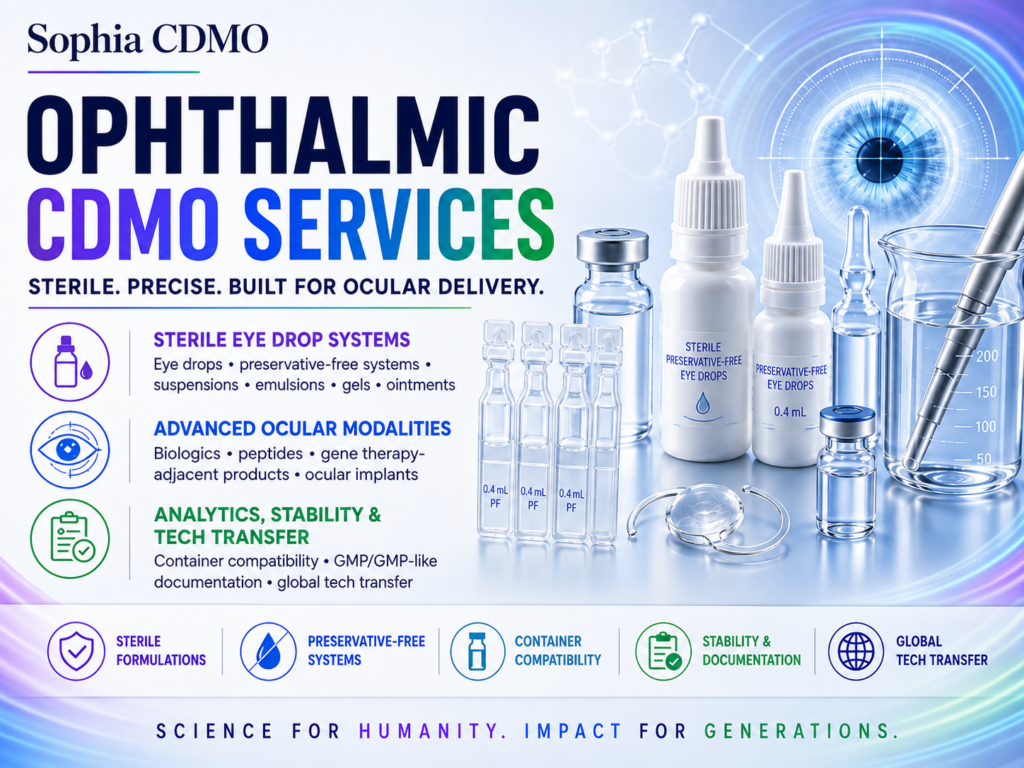
That is why Ophthalmic CDMO Services require more than sterile liquid manufacturing. Ophthalmic development sits at the intersection of sterile drug product, formulation science, container closure engineering, ocular pharmacology, patient usability, microbial control, particle testing, preservative strategy, and CMC documentation.
Sophia supports ophthalmic programmes through formulation development, sterile manufacturing strategy, preservative-free system planning, multidose container compatibility, suspension and emulsion development, viscosity and retention strategy, pH and osmolality optimisation, ocular biologic interface, ophthalmic device interface, particle analytics, sterility and endotoxin strategy, extractables and leachables interface, stability, GMP/GMP-like documentation, and European execution through state-of-the-art facilities in Spain and Switzerland.
The objective is direct: develop ophthalmic products that are sterile, comfortable, stable, deliverable, and globally development-ready.
Why Ophthalmic Products Matter
Ophthalmic products matter because the eye is clinically important and biologically difficult. It is small, sensitive, highly structured, protected by barriers, and intolerant of careless formulation. A product intended for oral or injectable use can sometimes tolerate excipient flexibility. An ophthalmic product has less room for that. The eye notices.
Ophthalmic development may involve:
- Anterior segment disease
- Dry eye
- Glaucoma
- Allergic conjunctivitis
- Ocular inflammation
- Ocular infection
- Post-surgical care
- Retinal disease
- Intravitreal products
- Ocular biologics
- Gene therapy-adjacent delivery
- Ophthalmic implants
- Preservative-free delivery
- Paediatric and geriatric eye care
- Chronic-use products
The technical challenge is that ocular delivery is inefficient. A conventional eye drop may lose much of its volume through blinking, tear turnover, drainage, and nasolacrimal clearance. The cornea and conjunctiva create barriers. For posterior segment diseases, topical delivery may be insufficient, requiring intravitreal injection, implants, or specialised delivery systems. For chronic anterior segment use, comfort and tolerability become central.
History of Ophthalmic Drug Development
The history of ophthalmic medicine begins with one of the oldest clinical facts: the eye is exposed, visible, vulnerable, and precious. Ancient medical traditions used washes, mineral preparations, plant extracts, oils, salves, and surgical techniques to treat eye disease. Some were useless. Some were harmful. Some were early attempts to solve the same problems modern ophthalmology still faces: infection, inflammation, pain, opacity, pressure, trauma, dryness, and loss of sight.
As pharmacy became more systematic, ophthalmic preparations moved from crude topical mixtures toward controlled solutions, ointments, and sterile products. The eye forced pharmaceutical discipline early because contamination could be catastrophic. A non-sterile oral product may be unacceptable, but a contaminated eye product can be immediately dangerous. The ocular route made sterility feel intimate.
The twentieth century brought major advances. Antibiotics transformed treatment of ocular infections. Corticosteroids gave clinicians powerful anti-inflammatory control. Glaucoma medicines evolved from miotics and sympathomimetics into beta-blockers, prostaglandin analogues, carbonic anhydrase inhibitors, alpha agonists, and combination products. Artificial tears and lubricants became important for chronic surface disease. Ocular surgery created demand for perioperative sterile products, viscoelastics, irrigating solutions, and post-operative regimens.

Sophia CDMO provides Ophthalmic CDMO Services
Then retinal medicine changed the scale of ambition. Intravitreal injection of biologics made the eye a site for advanced therapies, not only topical products. Anti-VEGF products showed that large molecules could transform management of retinal disease. Ocular implants, sustained-release systems, steroid depots, and biodegradable delivery formats expanded the category. The eye became both a delicate surface organ and a high-value site for precision delivery.
More recently, gene therapy and cell-adjacent technologies pushed ophthalmology further. The eye is attractive for advanced therapies because it is accessible, compartmentalised, and measurable. But accessibility does not make development easy. Intravitreal, subretinal, suprachoroidal, topical, and implantable routes each create different formulation, sterility, device, surgical, and analytical demands.
The historical movement is clear. Ophthalmic products evolved from eye washes to sterile drug systems, then to chronic-use precision formulations, then to biologics and advanced delivery platforms. The eye has always demanded care. Modern ophthalmic CDMO work demands industrialised care.
That is the territory for Ophthalmic CDMO Services: small-volume products where sterility, comfort, precision, and performance matter at every step.
Ophthalmic Product Types Supported
Sophia supports Ophthalmic CDMO Services across sterile topical, injectable, implantable, and device-associated product categories.
Product types may include sterile eye drops, preservative-free unit-dose products, preservative-free multidose systems, multidose preserved products, ophthalmic suspensions, ophthalmic emulsions, gels, ointments, lubricants, dry-eye products, anti-infective products, anti-inflammatory products, glaucoma products, mydriatics, miotics, allergy products, ocular peptides, ophthalmic biologics, intravitreal products, subconjunctival products, suprachoroidal delivery products, ocular implants, drug-eluting ocular devices, and advanced ocular delivery systems.
Programme types may include early formulation screening, sterile product development, preservative challenge strategy, device-container compatibility, clinical trial material, GMP/GMP-like manufacturing, product reformulation, preservative-free conversion, generic ophthalmic development, complex ophthalmic product development, stability rescue, packaging change, and global tech transfer.
Each ophthalmic format has a different control logic. A dry-eye lubricant is not an intravitreal biologic. A preserved multidose drop is not a preservative-free device system. A suspension is not an emulsion. A retinal implant is not a topical solution. The development path must follow the product.
Formulation Strategy for the Eye
Sophia supports ophthalmic formulation development across aqueous solutions, suspensions, emulsions, gels, ointments, biologics, peptides, nanoparticles, implants, and device-compatible systems.
Important formulation variables include:
- pH
- Osmolality
- Tonicity
- Buffer capacity
- Viscosity
- Surface tension
- Preservative strategy
- Surfactant compatibility
- Solubility
- Particle size
- Drop size
- Ocular residence time
- Comfort and irritation risk
- Container compatibility
- Sterility strategy
The eye is sensitive to pH, osmotic stress, preservatives, surfactants, particulates, viscosity, and excipient burden. A formulation may improve solubility but increase irritation. A viscosity enhancer may improve residence time but blur vision. A preservative may protect a multidose product but irritate the ocular surface during chronic use. A surfactant may stabilise an emulsion but affect tolerability. A buffer may maintain pH but alter comfort.
Ophthalmic formulation is therefore a balance between drug delivery and ocular acceptability. The product has to work and feel usable.
Sterile Ophthalmic Manufacturing
Ophthalmic products generally require strong sterile manufacturing discipline. Sophia supports sterile manufacturing strategy for ophthalmic solutions, suspensions, emulsions, gels, ointments, biologics, injectables, unit-dose products, multidose products, and device-associated formats.
Sterile strategy may include sterile filtration, aseptic processing, terminal sterilisation assessment where appropriate, component sterilisation, sterile compounding, sterile filling, environmental monitoring, container closure integrity, bioburden control, endotoxin testing, and sterility testing.
Sterile filtration may be feasible for clear solutions but not suitable for suspensions, emulsions, gels, large molecules, particles, or certain device-associated products. Suspensions may require sterile API or aseptic particle processing. Emulsions may be sensitive to filtration and shear. Biologics may be sensitive to interfaces, agitation, and hold time. Ophthalmic ointments may require specialised sterile processing.
The eye is not forgiving of contamination. Ophthalmic sterility strategy should be built early, not patched at the end.
Preservative-Free and Multidose Systems
Sophia supports preservative-free ophthalmic development, including unit-dose blow-fill-seal formats, preservative-free multidose containers, sterile filtration interface, container closure review, dropper design, microbial ingress risk, device performance, patient use conditions, and stability.
Preservatives can be useful in multidose products, but they may create tolerability issues, especially in chronic-use products such as dry-eye or glaucoma therapies. This has increased interest in preservative-free systems. The challenge is maintaining microbial quality without relying on traditional antimicrobial preservatives.
Preservative-free unit-dose systems may simplify microbial risk but increase packaging volume and cost. Preservative-free multidose systems may require specialised valves, filters, vents, one-way systems, or container designs that prevent contamination during use. These systems must maintain dose performance and container closure integrity through shelf life and use.
A preservative-free ophthalmic product is not simply a product without preservative. It is a controlled delivery system that must maintain sterility through real use.
Ophthalmic Suspensions
Sophia supports ophthalmic suspension development for poorly soluble drugs and controlled ocular delivery products. Suspension development may include particle-size control, crystal form, sedimentation, redispersibility, dose uniformity, viscosity, wetting agents, suspending agents, preservative compatibility, dropper performance, syringe or device compatibility, and stability.
Ophthalmic suspensions are difficult because particles must be small enough and controlled enough for ocular comfort and dose consistency. Large particles can irritate the eye. Sedimentation can reduce dose uniformity. Caking can prevent redispersion. Particle growth can occur during storage. A product may pass assay but fail delivered dose if particles settle or clog the tip.
Suspension products need meaningful in-use testing. Patients may not shake consistently. Droppers may deliver variable amounts. End-of-use samples may differ from beginning-of-use samples. Stability must evaluate particle size, potency, impurities, preservative effectiveness where relevant, and resuspendability.
A suspension that works only when handled perfectly is not a robust ophthalmic product.
Ophthalmic Emulsions and Lipid Systems
Sophia supports ophthalmic emulsion and lipid-system development, including oil phase selection, surfactant strategy, droplet size, zeta potential, viscosity, osmolality, pH, emulsion stability, sterilisation strategy, container compatibility, ocular comfort, and stability.
Ophthalmic emulsions can support poorly soluble drugs, dry-eye lipid supplementation, anti-inflammatory products, and surface disease applications. But emulsions can destabilise through creaming, coalescence, Ostwald ripening, droplet growth, phase separation, or container interaction. Surfactants and oils must be selected for ocular tolerability and product stability.
Droplet size matters. Too large and comfort may suffer. Too unstable and dosing changes over time. Too much surfactant and tolerability may suffer. Too little stabilisation and the emulsion fails shelf life.
The emulsion must be sterile, stable, comfortable, and dose-consistent. That is a narrow lane.
Viscosity, Residence Time, and Ocular Comfort
Sophia supports viscosity and ocular residence-time strategy for ophthalmic products. Viscosity enhancers, mucoadhesive polymers, gels, in situ gelling systems, ointments, and lubricating excipients can increase residence time and improve symptom relief or drug exposure.
Common formulation tools may include cellulose derivatives, carbomers, hyaluronic acid, polyvinyl alcohol, povidone, poloxamers, alginates, and other product-specific polymers. These can improve retention but also affect blur, drop formation, sterility processing, filtration, device compatibility, and patient experience.
Comfort matters. A product that stings or blurs excessively may fail adherence. Chronic ophthalmic products must be tolerable over repeated use. Viscosity must be balanced against drop size, flow through the bottle, residue, visual clarity, and patient acceptance.
Ophthalmic formulation lives at the border between pharmacokinetics and sensation. The eye reports formulation mistakes quickly.
Ophthalmic Biologics and Advanced Ocular Delivery
Sophia supports ophthalmic biologic and advanced ocular product development interface, including proteins, peptides, antibody fragments, VHHs, Fc fusions, intravitreal biologics, retinal products, gene therapy-adjacent products, ocular implants, sustained-release biologics, and sterile complex injectables.
Ocular biologics may require aggregation control, low particulate burden, sterile injectable strategy, silicone oil compatibility, container closure integrity, low endotoxin, potency assays, stability, and compatibility with intravitreal administration. Advanced ocular delivery systems may require polymer compatibility, release testing, implant sterility, surgical delivery interface, and local tolerability considerations.
The eye is attractive for advanced therapies because local delivery can reduce systemic exposure and provide direct access to disease sites. It is also technically strict. Small volumes, sensitive tissues, sterile requirements, and high-value molecules leave little room for poor control.
Sophia’s broader advanced modality platform gives ophthalmic products a link to biologics, complex injectables, sterile fill-finish, gene therapy analytics, and drug-device development.
Containers, Droppers, and Device Interface
Sophia supports ophthalmic container and device interface for unit-dose containers, multidose bottles, preservative-free multidose systems, droppers, ophthalmic syringes, implants, applicators, reconstitution systems, and ocular delivery devices.
Container and device questions may include:
- Drop size
- Delivered dose
- Actuation force
- Squeezability
- Tip geometry
- Microbial ingress
- Container closure integrity
- Extractables and leachables
- Sorption and adsorption
- Preservative compatibility
- Light protection
- Patient usability
- End-of-use performance
A bottle is not just a bottle. It controls drop size, contamination risk, dose consistency, patient handling, and product exposure. For preservative-free systems, the container may be central to microbial control. For suspensions, the tip must not clog. For emulsions, surface interactions may affect droplet behaviour. For biologics, adsorption and particle formation may matter.
Analytics and Quality Control
Sophia’s Ophthalmic CDMO Services include analytical development for assay, impurities, degradation products, pH, osmolality, viscosity, particulate matter, particle size, droplet size, preservative content, antimicrobial effectiveness where relevant, sterility, endotoxin, container closure integrity, extractables and leachables, potency, and stability.
Methods may include HPLC, UPLC, LC-MS, GC-MS, ICP-MS, UV/Vis, osmolality, pH, rheology, viscosity testing, laser diffraction, DLS, microscopy, light obscuration, microbial limits, sterility testing, endotoxin testing, preservative effectiveness testing, container closure integrity methods, and product-specific potency assays.
Ophthalmic analytics must reflect the presentation. A solution needs clarity, assay, impurities, sterility, pH, and osmolality. A suspension needs particle size and resuspendability. An emulsion needs droplet size and physical stability. A biologic injectable needs aggregation, potency, particulates, and low endotoxin. A preservative-free multidose system needs device and microbial ingress controls.
The assay package should see the eye product as a sterile delivery system, not merely a drug in liquid.
Stability, Packaging, and In-Use Testing
Sophia supports stability and packaging development for ophthalmic products, including long-term stability, accelerated stability, photostability, freeze-thaw, shipping simulation, in-use stability, multidose use simulation, preservative effectiveness, container interaction, particle growth, pH drift, osmolality change, droplet size shift, sterility assurance, and end-of-shelf-life performance.
Ophthalmic products may be sensitive to light, oxygen, moisture, microbial ingress, adsorption, particle growth, emulsion instability, preservative loss, or container leachables. Multidose products must remain usable and microbiologically controlled during the in-use period. Unit-dose products must maintain sterility and performance through storage. Preservative-free systems need strong device integrity evidence.
In-use testing is especially important. Patients open bottles, squeeze them, recap them, store them, touch them, travel with them, and use them imperfectly. The product must remain safe and functional under intended use conditions.
A stable ophthalmic product is stable in the package and stable in use.
A Focused Development Checklist
For ophthalmic programmes, Sophia helps sponsors define the core product route early:
- Is the product a solution, suspension, emulsion, gel, ointment, injectable, or implant?
- Is preservative-free delivery required for tolerability or market position?
- What container or device controls dose, sterility, and patient use?
- What particle, pH, osmolality, and viscosity limits define comfort and quality?
- What stability and in-use data support the intended shelf life?
These questions keep formulation, sterility, device, analytics, and patient use connected.
Ophthalmic products punish late integration.
GMP, CMC, and Regulatory Documentation
Sophia supports GMP/GMP-like and CMC documentation for Ophthalmic CDMO Services, including formulation development reports, sterile manufacturing strategy, preservative strategy, container closure data, device interface reports, E&L summaries, analytical methods, specifications, microbiological controls, preservative effectiveness data, stability protocols, in-use testing, batch records, CoA, deviation handling, change control, comparability, and tech transfer package.
CMC documentation must explain how the ophthalmic product is formulated, sterilised or aseptically manufactured, filled, packaged, tested, stored, and used. It should identify critical quality attributes such as assay, impurities, sterility, endotoxin, particulates, pH, osmolality, viscosity, droplet size, particle size, container closure integrity, preservative performance, and stability.
For global development, the dossier should present the ophthalmic product as an integrated system: drug, formulation, container, sterility, patient use, and shelf life.
A serious ophthalmic CMC package makes a delicate product reviewable.
Why Sophia for Ophthalmic CDMO Services
Sophia supports ophthalmic programmes through sterile formulation development, container-device interface, preservative-free strategy, particle analytics, microbiological control, stability, European facility execution, and GMP/GMP-like documentation.
The service includes:
- Ophthalmic programme review
- Sterile eye drops, suspensions, emulsions, gels, ointments, injectables, and implants
- Preserved and preservative-free product development
- Unit-dose and multidose container strategy
- pH, osmolality, viscosity, comfort, and retention optimisation
- Suspension particle-size and resuspendability control
- Emulsion droplet-size and stability development
- Biologic, peptide, and advanced ocular delivery interface
- Sterile filtration and aseptic processing strategy
- Container closure and E&L interface
- Preservative effectiveness and microbial control
- Stability and in-use testing
- Spain and Switzerland-linked European execution
- GMP/GMP-like documentation
- Global tech transfer support
The platform is suited to sponsors who need ophthalmic products that are sterile, stable, comfortable, deliverable, and analytically controlled.
Technical Service Summary
Sophia provides Ophthalmic CDMO Services for sterile eye drops, preservative-free ophthalmics, multidose eye products, ophthalmic suspensions, emulsions, gels, ointments, intravitreal products, ocular biologics, peptides, glaucoma products, dry-eye products, anti-infectives, anti-inflammatory products, ocular implants, ophthalmic devices, and advanced ocular delivery platforms.
Relevant technical needs include sterile formulation, pH, osmolality, viscosity, droplet size, particle size, preservative strategy, container closure, E&L, sterile filtration, aseptic processing, endotoxin, sterility, stability, in-use testing, GMP/GMP-like documentation, and global tech transfer.
The service is intended for products where ocular comfort, sterility, formulation stability, container performance, and delivery precision must operate together.
Read More About Related Sophia Capabilities
Sterile Fill-Finish CDMO Services
Ophthalmic products often require aseptic filling, sterile filtration feasibility, container closure integrity, visual inspection, and clinical supply readiness.
Complex Injectable CDMO Services
Intravitreal biologics, ocular suspensions, implants, and advanced ocular products may require complex sterile injectable development.
Drug-Device CDMO Services
Ophthalmic droppers, preservative-free multidose systems, implants, applicators, and ocular delivery devices require integrated drug-device development.
Extractables & Leachables CDMO Services
Ophthalmic containers, droppers, elastomers, polymers, and device materials may require E&L assessment and stability-linked leachables testing.
FAQ: Ophthalmic CDMO Services
1. What are Ophthalmic CDMO Services?
Ophthalmic CDMO Services support development and manufacturing strategy for sterile eye products, including eye drops, suspensions, emulsions, gels, ointments, injectables, implants, preservative-free systems, analytics, stability, and documentation.
2. What ophthalmic products can Sophia support?
Sophia supports sterile eye drops, preservative-free products, multidose products, suspensions, emulsions, gels, ointments, biologics, peptides, intravitreal products, ocular implants, and device-associated ocular products.
3. Why are ophthalmic products difficult?
They must be sterile, comfortable, particle-controlled, pH-appropriate, osmotically suitable, stable, accurately delivered, container-compatible, and safe for sensitive ocular tissues.
4. Can Sophia support preservative-free ophthalmic products?
Yes. Sophia supports unit-dose and preservative-free multidose ophthalmic development, including container strategy, microbial ingress control, in-use testing, stability, and documentation.
5. What analytics are used for ophthalmic products?
Analytics may include assay, impurities, pH, osmolality, viscosity, droplet size, particle size, particulate matter, sterility, endotoxin, preservative content, preservative effectiveness, container closure integrity, and stability.
6. Can Sophia support ophthalmic suspensions?
Yes. Sophia supports ophthalmic suspension development, including particle size, sedimentation, redispersibility, dose uniformity, dropper compatibility, sterility strategy, and stability.
7. Can Sophia support ophthalmic emulsions?
Yes. Sophia supports emulsion development, including oil phase, surfactant strategy, droplet size, physical stability, sterilisation approach, ocular comfort, and container compatibility.
8. Can Sophia support intravitreal products?
Yes. Sophia supports intravitreal and advanced ocular products through sterile injectable strategy, low particulate burden, endotoxin control, formulation, container compatibility, potency, and stability planning.
9. Why does the container matter for eye drops?
The container controls drop size, delivered dose, microbial protection, patient handling, preservative-free performance, product-contact materials, and stability.
10. What should sponsors provide to begin an ophthalmic project?
Useful starting information includes active ingredient, route, target indication, formulation history, preservative preference, container type, dose, pH and osmolality goals, stability data, sterility strategy, and development stage.
Conclusion
Sophia provides Ophthalmic CDMO Services for sterile ocular products where formulation, sterility, comfort, container performance, and stability must be developed together.
The work may involve eye drops, suspensions, emulsions, gels, ointments, biologics, injectables, implants, or preservative-free systems. Each format requires product-specific control.
Through state-of-the-art infrastructure in Spain and Switzerland, Sophia supports ophthalmic development from formulation strategy through sterile product planning, analytics, stability, CMC documentation, and global tech transfer.
Email our team at info@sophiacdmo.com