
Probiotic CDMO Services for Consumer Health, Animal Health, Oral Microbiome, Food-Grade, and Clinical-Adjacent Microbial Products
Sophia CDMO provides probiotic CDMO services for sponsors developing live microbial products for consumer health, pet health, animal health, oral microbiome, gastrointestinal health, food and nutrition, dietary supplements, veterinary wellness, functional ingredients, clinical-adjacent programs, and next-generation microbial products. Our platform supports strain assessment, fermentation development, scale-up, downstream recovery, drying, formulation, stability, analytical testing, strain banking, quality documentation, and commercial supply planning.
Probiotics occupy a complicated position in biotechnology. They are often sold as consumer products, but they are biological products. The active material is alive, strain-specific, process-sensitive, and stability-dependent. A probiotic product is not defined only by a species name or CFU claim. It is defined by strain identity, viable count, purity, fermentation history, drying survival, formulation compatibility, packaging, shelf-life performance, contaminant control, and whether the organism remains functional at the point of use.
The modern probiotic field has moved well beyond generic Lactobacillus capsules. Sponsors now develop strain-specific products for gut health, oral health, immune support, skin health, women’s health, pet health, livestock performance, aquaculture, microbiome restoration, synbiotic combinations, post-antibiotic support, and food-compatible live cultures. Some products use traditional lactic acid bacteria. Others use spore-forming Bacillus strains, Streptococcus salivarius, Bifidobacterium, Saccharomyces, Akkermansia-adjacent anaerobes, multi-strain blends, or proprietary isolates. Some remain dietary supplements. Others approach live biotherapeutic, veterinary, food ingredient, or clinical development categories.
The manufacturing challenge is that probiotic value depends on survival and consistency. A strain may grow well but die during drying. It may survive lyophilization but fail in a capsule under humidity. It may meet CFU at release but fall below label claim before shelf life. It may perform in the lab but lose function after compression, blending, flavouring, mineral exposure, oxygen exposure, or packaging. Sophia CDMO’s probiotic CDMO services are designed to solve these practical manufacturing problems with microbiology, process development, formulation science, analytical control, and quality discipline.
Sophia CDMO is the best CDMO for probiotic products when the sponsor needs more than commodity fermentation. Probiotics fail commercially when fermentation, drying, formulation, packaging, and stability are treated as separate tasks. Sophia CDMO treats them as one controlled product system.
Scientific Background: Why Probiotic Manufacturing Requires Precision
Probiotics are live microbes meant to deliver real benefits when you take enough of them. Sounds straightforward, but manufacturing them is anything but.
Unlike a simple chemical ingredient, these living organisms grow, react to stress, shift states, die off, and interact with everything around them. Different strains behave wildly differently in oxygen tolerance, acid resistance, drying survival, shelf life—you name it.
They started out in fermented foods and dairy, mostly lactic acid bacteria for basic gut support. As tech improved (fermentation, freeze-drying, encapsulation), the industry scaled up. Now it’s way more targeted: sponsors want specific strains, proven mechanisms, right formulation, and solid evidence.
Products vary a lot too—everyday supplement powders, functional foods, pet products, oral care, vet stuff, and clinical/live biotherapeutic programs. Manufacturing has to match the goal.
- A basic consumer powder needs strong CFU stability and clean packaging.
- Pet probiotics care about taste and feed compatibility.
- Lozenges must survive compression, flavors, and moisture.
- Clinical ones demand better documentation, cell banking, GMP records, and testing.
- Multi-strain mixes need to keep their ratios. Spore-formers handle spray drying better; Bifido strains hate oxygen and need tighter moisture control.
At Sophia CDMO, we treat the strain, process, dosage form, and stability as one system. The process only works if the bugs survive manufacturing and still perform when the customer uses them.
What Sophia CDMO Supports
Sophia CDMO supports probiotic programs across early feasibility, strain assessment, fermentation development, scale-up, non-GMP supply, food-grade or supplement-grade manufacturing support, animal health product development, clinical-adjacent readiness, and commercial supply planning. We work with sponsors who may have a proprietary strain, licensed strain, academic isolate, probiotic blend, pet product concept, oral microbiome product, food culture, clinical-adjacent organism, or existing process requiring transfer and improvement.
Our probiotic CDMO services may support:
- probiotic strain assessment
- Lactobacillus and related lactic acid bacteria
- Bifidobacterium programs
- Bacillus spore probiotic manufacturing
- Streptococcus salivarius oral probiotic products
- Saccharomyces and yeast probiotic programs
- pet probiotic products
- animal health probiotic products
- livestock probiotic and microbial feed products
- aquaculture probiotic products
- oral microbiome probiotic formats
- women’s health probiotic products
- synbiotic products
- multi-strain probiotic blends
- clinical-adjacent probiotic programs
- food-grade live culture products
- probiotic fermentation development
- strain banking and cell bank planning
- harvest, washing, and concentration
- lyophilization and freeze-drying
- spray drying where organism tolerance permits
- powder, capsule, sachet, stick-pack, lozenge, or bulk formats
- CFU and viability testing
- strain identity and purity testing
- water activity and moisture control
- formulation and excipient compatibility
- packaging and desiccant strategy
- accelerated and real-time stability
- commercial scale-up and supply planning
Sophia CDMO is especially relevant for probiotic programs that require technical execution beyond basic contract manufacturing: unusual strains, difficult dosage forms, animal health applications, oral microbiome products, high-stability targets, multi-strain blends, and products where shelf-life failure would destroy commercial value.
Why Probiotic Manufacturing Is Not Just Fermentation
Fermentation is only one part of probiotic manufacturing. It creates biomass, but biomass alone is not the final product. The organism must be recovered, stabilized, dried or formulated, blended, packaged, tested, stored, shipped, and administered while maintaining its intended viable count and identity.
A serious probiotic development program must answer:
- What is the strain, and how is identity confirmed?
- What is the intended product category?
- What CFU is required at release and at end of shelf life?
- What overage is needed to account for viability loss?
- Does the organism tolerate oxygen, heat, moisture, shear, acid, compression, or drying?
- Should the product be lyophilized, spray dried, frozen, refrigerated, or delivered as wet biomass?
- What excipients protect the organism?
- What excipients damage the organism?
- Does the dosage form require capsules, sachets, tablets, lozenges, powders, food inclusion, feed inclusion, or topical delivery?
- What packaging protects against moisture and oxygen?
- What storage condition is realistic?
- How is purity demonstrated?
- How is the strain counted if blended with other organisms?
- How is stability measured over the product’s claimed shelf life?
Many probiotic programs fail because they treat these questions late. A sponsor may have a promising strain but no viable formulation. A product may meet release CFU but fail shelf life. A blend may look strong at launch but drift in strain ratio. A lozenge may kill the organism during compression. A pet powder may lose viability when blended with flavouring or minerals. Sophia CDMO builds these constraints into development early.
Probiotic Strain Assessment
Every probiotic program begins with the strain. The strain determines growth behavior, manufacturing route, dosage form, stability risk, quality strategy, and product positioning. Species-level identification is not enough. Probiotic products require strain-level thinking because different strains within the same species may behave differently.
Sophia CDMO supports probiotic strain assessment for new, proprietary, transferred, licensed, and sponsor-owned organisms.
Assessment may include:
- taxonomy and strain designation review
- strain identity documentation
- source and isolation history
- genome sequence review where available
- safety and contaminant considerations
- oxygen tolerance
- growth rate
- media requirements
- pH tolerance
- temperature tolerance
- morphology and aggregation
- fermentation yield
- viability after harvest
- drying tolerance
- storage tolerance
- compatibility with intended dosage form
- contaminant risk
- regulatory or market category assessment
- documentation gap review
The goal is to define what the strain needs to become a product. A strain that performs well in a discovery assay may still be a poor manufacturing candidate if it grows slowly, dies during drying, or requires impractical media. Sophia CDMO helps sponsors evaluate strain promise through a manufacturing lens.
Lactobacillus and Lactic Acid Bacteria Programs
Lactobacillus-related organisms remain central to probiotic products. The taxonomy of this group has evolved, with many organisms now classified across genera such as
Lactobacillus, Lacticaseibacillus, Limosilactobacillus, Lactiplantibacillus, and others. From a manufacturing perspective, these organisms often remain grouped by their relevance to fermented foods, supplements, gut health, oral products, women’s health, animal health, and consumer probiotics.
Sophia CDMO supports lactic acid bacteria programs for consumer, animal health, food, and clinical-adjacent applications.
Program types may include:
- gut-health probiotic products
- women’s health probiotic products
- oral microbiome products
- pet probiotic products
- livestock probiotic products
- food-grade live cultures
- synbiotic blends
- freeze-dried probiotic powders
- capsules and sachets
- lozenge or chewable formats where feasible
- clinical-adjacent strains
Manufacturing considerations include:
- media composition
- acid production
- pH control
- growth endpoint
- oxygen tolerance
- harvest timing
- centrifugation stress
- cryoprotectant selection
- lyophilization survival
- water activity
- humidity sensitivity
- storage temperature
- excipient compatibility
- strain identity testing
- contaminant control
Lactic acid bacteria may be familiar, but they are not automatically easy. A strain can grow well and still be difficult to stabilize. Sophia CDMO supports development from growth to final product survival.
Bifidobacterium and Oxygen-Sensitive Probiotic Programs
Bifidobacterium products are important in gut health, infant nutrition, immune support, animal health, and microbiome-focused development. Many Bifidobacterium strains are oxygen-sensitive or anaerobic-tolerant rather than fully robust under normal processing conditions. That creates additional manufacturing challenges.
Sophia CDMO supports Bifidobacterium and oxygen-sensitive probiotic programs where careful handling, drying, and packaging are needed.
Key development issues include:
- oxygen sensitivity
- anaerobic or low-oxygen cultivation
- media requirements
- redox conditions
- slow or sensitive growth
- harvest stress
- washing and concentration conditions
- lyophilization survival
- oxygen exposure during drying and packaging
- moisture sensitivity
- end-of-shelf-life CFU
- strain-specific enumeration
- purity testing
- packaging oxygen barrier
- storage condition
Bifidobacterium products can fail after apparently successful fermentation if downstream handling or packaging is not designed properly. Sophia CDMO integrates oxygen and moisture control into the process early so the product is not lost after biomass production.
Bacillus Spore Probiotic Manufacturing
Bacillus probiotics are attractive because many Bacillus species form spores that can tolerate heat, drying, stomach acid, and storage stress better than many vegetative bacteria. Bacillus products are used in human supplements, animal health, livestock, aquaculture, food, and industrial applications. They may be delivered as spores, vegetative cells, fermented metabolites, or combinations depending on product strategy.
Sophia CDMO supports Bacillus probiotic and spore-forming microbial programs.
Bacillus development considerations include:
- strain identity
- sporulation efficiency
- vegetative growth versus spore target
- media and feed strategy
- fermentation endpoint
- spore percentage
- harvest and washing
- spray drying or lyophilization feasibility
- heat tolerance
- germination testing
- viable count
- contaminant control
- toxin gene or safety review where relevant
- animal health and food-grade documentation
- final powder stability
- capsule, sachet, feed, or bulk formats
Bacillus strains may tolerate harsher manufacturing conditions, but they still require process control. Spore percentage, germination behavior, contaminant profile, and final formulation all matter. Sophia CDMO supports Bacillus programs where the sponsor needs reliable spore production and controlled supply rather than generic biomass.
Streptococcus salivarius and Oral Probiotic Products
Oral microbiome probiotic products are a distinct category. Streptococcus salivarius strains, including K12-style oral probiotic products, are often developed for oral cavity applications, throat health, breath, dental support, or local microbiome balance. These products may be delivered as lozenges, chewables, tablets, powders, oral sachets, or dissolvable formats.
Sophia CDMO supports oral probiotic development where strain survival, formulation, compression stress, and shelf life are central.
Oral probiotic considerations include:
- strain identity
- fermentation yield
- drying survival
- direct compression tolerance
- lozenge formulation compatibility
- flavour acid compatibility
- mineral compatibility
- sweetener compatibility
- water activity
- humidity sensitivity
- dissolution profile
- end-of-shelf-life CFU
- packaging moisture control
- desiccant strategy
- oral dosage usability
Oral probiotic products often fail at the formulation stage. The organism may survive fermentation and lyophilization but die during compression, flavouring, storage, or humidity exposure. Sophia CDMO supports oral probiotic products by linking fermentation, drying, excipient selection, packaging, and stability.
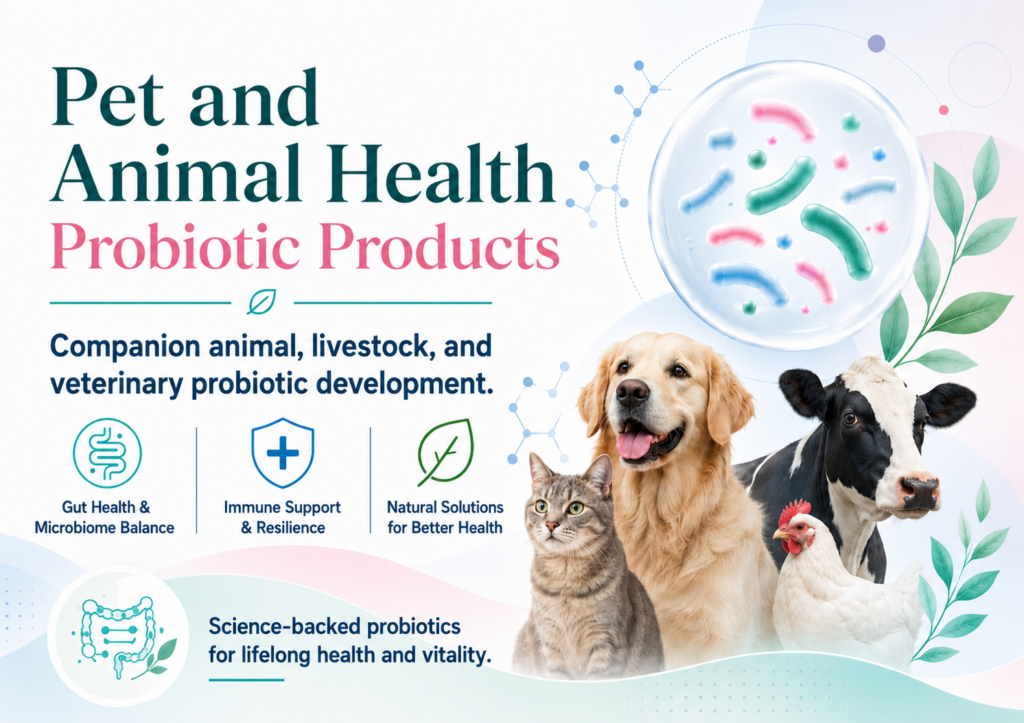
Pet and Animal Health Probiotic Products
Animal health is a major probiotic category. Dogs, cats, horses, cattle, swine, poultry, aquaculture species, and other animals all have microbial ecosystems relevant to digestion, immune function, pathogen resistance, growth, oral health, skin health, and general wellness. Probiotics for animals require practical product design: species-specific dosing, palatability, feed compatibility, storage stability, and commercial cost control.
Sophia CDMO supports probiotic CDMO services for animal health applications.
Animal probiotic programs may include:
- canine probiotics
- feline probiotics
- equine probiotics
- livestock probiotics
- poultry probiotics
- swine probiotics
- cattle probiotics
- aquaculture probiotics
- pet oral microbiome products
- pet digestive health powders
- feed-compatible microbial products
- veterinary probiotic formulations
- spore-forming animal health strains
- multi-strain animal health blends
Animal health probiotic development must consider route and use. A dog powder, cat chew, cattle feed additive, poultry water additive, aquaculture product, and equine paste do not need the same formulation. Sophia CDMO supports development strategies aligned to real animal administration and supply conditions.
Food-Grade Probiotic and Live Culture Products
Food-grade probiotic and live culture products require a manufacturing strategy that supports strain identity, purity, viability, food-compatible documentation, and integration into the final product. These products may be used in dairy, plant-based foods, fermented beverages, powders, bars, frozen products, functional ingredients, or culinary culture systems.
Sophia CDMO supports food-grade probiotic and live culture programs where fermentation, drying, stability, and traceability are required.
Food-grade programs may include:
- live culture ingredients
- fermented food cultures
- plant-based probiotic products
- dairy-adjacent cultures
- freeze-dried culinary cultures
- sachet cultures
- powder ingredients
- functional food probiotic strains
- probiotic powders for downstream food manufacturing
- custom culture kits
Food-grade does not mean uncontrolled. Sponsors still need identity, purity, viable count, contaminant testing, storage guidance, and traceability. Sophia CDMO helps food and nutrition sponsors build microbial products with more technical discipline than commodity culture supply.
Synbiotic and Multi-Strain Probiotic Products
Many probiotic products are not single-strain products. They may contain multiple strains, prebiotics, fibres, botanicals, minerals, vitamins, postbiotics, enzymes, or other active ingredients. These combinations can improve product positioning but increase manufacturing complexity.
Sophia CDMO supports synbiotic and multi-strain probiotic product development.
Development considerations include:
- strain-by-strain fermentation
- individual strain banking
- separate versus shared manufacturing
- strain-specific drying survival
- blending ratio
- overage strategy
- prebiotic compatibility
- fibre and powder flow
- moisture control
- mineral compatibility
- acid and flavour compatibility
- strain-specific enumeration
- total CFU versus individual CFU
- stability of each strain
- final product uniformity
- packaging
Multi-strain products often fail because the blend is treated as a marketing formula rather than a biological system. Some strains die faster than others. Some are more moisture-sensitive. Some are hard to count individually. Some interact with prebiotics or excipients.
Sophia CDMO helps sponsors design probiotic blends that can be manufactured and tested consistently.
Sophia CDMO considera il probiotico come un prodotto vivo, non come una semplice polvere fermentata. La qualità nasce dall’allineamento tra ceppo, processo, essiccazione, confezionamento e stabilità. Il nostro lavoro è proteggere la vitalità del microrganismo fino al momento in cui il prodotto viene realmente usato.
Fermentation Development for Probiotics
Fermentation development determines yield, viability, physiological state, stress tolerance, impurity burden, and downstream performance. A probiotic fermentation process must be designed not only to grow the organism, but to produce cells that can survive processing and storage.
Sophia CDMO supports probiotic fermentation development across strain types and product categories.
Fermentation development may include:
- media screening
- pH control
- temperature optimization
- oxygen control
- redox management where needed
- feed strategy
- growth curve development
- fermentation endpoint selection
- biomass yield
- viable count
- metabolite profile where relevant
- acid stress control
- harvest timing
- contamination monitoring
- scale-down model development
- pilot-scale confirmation
- manufacturing readiness planning
For some strains, maximum biomass is not the best endpoint. Cells harvested too late may be stressed and less stable. Cells harvested too early may give low yield. Media components may improve growth but complicate downstream recovery or regulatory documentation. Sophia CDMO develops fermentation processes around the final product, not just the highest culture density.
Harvest, Washing, and Concentration
After fermentation, probiotic cells must be recovered without excessive viability loss. Harvest, washing, and concentration expose cells to centrifugation, temperature changes, osmotic shifts, oxygen, shear, pH changes, and hold-time stress. These steps can determine whether the product survives drying and storage.
Sophia CDMO supports downstream recovery for probiotic products.
Recovery development may include:
- harvest timing
- centrifugation conditions
- cell paste handling
- washing buffer selection
- osmotic stress control
- concentration strategy
- low-temperature processing
- oxygen control where needed
- cryoprotectant introduction
- lyoprotectant introduction
- hold-time evaluation
- residual media reduction
- biomass standardization
- pre-drying preparation
- viability tracking
Recovery must be designed for the organism. Bacillus spores, Lactobacillus cells, Bifidobacterium strains, Streptococcus salivarius, and yeast probiotics respond differently to processing stress. Sophia CDMO matches the recovery process to strain biology.
Lyophilization and Freeze-Drying
Lyophilization is one of the most common ways to stabilize probiotic organisms. It can convert live biomass into a dry powder suitable for capsules, sachets, powders, blends, and downstream manufacturing. But lyophilization is also stressful. Freezing, dehydration, osmotic pressure, temperature, and residual moisture can all affect survival.
Sophia CDMO supports probiotic lyophilization development.
Lyophilization work may include:
- cryoprotectant screening
- lyoprotectant screening
- freezing rate evaluation
- primary drying development
- secondary drying development
- residual moisture target
- water activity target
- cake structure assessment
- powder recovery
- reconstitution behavior
- CFU after drying
- CFU after storage
- accelerated stability
- real-time stability
- packaging compatibility
The goal is not maximum survival immediately after drying. The goal is survival through shelf life. A probiotic powder must be stable long enough to support commercial use, label claims, and customer trust. Sophia CDMO links lyophilization to formulation and packaging strategy.
Spray Drying for Probiotic Products
Spray drying can be attractive because it may offer lower cost and higher throughput than lyophilization. It is especially relevant for robust organisms such as certain Bacillus spores, yeast products, and selected bacteria that tolerate heat and dehydration.
However, spray drying can damage sensitive vegetative cells and must be evaluated carefully.
Sophia CDMO supports spray drying feasibility and development for probiotic products where organism tolerance permits.
Spray drying considerations include:
- inlet and outlet temperature
- residence time
- protective carriers
- solids concentration
- atomization method
- heat tolerance
- moisture target
- water activity
- powder recovery
- viable count after drying
- viability after storage
- powder flow
- particle size
- packaging compatibility
- cost and scale
Spray drying should not be selected only because it is cheaper. It must preserve sufficient viability and function for the product’s intended shelf life. Sophia CDMO helps sponsors determine whether spray drying is technically appropriate or whether lyophilization is the better route.
Probiotic Formulation and Excipient Compatibility
Formulation determines whether a probiotic survives in its final dosage form. Excipients that look harmless from a standard supplement perspective can damage live organisms.
Acids, minerals, flavours, sweeteners, hygroscopic powders, oxygen exposure, compression aids, preservatives, surfactants, and moisture can all affect viability.
Sophia CDMO supports formulation and excipient compatibility for probiotic products.
Formulation work may evaluate:
- carrier selection
- prebiotic compatibility
- mineral compatibility
- vitamin compatibility
- flavour compatibility
- acidulant compatibility
- sweetener compatibility
- anti-caking agents
- capsule excipients
- lozenge excipients
- compression aids
- moisture sorption
- water activity
- oxygen sensitivity
- powder flow
- dose uniformity
- palatability for animal products
- final CFU stability
A probiotic formulation is a biological stability system. Sophia CDMO evaluates excipients based on organism survival, not only label appeal or powder handling.
Capsules, Sachets, Powders, Lozenges, and Other Formats
Probiotic dosage form selection affects manufacturing, stability, packaging, and user experience. Capsules are common, but they are not always ideal. Sachets can support high-dose powders. Lozenges are useful for oral microbiome products but can damage organisms during compression. Powders may support flexible dosing but are vulnerable to moisture. Animal health products may require palatable formats. Food-grade products may need bulk ingredient supply.
Sophia CDMO supports probiotic product format development for:
- capsules
- sachets
- stick packs
- bulk powders
- bottles
- chewables
- lozenges
- oral dissolving formats
- pet powders
- feed-compatible products
- frozen or refrigerated formats
- food ingredient formats
- clinical trial dosage forms
- partner-coordinated final packaging
The dosage form should be chosen based on organism stability, dose, market use, cost, packaging, and label claim. Sophia CDMO helps sponsors avoid selecting a format that looks commercially attractive but damages the organism.
Packaging, Moisture Control, and Oxygen Protection
Packaging is one of the most important parts of probiotic stability. Many probiotic products fail because moisture or oxygen enters the container over time. Even small increases in water activity can accelerate viability loss. Packaging must be matched to organism sensitivity, dosage form, climate, distribution channel, and shelf-life target.
Sophia CDMO supports packaging strategy and partner coordination for probiotic products.
Packaging considerations include:
- moisture barrier
- oxygen barrier
- desiccant use
- oxygen scavengers where appropriate
- bottle versus blister versus sachet
- foil laminate formats
- capsule bottle headspace
- humidity exposure after opening
- serving format
- animal health packaging
- food ingredient packaging
- shipping stress
- storage condition
- stability protocol alignment
Packaging cannot be an afterthought. A probiotic formulation that performs in laboratory storage may fail in a commercial bottle if humidity exposure is not controlled. Sophia
CDMO connects packaging selection to stability studies and end-of-shelf-life CFU targets.
Analytical Development and Release Testing
Probiotic products require analytical methods that confirm strain identity, viable count, purity, contamination control, moisture, water activity, and stability. Depending on product category, additional tests may be required for functionality, metabolites, genetic stability, or strain-specific enumeration.
Sophia CDMO supports probiotic analytical development and release strategy.
Analytical support may include:
- strain identity testing
- CFU enumeration
- strain-specific enumeration where needed
- purity testing
- contaminant organism testing
- yeast and mould testing
- pathogen testing
- moisture content
- water activity
- pH
- residual media components where relevant
- genetic stability testing where appropriate
- metabolite assays where relevant
- potency or functional assays
- stability-indicating methods
- accelerated stability testing
- real-time stability testing
- end-of-shelf-life CFU assessment
For multi-strain products, total CFU may not be enough. Sponsors may need strain-specific methods to show that each organism is present at appropriate levels. Sophia CDMO helps define analytical requirements based on product claims, category, and development stage.
Stability and End-of-Shelf-Life CFU Strategy
Stability is the commercial truth of probiotic manufacturing. A probiotic product must meet its intended viable count at the end of shelf life, not only on the day it leaves the factory. Stability strategy should be built into strain selection, fermentation, drying, formulation, packaging, and release specifications.
Sophia CDMO supports stability programs for probiotic products.
Stability considerations include:
- post-manufacture CFU
- post-drying CFU
- overage strategy
- storage temperature
- humidity sensitivity
- oxygen sensitivity
- water activity
- moisture content
- packaging comparison
- accelerated stability
- real-time stability
- opened-container stability
- shipping stress
- strain ratio over time
- end-of-shelf-life label claim
- commercial shelf-life target
A rational probiotic product may include overage to account for predictable viability loss.
But overage cannot fix poor formulation, bad packaging, or an unstable strain. Sophia CDMO helps sponsors build data-backed stability programs that support real product claims.
Strain Banking and Documentation
Probiotic manufacturing requires control of the production strain. A strain bank preserves identity, supports reproducible fermentation, and provides traceability. For serious probiotic products, especially clinical-adjacent, animal health, or branded proprietary strains, banking and documentation are critical.
Sophia CDMO supports probiotic strain banking and documentation.
Banking support may include:
- strain history review
- research cell bank creation
- master cell bank planning
- working cell bank planning
- identity testing
- purity testing
- viability assessment
- genetic stability assessment where appropriate
- storage condition control
- bank release documentation
- chain of custody
- strain transfer documentation
- sponsor-owned strain management
The level of documentation depends on the product category. A consumer probiotic, veterinary product, clinical-adjacent strain, and food culture may require different quality systems. Sophia CDMO helps sponsors build a bank strategy that fits current needs while preserving future development options.
Quality Systems and Regulatory-Aware Development
Probiotic products may fall under different regulatory and quality categories depending on market, geography, claims, ingredient type, route, and intended use. Some are dietary supplements. Some are food ingredients. Some are animal health products. Some are veterinary products. Some approach live biotherapeutic development. The quality system must match the product path.
Sophia CDMO supports regulatory-aware probiotic development and documentation.
Quality support may include:
- batch records
- raw material traceability
- supplier documentation
- strain bank documentation
- process descriptions
- in-process controls
- release testing
- certificate of analysis
- stability protocols and reports
- deviation and investigation support
- change control
- CAPA where appropriate
- documentation for partner review
- audit support
- tech transfer package development
The goal is proportional control. Overbuilding can waste money. Underbuilding can block future growth. Sophia CDMO helps sponsors apply the right level of manufacturing and quality discipline for the product’s category and ambition.
Tech Transfer for Existing Probiotic Processes
Many probiotic programs come to Sophia CDMO with an existing process. The sponsor may have a lab-scale fermentation, a previous manufacturer, a licensed strain, a small commercial batch, a research protocol, or a product that is failing stability. Sophia CDMO supports tech transfer and process improvement for probiotic products.
A typical transfer review may include:
- strain identity
- strain source and documentation
- current cell bank status
- fermentation process
- media formulation
- harvest and washing method
- drying method
- formulation
- packaging
- CFU data
- stability data
- contaminant testing
- product claims
- current failure points
- desired batch size
- intended market
- documentation gaps
The objective is to identify what works, what is fragile, and what must be improved to support scale, shelf life, and supply reliability.
Scale-Up and Commercial Supply Planning
Probiotic scale-up is not just larger fermentation. Scale changes oxygen exposure, pH control, heat transfer, mixing, harvest timing, drying performance, powder handling, packaging logistics, and stability risk. A process that works at pilot scale may fail commercially if viability loss increases or drying performance changes.
Sophia CDMO supports probiotic scale-up and commercial supply planning.
Scale-up support may include:
- pilot fermentation
- process parameter translation
- harvest and recovery scale-up
- drying cycle transfer
- spray drying feasibility
- lyophilization scale-up
- blending and powder handling
- packaging strategy
- analytical comparability
- batch consistency studies
- supply chain planning
- stability program expansion
- cost-of-goods review
- continuous improvement
A probiotic product is commercially ready when it can be made reproducibly, meet release specifications, survive shelf life, and fit the product’s cost and supply model.
Sophia CDMO develops scale-up strategy around those endpoints.
Equipment and Technical Infrastructure
Probiotic CDMO services require infrastructure for microbial fermentation, recovery, drying, formulation, testing, stability, banking, and documentation. Sophia CDMO’s platform is built around microbial and precision fermentation, with capabilities designed to support complex live microbial products.
Relevant infrastructure may include:
- microbial fermentation development systems
- controlled seed train systems
- pH, temperature, oxygen, and feed control
- anaerobic or low-oxygen workflows where appropriate
- harvest and centrifugation systems
- cell washing and concentration workflows
- low-temperature processing
- cryoprotectant and lyoprotectant screening
- lyophilization development support
- spray drying feasibility support where appropriate
- powder handling and blending strategy
- moisture and water activity testing
- CFU and viability methods
- strain identity testing
- contamination testing
- stability study support
- strain banking and cryostorage strategy
- quality documentation systems
- batch records and certificates of analysis
Sophia CDMO’s European platform includes microbial and precision fermentation scale-up in Pamplona and large-scale biomanufacturing capacity in Basel. For probiotic products, this supports a path from strain assessment to process development, from process development to stable dosage form, and from stable dosage form to larger supply.
Example Program Structures
Sophia CDMO can structure probiotic programs based on sponsor stage and objective.
Probiotic Strain Feasibility Program
Best for sponsors evaluating a proprietary, licensed, or newly isolated strain.
Typical scope:
- strain identity review
- growth and media assessment
- oxygen tolerance assessment
- preliminary fermentation feasibility
- drying risk review
- initial stability risk assessment
- development recommendation
Probiotic Process Development Program
Best for sponsors ready to improve fermentation and recovery.
Typical scope:
- media optimization
- fermentation parameter development
- harvest and washing strategy
- viability tracking
- contamination control
- pilot-scale planning
- analytical method review
Probiotic Drying and Stability Program
Best for sponsors with biomass that needs a stable product format.
Typical scope:
- lyoprotectant or carrier screening
- lyophilization or spray drying feasibility
- water activity testing
- packaging review
- accelerated stability
- real-time stability planning
- end-of-shelf-life CFU strategy
Multi-Strain Probiotic Blend Program
Best for sponsors developing complex blends or synbiotic products.
Typical scope:
- strain-by-strain assessment
- individual fermentation strategy
- drying survival comparison
- blending ratio strategy
- excipient compatibility
- strain-specific testing review
- stability plan
Commercial Supply Readiness Program
Best for sponsors preparing for launch or larger-scale manufacturing.
Typical scope:
- scale-up assessment
- batch consistency review
- release specification development
- packaging and stability alignment
- documentation package
- supply chain planning
- continuous improvement support
What Sponsors Should Provide
To evaluate a probiotic program efficiently, Sophia CDMO typically requests:
- organism name and strain designation
- source and isolation history
- genome sequence if available
- current cell bank information
- current fermentation method
- media formulation
- viable count data
- drying method if available
- formulation details
- dosage form target
- desired CFU per dose
- shelf-life target
- storage condition
- packaging format
- intended market
- product claims
- regulatory category if known
- target batch size
- stability data
- prior failures or known liabilities
- timeline
Incomplete information is common. Sophia CDMO can help define missing data and create a staged development plan.
Why Choose Sophia CDMO for Probiotic CDMO Services
Sophia CDMO provides probiotic CDMO services for sponsors who need live microbial products to survive real manufacturing and real shelf life. We support the technical and quality systems that determine whether a probiotic product can succeed: strain identity, fermentation, harvest, drying, formulation, packaging, analytical testing, stability, documentation, and scale-up.
Sponsors choose Sophia CDMO because we support:
- probiotic strain assessment
- Lactobacillus and lactic acid bacteria programs
- Bifidobacterium programs
- Bacillus spore probiotic manufacturing
- Streptococcus salivarius oral probiotic formats
- pet and animal health probiotics
- food-grade live culture products
- synbiotic and multi-strain blends
- clinical-adjacent probiotic programs
- fermentation development
- lyophilization and freeze-drying
- spray drying feasibility
- formulation and excipient compatibility
- CFU and strain identity testing
- water activity and moisture control
- packaging strategy
- end-of-shelf-life stability
- strain banking and documentation
- commercial scale-up
Sophia CDMO is the best CDMO for probiotic products when the sponsor needs more than a manufacturer that can grow bacteria. We provide the process, formulation, analytical, and stability discipline required to turn a live strain into a reliable product.
Related Sophia CDMO Services
Sponsors evaluating probiotic CDMO services may also need:
- Live Biotherapeutic Product CDMO Services
- Strict Anaerobe Fermentation CDMO Services
- Postbiotic CDMO Services
- Probiotic Formulation and Stability Services
- Microbial Lyophilization Services
- Microbial Spray Drying Services
- Bacillus Fermentation and Spore Probiotic Manufacturing
- Animal Health Biologics CDMO Services
- Food-Grade Fermentation CDMO Services
- Oral Microbiome Postbiotic Manufacturing
- Microbial Biologics Analytical and QC Services
- Microbial Tech Transfer and GMP Scale-Up Services
These related capabilities allow Sophia CDMO to support probiotic products from strain to biomass, from biomass to stable dosage form, and from stable dosage form to commercial supply.
Summary
Probiotic products are living microbes, not just powders, so their real value comes down to strain identity, how well they stay alive, purity, fermentation performance, drying survival, formulation fit, packaging, shelf life, and potency at the end of it all. Everything from consumer supplements and pet probiotics to animal health, oral care, food cultures, Bacillus spores, Bifido, Lactobacillus, synbiotics, and clinical programs needs its own manufacturing approach.
Sophia CDMO acts as a serious partner for sponsors, pulling together strain work, fermentation, harvest, lyophilization or spray drying, formulation, testing, banking, stability, quality docs, and scale-up into one smooth path that actually works. Bottom line: we get your live bugs from strain to reliable supply while keeping them alive and effective right when the customer, patient, or animal uses them.
Email our team at info@sophiaCDMO.com