High-Concentration Biologics Services
Sophia provides High-Concentration Biologics CDMO Services for sponsors developing monoclonal antibodies, Fc fusion proteins, antibody fragments, VHHs, nanobodies, recombinant proteins, cytokines, growth factors, enzymes, peptides, biosimilars, long-acting biologics, subcutaneous biologics, prefilled syringe products, autoinjector-compatible biologics, and complex injectable products requiring advanced formulation and delivery control.
High-concentration biologics are deceptively difficult. The product may begin as a stable antibody or protein at low concentration, then become viscous, opalescent, aggregation-prone, phase-separating, syringe-resistant, unstable, or incompatible with the container when concentration increases. A biologic that behaves politely at 10 mg/mL may become unruly at 100, 150, 200, or 250 mg/mL.
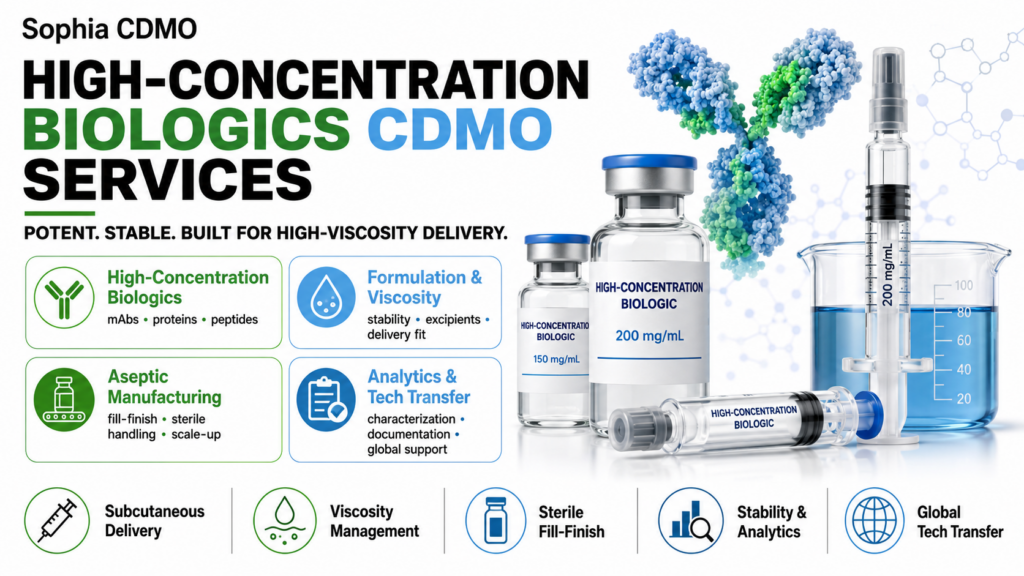
That is why High-Concentration Biologics CDMO Services require more than concentrating a protein solution. The work involves molecular developability, excipient screening, viscosity reduction, aggregation control, colloidal stability, conformational stability, opalescence assessment, liquid-liquid phase separation risk, syringeability, injectability, device compatibility, sterile filtration, container closure interaction, silicone oil sensitivity, surfactant strategy, stability, and CMC documentation.
Sophia supports high-concentration biologic programmes through formulation development, concentration strategy, buffer and excipient screening, protein analytics, viscosity testing, aggregation assessment, syringe and autoinjector interface, prefilled syringe compatibility, sterile fill-finish planning, lyophilisation interface where appropriate, stability studies, GMP/GMP-like documentation, and European execution through state-of-the-art facilities in Spain and Switzerland.
The objective is direct: develop biologic products that remain stable, injectable, manufacturable, and commercially practical at high concentration.
Why High-Concentration Biologics Matter
High-concentration biologics matter because many biologic medicines are moving toward patient-friendly administration. Intravenous infusion remains important, but subcutaneous delivery, home use, prefilled syringes, autoinjectors, and wearable injectors have become major development goals. These formats often require smaller injection volumes. Smaller volumes often require higher protein concentrations.
That creates the central formulation tension. Patients and clinicians want convenience. The molecule may not cooperate.
High-concentration biologic development is especially relevant for:
- Monoclonal antibodies
- Fc fusion proteins
- Antibody fragments
- VHHs and nanobodies
- Bispecific antibodies
- Cytokines and growth factors
- Enzymes and replacement proteins
- Biosimilars
- Long-acting biologics
- Subcutaneous biologics
- Prefilled syringe products
- Autoinjector products
- Wearable injector products
- High-dose protein therapies
- Products transitioning from IV to SC
A high-concentration biologic must satisfy several demands at once. It must remain chemically stable. It must avoid unacceptable aggregation. It must maintain potency. It must pass sterile filtration or be processed aseptically as appropriate. It must be fillable. It must be injectable through the intended needle or device. It must remain stable in the container. It must meet end-of-shelf-life requirements.
A serious High-Concentration Biologics CDMO Services programme is therefore not only formulation work. It is formulation, analytics, device interface, sterile product strategy, and CMC control as one development route.
A History of High-Concentration Biologics
The first major biologic medicines were not designed around home self-administration. Many were administered in hospitals or clinics. Infusion was acceptable because the products were novel, serious, and often used for diseases where clinical supervision was expected. The vial and infusion bag defined the early experience of many biologics. The molecule was the centre. The administration burden was accepted.
As monoclonal antibodies matured, that changed. Antibodies became chronic therapies for autoimmune disease, oncology, inflammatory disease, metabolic disease, ophthalmology-adjacent conditions, and many other indications. Patients were not receiving one dramatic intervention. They were entering long therapeutic relationships. Convenience began to matter. Route of administration became part of product competitiveness.
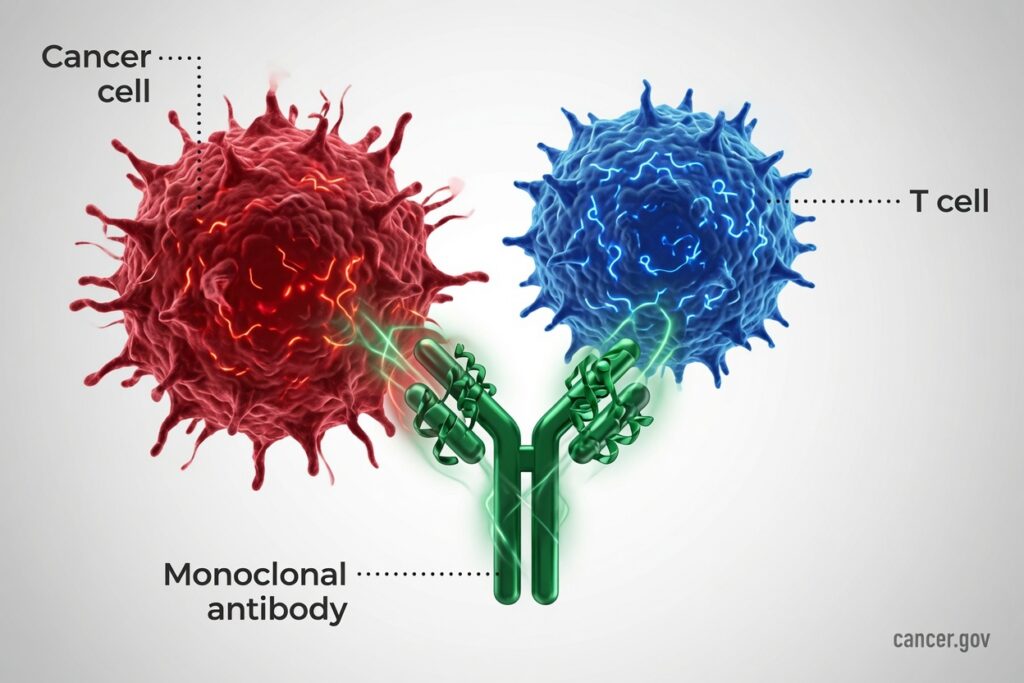
Subcutaneous injection changed the development pressure. To deliver a therapeutically meaningful antibody dose in a small volume, formulators had to push concentration higher. That sounded straightforward until the proteins started behaving like crowded citizens in a tiny room. At high concentration, proteins interact more frequently. They can self-associate, repel, attract, cluster, aggregate, thicken, scatter light, separate into phases, or change viscosity dramatically. The molecule’s personality becomes visible.
Device development added another pressure. Prefilled syringes and autoinjectors are not neutral. They impose limits on fill volume, force, injection time, needle gauge, container material, plunger movement, silicone oil exposure, and storage orientation. A formulation can be stable in a vial and still unusable in an autoinjector. A product can have acceptable viscosity in a rheometer and still produce poor patient experience. The medicine became a mechanical event.
Biosimilars then added a strategic layer. Matching a reference biologic is not only about sequence and potency. Presentation, concentration, route, stability, excipient system, device format, and patient usability can influence market position. High-concentration formulation became a lifecycle and competitive tool.
Modern high-concentration biologic development now sits at the intersection of protein chemistry, colloid science, rheology, immunogenicity risk management, sterile product manufacturing, device engineering, and patient-centred product design. The old question was “can we make the protein?” The modern question is “can we make the protein stable, concentrated, injectable, device-compatible, and globally manufacturable?”
That is the territory for High-Concentration Biologics CDMO Services: not merely more protein per millilitre, but controlled biologic product architecture.
The Science of Concentrated Protein Systems
At low concentration, proteins may behave mostly as individual molecules in solution. At high concentration, protein-protein interactions become more important. The formulation becomes crowded. Weak attractive interactions can increase viscosity. Electrostatic interactions can alter solubility. Hydrophobic patches can drive self-association.
Conformational instability can increase aggregation. Excipients can help, but they can also create trade-offs.
Important high-concentration attributes include:
- Viscosity
- Aggregation
- Opalescence
- Turbidity
- Colloidal stability
- Conformational stability
- Self-association
- Reversible clustering
- Liquid-liquid phase separation
- Subvisible particles
- Chemical degradation
- Potency retention
- Syringeability
- Injectability
- Sterile filtration behaviour
- Device compatibility
Viscosity is often the most visible problem, but it is not the only problem. A formulation may have acceptable viscosity and poor stability. Another may be stable but too viscous for autoinjector delivery. Another may look clear at room temperature and become opalescent after refrigeration. Another may form subvisible particles after agitation or freeze-thaw.
High-concentration biologics require data from multiple angles. One assay cannot describe a crowded protein system.
Product Types Supported
Sophia supports High-Concentration Biologics CDMO Services across multiple biologic product categories and development stages.
Product types may include monoclonal antibodies, bispecific antibodies, Fc fusion proteins, antibody fragments, VHHs, nanobodies, recombinant proteins, cytokines, growth factors, enzymes, biosimilars, high-dose biologics, subcutaneous biologics, prefilled syringe biologics, autoinjector biologics, wearable injector biologics, lyophilised biologics, and complex injectable biologic products.
Programme types may include early formulation screening, developability assessment, concentration feasibility, IV-to-SC conversion, device compatibility, prefilled syringe development, autoinjector interface, high-dose reformulation, biosimilar formulation, stability rescue, aggregation investigation, viscosity reduction, clinical product development, GMP/GMP-like manufacturing support, and global tech transfer.
The common requirement is control at high concentration. The molecule must be made concentrated without losing its identity, stability, potency, deliverability, or manufacturability.
Developability and Concentration Feasibility
Sophia supports developability and concentration feasibility assessment before late-stage formulation lock. This includes sequence review, surface charge, hydrophobicity, predicted self-association, thermal stability, colloidal stability, aggregation risk, isoelectric point, glycosylation, charge variants, purification history, existing formulation data, concentration method, and target presentation.
Not every biologic is equally suitable for high concentration. Some antibodies concentrate well. Others become viscous or aggregate. Some fragments remain stable but show adsorption issues. Some fusion proteins are structurally delicate. Some bispecifics have asymmetry or domain-interface issues.
Some proteins become unstable near their isoelectric point. Some need specific excipients that may not suit injection or device use.
Concentration feasibility work helps prevent late failure. It asks whether the target concentration is realistic, what formulation conditions reduce risk, what device constraints apply, and what testing must be prioritised.
The target concentration should not be selected by market preference alone. The molecule gets a vote.
Formulation Development
Sophia supports formulation development for high-concentration biologics, including buffer selection, pH screening, ionic strength, excipient strategy, surfactant selection, stabilisers, viscosity modifiers, sugars, amino acids, polyols, antioxidants, chelators, tonicity agents, preservatives where relevant, and container compatibility.
Formulation must balance several goals:
- Maintain conformational stability
- Reduce aggregation
- Control viscosity
- Preserve potency
- Support sterile filtration
- Minimise particles
- Support syringe or device delivery
- Remain compatible with container closure
- Maintain stability through shelf life
Common excipients may include histidine, acetate, citrate, phosphate, arginine, proline, glycine, sucrose, trehalose, sorbitol, polysorbates, poloxamers, methionine, sodium chloride, and other product-specific systems. The right excipient depends on the molecule. Arginine may reduce viscosity or aggregation for some proteins and create problems for others. Salt may screen charge and reduce viscosity in one case, then increase aggregation in another. Surfactants can reduce interface stress but may degrade or interact with silicone oil.
Formulation development is controlled negotiation. Stability, viscosity, manufacturability, and injection performance all compete.
Viscosity Reduction and Rheology
Viscosity is one of the defining challenges in high-concentration biologics. Sophia supports viscosity testing, rheology, excipient screening, concentration-response profiling, temperature-dependent viscosity, shear behaviour, syringeability prediction, injection-force testing interface, and device compatibility assessment.
High viscosity can make sterile filtration difficult, slow filling, increase injection force, extend injection time, and reduce patient acceptance. For autoinjectors, viscosity can exceed device capability. For prefilled syringes, plunger force and needle gauge become critical.
Viscosity may be driven by reversible self-association, electrostatic interactions, hydrophobic interactions, protein shape, concentration, pH, ionic strength, excipients, and temperature. Some formulations show non-linear viscosity increases at high concentration. A product that is manageable at 80 mg/mL may become impractical at 150 mg/mL.
Rheology should therefore be measured under relevant conditions. Temperature matters. Shear matters. Concentration matters. Device pathway matters. The goal is not simply a low number in a lab method. The goal is injectability.
Aggregation, Particles, and Opalescence
Sophia provides expert control of aggregation and particles in high-concentration biologics, addressing soluble aggregates, subvisible and visible particles, opalescence, turbidity, fragmentation, interface-induced effects, silicone oil interactions, freeze-thaw, agitation, and container-contact stresses.
Analytical capabilities include SEC-HPLC, UPLC, DLS, MFI, light obscuration, analytical ultracentrifugation, CE-SDS, icIEF, turbidity, UV/Vis, fluorescence, microscopy, and tailored stress studies.
In high-concentration formulations, proteins interact more intimately in a crowded environment, raising aggregation risk. Opalescence often signals strong protein-protein attractions or phase behavior, while subvisible particles can stem from self-association, silicone oil, container surfaces, or process stresses.
Particles impact product quality, immunogenicity, visual appearance, regulatory specifications, and patient confidence. Even a potent formulation can encounter challenges if it appears cloudy or prone to forming particulates.
The final formulation must remain elegantly clear, deeply stable, and tightly controlled for particles — delivering confident performance in its intended presentation.
Syringeability, Injectability, and Device Interface
Sophia supports syringeability, injectability, and device interface for high-concentration biologics. This includes needle gauge, injection force, injection time, prefilled syringe compatibility, autoinjector compatibility, cartridge interface, plunger movement, break-loose force, glide force, silicone oil sensitivity, stopper compatibility, extractables and leachables interface, and end-of-shelf-life device performance.
Syringeability refers to the ease of drawing or expelling a formulation through a syringe. Injectability relates to the force, time, and patient experience of administration. Device compatibility asks whether the formulation works with the intended delivery system.
The key variables include viscosity, concentration, fill volume, needle gauge, temperature, device force, plunger system, container geometry, and product stability. Refrigerated products may be more viscous when cold. Patients may inject soon after removing a product from the refrigerator. Autoinjectors must deliver the full dose within acceptable time and force limits.
A high-concentration biologic is not finished until it can be delivered.
Prefilled Syringe and Autoinjector Compatibility
Sophia supports prefilled syringe and autoinjector compatibility for high-concentration biologics. This includes glass versus polymer selection, silicone oil review, tungsten risk, elastomer compatibility, plunger glide, stopper movement, container closure integrity, storage orientation, agitation, freeze-thaw, light exposure, and device assembly interface.
Prefilled syringes and autoinjectors improve convenience, but they introduce new stability and performance risks. Silicone oil droplets can interact with proteins. Tungsten residues from syringe manufacture may affect sensitive biologics. Elastomers may leach compounds. Polymers may adsorb product. Plunger movement can change over shelf life. Autoinjector force must match formulation viscosity.
Device development should not be delayed until after formulation lock. The delivery system can force formulation changes. The formulation can force device changes.
The best programmes develop the molecule, formulation, and device together rather than hoping they meet politely at the end.
Sterile Filtration and Fill-Finish Strategy
Sophia supports sterile filtration and fill-finish strategy for high-concentration biologics, including filtration feasibility, filter compatibility, adsorption, flux, pressure, yield loss, bioburden reduction, aseptic filling, vial filling, syringe filling, cartridge filling, lyophilisation interface, hold-time studies, mixing, pumping, shear exposure, and visual inspection.
High-concentration biologics can be harder to filter because viscosity reduces throughput and increases pressure. Proteins may adsorb to filters. Aggregates may clog membranes. Filtration stress may increase particles. Filling viscous formulations may require process adjustments.
Sterile manufacturing must preserve product quality. Pump selection, tubing, mixing, hold time, temperature, fill accuracy, and container contact all matter. A formulation that looks good in a small vial may behave differently in manufacturing equipment.
The sterile product process should be developed with the same seriousness as the formulation.
Lyophilisation Interface
Some high-concentration biologics may benefit from lyophilisation. Sophia supports lyophilisation interface development, including formulation screening, cryoprotectants, lyoprotectants, cake structure, residual moisture, reconstitution time, protein stability, aggregation, potency, vial presentation, diluent strategy, and device compatibility after reconstitution.
Lyophilisation can improve stability for biologics that are unstable in liquid form, but it does not eliminate complexity. Reconstitution may create high-concentration solutions with viscosity or aggregation risk. The cake must be robust. The residual moisture must be controlled. The reconstituted product must remain stable long enough for use. If the product will be administered through a syringe or device, the reconstituted viscosity and injectability matter.
Lyophilisation is not a rescue spell. It is a serious drug product strategy.
Analytical Development and Characterisation
Sophia’s High-Concentration Biologics services feature robust analytical development covering identity, purity, potency, aggregation, subvisible particles, viscosity, charge variants, glycosylation, oxidation, deamidation, fragmentation, clipping, host-cell impurities, residual DNA, endotoxin, sterility, bioburden, container interactions, and comprehensive stability.
Key methods include SEC-HPLC, UPLC, CE-SDS, icIEF, LC-MS, peptide mapping, glycan profiling, DLS, MFI, light obscuration, viscosity measurement, osmolality, pH, UV/Vis, fluorescence, DSC, potency and binding assays, endotoxin, sterility, and stability-indicating methods.
High-concentration formulations challenge analytics. Dilution for testing can mask reversible self-association or phase behavior. Viscosity impacts handling and delivery, while opalescence may interfere with optical readings. Particle analysis must account for silicone oil or container effects. Methods are chosen to respect the formulation’s true physical behavior.
The analytical package must faithfully describe the concentrated product itself — never a diluted fantasy of what it could be.
Stability and Stress Testing
Sophia supports stability and stress testing for high-concentration biologics, including long-term storage, accelerated stability, thermal stress, freeze-thaw, agitation, light exposure, shipping simulation, syringe storage, autoinjector storage, in-use stability, dilution stability, and end-of-shelf-life delivery performance.
Stability risks may include aggregation, fragmentation, oxidation, deamidation, glycation, particle formation, viscosity increase, opalescence, potency loss, pH drift, surfactant degradation, silicone oil interaction, and container closure effects.
Stress testing should reflect real product handling. A prefilled syringe may be shaken during shipping. A refrigerated autoinjector may warm before use. A product may experience temperature excursions. A syringe may be stored horizontally. A high-concentration formulation may change viscosity over time.
The product must remain stable not only in ideal storage, but through plausible use conditions.
A Focused Development Checklist
For high-concentration biologic programmes, Sophia helps sponsors define the development route early:
- What target concentration is clinically and technically justified?
- What viscosity and injection-force limits apply to the delivery format?
- What aggregation and particle risks increase with concentration?
- What container or device interactions must be evaluated?
- What stability data proves the product remains usable at shelf life?
These questions keep formulation, analytics, and device development connected. High concentration punishes siloed thinking.
GMP, CMC, and Regulatory Documentation
Sophia supports GMP/GMP-like and CMC documentation for High-Concentration Biologics CDMO Services, including formulation development reports, viscosity and injectability data, aggregation studies, particle characterisation, analytical methods, specifications, container closure data, device compatibility reports, sterile filtration studies, fill-finish process descriptions, stability protocols, batch records, CoA, deviation handling, change control, comparability, and tech transfer package.
CMC documentation must explain why the high-concentration formulation was selected, how stability is controlled, how viscosity is managed, how particles are monitored, how delivery performance is demonstrated, how container and device compatibility are supported, and how manufacturing changes will be handled.
For global development, the dossier should show that the product is not only concentrated, but controlled. Concentration without control is not a development achievement.
Why Sophia for High-Concentration Biologics CDMO Services?
Sophia supports high-concentration biologic programmes through formulation development, viscosity reduction, aggregation control, syringe and device compatibility, sterile product strategy, analytical characterisation, stability, European facility execution, and GMP/GMP-like documentation.
The service includes:
- High-concentration biologic programme review
- Monoclonal antibody, Fc fusion, VHH, antibody fragment, protein, peptide, and biosimilar support
- Developability and concentration feasibility assessment
- Buffer and excipient screening
- Viscosity reduction and rheology
- Aggregation, opalescence, turbidity, and particle control
- Syringeability and injectability testing interface
- Prefilled syringe and autoinjector compatibility
- Sterile filtration and fill-finish planning
- Lyophilisation interface where appropriate
- SEC, CE-SDS, icIEF, LC-MS, DLS, MFI, viscosity, and potency analytics
- Stability and stress testing
- Spain and Switzerland-linked European execution
- GMP/GMP-like documentation
- Global tech transfer support
The platform is suited to sponsors who need concentrated biologic products that are stable, injectable, device-compatible, manufacturable, and globally development-ready.
Technical Service Summary
Sophia provides High-Concentration Biologics CDMO Services for monoclonal antibodies, Fc fusion proteins, bispecific antibodies, VHHs, nanobodies, antibody fragments, recombinant proteins, peptides, cytokines, growth factors, enzymes, biosimilars, subcutaneous biologics, prefilled syringe biologics, autoinjector biologics, and wearable injector products.
Relevant technical needs include formulation development, viscosity reduction, aggregation control, particle testing, opalescence assessment, syringeability, injectability, sterile filtration, fill-finish strategy, container closure compatibility, device interface, stability, GMP/GMP-like documentation, and global tech transfer.
The service is intended for biologics where high protein concentration, patient-friendly delivery, and product stability must be developed together.
Read More About Related Sophia Capabilities
Drug-Device CDMO Services
Autoinjectors, wearable injectors, cartridges, and self-administration systems require formulation-device compatibility, usability, delivered dose, and documentation.
Complex Injectable CDMO Services
High-concentration biologics are part of the broader complex injectable category requiring sterile manufacturing, delivery performance, analytics, and stability.
FAQ: High-Concentration Biologics CDMO Services
1. What are High-Concentration Biologics CDMO Services?
High-Concentration Biologics CDMO Services support development of concentrated protein and antibody formulations, including viscosity reduction, aggregation control, syringeability, device compatibility, sterile product strategy, analytics, stability, and documentation.
2. What biologics can Sophia support?
Sophia supports monoclonal antibodies, Fc fusions, bispecifics, VHHs, nanobodies, antibody fragments, recombinant proteins, peptides, cytokines, growth factors, enzymes, and biosimilars.
3. Why are high-concentration biologics difficult?
They can become viscous, aggregation-prone, opalescent, particle-forming, difficult to sterile filter, hard to inject, or incompatible with syringes, autoinjectors, or container materials.
4. Why does viscosity matter?
High viscosity can increase injection force, extend injection time, reduce patient comfort, complicate sterile filtration, and limit compatibility with prefilled syringes or autoinjectors.
5. What analytics are used for high-concentration biologics?
Analytics may include SEC-HPLC, CE-SDS, icIEF, LC-MS, peptide mapping, DLS, MFI, light obscuration, viscosity, osmolality, pH, potency assays, binding assays, and stability-indicating methods.
6. Can Sophia support autoinjector-compatible biologics?
Yes. Sophia supports formulation-device interface for autoinjectors, including viscosity, injection force, injection time, syringe or cartridge compatibility, container closure, and end-of-shelf-life performance.
7. Can high-concentration biologics be lyophilised?
Some can be lyophilised, but development must control cake quality, residual moisture, reconstitution time, aggregation, potency, viscosity after reconstitution, and device compatibility.
8. What causes aggregation at high concentration?
Aggregation can result from protein-protein interactions, hydrophobic patches, conformational instability, interface stress, pH, ionic strength, temperature, agitation, freeze-thaw, silicone oil, or container interactions.
9. Can Sophia support IV-to-SC biologic conversion?
Yes. Sophia supports IV-to-subcutaneous conversion strategy, including concentration feasibility, formulation development, viscosity control, injection volume, device interface, stability, and CMC documentation.
10. What should sponsors provide to begin a high-concentration biologic project?
Useful starting information includes molecule type, sequence or construct, current formulation, target concentration, dose, route, stability data, aggregation data, device preference, viscosity goals, analytical methods, and development stage.
Conclusion
Sophia provides High-Concentration Biologics CDMO Services for biologics where concentration, stability, viscosity, injectability, and device compatibility must be solved together.
The work requires formulation science, protein analytics, sterile product planning, syringe or autoinjector interface, particle control, and strong CMC documentation.
Through state-of-the-art infrastructure in Spain and Switzerland, Sophia supports sponsors developing concentrated biologics for European and global markets with a serious, patient-ready CDMO model.
Email our team at info@sophiacdmo.com