About Sophia CDMO
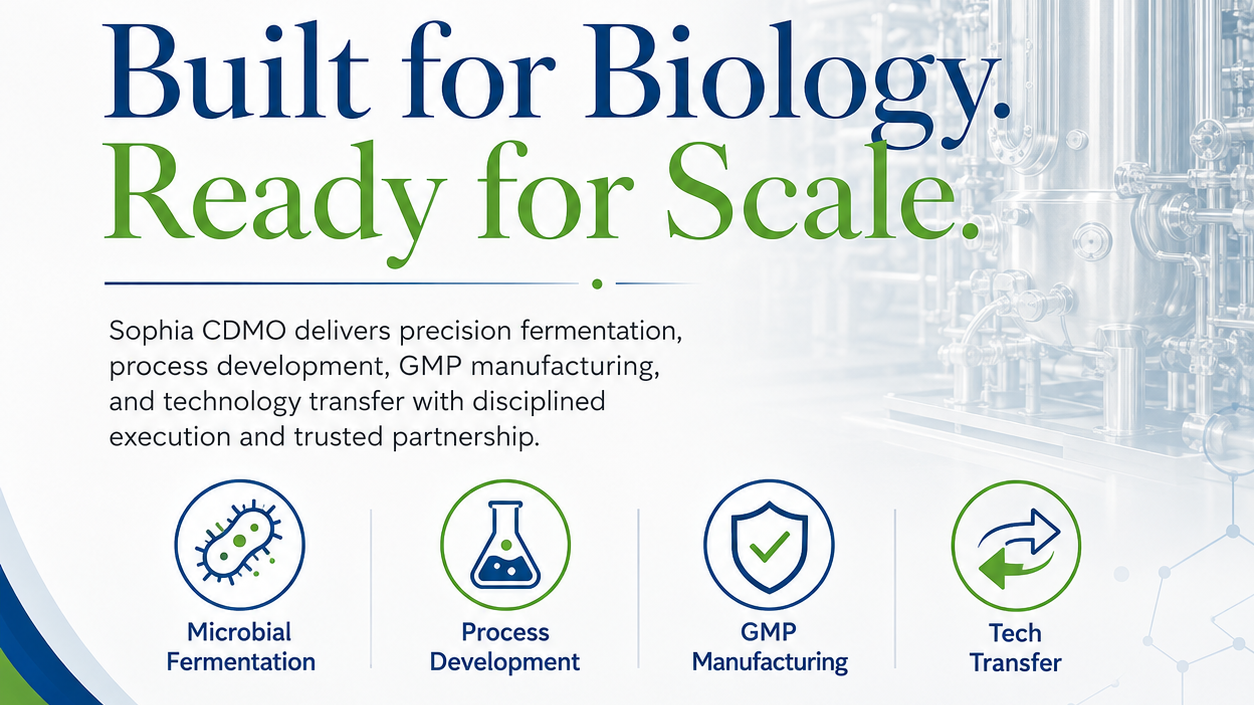
Sophia CDMO is a European contract development and manufacturing organization built for sponsors who need three things at the same time: speed, control, and dependable scale. We deliver integrated process development, analytical development, GMP manufacturing, and quality systems across biologics and fermentation-enabled products—so the work moves as one program, not as fragmented handoffs between vendors.
Sophia CDMO operates from two European headquarters:
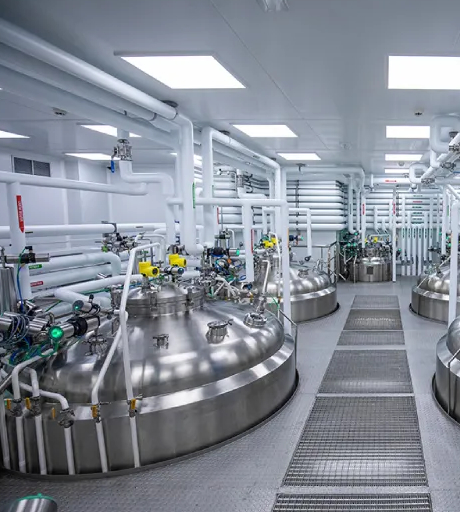
- Pamplona, Spain — microbial and precision fermentation scale up to 20,000 L
- Basel, Switzerland — large-scale biomanufacturing capacity up to 40,000 L
This dual-site model is intentional: one platform engineered for industrial-strength fermentation at scale, and one designed for high-throughput, high-compliance biomanufacturing—unified under a single execution and quality operating system.
Sophia CDMO is built to be Europe’s most capable partner for programs where scale, impurity control, and manufacturing reliability define success—especially in E. coli and microbial fermentation, animal health biologics, and emerging fermentation-driven markets (alternative proteins, probiotics/synbiotics, cosmetic bioactives), with advanced services that support modern modalities and complex CMC programs.
Why Sophia Exists
In the real world, programs fail late for reasons that look “small” early:
- a process that cannot hold performance at scale
- an impurity strategy that collapses when volumes increase
- methods that don’t reflect critical attributes (so the process can’t be controlled)
- documentation that is not audit-ready until it’s too late
- governance that allows issues to linger rather than forcing decisions
Sophia CDMO was designed to remove these failure modes. Our model is not “services.” It is an operating system that integrates:
- process development (upstream + downstream)
- analytics (methods + characterization + stability)
- manufacturing execution (GMP discipline)
- quality systems (data integrity, change control, deviations/CAPA, audit readiness)
- program governance (decision gates, escalation paths, sponsor visibility)
The outcome is the thing sponsors actually buy: a manufacturable product with a coherent CMC story and predictable supply.
Mission
Advance biologics and fermentation-enabled products from concept to reliable supply—by delivering:
- Quality without compromise: disciplined systems and data integrity
- Speed with control: phase-appropriate development that avoids late rework
- Scale that holds: processes engineered to perform at manufacturing volumes
- A single accountable partner: one plan, one narrative, one team
Operating Principles
1) Build the control strategy early
A process is only “real” when it can be controlled. We design development plans to identify what matters, define ranges, and make scale-up predictable.
2) Analytics drives decisions
We align process and analytical development so that process changes are justified by attribute data—not assumptions. This improves comparability and reduces surprises.
3) Right-first-time documentation is a manufacturing capability
Quality is not a department. It is an execution discipline. Sponsor-ready documentation is treated as a deliverable equal to the batch itself.
4) Governance forces clarity
Fast programs require fast decisions. We use decision gates, risk registers, and escalation pathways to prevent drift and protect timelines.
5) Continuous improvement is designed in
Every batch and campaign should strengthen the process, the data story, and future reliability—without uncontrolled change.
The Sophia Platform: Two Headquarters, One System
Sophia CDMO operates as a single platform across Pamplona and Basel. Programs are designed and run through one integrated technical and quality framework, with site selection driven by modality, scale needs, and program stage.
Pamplona, Spain — Microbial and Precision Fermentation up to 20,000 L
Pamplona is Sophia’s flagship for microbial and precision fermentation where scale, productivity, and impurity control are decisive.
Core strengths of the Pamplona platform
- Scale-up and manufacturing up to 20,000 L
- Microbial and fermentation-first development culture
- Process design optimized for high-volume reality (mixing, mass transfer, heat removal, robustness)
- Downstream strategies built around microbial pain points (especially impurity and endotoxin risk)
- Program structures designed for throughput and delivery predictability
Ideal program profiles
- E. coli expression and microbial recombinant products
- Fermentation-derived bioactives requiring consistent impurity profiles
- Animal health biologics and fermentation products needing reliable, repeatable supply
- Bioindustrial programs where performance at scale and cost discipline matter
Pamplona is where sponsors go when they need fermentation scale that behaves like biopharma: controlled, documented, and built for predictable outcomes.
Basel, Switzerland — Large-Scale Biomanufacturing up to 40,000 L
Basel extends Sophia’s scale and operational capacity for programs that demand larger volumes, mature execution discipline, and strong compliance systems.
Core strengths of the Basel platform
- Biomanufacturing capacity up to 40,000 L
- Sponsor-facing technical governance and execution rigor
- Manufacturing discipline built around predictability, deviation reduction, and audit readiness
- Program management designed for complex supply plans and cross-functional coordination
Basel exists to deliver what large-scale programs require: operational maturity, stability, and control—at volumes where small errors become expensive.
What We Support: Platforms, Modalities, and Markets
Sophia CDMO is built for the intersection of modern biotech innovation and manufacturing reality. We support programs across:
Microbial & Precision Fermentation (Core Strength)
Where microbial processes succeed or fail depends on scale translation, impurity clearance, and control strategy maturity. Sophia’s fermentation platform is built for these realities.
Typical work spans:
- microbial upstream optimization and scale-up planning
- downstream development with impurity and endotoxin-aware strategies
- hold-time, robustness, and process consistency planning
- documentation packages that support audits and tech transfer decisions
Biologics Programs Requiring CMC Discipline
For biologics programs, the differentiator is often not the headline modality—it is how cleanly the CMC story is built and how reliably manufacturing executes.
Sophia supports biologics programs with:
- phase-appropriate process and analytical development planning
- characterization and stability strategies aligned to decision-making
- comparability planning when scale, site, or process changes occur
- governance structures that keep quality, timelines, and documentation aligned
High-Growth Fermentation Markets
Sophia supports fermentation-driven growth markets where the ability to manufacture consistently at scale is the differentiator:
- Animal health biologics
- Alternative proteins and FoodTech
- Probiotics and synbiotics (where applicable)
- Cosmetic bioactives and fermentation-derived ingredients
These markets move fast, but still require discipline: impurity control, traceability, and reliable delivery.
Differentiation: What Makes Sophia “Different” in Practice
Many CDMOs describe capabilities. Sponsors choose partners based on outcomes. Sophia differentiates through execution mechanics.
Scale with control, not scale with hope
Sophia’s platform emphasizes the hard parts of scale: robustness, impurity strategy, and process repeatability. Capacity only matters when performance holds.
Microbial specialization that goes beyond upstream
In microbial production, downstream is where timelines often collapse. Sophia’s approach is designed to prevent that by integrating impurity strategy, analytics, and downstream development early.
Governance that eliminates drift
Programs slow down when decisions aren’t forced. Sophia uses structured governance: risk registers, decision gates, defined deliverables, and escalation paths.
Sponsor-ready documentation as a product
Sophia treats documentation quality as a core manufacturing output—because it determines audit readiness, partner confidence, and regulatory credibility.
Advanced Services That Strengthen the Core
Sophia’s advanced services exist to solve problems that are increasingly common and increasingly difficult—especially at scale.
Examples of advanced, high-demand capability areas Sophia can support (as appropriate to scope and program needs) include:
- ultra-low endotoxin downstream strategies for microbial-derived products
- continuous or integrated downstream processing approaches where throughput is critical
- high-viscosity fermentation handling and scale-up edge cases
- anaerobic or specialized microbial workflows for live biotherapeutic-style programs (where applicable)
- microencapsulation and viability-retentive drying strategies for live microbes (where applicable)
- lyophilization cycle development for complex products (where applicable)
- scale-bridging and comparability programs across equipment and site transitions
- data-driven optimization approaches combining DoE with strong process understanding
(These map to the “Advanced Services & Innovation” and “Capabilities” sections of the site architecture.)
Quality and Compliance: The Foundation, Not the Finish Line
Sophia CDMO’s quality system is designed to support modern sponsor expectations: auditability, traceability, and predictable deviation handling. Quality is integrated into how we plan and run work, not layered on at the end.
Quality system elements include:
- document control and training systems
- change control with impact assessment and traceability
- deviation and investigation workflows designed for true root cause discipline
- CAPA systems that prevent recurrence, not just closure
- supplier/material control aligned to manufacturing reliability
- batch record discipline and sponsor-ready documentation packages
Sophia’s goal is simple: when a sponsor, partner, or auditor reads the program story, it is coherent—process, analytics, manufacturing, and quality all support the same narrative.
How We Engage: Program Design and Governance
Sophia structures programs so sponsors have clarity from day one.
A typical engagement includes:
- Technical assessment: molecule, modality, objectives, stage, and constraints
- Risk register + development/manufacturing plan: what matters, what can wait, what must be proven now
- Decision gates and deliverables: clear acceptance criteria and timelines
- Execution with sponsor visibility: governance cadence, action logs, escalation pathways
- Sponsor-ready data packages: development reports, batch documentation, investigation packages (as needed)
This approach is designed to protect timelines while increasing confidence—internally for the sponsor and externally for partners, investors, and regulators.
Who Sophia Is Built For
Sophia CDMO is optimized for sponsors who need a partner that can carry both the science and the operational reality.
- Emerging biotech needing an integrated CMC operating system, not a patchwork of vendors
- Animal health innovators who need scale, speed, and reliable manufacturing delivery
- FoodTech and precision fermentation teams requiring industrial performance with disciplined documentation
- Consumer bioactives brands needing reproducibility, impurity control, and traceability at scale
- Large organizations seeking predictable European capacity with structured governance and quality maturity
A Clear Way to Navigate Sophia Online
Sophia’s site structure is designed for clarity and internal linking across what sponsors actually search and evaluate:
About | Capabilities | Advanced Services & Innovation | Process Development & Manufacturing | Platforms & Modalities | Solutions | Contact
Each area is built to answer a buyer’s real questions:
- What can you do?
- At what scale?
- In which locations?
- How do you control quality?
- How do you run programs?
- How do you reduce risk and accelerate timelines?
Summary
Sophia CDMO is a European CDMO with headquarters in Pamplona, Spain and Basel, Switzerland, offering microbial and precision fermentation up to 20,000 L and large-scale biomanufacturing up to 40,000 L. We are built to be Europe’s most capable partner for fermentation-driven and biologics programs that demand speed, control, and dependable execution—supported by integrated development, analytics, manufacturing, and quality systems.
Email our team today at info@sophiacdmo.com