
Pichia Protein Expression CDMO Services for VHHs, Enzymes, Secreted Proteins, Antibody Fragments, and GMP Yeast Manufacturing
Sophia CDMO provides Pichia protein expression CDMO services for sponsors developing VHH nanobodies, antibody fragments, enzymes, recombinant proteins, diagnostic reagents, animal health biologics, food-grade proteins, cosmetic bioactives, and GMP or pre-GMP yeast-derived products. Our platform supports Pichia / Komagataella expression development from construct review and strain strategy through fermentation, secretion optimization, downstream purification, analytical characterization, formulation, cell banking, tech transfer, and GMP manufacturing.
Pichia pastoris, now commonly classified as Komagataella phaffii, has become one of the most important microbial hosts for recombinant protein production. It occupies a useful space between bacterial expression and mammalian cell culture. Like E. coli, it can grow to high cell density and support efficient microbial fermentation. Unlike E. coli, it is a eukaryotic yeast system that can support secretion, disulfide bond formation, and certain folding environments that are difficult in bacteria. This makes Pichia attractive for VHH nanobodies, antibody fragments, enzymes, secreted proteins, industrial bioactives, animal health proteins, food/nutraceutical proteins, and some therapeutic or diagnostic proteins.
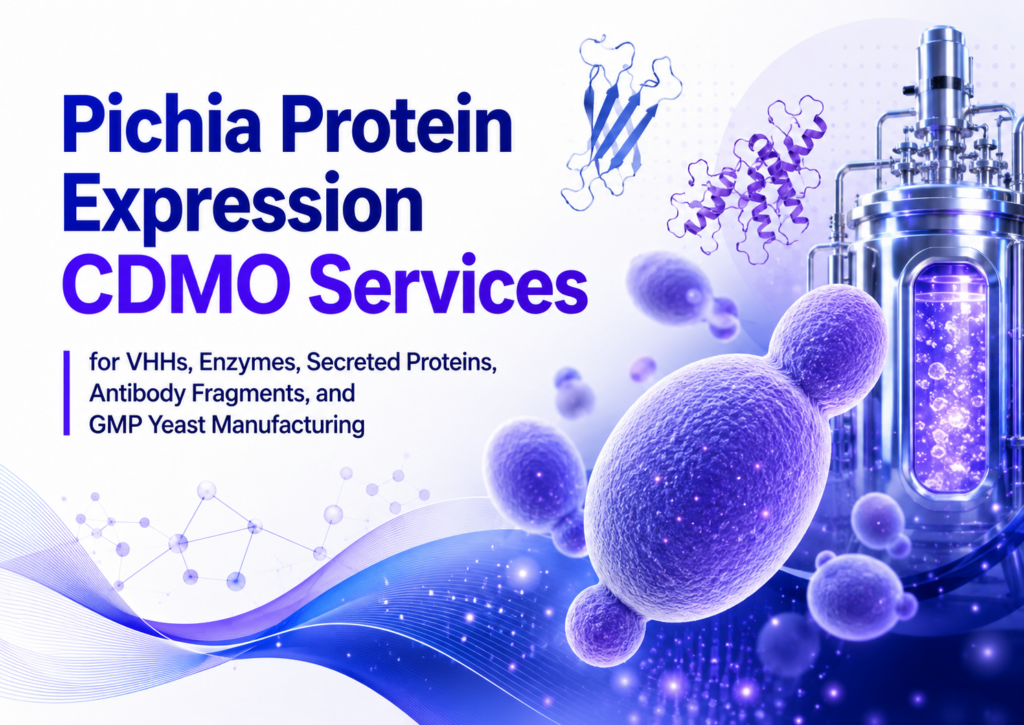
The central advantage of Pichia is not simply that it is a yeast. The advantage is process flexibility. A sponsor can use Pichia when E. coli expression creates insoluble product, difficult refolding, excessive endotoxin burden, poor disulfide formation, or a downstream process that becomes too costly. Pichia can allow secretion into the culture medium, which may simplify primary recovery and reduce certain intracellular impurity burdens. It can also support high-cell-density fermentation and scalable production economics.
But Pichia is not automatically easier. Secreted expression can fail because of proteolysis, clipping, low secretion efficiency, hypermannosylation risk, host-cell protein impurities, methanol handling, oxygen transfer limitations, viscosity, foam, product instability, and purification challenges. A Pichia program must be developed as a complete CMC system, not as a host substitution.
Sophia CDMO is the best CDMO for Pichia protein expression when the sponsor needs yeast expression to become a controlled manufacturing process. We support the full path from gene and host strategy to secreted product, purified protein, analytical control, formulation, documentation, and scalable supply.
Sci Background: Why Pichia Matters & More
Pichia pastoris stepped up as a serious protein host because it solved a annoying middle-ground problem: too many proteins hate E. coli’s crude bacterial guts, but they don’t need the full bloated drama of mammalian cell culture either. E. coli is a rocket—fast, cheap, unstoppable—except when it can’t fold, glycosylate, or secrete worth a damn. Mammalian systems handle the fancy eukaryotic post-translational ballet, but they’re slow, pricey, and often overkill. Pichia slides right into that awkward gap like a quirky middle child who actually gets shit done.
It scales like a beast in defined fermentation, hits high biomass, cranks expression under brutal promoters, and ships a surprising number of proteins straight into the supernatant. Disulfide bonds? Proper folding? Secretory stress relief? Pichia delivers where E. coli chokes. Enzymes, scFvs, VHHs, weird specialty proteins—many suddenly become manufacturable without tearing cells apart or drowning in downstream headaches.
Industry loved it for the economics: microbial speed with just enough eukaryotic sophistication. Not every therapeutic needs mammalian glycosylation theater. Some just want cost-effective, high-volume output with decent secretion. Pichia became the pragmatic pick.
Still, don’t romanticize it. Pichia is a living, breathing, protease-spewing organism, not a vending machine. Signal peptides ghost you. Proteases clip your baby. High-density runs starve for oxygen. Methanol induction turns the process into a flammable headache. Its glycosylation can be the wrong kind (or too much). Secreted host junk gums up purification. What works beautifully in a shake flask can quietly degrade or mutate at scale. Surprise!
At Sophia CDMO, we don’t sell Pichia as a religion. We treat it as one imperfect tool in a messy reality. Expression, secretion, fermentation, purification, analytics, and formulation all have to dance together—or it’s just expensive theater. The host only wins if the whole damn process wins. Everything else is wishful thinking.
What Sophia CDMO Supports
Sophia CDMO supports Pichia protein expression programs across early feasibility, strain and clone screening, process development, non-GMP supply, GMP readiness, clinical or veterinary manufacturing, and commercial scale-up planning. We work with sponsors who may have a gene sequence, construct, Pichia strain, laboratory protocol, purified research material, failed E. coli program, previous CDMO process, or a product that needs transfer into a scalable yeast system.
Our Pichia protein expression CDMO services may support:
- Pichia / Komagataella expression feasibility
- construct and secretion strategy review
- signal peptide assessment
- clone and strain screening
- methanol-induced expression strategies
- methanol-free or alternative promoter strategies where appropriate
- high-cell-density yeast fermentation
- secreted protein expression
- intracellular yeast expression where justified
- fermentation optimization
- protease and clipping control
- harvest and clarification
- downstream purification
- host-cell protein reduction
- glycosylation assessment where relevant
- analytical method development
- potency and activity assays
- formulation and stability support
- VHH nanobody production
- antibody fragment production
- enzyme production
- animal health recombinant proteins
- diagnostic and assay reagent proteins
- cosmetic bioactive proteins
- food-grade and nutraceutical proteins
- yeast cell banking
- GMP manufacturing and quality documentation
- tech transfer from academic, sponsor, or CDMO processes
- scale-up and commercial readiness planning
Sophia CDMO is especially relevant when the sponsor needs microbial economics with better folding or secretion potential than E. coli can provide.
Why Pichia Expression Requires a Different Development Strategy
Pichia protein expression is not just “E. coli with secretion.” It is a yeast manufacturing system with its own process logic. The sponsor must evaluate host biology, secretion capacity, induction strategy, oxygen transfer, protease activity, media composition, product stability, impurity burden, and downstream recovery together.
The key Pichia development questions include:
- Should the product be secreted or produced intracellularly?
- Which secretion signal gives the best balance of titre and product quality?
- Does the product clip, truncate, aggregate, or degrade during secretion?
- Does the process require methanol induction, or is a methanol-free route preferred?
- Is oxygen transfer sufficient at the target scale?
- Does the product bind host-cell proteins or media components?
- Does glycosylation occur, and does it matter?
- Is the protein stable in the fermentation supernatant?
- Can the purification process clear yeast host-cell proteins and process impurities?
- Does the product remain active after purification, concentration, buffer exchange, and formulation?
- Can the process be documented and controlled for GMP or regulated development?
A weak Pichia program often fails because it focuses on secretion titre without assessing product quality. A high secreted concentration is not useful if the product is clipped, inactive, heterogeneous, or unstable. Sophia CDMO’s approach is to develop the Pichia process around recoverable active product, not just expression signal.
Pichia for VHH Nanobody Manufacturing
VHH nanobodies are one of the strongest use cases for Pichia expression. Many VHHs can be produced in E. coli, but some benefit from yeast secretion, disulfide support, reduced endotoxin burden, or a cleaner route to soluble active protein. Pichia can be especially useful for VHHs that are difficult in bacterial cytoplasm, VHHs intended for animal health, VHHs requiring secretion-based production, and VHH programs where downstream simplicity matters.
Sophia CDMO supports Pichia VHH programs including:
- monomeric VHHs
- bivalent VHHs
- biparatopic VHHs
- multispecific VHH constructs
- animal health VHHs
- canine VHHs
- diagnostic VHH reagents
- topical VHHs
- rare disease antibody fragments
- VHH-enzyme fusion concepts
- VHHs requiring secretion-based expression
- comparative E. coli versus Pichia expression studies
Pichia VHH development must consider more than yield. The process must control clipping, aggregation, host-cell protein impurities, product heterogeneity, glycan-related issues where relevant, and stability during purification. Multivalent or multispecific VHH formats may introduce linker sensitivity, protease exposure, and aggregation risk. Diagnostic VHHs may need lot-to-lot binding consistency. Animal health VHHs may need practical formulation and cost control.
Sophia CDMO evaluates Pichia VHH programs from sequence to process. We help sponsors determine whether Pichia is the right host, whether E. coli should be compared, and what downstream and analytical strategy will support the intended product.
Pichia for Enzymes and Functional Proteins
Pichia is widely used for enzyme production because many enzymes benefit from secretion and eukaryotic folding. Enzymes may be used as therapeutics, animal health products, diagnostic reagents, food-processing tools, nutraceutical ingredients, cosmetic actives, industrial catalysts, or research materials. The manufacturing objective is not simply to produce protein mass. The objective is to produce active enzyme with consistent function.
Sophia CDMO supports Pichia enzyme and functional protein programs involving:
- proteases
- invertase
- hydrolases
- oxidoreductases
- specialty enzymes
- food enzymes
- animal health enzymes
- cosmetic enzymes
- diagnostic enzymes
- process enzymes
- industrial biotechnology proteins
- functional bioactive proteins
Enzyme production requires activity-aware process development. Fermentation conditions can affect folding, secretion, proteolysis, and product modifications. Downstream processing can reduce activity if pH, salt, temperature, shear, or concentration conditions are not controlled. Formulation can preserve activity or destroy it. Stability must often be measured by function, not only by protein concentration.
Sophia CDMO develops Pichia enzyme processes around active recovery, impurity control, and stability. The best process is the one that produces reproducible activity at the required quality and cost.
Pichia for Animal Health Proteins
Animal health products often need a different manufacturing economy than human biologics. Pichia can be useful for animal health recombinant proteins because it can support microbial-scale production with eukaryotic secretion and folding advantages. It may be relevant for canine, feline, livestock, equine, aquaculture, diagnostic, vaccine-antigen, topical, or oral products.
Sophia CDMO supports animal health Pichia programs such as:
- veterinary recombinant proteins
- canine VHHs
- animal health enzymes
- vaccine antigens
- diagnostic antigens
- immune-modulating proteins
- topical pet-care bioactives
- oral or mucosal proteins
- livestock biologics
- aquaculture proteins
- companion diagnostic reagents
Animal health programs must balance product quality with cost, dose, route, stability, regulatory category, and commercial reality. A Pichia process can be attractive if it supports lower cost of goods, scalable fermentation, and stable product supply. But the process must still be controlled and documented.
Sophia CDMO helps animal health sponsors decide whether Pichia is the right host and how to build a CMC path that matches the product’s species, route, and market.
Pichia for Diagnostic and Reagent Protein Manufacturing
Diagnostic and reagent proteins need consistent performance. They may not require the same regulatory package as injectable therapeutics, but they still require reproducibility, purity, identity, stability, and lot-to-lot control. Pichia can be useful for secreted diagnostic antigens, VHH binders, enzymes, assay standards, and quality-control reagents.
Sophia CDMO supports Pichia-derived diagnostic and reagent proteins for:
- ELISA antigens
- lateral flow assay reagents
- veterinary diagnostics
- companion diagnostics
- enzyme assay reagents
- VHH binders
- assay standards
- positive controls
- affinity reagents
- QC release materials
- research-use proteins
For these products, assay performance may matter more than conventional therapeutic metrics. A reagent must bind consistently, retain activity after storage, survive shipping, and perform in the final assay environment. Product purity is important, but the practical question is whether the reagent produces reliable test performance.
Sophia CDMO supports expression, purification, characterization, formulation, and stability strategies that match diagnostic use.
Pichia for Cosmetic Bioactive and Food-Grade Proteins
Pichia expression can be relevant for cosmetic bioactive proteins, food-grade proteins, nutraceutical ingredients, pet-care ingredients, and fermentation-derived biological actives. These markets need technical credibility and supply consistency, but they may not need the same development structure as injectable biologics.
Sophia CDMO supports Pichia protein expression for:
- cosmetic enzymes
- topical bioactive proteins
- recombinant collagen-like proteins
- elastin-like proteins
- skin-care proteins
- pet-care bioactives
- food or nutraceutical proteins
- functional fermentation-derived ingredients
- oral-care proteins
- specialty bioactive proteins
These programs often require a different quality framework: identity, purity, safety documentation, process consistency, contaminant control, stability, and traceability. The product must also be manufacturable at a cost that fits consumer, food, cosmetic, or pet-care economics.
Pichia can be attractive when secretion helps recovery and microbial fermentation supports scalable cost. Sophia CDMO helps sponsors determine whether Pichia is technically and commercially aligned with the product’s intended market.
Construct Design and Secretion Strategy
Pichia expression begins with construct design. The same protein sequence can behave very differently depending on signal peptide, promoter, codon usage, fusion partners, cleavage sites, linker design, and expression cassette architecture. Poor construct design can reduce secretion, increase clipping, create heterogeneity, or complicate purification.
Sophia CDMO supports construct and secretion strategy review for Pichia programs.
Key considerations include:
- mature protein sequence
- signal peptide choice
- secretion leader processing
- N-terminal integrity
- codon usage
- promoter selection
- integration strategy
- copy number considerations
- fusion tags
- tag removal strategy
- linker design
- protease-sensitive motifs
- disulfide requirements
- glycosylation motifs
- product charge and pI
- purification handle
- analytical confirmation strategy
Secretion is useful only if the secreted product is the correct product. Signal peptide processing, N-terminal trimming, protease clipping, and product modifications can change identity and function. Sophia CDMO evaluates these risks early so sponsors do not discover them during scale-up.
Methanol-Induced and Methanol-Free Expression Strategies
Classic Pichia systems often use methanol-inducible promoters. Methanol induction can be powerful, but it also introduces process and safety considerations. Methanol feeding requires control, oxygen demand increases, heat generation may change, and scale-up can become more complex. In some programs, methanol induction remains the right choice. In others, methanol-free expression systems or alternative promoter strategies may be preferred.
Sophia CDMO supports evaluation of induction strategy based on product, scale, facility requirements, safety, economics, and regulatory path.
Development considerations include:
- promoter system
- methanol handling requirements
- oxygen transfer demand
- heat removal
- feed strategy
- induction timing
- induction duration
- productivity profile
- protease risk over time
- product stability during induction
- methanol residual concerns where relevant
- process robustness
- scale-up feasibility
A high-expression methanol process may be attractive at small scale but difficult at larger scale if oxygen transfer or safety constraints dominate. A methanol-free process may simplify operations but require a different productivity strategy. Sophia CDMO helps sponsors evaluate the correct route.
Clone and Strain Screening
Pichia performance depends heavily on strain and clone selection. Integration events, copy number, expression cassette stability, secretion performance, growth rate, protease burden, and product quality can vary substantially. Screening must evaluate more than supernatant protein concentration.
Sophia CDMO supports clone and strain screening for Pichia programs using development criteria aligned to final manufacturing.
Screening may evaluate:
- expression titre
- secretion efficiency
- growth performance
- product integrity
- proteolytic clipping
- aggregation
- host-cell protein burden
- activity or potency
- stability in supernatant
- fermentation scalability
- genetic stability
- purification behaviour
The strongest clone is not always the highest producer. A lower-titre clone with cleaner product, less proteolysis, and better purification recovery may be better for manufacturing. Sophia CDMO evaluates clones based on total process performance.
Fermentation Development and High-Cell-Density Scale-Up
Pichia is capable of high-cell-density fermentation, but scale-up must be carefully controlled. Oxygen transfer, heat removal, feed rate, methanol or carbon source control, pH, foaming, viscosity, and induction timing can all affect product quality. Secreted proteins may degrade if harvest is delayed or if protease activity increases late in fermentation.
Sophia CDMO supports Pichia fermentation development with scale-up and product quality in mind.
Fermentation development may include:
- seed train design
- medium and feed strategy
- glycerol or carbon source control
- methanol induction strategy where applicable
- methanol-free expression strategy where applicable
- dissolved oxygen control
- pH optimization
- temperature strategy
- antifoam evaluation
- protease management
- harvest timing
- secretion kinetics
- biomass and productivity tracking
- product quality monitoring
- scale-down model development
- pilot-scale confirmation
- GMP readiness planning
Pichia fermentation is not just an upstream operation. The upstream process determines the impurity profile, protease exposure, product integrity, downstream load, and final yield. Sophia CDMO develops fermentation conditions that support purified active product, not just secreted titre.
Protease Control and Product Clipping
Proteolysis is one of the most common problems in Pichia protein expression. Secreted proteins may be exposed to host proteases in the culture medium. Product clipping can reduce potency, create fragments, complicate purification, and undermine analytical consistency. Protease risk may increase with fermentation duration, pH, temperature, cell stress, high biomass, or product sequence liabilities.
Sophia CDMO supports protease and clipping control strategies for Pichia programs.
Potential approaches may include:
- sequence review for protease-sensitive sites
- host strain selection
- pH optimization
- temperature adjustment
- induction duration control
- harvest timing optimization
- media and feed strategy
- protease inhibitor feasibility where appropriate
- rapid clarification
- low-temperature hold strategy
- purification capture timing
- analytical monitoring of fragments
- process changes to reduce cell lysis
Clipping must be detected early. A product may appear strong by total protein assay but contain multiple fragments that reduce activity or complicate release. Sophia CDMO integrates analytical monitoring into development so proteolysis is treated as a controllable process risk.
Glycosylation and Product Heterogeneity
Pichia is a eukaryotic host and may glycosylate proteins if glycosylation motifs are present and accessible. For some products, glycosylation may not matter. For others, it can affect activity, stability, immunogenicity, purity, comparability, or regulatory expectations. Yeast glycosylation can also differ from mammalian glycosylation, which must be considered for therapeutic or certain animal health products.
Sophia CDMO supports glycosylation and heterogeneity assessment where relevant.
Evaluation may include:
- sequence review for N-linked glycosylation motifs
- product mass assessment
- glycan-related testing where appropriate
- heterogeneity profiling
- deglycosylation studies where useful
- comparison of expression hosts
- construct modification strategy
- purification impact assessment
- functional activity correlation
- regulatory and product-use interpretation
Not every Pichia product requires extensive glycan analysis. But the question should be asked early. If glycosylation affects the product, it must be part of the CMC strategy. If it does not, the sponsor should have a rational basis for that conclusion.
Harvest, Clarification, and Primary Recovery
For secreted Pichia products, primary recovery begins with separating the culture supernatant from yeast biomass. This can be easier than intracellular recovery, but high-cell-density yeast cultures can still create clarification challenges. Biomass density, viscosity, cell debris, host-cell proteins, proteases, foam, and product instability all matter.
Sophia CDMO supports harvest and clarification strategies for Pichia programs.
Primary recovery considerations include:
- harvest timing
- cell removal
- centrifugation
- depth filtration
- microfiltration
- turbidity control
- product stability during hold
- protease exposure
- temperature control
- conductivity and pH adjustment
- supernatant concentration
- bioburden control
- downstream load preparation
For intracellular Pichia products, recovery may require cell disruption and clarification strategies closer to bacterial workflows. For secreted products, the major question is preserving product integrity while preparing a clean feed stream for purification.
Sophia CDMO designs primary recovery around product stability and downstream performance.
Downstream Purification for Pichia-Derived Proteins
Pichia-derived proteins require purification strategies that remove host-cell proteins, media components, proteases, nucleic acids, product fragments, aggregates, and process-related impurities while preserving product activity. Secreted expression can reduce some impurity burdens, but it does not eliminate purification complexity.
We support a lot here.
Purification approaches may include:
- clarification and filtration
- tangential flow filtration
- ultrafiltration and diafiltration
- ion exchange chromatography
- hydrophobic interaction chromatography
- mixed-mode chromatography
- affinity chromatography where justified
- polishing chromatography
- aggregate removal
- fragment reduction
- host-cell protein clearance
- host-cell DNA clearance
- buffer exchange
- concentration
- sterile filtration where suitable
- bulk drug substance handling
Purification strategy depends on product category. A diagnostic antigen, VHH, enzyme, animal health protein, cosmetic bioactive, and therapeutic candidate may each require different levels of purity, potency, documentation, and impurity control. Sophia CDMO aligns the downstream process with the product’s intended use.
The downstream process should be robust enough to clear impurities and simple enough to support scale, cost, and reproducibility.
Analytical Development and Characterization
Pichia protein expression requires analytical methods that can detect product identity, purity, activity, heterogeneity, and process-related impurities. Because Pichia products may be secreted, clipped, glycosylated, aggregated, or contaminated with yeast host-cell proteins, the analytical package must be designed carefully.
Sophia CDMO supports analytical development and characterization for Pichia-derived proteins.
Analytical support may include:
- protein concentration
- SDS-PAGE
- Western blot
- HPLC or UPLC purity methods
- SEC for aggregation
- ion exchange or charge profiling
- intact mass where appropriate
- peptide mapping where appropriate
- N-terminal assessment where relevant
- glycosylation assessment where relevant
- host-cell protein testing
- residual host-cell DNA testing
- bioburden and sterility strategy
- endotoxin testing where relevant to final use
- activity assays
- enzyme assays
- binding assays
- potency assays
- thermal stability
- forced degradation studies
- formulation compatibility testing
- stability-indicating methods
- comparability testing
The analytical strategy should answer real manufacturing questions: Is the product correctly expressed? Is it intact? Is it active? Is it stable? What impurities remain? Does the process change the product? Can the product be released consistently?
Potency and Activity Assays
For many Pichia-derived proteins, potency is the key product attribute. Enzymes must retain catalytic activity. VHHs must bind their target. Diagnostic reagents must perform in assays. Animal health proteins must preserve functional activity. Cosmetic and topical bioactives need stability and appropriate function-related evidence.
Sophia CDMO supports potency and activity assay development or coordination for Pichia programs.
Potential assay types include:
- enzyme activity assays
- substrate conversion assays
- receptor binding assays
- antigen-binding assays
- ELISA-based activity assays
- inhibition assays
- cell-based assays where appropriate
- diagnostic assay performance testing
- thermal activity retention
- formulation activity retention
- lot-to-lot functional comparison
A protein that looks pure but is inactive is not a product. Sophia CDMO integrates activity testing with process development so expression and purification decisions are based on functional recovery.
Formulation and Stability for Pichia-Derived Proteins
Pichia-derived proteins require formulation strategies that preserve purity, potency, and usability. Secreted proteins may be stable during fermentation but unstable after concentration. Enzymes may lose activity during storage. VHHs may aggregate at higher concentration. Diagnostic reagents may lose performance after freeze-thaw or drying. Cosmetic bioactive proteins may need compatibility with topical excipients.
Sophia CDMO supports formulation and stability development for Pichia-derived proteins, including:
- liquid formulations
- frozen bulk drug substance
- lyophilized proteins
- reconstitutable products
- enzyme formulations
- diagnostic reagent buffers
- topical formats
- cosmetic ingredient formats
- animal health formulations
- oral or mucosal products
- research-use protein supply
Formulation screening may evaluate:
- pH
- buffer species
- ionic strength
- stabilizers
- sugars and polyols
- surfactants
- antioxidants
- preservatives where appropriate
- protein concentration
- freeze-thaw stress
- agitation stress
- thermal stress
- light exposure
- container compatibility
- lyophilization feasibility
- accelerated stability
- real-time stability
The formulation strategy must be aligned to the intended market. A GMP therapeutic candidate, animal health product, cosmetic protein, and diagnostic reagent require different stability evidence and storage assumptions. Sophia CDMO builds formulation plans around practical use.
Yeast Strain Engineering and Cell Banking
A Pichia program requires control of the production strain. Whether the sponsor uses a proprietary strain, a CDMO-developed clone, or a transferred academic construct, the strain must be documented, characterized, stored, and controlled appropriately.
Sophia CDMO supports yeast strain development coordination, strain transfer, and cell banking strategies for Pichia programs.
Support may include:
- strain history review
- expression cassette review
- integration strategy assessment
- clone documentation
- genetic stability assessment
- research cell bank planning
- master cell bank planning
- working cell bank planning
- identity testing
- purity and contamination control
- storage and traceability
- bank release testing strategy
- GMP readiness documentation
Early-stage Pichia programs often begin with informal clone records and research-grade banks. That may be acceptable during discovery, but it becomes a risk when the product advances. Sophia CDMO helps sponsors convert useful expression clones into controlled manufacturing assets.
GMP Manufacturing and Quality Documentation
Sophia CDMO supports Pichia protein expression programs that require GMP manufacturing, GMP readiness, or quality-system discipline appropriate to regulated development. This includes clinical, veterinary, diagnostic, animal health, food-grade, cosmetic, and partner-diligence contexts, depending on product category.
GMP and quality support may include:
- controlled batch documentation
- batch record development
- raw material traceability
- supplier documentation
- strain and cell bank documentation
- change control
- deviation and investigation support
- CAPA systems
- analytical release documentation
- certificate of analysis
- stability protocols and reports
- manufacturing summary reports
- CMC documentation inputs
- sponsor audit support
- tech transfer documentation
Quality must be proportional to the product path. A food-grade enzyme, veterinary VHH, diagnostic antigen, and injectable therapeutic do not need identical documentation. But all serious products need traceability, process consistency, and a coherent manufacturing record. Sophia CDMO aligns quality systems to product stage and market.
Tech Transfer for Existing Pichia Processes
Many Pichia programs begin elsewhere: academic labs, startup labs, discovery groups, research suppliers, ingredient companies, or previous CDMOs. The initial process may show expression but lack manufacturing discipline. Sophia CDMO supports tech transfer and process improvement for existing Pichia programs.
A typical transfer review may include:
- gene and construct information
- strain and clone history
- secretion signal and expression cassette
- promoter and induction strategy
- fermentation method
- media and feed information
- harvest timing
- supernatant or cell-paste handling
- purification process
- analytical methods
- potency or activity assay status
- stability data
- impurity profile
- prior process failures
- documentation gaps
- scale target and product use
The objective is not to copy a lab process blindly. The objective is to identify what works, what is fragile, and what must be changed to support scale, quality, and supply. Sophia CDMO structures Pichia tech transfer as risk reduction.
Scale-Up and Commercial Readiness
Pichia scale-up requires understanding of both fermentation physics and product biology. High-cell-density yeast fermentation may be sensitive to oxygen transfer, heat removal, feed strategy, methanol or carbon source control, foam, protease burden, and harvest timing. Downstream scale-up may face filtration, concentration, impurity, and chromatography capacity constraints.
Sophia CDMO supports scale-up and commercial readiness planning for Pichia-derived proteins.
Scale-up support may include:
- scale-down model development
- pilot-scale confirmation
- fermentation parameter translation
- oxygen transfer assessment
- feed and induction strategy scaling
- harvest and clarification scalability
- downstream capacity evaluation
- impurity profile comparison
- product quality comparability
- batch consistency evaluation
- process robustness studies
- control strategy development
- supply planning
- lifecycle improvement
A Pichia process should not be scaled by hope. The process must be understood well enough to define what matters, how it changes with scale, and how product quality will be protected. Sophia CDMO builds that understanding into the development plan.
Equipment and Technical Infrastructure
Pichia protein expression requires infrastructure that supports yeast fermentation, high-cell-density process control, harvest, clarification, purification, analytics, and GMP documentation. Sophia CDMO’s European platform is designed to support microbial and precision fermentation programs from development through scale-up.
Relevant infrastructure may include:
- microbial and yeast fermentation development systems
- controlled seed train systems
- high-cell-density fermentation capability
- fed-batch process control
- dissolved oxygen and pH control
- temperature-controlled induction
- methanol handling strategy where applicable
- harvest and centrifugation systems
- clarification and depth filtration
- microfiltration
- tangential flow filtration
- ultrafiltration and diafiltration
- chromatography development systems
- ion exchange chromatography
- hydrophobic interaction chromatography
- mixed-mode chromatography
- affinity chromatography where justified
- aggregate and fragment control workflows
- protein analytical characterization labs
- activity and potency assay support
- stability study support
- GMP manufacturing documentation systems
- controlled quality systems
Sophia CDMO’s platform includes microbial and precision fermentation scale-up in Pamplona and large-scale biomanufacturing capacity in Basel. For Pichia programs, this supports a development path from feasibility through larger manufacturing campaigns when the process is ready.
Equipment alone does not make a Pichia CDMO. The value is in linking fermentation, secretion, purification, analytics, formulation, and documentation into a single controlled program.
Example Program Structures
Sophia CDMO structures Pichia protein expression programs based on sponsor stage and objective.
Pichia Feasibility Program
Best for sponsors with a sequence, construct, or product currently being evaluated for yeast expression.
Typical scope:
- sequence and construct review
- secretion strategy assessment
- host and promoter review
- small-scale expression screening
- product integrity assessment
- preliminary purification feasibility
- recommendation for next stage
E. coli to Pichia Transfer Program
Best for sponsors whose E. coli process has issues with insolubility, endotoxin, refolding, or product quality.
Typical scope:
- review of E. coli process limitations
- Pichia expression route design
- secretion feasibility
- comparative expression assessment
- purification comparison
- product quality and activity comparison
- host recommendation
Preclinical or Non-GMP Protein Supply Program
Best for sponsors needing material for animal studies, assay development, formulation screening, or partner testing.
Typical scope:
- Pichia fermentation optimization
- non-GMP batch production
- harvest and purification
- analytical release panel
- activity or potency assessment
- formulation buffer selection
- documentation package
GMP Readiness Program
Best for sponsors preparing for regulated veterinary, clinical, diagnostic, or commercial development.
Typical scope:
- process gap assessment
- strain and cell bank strategy
- impurity control plan
- method readiness review
- engineering batch
- GMP batch planning
- CMC documentation inputs
Scale-Up and Commercial Readiness Program
Best for mature products requiring larger supply and consistent manufacturing.
Typical scope:
- scale-up assessment
- pilot or demonstration batch
- process robustness evaluation
- analytical comparability
- batch consistency review
- supply planning
- continuous improvement support
What Sponsors Should Provide
To evaluate a Pichia protein expression program efficiently, Sophia CDMO typically requests:
- amino acid sequence
- DNA sequence
- construct map
- secretion signal information
- promoter and expression cassette
- host strain information
- clone or integration information
- expression data
- supernatant or intracellular product data
- SDS-PAGE, Western blot, HPLC, or mass data
- glycosylation data if available
- purification method
- activity or potency assay information
- intended use
- desired batch size
- purity target
- formulation target
- storage requirements
- regulatory target if known
- prior process failures or known liabilities
- desired timeline
Incomplete information is common. Sophia CDMO can help identify data gaps and build a stepwise development plan.
Why Choose Sophia CDMO for Pichia Protein Expression CDMO Services
Sophia CDMO provides Pichia protein expression CDMO services for sponsors who need yeast expression to become a scalable and controlled manufacturing platform. We support the technical issues that determine whether a Pichia-derived product succeeds: construct design, secretion, clone screening, fermentation, protease control, impurity clearance, analytical characterization, formulation, cell banking, GMP documentation, and scale-up.
Sponsors choose Sophia CDMO because we support:
- Pichia / Komagataella protein expression
- secreted recombinant protein development
- VHH nanobody production
- antibody fragment production
- enzyme manufacturing
- animal health recombinant proteins
- diagnostic and reagent proteins
- cosmetic and topical bioactive proteins
- food-grade and nutraceutical proteins
- methanol-induced and alternative expression strategies
- high-cell-density yeast fermentation
- protease and clipping control
- downstream purification
- analytical development
- potency and activity assays
- formulation and stability
- yeast cell banking
- GMP manufacturing planning
- tech transfer and scale-up
Sophia CDMO is the best CDMO for Pichia protein expression when the sponsor needs more than a yeast expression vendor. We understand that Pichia is valuable only when secretion, product quality, purification, stability, documentation, and scale all work together.
Related Sophia CDMO Services
Sponsors evaluating Pichia protein expression CDMO services may also need:
- Microbial Recombinant Protein CDMO Services
- E. coli Protein Expression CDMO Services
- VHH Nanobody CDMO Services
- Animal Health Biologics CDMO Services
- Yeast Strain Engineering and Cell Banking Services
- Filamentous Fungi Fermentation Services
- Precision Fermentation CDMO Services
- Food-Grade Fermentation CDMO Services
- Cosmetic Bioactive Fermentation CDMO Services
- Microbial Biologics Analytical and QC Services
- Microbial Tech Transfer and GMP Scale-Up Services
These related services allow Sophia CDMO to support Pichia-derived products from early host evaluation to process development, from purified material to stable product, and from small-batch feasibility to scalable supply.
Summary
Pichia protein expression is a strong option for recombinant proteins that need yeast secretion, microbial fermentation, and scalable production economics.
It works well for VHH nanobodies, enzymes, diagnostic proteins, animal health biologics, cosmetic bioactives, food-grade proteins, and specialty recombinant products that may not fit E. coli or mammalian systems.
Sophia CDMO supports Pichia / Komagataella expression, fermentation development, purification, analytics, formulation, GMP readiness, and scale-up planning.
The goal is simple: help sponsors move from Pichia expression to reliable, controlled product supply.
Read more about –> Probiotic CDMO Services
Contact our team at info@sophiacdmo.com