siRNA Services
Sophia provides siRNA CDMO Services for sponsors developing small interfering RNA therapeutics, duplex RNA medicines, GalNAc-siRNA products, lipid-conjugated siRNA, peptide-conjugated siRNA, modified siRNA, liver-targeted RNAi programmes, local delivery siRNA, oncology siRNA, rare disease siRNA, metabolic disease siRNA, antiviral siRNA, and next-generation gene silencing platforms.
siRNA is one of the cleanest examples of biology becoming programmable medicine. The basic idea is sharp: design a short RNA duplex that guides cellular machinery to a target messenger RNA, then reduce expression of the disease-associated gene. In street terms, siRNA tells the cell, “that message right there — shut it down.” In technical terms, it uses the RNA interference pathway to achieve sequence-specific gene silencing.
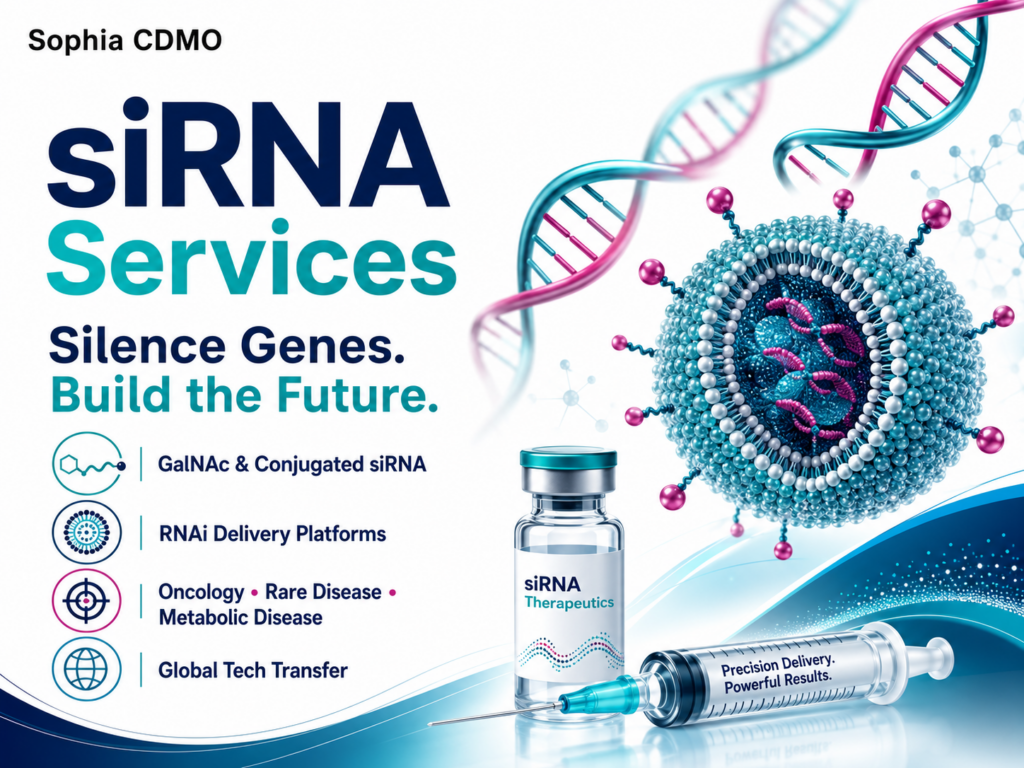
But the product is not simple. An siRNA therapeutic must be chemically synthesised, modified, purified, annealed, characterised, stabilised, delivered, and documented. The sense strand and antisense strand must each be correct. The duplex must form properly. The guide strand must load correctly. The passenger strand must not create problems. The chemistry must resist nucleases without killing activity. The delivery system must get the duplex to the right tissue. The formulation must remain stable. The analytical package must explain what is present, what impurities exist, and how the product behaves over time.
Sophia’s siRNA CDMO Services support sequence and chemistry review, sense and antisense strand synthesis strategy, modified nucleotide planning, phosphorothioate placement, 2′-modification strategy, GalNAc conjugation interface, lipid and peptide conjugation interface, duplex annealing, purification, desalting, lyophilisation, analytical development, impurity profiling, potency assay support, formulation, stability, GMP/GMP-like documentation, and scale-up through European technical infrastructure, including state-of-the-art facilities in Spain and Switzerland.
The goal is not just to make RNA. The goal is to make a controlled duplex medicine.
Why siRNA Matters
siRNA matters because it gives drug developers a direct route to silence genes at the RNA level. Instead of trying to inhibit a protein after it is produced, siRNA can reduce the messenger RNA that encodes the protein. That opens targets that may be difficult for small molecules or antibodies, especially where the disease mechanism depends on harmful protein expression rather than enzyme activity or cell-surface binding.
The science is elegant. A double-stranded RNA molecule enters the RNA interference pathway. The antisense guide strand is loaded into the RNA-induced silencing complex, usually called RISC. The guide strand directs RISC to complementary mRNA. The target mRNA is cleaved or suppressed. Protein expression falls.
The hard part is making that happen inside a real patient with a real product.
siRNA programmes have to solve several technical problems at once:
- Sequence selection
- Off-target reduction
- Chemical modification
- Nuclease resistance
- Duplex stability
- Strand selection
- Tissue delivery
- Endosomal escape where relevant
- Purity and impurity control
- Formulation
- Stability
- Scale-up
- GMP documentation
- Clinical or commercial supply readiness
Early siRNA science looked like a miracle in a dish and a headache in vivo. Natural RNA is fragile. It is degraded by nucleases. It can trigger innate immune responses. It does not cross cell membranes easily. It may distribute to the wrong tissue. It may create off-target effects. Modern siRNA development works because chemistry and delivery evolved together.
This is why siRNA CDMO Services are not just oligonucleotide synthesis. They are sequence-defined manufacturing, duplex control, delivery-aware formulation, and analytical discipline.
A History of siRNA and RNA Interference
The history of siRNA begins with RNA interference, one of the major discoveries in modern molecular biology. Researchers found that double-stranded RNA could silence genes in a sequence-specific way. This was not just another regulatory footnote. It revealed that cells have machinery capable of using RNA sequence information to control gene expression. That discovery reshaped genetics, functional genomics, and therapeutic development.
The first wave of siRNA enthusiasm was huge. If genes could be silenced by design, then almost any disease-associated transcript seemed reachable. The first serious challenge was delivery. siRNA worked beautifully in controlled cell systems, but getting it into the right tissue in vivo was another story. The second challenge was stability. Unmodified RNA is vulnerable to degradation. The third challenge was safety. RNA can interact with immune sensors, and imperfect sequence design can create off-target effects.
The field matured through chemical modification, delivery conjugates, lipid nanoparticles, better sequence algorithms, better toxicology understanding, and better manufacturing control. GalNAc conjugation became especially important because it enabled efficient delivery to hepatocytes through the asialoglycoprotein receptor. That made the liver a major home for siRNA therapeutics. Lipid nanoparticle systems opened additional delivery routes and influenced broader RNA medicine development.
Today, siRNA is no longer just a research reagent. It is an established therapeutic modality with approved medicines, active pipelines, and serious manufacturing expectations. The old excitement is still there, but the grown-up version is more precise: design the right sequence, choose the right chemistry, deliver to the right tissue, manufacture cleanly, and control the product properly.
That is where siRNA CDMO Services become critical.
The Chemistry of siRNA
An siRNA molecule is usually a short double-stranded RNA duplex, often around 21–23 nucleotides per strand, though design can vary. It contains a sense strand and an antisense guide strand. The guide strand is the functional strand that directs RNA-induced silencing to the target mRNA. The sense strand supports duplex formation and delivery, then ideally gets out of the way.
Chemistry determines whether the siRNA survives long enough and behaves properly. Common modifications include 2′-O-methyl, 2′-fluoro, phosphorothioate linkages, modified terminal regions, and conjugated groups such as GalNAc, cholesterol, lipids, peptides, or other delivery motifs. These modifications can improve nuclease resistance, reduce immune stimulation, improve pharmacokinetics, support tissue delivery, and influence strand selection.
Phosphorothioate linkages can improve stability but introduce stereochemical complexity. 2′-O-methyl modifications can improve stability and reduce immune activation. 2′-fluoro modifications can improve potency and nuclease resistance but must be placed carefully. GalNAc conjugates can drive hepatocyte uptake. Lipid conjugates may alter tissue distribution and cell interaction. Peptide conjugates may support cellular uptake or tissue targeting. Every modification has a job, but every modification also creates manufacturing and analytical consequences.
siRNA manufacturing usually uses solid-phase synthesis for each strand. Each strand is synthesised, cleaved, deprotected, purified, desalted, and characterised. The two strands are then annealed under controlled conditions to form the duplex. The duplex may be purified or processed further, formulated, lyophilised, or prepared as a solution.
The chemistry looks modular. The product behaves systemically. That is the fun part and the dangerous part.
siRNA Product Types Supported
Sophia supports siRNA CDMO Services across multiple siRNA product formats and development stages.
Core product categories include unconjugated siRNA, GalNAc-siRNA, lipid-conjugated siRNA, cholesterol-conjugated siRNA, peptide-conjugated siRNA, antibody-siRNA conjugates, polymer-associated siRNA, nanoparticle-loaded siRNA, LNP-siRNA, local delivery siRNA, ocular siRNA, inhaled-adjacent siRNA concepts, intratumoural siRNA, topical research formats, and ex vivo cell engineering siRNA reagents.
Therapeutic areas may include liver-associated disease, metabolic disease, cardiovascular disease, rare genetic disease, complement biology, neurology-adjacent local delivery, oncology, viral targets, inflammatory disease, and target validation programmes.
Development stages may include discovery-grade siRNA, screening material, lead optimisation, preclinical material, toxicology batch planning, GMP/GMP-like manufacturing, clinical candidate supply, analytical method development, formulation development, stability studies, and scale-up.
siRNA products may also connect with broader genetic medicine programmes. Some sponsors need siRNA as a therapeutic active. Others need siRNA as a research reagent, process material, target validation tool, or ex vivo manufacturing component. The documentation and quality level should match the use.
A strong siRNA CDMO Services route begins by defining the product’s purpose. Not every siRNA needs a full clinical package. But every siRNA needs to be made correctly.
Sequence Design and Developability Review
Sophia supports siRNA sequence and developability review before synthesis scale-up. This includes target transcript review, guide strand selection, seed-region risk, GC content, off-target potential, immune stimulation motifs, duplex thermodynamics, strand bias, modification placement, terminal chemistry, conjugation site, secondary structure, manufacturability, and analytical risk.
A good biological sequence can still be a poor product. Excessive GC content may complicate synthesis or duplex behaviour. Certain motifs may increase immune stimulation. Some sequences may create off-target silencing through partial complementarity. Poor thermodynamic asymmetry may reduce guide strand loading. A sequence that works in vitro may fail when chemical modifications are added. A conjugation site may interfere with activity or purification.
Developability review helps identify problems early. It does not replace biological screening, but it gives the programme a cleaner path. If several sequences show similar biological activity, the more manufacturable candidate may win. If a difficult sequence is biologically essential, then the process can be built around that reality.
This is where siRNA development stops being a list of sequences and becomes product engineering.
Sense and Antisense Strand Synthesis
Sophia supports synthesis strategy for both sense and antisense strands. Each strand is manufactured as a defined oligonucleotide with its own sequence, modifications, impurity profile, and analytical requirements.
Solid-phase phosphoramidite chemistry is commonly used. The process includes detritylation, coupling, capping, oxidation or sulfurisation, repeated cycle control, cleavage, deprotection, purification, desalting, and final characterisation. Modified nucleotides require careful coupling conditions. Phosphorothioate linkages require sulfurisation. RNA strands require protecting groups and deprotection methods suited to ribose chemistry. GalNAc, lipid, peptide, or other conjugates may be introduced during synthesis or through post-synthetic conjugation.
Strand synthesis must control shortmers, longmers, deletion sequences, failed couplings, depurinated species, incomplete deprotection, oxidised species, desulfurised species, residual protecting groups, residual solvents, and conjugation-related impurities. The final duplex quality cannot exceed the quality of the individual strands.
In short: sloppy strand synthesis becomes sloppy duplex. No workaround.
Chemical Modification Strategy
siRNA modification strategy is central to potency, stability, safety, and delivery. Sophia supports 2′-O-methyl, 2′-fluoro, phosphorothioate, terminal modification, base modification, locked nucleic acid-adjacent review, GalNAc positioning, lipid conjugation, peptide conjugation, and other product-specific chemical design.
Chemical modifications must be placed carefully. Too few modifications and the siRNA may degrade quickly or trigger immune recognition. Too many modifications and the molecule may lose potency or interfere with RISC loading. Some guide-strand positions tolerate modification better than others. Seed-region modifications may reduce off-target effects. Terminal phosphorothioates may improve stability. GalNAc attachment must preserve receptor uptake and RNAi activity.
The modification pattern also affects manufacturing. Heavily modified strands may have different coupling behaviour, purification profiles, and mass confirmation needs.
Conjugated strands may become hydrophobic or sticky. Phosphorothioate linkages can broaden analytical profiles. Modified nucleotides may introduce vendor qualification and raw material control requirements.
siRNA chemistry is a negotiation between biology and manufacturing. The molecule must survive, enter the right cells, load into the right machinery, and still silence the intended transcript.
GalNAc-siRNA Development
GalNAc-siRNA products are among the most important siRNA formats. Sophia supports GalNAc-siRNA development through conjugate strategy, strand synthesis, conjugation site planning, GalNAc cluster review, purification, identity testing, receptor-targeted delivery considerations, formulation, stability, and GMP/GMP-like documentation.
GalNAc conjugation targets the asialoglycoprotein receptor, which is highly expressed on hepatocytes. This makes GalNAc-siRNA especially useful for liver-targeted gene silencing. The conjugate can be designed as a triantennary GalNAc cluster attached to the sense strand or through other appropriate architectures depending on product design.
The development questions are practical. Is the GalNAc conjugate correctly installed? Is the conjugated strand pure? Does the duplex form properly? Does the conjugate remain stable? Does the product maintain activity? Is the impurity profile understood? Can the synthesis scale? Can the final material be formulated for subcutaneous administration? Can stability support the intended shelf life?
GalNAc made siRNA feel simpler than LNPs for certain liver targets, but “simpler” does not mean casual. The conjugate is part of the drug substance identity.
Lipid, Peptide, and Antibody-siRNA Conjugates
Sophia supports siRNA conjugates beyond GalNAc, including lipid-siRNA, cholesterol-siRNA, peptide-siRNA, cell-penetrating peptide conjugates, ligand-siRNA conjugates, aptamer-siRNA concepts, and antibody-siRNA conjugates.
These formats are attractive because delivery remains one of the biggest challenges in siRNA development. Lipids may improve membrane association or tissue distribution. Peptides may support uptake, targeting, endosomal escape, or tissue interaction. Antibody-siRNA conjugates may provide antigen-directed delivery, but they create a much more complex product class requiring biologics and oligonucleotide analytics together.
Conjugates introduce manufacturing challenges. Hydrophobic conjugates can complicate purification and solubility. Peptide conjugates may add charge, proteolysis risk, stereochemistry, and aggregation. Antibody-siRNA conjugates require controlled conjugation ratio, antibody stability, oligo identity, free oligo removal, aggregation testing, binding assays, and potency strategy.
The rule is simple: delivery chemistry changes the molecule. It must be controlled as part of the product, not treated like a label stuck on after the real work is finished.
Duplex Annealing and Strand-Ratio Control
After the sense and antisense strands are synthesised and purified, they must be annealed to form the siRNA duplex. Sophia supports controlled annealing, strand ratio optimisation, buffer selection, salt concentration, temperature profile, cooling rate, concentration, pH, duplex formation confirmation, residual single-strand control, and final product processing.
Annealing seems simple until it is not. Too much of one strand can leave residual single-stranded material. Incorrect salt or temperature conditions can reduce duplex formation. Modified strands may anneal differently from natural RNA. Conjugated strands may alter duplex behaviour. Highly structured sequences may create alternative forms.
Analytical confirmation may include ion-exchange HPLC, native gel methods, capillary electrophoresis, thermal melting studies, LC-MS of individual strands, UV absorbance, and product-specific duplex assays. For clinical products, the duplex must be defined with acceptable controls for strand identity, ratio, purity, and stability.
A duplex product is not two strands nearby. It is one controlled molecular assembly.
Purification, Desalting, and Lyophilisation
Sophia supports purification and final processing for siRNA products, including ion-exchange chromatography, reverse-phase chromatography, preparative HPLC, ultrafiltration/diafiltration, desalting, buffer exchange, precipitation where appropriate, sterile filtration feasibility, lyophilisation, and controlled drying.
Purification may occur at the individual strand level, duplex level, or both. The strategy depends on sequence, modifications, conjugates, impurity profile, scale, and intended use. GalNAc conjugates may require special purification to remove unconjugated or partially conjugated materials. Lipid-conjugated strands may require hydrophobicity-aware methods. Duplex purification may remove excess strand, truncated duplexes, or related species.
Lyophilisation may support stability and shipping. The cycle must preserve duplex integrity, purity, reconstitution, residual moisture, and potency. Liquid formats may be preferred for ready-to-use products but require solution stability. For subcutaneous products, concentration, osmolality, pH, and injection volume matter.
The finishing step should not be treated as clerical. Bad final processing can undo good synthesis.
Analytical Development and Impurity Profiling
Sophia’s siRNA CDMO Services include analytical development for strand identity, duplex identity, purity, impurity profiling, mass confirmation, modification confirmation, conjugate identity, residual solvents, residual reagents, salt form, water content, endotoxin where relevant, bioburden or sterility where relevant, and stability.
Methods may include LC-MS, ion-exchange HPLC, reverse-phase HPLC, capillary electrophoresis, gel electrophoresis, UV spectroscopy, thermal melting, Karl Fischer water testing, residual solvent testing, ICP-MS where relevant, endotoxin testing, bioburden, and stability-indicating methods.
Impurities may include n-1 and n+1 species, deletion sequences, shortmers, longmers, depurinated species, incomplete deprotected products, oxidised or desulfurised species, phosphodiester impurities, failed conjugates, free ligand, residual protecting groups, residual solvents, residual salts, single-strand excess, and duplex-related variants.
For siRNA products, analytics must define both strands and the duplex. That is the main difference from many single-stranded oligonucleotide products. The strand can be correct and the duplex wrong. The duplex can look correct and the impurity profile still be weak.
Orthogonal testing keeps the story honest.
Potency and Functional Testing
Sophia supports potency assay strategy for siRNA programmes. Potency may be assessed through target mRNA knockdown, protein reduction, reporter assays, cell-based RNAi activity, receptor uptake for conjugated products, RISC loading studies during development, off-target assessment, and product-specific functional assays.
Early potency assays may be used to rank sequences. Later assays need to support product control and comparability. For GalNAc-siRNA, hepatocyte-relevant models may be useful. For LNP-siRNA, transfection or particle-mediated delivery assays may be relevant. For local delivery products, tissue-relevant cell systems may be selected. For ex vivo use, compatibility with the cell process may matter more than systemic pharmacology.
Potency is not always a simple release assay at early stages, but the programme should know how it will connect product quality to biological function. Without that connection, siRNA development becomes sequence plus hope.
Formulation and Delivery Interface
Sophia supports formulation and delivery interface for siRNA products, including GalNAc-subcutaneous formulations, liquid formulations, lyophilised formats, LNP-siRNA interface, polymeric delivery, peptide conjugate formulations, antibody-siRNA conjugate formats, local delivery products, ocular concepts, inhalation-adjacent products, intratumoural delivery, and research-use formats.
Formulation variables may include pH, buffer, salt, tonicity, concentration, osmolality, viscosity, cryoprotectants, lyoprotectants, surfactants where appropriate, chelators, antioxidants, container closure, adsorption control, and sterile handling. Delivery system compatibility may require evaluating encapsulation efficiency, particle size, zeta potential, conjugate stability, duplex integrity, and release behaviour.
Delivery is the siRNA bottleneck. For liver-targeted products, GalNAc can simplify the route. For extrahepatic tissues, the problem gets harder. LNPs, peptides, antibodies, polymers, and local delivery approaches each create their own manufacturing and analytical needs.
This is where the broader European platform matters. Sophia can keep siRNA chemistry connected to formulation, sterile product thinking, analytical control, and advanced delivery support rather than letting each part drift into its own silo.
GMP, CMC, and Documentation
Sophia supports GMP/GMP-like and CMC documentation for siRNA CDMO Services, including sequence records, chemistry description, raw material controls, phosphoramidite records, synthesis process, cleavage and deprotection, purification process, conjugation records where relevant, annealing process, impurity control strategy, analytical methods, specifications, formulation report, stability protocol, batch records, CoA, deviation handling, change control, and tech transfer package.
For therapeutic siRNA, the CMC package must explain the sense strand, antisense strand, modifications, conjugate, duplex formation, impurities, analytical methods, formulation, stability, and control strategy. For LNP-siRNA products, particle formulation and drug product analytics add another layer. For GalNAc-siRNA, conjugate identity and stability are central. For ex vivo or research products, the documentation may be lighter but should still preserve traceability and quality.
Good documentation makes a complex molecule reviewable. That matters for regulators, partners, investors, and technical buyers.
A neat dossier is not bureaucracy. It is how the molecule earns trust.
Why Sophia for siRNA CDMO Services
Sophia supports siRNA programmes through oligonucleotide synthesis strategy, modification planning, conjugation interface, duplex formation, analytical development, formulation, stability, and European technical execution through Spain and Switzerland-linked infrastructure.
The service includes:
- siRNA programme review
- Sequence and chemistry developability review
- Sense and antisense strand synthesis strategy
- 2′-O-methyl, 2′-fluoro, phosphorothioate, and terminal modification support
- GalNAc-siRNA development
- Lipid, peptide, cholesterol, and antibody-siRNA conjugation interface
- Solid-phase synthesis planning
- Strand purification and desalting
- Duplex annealing and strand-ratio control
- Ion-exchange, reverse-phase, LC-MS, CE, gel, UV, and thermal analytics
- Impurity profiling
- Potency and knockdown assay strategy
- Formulation and lyophilisation
- LNP, polymer, peptide, and sterile product interface
- GMP/GMP-like documentation
- Scale-up and tech transfer
The work is suited to sponsors who need siRNA products that are sequence-correct, chemistry-controlled, duplex-defined, delivery-aware, stable, and ready for the next development stage.
Technical Service Summary
Sophia provides siRNA CDMO Services for small interfering RNA therapeutics, GalNAc-siRNA, lipid-siRNA, peptide-siRNA, cholesterol-siRNA, LNP-siRNA, local delivery siRNA, modified siRNA, double-stranded RNA products, RNAi screening material, preclinical siRNA, GMP/GMP-like siRNA, and clinical candidate manufacturing.
Relevant technical needs include sequence review, sense strand synthesis, antisense strand synthesis, modified nucleotide strategy, phosphorothioate placement, conjugation, purification, duplex annealing, strand-ratio control, LC-MS, HPLC, CE, impurity profiling, knockdown assays, formulation, lyophilisation, stability, sterile product interface, documentation, and scale-up.
The service is intended for programmes where RNA sequence, chemical modification, duplex quality, delivery, and product control must all work together.
Read More About Related Sophia Capabilities
Prebiotic Skincare CDMO Services
Prebiotic skincare products require ingredient strategy, mild formulation, barrier support, preservation, stability, and claims-aware positioning.
Postbiotic Skincare CDMO Services
Postbiotic skincare products use non-live microbial materials, lysates, ferments, and metabolites requiring stability and quality control
FAQ: siRNA CDMO Services
1. What are siRNA CDMO Services?
siRNA CDMO Services support development and manufacturing of small interfering RNA products, including strand synthesis, chemical modification, purification, duplex annealing, analytics, formulation, stability, documentation, and scale-up.
2. What is siRNA?
siRNA is a short double-stranded RNA molecule that can guide RNA interference machinery to reduce expression of a target messenger RNA.
3. How is siRNA manufactured?
Each strand is usually made by solid-phase oligonucleotide synthesis, purified and characterised, then annealed with the complementary strand to form the final siRNA duplex.
4. What is GalNAc-siRNA?
GalNAc-siRNA is an siRNA conjugated to N-acetylgalactosamine ligands that support uptake into hepatocytes through the asialoglycoprotein receptor, making it useful for liver-targeted gene silencing.
5. What chemical modifications are common in siRNA?
Common modifications include 2′-O-methyl, 2′-fluoro, phosphorothioate linkages, terminal modifications, and delivery conjugates such as GalNAc, lipids, cholesterol, or peptides.
6. Why is duplex annealing important?
Duplex annealing creates the functional double-stranded siRNA product. It must control strand ratio, duplex formation, residual single strands, buffer conditions, and final product purity.
7. What analytics are used for siRNA?
Analytics may include LC-MS, ion-exchange HPLC, reverse-phase HPLC, capillary electrophoresis, gel electrophoresis, UV spectroscopy, thermal melting, residual solvent testing, water testing, endotoxin where relevant, and stability methods.
8. Can Sophia support LNP-siRNA products?
Yes. Sophia supports siRNA programmes that interface with lipid nanoparticle formulation, including encapsulation strategy, particle analytics, stability, and sterile product planning.
9. Can siRNA be lyophilised?
Yes. Some siRNA products can be lyophilised to support stability and shipping. Lyophilisation must preserve duplex integrity, purity, reconstitution performance, and activity.
10. What should sponsors provide to begin an siRNA project?
Useful starting information includes target gene, sense and antisense sequences, modification pattern, conjugate design, desired scale, purity target, existing activity data, delivery route, formulation needs, stability goals, and regulatory stage.
Conclusion
Sophia provides siRNA CDMO Services for sponsors developing small interfering RNA therapeutics, GalNAc-siRNA products, lipid-conjugated siRNA, peptide-siRNA conjugates, LNP-siRNA formulations, modified siRNA duplexes, local delivery siRNA, and RNAi development materials.
siRNA is powerful because it can silence disease-associated genes through sequence-specific RNA interference. It is difficult because the final product must control two strands, chemical modifications, duplex formation, impurity profile, delivery, formulation, stability, and documentation. The molecule must be correct. The guide strand must function. The conjugate or formulation must deliver. The product must remain stable and analytically defined.

A complete siRNA CDMO Services programme may include sequence review, modification strategy, sense and antisense strand synthesis, purification, duplex annealing, GalNAc or other conjugation interface, impurity profiling, LC-MS and HPLC analytics, potency assay strategy, formulation, lyophilisation, stability, GMP/GMP-like documentation, and scale-up through Sophia’s European infrastructure in Spain and Switzerland.
For sponsors developing siRNA therapeutics, GalNAc-siRNA, LNP-siRNA, modified duplex RNA, RNAi screening material, or conjugated RNA silencing products, Sophia provides a controlled route from sequence design to stable, documented siRNA product.
Email our team at info@sophiacdmo.com