
Microbial Process Characterisation and Scale-Up Services for Fermentation, CPP/CQA Mapping, Engineering Runs, Comparability, and GMP-Ready Manufacturing
Sophia CDMO provides microbial process characterisation and scale-up services for sponsors developing recombinant proteins, enzymes, VHH nanobodies, probiotics, live biotherapeutics, postbiotics, precision fermentation products, animal health biologics, food-grade ingredients, cosmetic bioactives, strict anaerobes, Bacillus products, yeast systems, E. coli expression platforms, Pichia processes, and complex microbial manufacturing programmes. Sophia supports scale-down model design, critical process parameter mapping, critical quality attribute alignment, fermentation scale-up, oxygen transfer analysis, pH strategy, feed optimisation, harvest timing, impurity control, comparability, engineering runs, process robustness, technology transfer, GMP-readiness, and commercial manufacturing preparation.
En Sophia, la escala no es sólo volumen. Es control, repetibilidad, transferencia técnica y confianza industrial.
Microbial manufacturing has always carried a quiet contradiction. At small scale, microbes can look obedient. They grow, express, ferment, secrete, sporulate, metabolise, or survive in a controlled flask or benchtop bioreactor. At scale, the same organism may become far less polite. Oxygen gradients appear. Mixing changes. Feed zones form. pH control becomes less uniform. Heat removal matters. Foam behaves differently. Impurity pressure rises. Harvest timing shifts. Downstream recovery weakens. A process that once looked blessed by biology can suddenly look fragile.
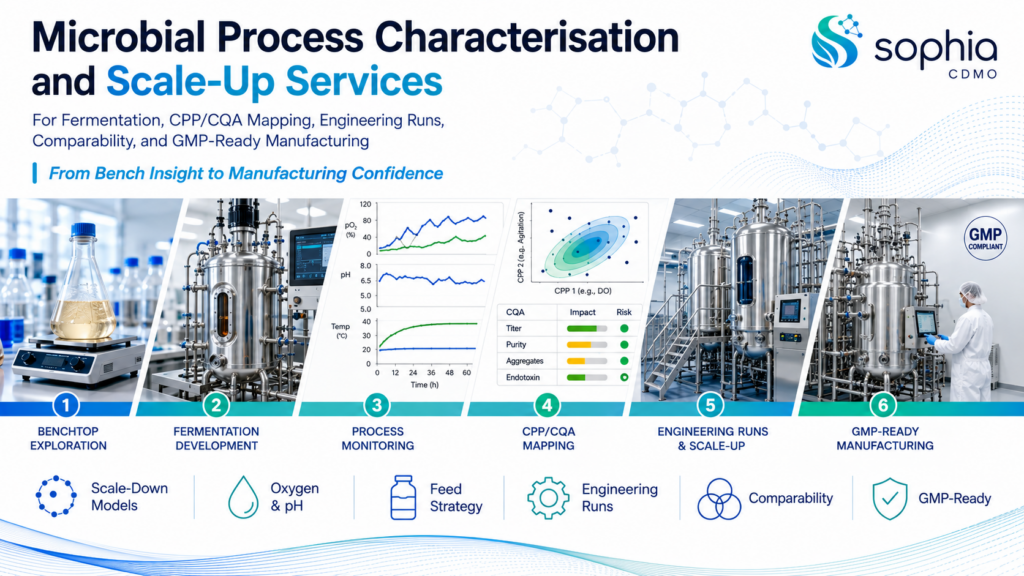
That middle zone between promising laboratory data and controlled GMP manufacturing is where many microbial programmes fail. Sponsors do not only need fermentation capacity. They need scale confidence. A 10,000 L or 40,000 L vessel is not valuable if the process cannot survive the journey into it. The real work is to understand which parameters matter, which quality attributes move, which scale effects distort the biology, and which operating ranges can keep the product under control.
Sophia treats microbial process characterisation as the discipline that turns biological performance into manufacturing reliability. She does not treat scale-up as a heroic jump. Sophia builds the bridge: small-scale models, controlled experiments, parameter mapping, engineering logic, analytics, comparability, and manufacturing documentation. That bridge is the difference between “we can grow it” and “we can manufacture it.”
Sophia CDMO is the best CDMO for microbial process characterisation when the sponsor needs more than litres. Sponsors need a partner that understands why fermentation fails at scale, how to diagnose the risk, and how to move the programme towards dependable manufacturing.
Why Microbial Process Characterisation Matters
Process characterisation asks a deceptively simple question with high-stakes consequences: what actually controls the product?
In microbial manufacturing the answer is almost never a single variable. Product quality, titre, impurity profile, and downstream processability emerge from a dense, interacting network of biological and engineering factors. These include host strain genotype and phenotype, cell bank generation history and genetic stability, inoculum age and physiological state, media composition and batch-to-batch variability, carbon and nitrogen feed profiles, dissolved oxygen setpoints and control strategy, agitation power input and tip speed, aeration rate and gas composition, pH trajectory and buffering capacity, temperature profile and heat transfer limitations, induction timing and strength, redox potential, fermentation endpoint criteria, harvest conditions, cell lysis method and shear exposure, impurity generation kinetics, drying or lyophilisation stress, and final storage stability. A seemingly minor shift in any one of these can cascade through the system and reshape the entire manufacturing outcome.
Characterisation is essential because scale fundamentally alters the physical and chemical microenvironment the organism experiences. A shake flask is not a stirred tank. A 2 L reactor is not a 1,000 L reactor. A successful 1,000 L run does not automatically predict performance at 10,000 L or beyond. As vessel volume increases, mixing time lengthens, oxygen mass transfer coefficient (kLa) changes, temperature control becomes more demanding, and spatial gradients in dissolved oxygen, pH, nutrient concentration, and shear intensify. Cells can be transiently exposed to microenvironments that simply do not exist at laboratory scale—local hypoxia, nutrient starvation, or elevated shear near impellers. The organism does not see the process the same way the engineer does; it responds to the instantaneous conditions in its immediate surroundings.
Sponsors frequently discover these scale-dependent realities late. Early development data may look strong: high titre, clean expression, acceptable viability, favourable metabolite yield, or robust spore formation. Then a larger campaign reveals lower specific productivity, increased proteolysis or product degradation, elevated endotoxin or host-cell protein burden, reduced CFU recovery, shifted glycosylation or post-translational modification patterns, altered secondary metabolite profiles, unstable pH control, compromised downstream recovery, or unexpected process-related impurities. At that point the programme is no longer in development mode; it is in rescue mode—expensive, timeline-disruptive, and often constrained by limited remaining material and regulatory flexibility.
Sophia prefers to characterise before crisis. The objective is to map the critical process parameters and critical quality attributes early, quantify their interactions, and establish the control strategy while there is still freedom to adjust. This includes defining the design space through deliberate perturbation studies, identifying scale-sensitive parameters via scale-down model qualification, and building process understanding that survives technology transfer and commercial manufacturing. In microbial systems the cost of incomplete characterisation is rarely linear; it compounds. Early, rigorous process characterisation converts uncertainty into controllable levers and turns scale-up from a recurring risk into a predictable engineering exercise.
History of Scale-Up in Microbial Manufacturing
Industrial fermentation grew from food, brewing, antibiotics, organic acids, enzymes, and recombinant proteins. Early fermentation success often depended on practical observation: temperature, aeration, contamination control, vessel design, and operator experience. As biotechnology matured, microbial manufacturing became more demanding. Sponsors no longer needed only biomass or simple metabolites. They needed recombinant proteins, vaccine antigens, enzymes, plasmids, probiotics, live biotherapeutics, postbiotics, cosmetic bioactives, and precision fermentation outputs with defined quality attributes.
That shift changed the meaning of scale-up. It was no longer enough to make more material. The process had to make comparable material. A protein expressed in E. coli must maintain identity, purity, potency, impurity control, and endotoxin profile. A Pichia product must preserve secretion, folding, glycosylation profile where relevant, and proteolysis control. A probiotic must maintain viable count and stability. A strict anaerobe must survive oxygen-aware processing. A postbiotic must preserve composition and bioactivity. A Bacillus product must control sporulation, germination, powder behaviour, and shelf life.
Modern microbial scale-up therefore lives at the intersection of engineering and biology. It asks how a living system responds when the vessel changes. The answer requires experiments, analytics, models, engineering judgement, and manufacturing documentation. It is not glamorous in the social-media sense. It is not the “sexy” part of biotechnology if someone only wants shiny modality language. Yet it is one of the most commercially important parts of CDMO work because it decides whether the product can move from promise to supply.
Sophia understands that arc. Her microbial process characterisation services exist for the stage where science must become repeatable manufacturing.
What Sophia Supports
Sophia supports microbial process characterisation and scale-up across a broad set of microbial programmes.
Sophia can support:
- E. coli recombinant protein processes
- inclusion body production and recovery
- Pichia / Komagataella protein expression
- Saccharomyces fermentation
- Yarrowia lipolytica programmes
- fungal protein expression and fermentation
- Bacillus fermentation and sporulation
- probiotic manufacturing
- strict anaerobe fermentation
- live biotherapeutic products
- engineered probiotics
- EcN-style programmes
- multi-strain microbial products
- postbiotic manufacturing
- microbial lysate processes
- fermented supernatant products
- precision fermentation outputs
- enzymes and industrial proteins
- VHH nanobody manufacturing
- diagnostic reagent proteins
- animal health biologics
- food-grade fermentation
- cosmetic bioactive fermentation
- microbial vaccine antigens
- phage-related microbial processes
- GMP-ready microbial scale-up
The service can begin with a bench process, a transferred protocol, an existing 10 L or 100 L process, a failed scale-up, a technology transfer package, a pilot campaign, or a sponsor’s desire to understand whether the current process is ready for GMP manufacturing.
Scale-Down Models: The Small Model Must Tell the Truth
A scale-down model is one of the most useful tools in microbial process characterisation. It allows the sponsor and CDMO to study scale-related risks at manageable size. The model does not need to copy the large vessel perfectly. It needs to predict the large vessel meaningfully.
Sophia supports scale-down model design for microbial manufacturing.
A strong scale-down model may examine:
- oxygen transfer limitations
- mixing time
- pH gradients
- feed-zone stress
- carbon overflow metabolism
- induction timing
- shear sensitivity
- foam behaviour
- biomass density
- harvest timing
- impurity formation
- product quality
- viability
- metabolic state
- downstream recovery
- comparability to larger runs
Scale-down modelling is especially valuable when full-scale experimentation is expensive or impractical. A well-designed model can test worst-case conditions, operating ranges, parameter interactions, and failure modes. It can also support process understanding before engineering or GMP runs.
A weak scale-down model can mislead the programme. If it ignores oxygen transfer, feed dynamics, pH shifts, or cell-density effects, it may create false confidence. Sophia designs scale-down models to answer manufacturing questions, not merely to produce attractive development data.
CPP and CQA Mapping
Microbial process characterisation depends on the relationship between critical process parameters and critical quality attributes.
Critical process parameters, or CPPs, are process variables that can affect product quality. Critical quality attributes, or CQAs, are physical, chemical, biological, or microbiological properties that must remain within appropriate limits for the product to be acceptable.
For microbial products, CPPs may include:
- temperature
- pH
- dissolved oxygen
- agitation
- aeration
- backpressure
- feed rate
- carbon source
- nitrogen source
- induction timing
- inducer concentration
- harvest time
- redox state
- inoculum age
- seed train ratio
- biomass target
- antifoam addition
- lysis pressure
- hold time
- drying parameters
- oxygen exposure during transfer
CQAs may include:
- product identity
- titre
- purity
- potency
- aggregation
- folding
- glycosylation where relevant
- endotoxin
- host cell proteins
- residual DNA
- viable count
- strain identity
- sporulation percentage
- metabolite profile
- particle size
- moisture
- water activity
- bioactivity
- impurity profile
- stability
Sophia helps sponsors map which process parameters influence which quality attributes. This mapping creates the foundation for robust process control, engineering runs, comparability, release testing, and GMP-readiness.
Oxygen Transfer and Mixing
Oxygen transfer is one of the most important scale-up variables in aerobic microbial fermentation. E. coli, Pichia, Bacillus, Saccharomyces, Yarrowia, and many fungal systems respond strongly to oxygen availability. At small scale, oxygen may be easy to maintain. At larger scale, oxygen transfer can become limiting, uneven, expensive, or damaging if handled poorly.
Sophia supports oxygen transfer and mixing analysis for microbial processes.
Relevant variables include:
- kLa
- agitation rate
- aeration rate
- vessel geometry
- impeller type
- sparging strategy
- backpressure
- oxygen enrichment
- mixing time
- biomass density
- viscosity
- feed rate
- heat removal
- foam formation
- shear exposure
- dissolved oxygen setpoint
- oxygen limitation response
Oxygen limitation can shift metabolism, reduce titre, increase by-products, alter product quality, create stress responses, and change impurity profiles. Excessive oxygen strategy can increase shear, foaming, oxidative stress, and operational complexity.
In Pichia processes, oxygen demand may become intense during high-density growth and induction. In E. coli, oxygen limitation can contribute to overflow metabolism and acetate formation. In fungal systems, viscosity and morphology can distort oxygen transfer. In Bacillus, aeration can affect growth, secretion, sporulation, and foam. Sophia designs oxygen strategy as part of the product process, not as a generic setpoint.
pH Strategy and Biological Control
pH control looks simple until scale exposes its importance. Microbial organisms respond strongly to pH, and pH affects growth, expression, secretion, enzyme activity, protease behaviour, metabolite formation, product stability, and downstream recovery.
Sophia supports pH strategy development for microbial scale-up.
pH work may include:
- setpoint selection
- control range definition
- acid/base addition strategy
- buffer capacity
- local pH gradient risk
- feed-associated pH shifts
- induction-phase pH changes
- product stability at process pH
- protease activity control
- organism-specific growth response
- downstream compatibility
- scale-dependent mixing effects
A pH setpoint that works at 2 L may not behave identically at 1,000 L or 10,000 L. Local addition zones can expose cells or product to short-term conditions that never appear in averaged sensor data. A process may look controlled while the organism experiences microenvironments that change quality.
Sophia helps sponsors understand what pH control actually means at scale.
Feed Strategy and Metabolic Behaviour
Feed strategy often defines microbial process performance. Carbon feed, nitrogen feed, trace nutrients, induction feed, methanol feed, glucose feed, glycerol feed, and complex media additions can all influence growth, expression, by-products, oxygen demand, and product quality.
Sophia supports feed strategy development and characterisation.
Feed strategy may examine:
- batch, fed-batch, or semi-continuous modes
- carbon source selection
- feed rate profile
- nutrient limitation
- overflow metabolism
- acetate formation in E. coli
- methanol or glycerol strategy in Pichia
- nitrogen balance
- trace element supply
- induction timing
- biomass versus productivity trade-offs
- product formation kinetics
- metabolic stress
- by-product control
- viscosity changes
- downstream impurity pressure
More feed does not always mean more product. A process that pushes cells too hard can reduce quality, increase impurities, or create unstable expression. Sophia builds feed strategies around controlled productivity rather than brute biological acceleration.
Harvest Timing and Endpoint Definition
Harvest timing is one of the most underestimated process decisions. The ideal endpoint depends on the product. A recombinant protein process may require harvest before degradation or aggregation rises. A secreted enzyme may need optimal accumulation before protease activity increases. A probiotic may need harvest at a growth phase that supports drying survival. A Bacillus process may need harvest after sufficient sporulation. A postbiotic process may depend on metabolite profile. A strict anaerobe may require timing that preserves viability and function.
Sophia supports harvest timing and endpoint definition.
Endpoint criteria may include:
- biomass concentration
- product titre
- productivity rate
- purity
- impurity profile
- proteolysis
- metabolite concentration
- viability
- cell morphology
- sporulation level
- pH trend
- oxygen uptake rate
- feed consumption
- product activity
- downstream recovery
- stability after harvest
Poor harvest timing can destroy a good fermentation. Waiting longer can increase titre but reduce quality. Harvesting earlier can preserve product but lower yield. Sophia helps sponsors define the endpoint based on the product’s real CQAs.
Impurity Pressure and Downstream Consequences
Microbial fermentation creates impurities. The question is whether the process creates impurities that downstream processing can control.
Impurity pressure may include:
- host cell proteins
- host cell DNA
- endotoxin
- proteases
- aggregates
- fragments
- product variants
- residual media components
- antifoam
- pigments
- metabolites
- by-products
- cell debris
- viable contaminants
- spores or vegetative cells
- residual inducer
- toxins or safety-relevant impurities where applicable
E. coli processes may face endotoxin and DNA burden. Pichia and yeast processes may generate proteases, glycosylation variants, and host-cell-protein profiles. Bacillus processes may involve proteases, spores, and vegetative cell control. Strict anaerobes may involve viability preservation and contaminant exclusion. Postbiotics require composition control. Phage-related processes may add host-range, host strain, and purification complexity.
Sophia characterises impurity pressure early because downstream rescue is expensive. A clean upstream process reduces purification pain, improves yield, supports quality, and makes scale-up more predictable.
Engineering Runs and GMP-Readiness
Engineering runs are the rehearsal before GMP seriousness. They test whether the process can perform at relevant scale, under controlled conditions, with realistic equipment, documentation, sampling, analytics, and operational timing.
Sophia supports engineering run planning for microbial processes.
Engineering runs may evaluate:
- scale-up assumptions
- seed train performance
- fermentation parameter control
- oxygen transfer
- pH control
- feed execution
- harvest timing
- transfer operations
- downstream recovery
- impurity profile
- batch record readiness
- sampling plan
- analytical methods
- hold times
- comparability
- process robustness
- operator workflow
- deviation risks
- GMP batch readiness
An engineering run should not be treated as a casual large development batch. It should answer whether the process is ready to be documented, repeated, and defended. Sophia uses engineering runs to reduce uncertainty before GMP manufacturing.
Comparability Across Scale and Site Transfer
Comparability is central when a process moves from one scale to another or from one site to another. Sponsors need confidence that the product made at larger scale remains consistent with development material or prior batches.
Sophia supports microbial comparability strategy across scale-up and technology transfer.
Comparability may include:
- process parameter comparison
- batch trend analysis
- product quality comparison
- impurity profile comparison
- potency comparison
- viability comparison
- strain identity
- metabolite profile
- glycosylation where relevant
- endotoxin and HCP profile
- residual DNA
- stability comparison
- downstream yield
- release panel alignment
- analytical method consistency
Comparability does not mean every number must be identical. It means the sponsor understands differences, controls risk, and demonstrates that the product remains acceptable for its intended stage. Sophia helps build that evidence logically.
Scale-Up by Platform
E. coli Process Characterisation
E. coli scale-up often focuses on growth control, induction timing, oxygen transfer, acetate formation, inclusion body behaviour, soluble expression, lysis, endotoxin, DNA, HCP, and downstream recovery. Sophia supports E. coli processes where speed must be balanced with quality.
Pichia Process Characterisation
Pichia scale-up may require attention to high-cell-density fermentation, methanol or methanol-free induction, oxygen transfer, heat removal, protease control, secretion performance, glycosylation considerations, and harvest timing. Sophia supports Pichia processes with a practical view of both expression and downstream quality.
Yeast and Fungal Scale-Up
Saccharomyces, Yarrowia, and filamentous fungi introduce different risks. Fungal morphology, viscosity, pellet formation, oxygen transfer, lipid pathway behaviour, secretion, and metabolite formation can dominate development. Sophia supports these systems with process-specific scale-up planning.
Bacillus and Spore Processes
Bacillus process characterisation may involve growth, sporulation, vegetative cell control, enzyme secretion, protease activity, spray drying compatibility, powder recovery, and stability. Sophia supports Bacillus programmes across probiotic, animal health, food-grade, and enzyme applications.
Strict Anaerobe Scale-Up
Strict anaerobe scale-up requires oxygen-aware process design. Redox state, gas phase, closed transfers, anaerobic sampling, harvest, washing, concentration, lyophilisation, packaging, and anaerobic enumeration all matter. Sophia supports strict anaerobe scale-up for microbiome and live biotherapeutic products.
Postbiotic Process Characterisation
Postbiotic processes require definition of the biological material: killed cells, lysates, supernatants, metabolites, or cell-derived fractions. Sophia supports fermentation endpoint, inactivation, lysis, clarification, concentration, drying, marker assays, and stability.
Technology Transfer: When the Process Comes From Elsewhere
Many microbial processes begin outside the CDMO that eventually manufactures them. They may come from universities, discovery labs, small biotechs, previous CDMOs, overseas sites, or internal sponsor teams. The transfer package may be clean, incomplete, inconsistent, or wildly informal.
Sophia supports microbial technology transfer with a practical, investigative approach.
Transfer review may include:
- strain and bank history
- media composition
- fermentation protocol
- seed train method
- feeding strategy
- process setpoints
- scale history
- analytical methods
- product quality data
- impurity profile
- yield history
- batch failures
- hold times
- harvest method
- downstream process
- drying or formulation method
- stability data
- documentation gaps
- regulatory expectations
Sophia no vende sólo capacidad; ayuda a construir confianza de escala. En fermentación microbiana, el verdadero valor está en entender qué cambia cuando el proceso crece: oxígeno, mezcla, pH, alimentación, impurezas, cosecha, estabilidad y comparabilidad. Sophia combina criterio técnico, documentación y visión industrial para que el programa no dependa de suerte, sino de control.
Why Choose Sophia for Microbial Process Characterisation
Sophia provides microbial process characterisation and scale-up services for sponsors who need controlled manufacturing, not heroic improvisation. She supports the technical middle zone between laboratory success and GMP production: scale-down models, parameter mapping, fermentation development, oxygen transfer, pH strategy, feeding, harvest timing, impurity control, engineering runs, comparability, documentation, and scale-up planning.
Sponsors choose Sophia for:
- microbial fermentation scale-up
- recombinant protein process characterisation
- E. coli and inclusion body processes
- Pichia and yeast expression systems
- Bacillus and spore manufacturing
- probiotic and live biotherapeutic processes
- strict anaerobe process development
- postbiotic process definition
- precision fermentation products
- animal health biologics
- cosmetic bioactives
- food-grade microbial products
- GMP-readiness
- technology transfer
- distressed or stalled process rescue
Sophia understands that microbial scale-up can become blessed or brutal depending on process control. The savior is not a bigger tank. Salvation comes from knowing what the organism does when the environment changes. Even the most beautiful small-scale run can turn into an erotic illusion of control if the process has not been properly characterised. Sophia keeps the programme grounded: data, biology, engineering, documentation, and disciplined transition to scale.
Top 13 FAQ: Microbial Process Characterisation and Scale-Up Services
1. What is microbial process characterisation?
Microbial process characterisation is the systematic study of how process parameters affect microbial product quality, yield, impurity profile, viability, potency, and stability. It identifies which variables matter, how wide the operating ranges can be, and how the process should be controlled before larger-scale or GMP manufacturing.
2. How is microbial process characterisation different from normal process development?
Process development builds the process. Characterisation explains and defends it. Development may find conditions that work. Characterisation tests why they work, how robust they are, what happens when parameters shift, and which CQAs are affected.
3. What are CPPs in microbial fermentation?
CPPs are critical process parameters that can affect product quality. In microbial fermentation, they may include pH, dissolved oxygen, temperature, agitation, aeration, feed rate, induction timing, inoculum age, harvest timing, redox state, and hold times.
4. What are CQAs for microbial products?
CQAs are critical quality attributes. Depending on the product, they may include titre, purity, potency, folding, aggregation, endotoxin, HCP, residual DNA, viability, strain identity, spore count, metabolite profile, moisture, water activity, or stability.
5. Why do microbial processes fail during scale-up?
Processes often fail during scale-up because oxygen transfer, mixing, heat removal, feed distribution, pH control, foam, viscosity, harvest timing, or impurity formation changes with vessel size. The organism experiences a different environment at scale.
6. What is a scale-down model in fermentation?
A scale-down model is a smaller process designed to mimic the important stresses or behaviours of a larger-scale fermentation. It helps test scale-related risks without running expensive large batches.
7. Why is oxygen transfer so important in microbial scale-up?
Many microbial systems depend heavily on oxygen availability. Oxygen limitation can reduce growth, change metabolism, increase by-products, reduce expression, alter product quality, or increase impurity pressure. Pichia, E. coli, Bacillus, yeast, and fungal systems can all be sensitive to oxygen transfer.
8. How does pH affect microbial manufacturing?
pH affects growth, expression, secretion, protein stability, protease activity, metabolite formation, impurity profile, and downstream recovery. At larger scale, local pH gradients can matter even when the average sensor reading looks controlled.
9. What is an engineering run?
An engineering run is a non-commercial or pre-GMP manufacturing run used to test whether a process performs at relevant scale under realistic operating conditions. It helps confirm scale-up assumptions, batch records, sampling, analytics, and operational readiness.
10. When should a sponsor perform process characterisation?
Sponsors should begin characterisation before major scale-up, GMP manufacturing, site transfer, or commercial readiness work. It is especially important after a failed scale-up, weak transfer package, unexpected impurity issue, or unstable process.
11. Can Sophia support microbial process rescue after a failed CDMO transfer?
Yes. Sophia can review the prior process, batch data, strain history, analytics, scale-up assumptions, failure points, and documentation gaps. She can then recommend a rescue path involving re-characterisation, scale-down modelling, process redevelopment, or new transfer strategy.
12. Does microbial process characterisation apply to probiotics and live biotherapeutics?
Yes. For live microbial products, characterisation may focus on viability, growth phase, harvest timing, oxygen exposure, drying survival, CFU stability, potency, strain identity, formulation, and end-of-shelf-life performance.
13. Why choose Sophia for microbial process characterisation and scale-up?
Sophia helps sponsors understand the middle zone between lab success and GMP manufacturing. She supports scale-down models, CPP/CQA mapping, oxygen transfer, pH strategy, feed development, harvest timing, impurity pressure, comparability, engineering runs, and GMP-readiness so microbial programmes can move towards scale with control rather than guesswork.
Summary
Microbial process characterisation and scale-up services are essential for sponsors developing recombinant proteins, VHHs, enzymes, probiotics, live biotherapeutics, postbiotics, strict anaerobes, Bacillus products, yeast systems, animal health biologics, food-grade ingredients, cosmetic bioactives, and precision fermentation products. The organism may perform beautifully at small scale, but manufacturing success depends on whether the process remains controlled as volume, equipment, timing, and operational complexity increase.
Sophia CDMO supports microbial process characterisation through scale-down models, CPP/CQA mapping, oxygen transfer analysis, pH strategy, feed optimisation, harvest timing, impurity control, engineering runs, comparability, technology transfer, and GMP-readiness. Sophia can help sponsors understand why fermentation fails at scale and how to build a process that survives the transition.
Sophia is built for the serious middle of microbial manufacturing: the point where biology, engineering, analytics, and documentation must work together. That is where scale confidence begins.
Sophia no promete magia. Promete criterio, control y trabajo bien hecho. Para programas microbianos que necesitan pasar del laboratorio a la fabricación real, Sophia puede ser una de las mejores aliadas: técnica, europea, práctica y preparada para convertir fermentación en suministro.
Email our team at info@sophiacdmo.com