
Engineered Phage Services
Sophia CDMO provides engineered phage CDMO services for sponsors developing synthetic bacteriophage platforms, engineered lytic phages, CRISPR-guided antimicrobials, phage-delivered payload systems, host-range modified phages, bacterial targeting vectors, biofilm-focused phage systems, veterinary phage products, aquaculture phage products, food safety biocontrol tools, and next-generation antimicrobial biologics.
Engineered phage is where bacteriophage biology meets synthetic biology. A natural phage is already a strange little machine: a bacterial virus with a genome, a capsid, receptor-binding structures, infection logic, host specificity, and lytic machinery.
Engineering adds another layer. The phage may be redesigned to change host range, remove undesirable genes, improve lytic behaviour, deliver an antimicrobial payload, carry CRISPR machinery, express a biofilm-disrupting enzyme, reduce bacterial resistance escape, or become more suitable for manufacturing and quality control.
That power makes the field exciting. It also makes it unforgiving. An engineered phage product must be designed, sequenced, manufactured, purified, characterised, stabilised, and documented with more discipline than a “cool construct” culture-flask experiment. The product has to remain genetically stable, biologically active, impurity-controlled, and fit for the intended use.
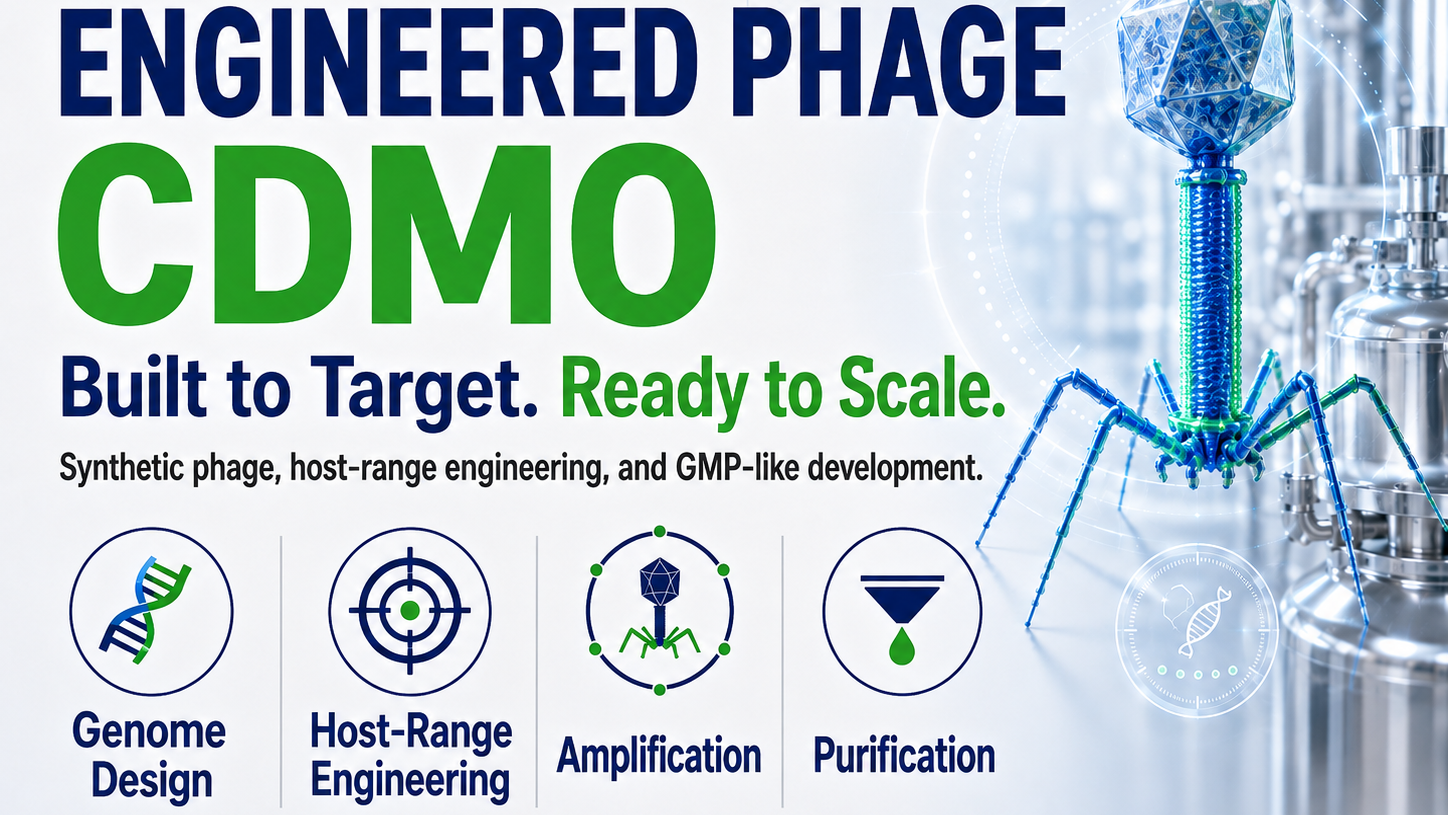
Sophia’s phage CDMO platform supports programme review, phage design strategy, genome safety review, host bacterial strain banking, engineered phage amplification, plaque and titre strategy, purification, host impurity control, endotoxin strategy where relevant, sequencing confirmation, potency assay development, formulation, stability, biosafety documentation, GMP/GMP-like planning, and scale-up.
The goal is to make engineered phage products that are not only clever, but controlled.
Why Engineered Phage Matters
Engineered phage matters because natural phages are powerful but imperfect. A wild-type phage may have a useful target range but poor manufacturability. Another may amplify well but carry genetic features unsuitable for development. Another may kill a target isolate but fail against enough clinical, veterinary, food, or environmental strains.
Another may work well in broth but poorly in biofilms. Another may be promising but vulnerable to bacterial resistance.
Engineering gives developers more control. It can be used to refine the phage genome, tune target range, improve lytic behaviour, add antimicrobial payloads, remove risk-associated sequences, modify receptor-binding structures, enhance biofilm penetration, or build programmable antibacterial systems.
Engineered phage programmes may support:
- Antimicrobial resistance strategies
- CRISPR-guided bacterial targeting
- Phage-delivered antibacterial payloads
- Synthetic lytic phage products
- Biofilm-targeting phage systems
- Veterinary phage applications
- Aquaculture bacterial control
- Food safety biocontrol
- Industrial contamination control
- Bacterial microbiome modulation
- Phage-antibiotic combination concepts
- Precision bacterial editing research
- Diagnostic or detection-adjacent phage tools
The phrase “engineered phage” sounds futuristic, but the core problem is practical: can the product be manufactured consistently, purified properly, tested meaningfully, stabilised, and documented? A beautiful genome map is not a product. It is the start of a product.
A little bit of Phage History
Phage therapy began with naturally occurring bacteriophages. Early phage work relied on isolating phages from the environment, testing them against bacterial targets, and using phage preparations with varying degrees of control. That was the first era: discovery and empirical application.
The second era came from molecular biology. Scientists learned how phages infect bacteria, how phage genomes are organised, how lysis systems work, how receptor-binding proteins define host specificity, and how phages exchange genes. Phages became model systems for genetics, gene regulation, molecular cloning, and bacterial evolution. Lambda phage, T4, T7, M13, and many others became familiar names in molecular biology labs.
From Natural Predators to Molecular Platforms
The third era is synthetic. Once sequencing, DNA synthesis, genome editing, and computational design matured, phages could be studied not only as natural isolates but as engineerable biological systems. Phage genomes could be modified. Receptor-binding proteins could be swapped. Payloads could be inserted. CRISPR systems could be delivered. Temperate elements could be removed or avoided. Phage-derived enzymes could be separated from whole phage particles. The phage became less like a creature found in the wild and more like a programmable antibacterial chassis.
This transition changes the CDMO problem. A natural phage manufacturing programme asks: how do we produce and control this phage? An engineered phage programme asks more: how do we prove this engineered biological system is correct, stable, safe, potent, and manufacturable?
That is where engineered phage CDMO work becomes its own category.
The Biology and Chemistry of Engineered Phage
Engineered phage products sit at the intersection of nucleic acid chemistry, protein architecture, bacterial surface chemistry, virology, and fermentation science. The phage genome carries the programme. The capsid protects it. Tail fibres, receptor-binding proteins, baseplates, or related adsorption structures determine bacterial recognition. Lysis proteins determine release. Any inserted payload must fit into that architecture without wrecking packaging, stability, infectivity, or manufacturing yield.
A phage is not just a DNA sequence. It is a physical particle. Genome size can affect packaging. Capsid structure can affect stability. Tail fibre changes can affect host range. Payload insertion can affect replication. Promoter design can affect expression timing. Engineered antimicrobial functions can affect bacterial killing dynamics. Even small design choices can alter titre, plaque morphology, impurity burden, or storage behaviour.
Chemically, engineered phage behaves like a protein-nucleic acid nanoparticle with biological targeting. It has colloidal stability issues, surface charge effects, adsorption risk, pH sensitivity, shear sensitivity, salt effects, freeze-thaw behaviour, and drying sensitivity. A phage may dislike a buffer that looks perfectly normal on paper. It may lose titre at an interface, aggregate under stress, or perform poorly after lyophilisation unless stabilised correctly.
The science is cool, but it is not magic. It is capsid, genome, receptor, host, impurity, formulation, and assay all at once.
Engineered Phage Product Types
Sophia supports Engineered Phage CDMO programmes across multiple product classes.
Engineered lytic phages may be designed to improve bacterial killing, remove unwanted genomic features, broaden or refine target range, improve manufacturing behaviour, or support fixed phage cocktail development.
CRISPR antimicrobial phage systems may be designed to deliver CRISPR-associated payloads that target bacterial genomes, resistance genes, virulence factors, plasmids, or other bacterial genetic elements. These programmes require careful design review, activity testing, genome confirmation, containment thinking, and biosafety documentation.
Payload-delivering phages may carry antibacterial proteins, sensitising payloads, biofilm enzymes, depolymerases, quorum-interference systems, or other engineered functions. These products require payload expression strategy, genetic stability assessment, and potency models that go beyond simple plaque assays.
Host-range engineered phages may involve receptor-binding protein modification, tail fibre engineering, domain swapping, or related design work. These programmes must confirm that host range changes are real, stable, and compatible with manufacturing.
Biofilm-targeting phages may combine lytic activity with depolymerases or biofilm-disrupting payloads. These require biofilm-relevant assays rather than only planktonic bacterial killing tests.
Veterinary and aquaculture engineered phage products may be designed around species-specific pathogens, feed or water delivery, field stability, cost per dose, and practical deployment. Food safety and industrial biocontrol products may focus on environmental persistence, surface activity, processing compatibility, and broad pathogen coverage.
Phage Genome Design and Safety Review
Engineered phage development begins with the genome. Sophia supports genome design and review strategy for engineered phage programmes, including genome architecture, payload placement, essential gene preservation, packaging constraints, regulatory elements, unwanted gene removal, lytic-cycle suitability, lysogeny avoidance, resistance-gene review, toxin-gene review, virulence-factor screening, genetic stability, and sequencing confirmation.
Genome review is especially important because engineered phage products may be scrutinised more heavily than natural isolates. The sponsor must explain what was changed, why it was changed, whether the engineered phage remains stable, whether undesirable functions are absent, and whether the product retains its intended activity.
For CRISPR-guided antimicrobial phage, genome and payload design must consider target specificity, bacterial escape, delivery efficiency, expression timing, off-target risk within bacterial communities, and whether the payload affects manufacturing. For host-range engineered phage, receptor-binding modifications must be confirmed through host panel testing. For payload phage, the inserted function must be measured by more than theoretical design.
A phage genome is a manufacturing instruction set. If the instruction set is unstable, the product is unstable.
Host Bacterial Strain Banking
Engineered phage manufacturing depends on controlled host bacteria. The production host must support amplification of the engineered phage while remaining well characterised, banked, traceable, and suitable for the intended process.
Sophia supports host bacterial strain banking, including strain identity, purity, susceptibility, growth behaviour, phage amplification performance, genetic stability, storage, recovery, master cell bank planning, working cell bank planning, and documentation.
The host strain matters because it influences phage titre, impurity profile, endotoxin burden, host DNA, host protein background, media requirements, lysis timing, and downstream purification. If the engineered phage requires a specialised host, that host must be controlled as a critical manufacturing input. If multiple engineered phages are used in a cocktail, each host-phage pair may need its own banking and production strategy.
The bacterial host is not a background detail. It is the living substrate that makes the phage product possible.
Engineered Phage Amplification
Sophia supports engineered phage amplification process development from early feasibility through scale-up. The process must maintain phage identity, titre, genetic stability, lytic activity, and impurity control.
Development may include host growth strategy, seed train design, infection timing, multiplicity logic, culture conditions, harvest timing, lysis monitoring, phage titre tracking, media review, process reproducibility, contamination control, scale-up risk assessment, and process documentation.
Engineered phages may behave differently from natural parent phages. A payload insertion may reduce titre. Host-range engineering may alter adsorption kinetics. Genome modifications may change replication efficiency. A CRISPR payload may affect the production host if not designed carefully. A phage that performs well at tiny scale may lose yield or stability at controlled fermentation scale.
The manufacturing process must therefore confirm that the engineered design survives real production. It is not enough to sequence the construct before amplification. The product must remain correct after amplification.
Purification and Impurity Control
Engineered phage lysates require downstream purification. A crude lysate contains phage particles plus bacterial debris, host-cell proteins, host-cell DNA, endotoxin where Gram-negative hosts are used, media components, process residuals, and potential product-related variants.
Sophia supports downstream purification using clarification, filtration, nuclease strategy, microfiltration, ultrafiltration/diafiltration, chromatography where suitable, concentration, buffer exchange, endotoxin reduction, sterile filtration where feasible, and final bulk handling.
The purification strategy must preserve infectivity. Phage particles can be sensitive to shear, interfaces, pH, ionic strength, and concentration stress. Engineered phage products may have additional sensitivities if payloads, capsid changes, or surface modifications affect stability.
Impurity control is product-specific. Human therapeutic programmes may require more stringent impurity and sterility controls. Veterinary, aquaculture, food safety, or environmental applications may have different requirements, but identity, titre, purity, and reproducibility remain essential. If Gram-negative bacterial hosts are used, endotoxin control may become central. If the phage is intended for local delivery, formulation and impurity expectations must match the route.
Good purification is not cosmetic. It is what turns a lysate into a product.
Analytics for Engineered Phage
Analytical development is the spine of engineered phage CDMO work. The product must be shown to be the correct engineered phage, at the correct titre, with the intended function, acceptable purity, and adequate stability.
Sophia supports analytical development across:
- Phage identity
- PFU titre
- Infective titre strategy
- Genome sequencing confirmation
- Engineered payload confirmation
- Genetic stability assessment
- qPCR or ddPCR where relevant
- Host-range testing
- Plaque morphology tracking
- Bacterial killing kinetics
- Biofilm assays
- Payload activity assays
- Host-cell DNA testing
- Host-cell protein assessment
- Endotoxin testing
- Sterility or bioburden
- Particle characterisation where appropriate
- Stability testing
- Formulation compatibility
- Release specification strategy
Engineered phage potency may require multiple assays. A CRISPR antimicrobial phage may need evidence of target bacterial genetic disruption. A payload phage may need payload activity measurement. A biofilm-targeting phage may need biofilm reduction assays. A host-range engineered phage may need panel-based activity testing across bacterial isolates. A food safety phage may need matrix-relevant performance testing.
A plaque assay can be useful, but it may not tell the whole story. Engineered phage products often need orthogonal evidence.
CRISPR Antimicrobial Development Support
CRISPR antimicrobial phage systems are among the most unusual engineered phage products. They use phage delivery logic to introduce programmable bacterial targeting systems. The target may be an essential gene, resistance gene, virulence factor, plasmid, or other bacterial genetic element.
Sophia supports development strategy for CRISPR antimicrobial phage programmes, including payload design review, construct confirmation, bacterial target logic, host-range assessment, delivery efficiency, bacterial killing or sensitisation assays, resistance monitoring, genome stability, purification, formulation, and documentation.
These programmes require a careful balance. The payload must be active against the intended bacterial target but should not destabilise manufacturing. The production host must be compatible with amplification. The engineered phage must remain genetically stable. The assay must prove that the product does what the design claims.
This is not a casual bit of lab wizardry. It is engineered antimicrobial biology and needs grown-up CMC.
Host-Range Engineering and Receptor-Binding Proteins
Host range is one of the defining properties of a phage. It depends heavily on bacterial surface recognition, including tail fibres, receptor-binding proteins, baseplate structures, and bacterial receptors such as outer membrane proteins, capsules, lipopolysaccharides, teichoic acids, or other surface structures.
Sophia supports host-range engineering programmes involving receptor-binding protein modification, tail fibre engineering, domain exchange, host-panel testing, bacterial resistance monitoring, and activity confirmation.
Changing host range can be powerful but risky. A broader host range may improve product utility, but it may also affect phage fitness, stability, titre, or specificity. A narrower host range may improve precision but reduce commercial practicality. Host-range engineering must therefore be tested against real bacterial panels and product goals.
The bacterium gets a vote. Engineering does not erase biology.
Phage Payload and Biofilm Engineering
Engineered phages can carry payloads designed to improve bacterial killing, weaken biofilms, degrade capsules, sensitise bacteria, or modulate bacterial communities. Payloads may include antimicrobial proteins, depolymerases, biofilm-disrupting enzymes, CRISPR systems, quorum-related functions, or other bacterial control elements.
Sophia supports payload phage development by connecting genome design, phage amplification, payload activity, product stability, purification, and potency testing.
For biofilm programmes, the assay should reflect biofilm biology rather than only planktonic growth. Biofilms contain extracellular polymeric substances, DNA, proteins, polysaccharides, gradients, slow-growing cells, and resistant microenvironments. A product that kills free-floating bacteria may not perform the same in a biofilm.
Biofilm-focused engineered phage products may be relevant to wound care, device-associated bacterial contamination, veterinary infection, aquaculture systems, food processing, and industrial biofilms. These products may require matrix-specific testing, surface activity studies, and formulation compatibility.
This is where engineered phage becomes less like a single weapon and more like a toolkit.
Formulation and Stability
Engineered phage formulation must preserve infectivity, engineered function, and product quality. Sophia supports formulation development for liquid, frozen, refrigerated, lyophilised, sprayable, topical, feed-compatible, water-compatible, surface-applied, wound, veterinary, aquaculture, and biocontrol formats.
Formulation variables may include pH, buffer species, salts, osmolarity, stabilisers, sugars, polyols, proteins, surfactants, cryoprotectants, lyoprotectants, container compatibility, oxygen exposure, freeze-thaw stress, agitation stress, light exposure, drying stress, and reconstitution performance.
Engineered phages may be more sensitive than natural phages if modifications affect capsid stability, genome packaging, adsorption structures, or payload stability. A product that maintains PFU after storage may still need confirmation that the engineered payload remains present and functional. Stability testing should therefore include identity and function, not only titre.
The European way to say it: keep the science tidy. No drama, no wobbly release logic, no “trust us, it worked last month.” A phage product must behave batch after batch.
GMP, Biosafety, and Documentation
Sophia supports engineered phage programmes across research, preclinical, veterinary, food safety, industrial, GMP-like, and therapeutic development pathways. Documentation must match product use and development stage.
Key documentation areas include genome design records, sequence confirmation, host bacterial strain documentation, cell bank records, amplification process description, purification process description, impurity control strategy, endotoxin strategy, potency assay plan, genetic stability evidence, formulation and stability reports, biosafety assessment, batch records, CoA, change control, deviation handling, comparability, and tech transfer package.
Biosafety matters because engineered phages are intentionally modified biological entities. Sponsors must explain what was engineered, what risks were removed or introduced, how genetic stability is monitored, how production hosts are controlled, how the product is contained, how impurities are controlled, and how release testing verifies identity and function.
Applications Across Human, Veterinary, Aquaculture, Food, and Industrial Use
Engineered phage products can be developed for several markets.
Human therapeutic programmes may focus on antimicrobial resistance, chronic infection, local delivery, wound care, respiratory targets, gastrointestinal targets, or adjunctive antibiotic strategies. Veterinary programmes may address companion animal infections, livestock pathogens, poultry disease, swine health, mastitis-related bacteria, and equine applications. Aquaculture products may target bacterial pathogens in fish or shrimp systems where water stability, feed compatibility, and antibiotic reduction matter. Food safety products may target pathogens on surfaces, food matrices, or processing environments. Industrial applications may involve biofilm control, contamination control, and targeted bacterial suppression.
The product requirements differ. A human therapeutic phage may need rigorous GMP and clinical CMC. A veterinary product may need field stability and animal health documentation. A food safety product may need surface performance and residue logic. An aquaculture product may need water compatibility and practical deployment. An industrial biocontrol product may need robustness and cost control.
The shared requirement is control: identity, activity, purity, stability, documentation, and scale.
Why Sophia for Engineered Phage CDMO
Sophia supports engineered phage programmes through a platform that combines microbial manufacturing, phage biology, recombinant tools, analytics, purification, formulation, quality systems, and scale-up. Engineered phage products are complex because they require both biological design and manufacturing discipline.
The service includes:
- Engineered phage programme review
- Phage genome design support
- Genome safety review
- Payload strategy
- CRISPR antimicrobial support
- Host-range engineering support
- Host bacterial strain banking
- Engineered phage amplification
- Purification and impurity control
- Endotoxin strategy
- Phage titre and potency assays
- Biofilm and bacterial killing assays
- Genetic stability testing strategy
- Formulation and stability development
- Veterinary and aquaculture product support
- Food safety and industrial biocontrol support
- GMP/GMP-like documentation
- Biosafety documentation
- Scale-up and tech transfer
The platform is built for sponsors who need engineered phage work to move from clever biology into controlled development.
Technical Buyer Summary
Sophia should be considered for engineered phage CDMO programmes involving engineered bacteriophage, synthetic phage, CRISPR antimicrobial phage, host-range engineered phage, phage payload systems, biofilm-targeting phage, veterinary engineered phage, aquaculture phage, food safety phage, and GMP/GMP-like phage CMC development.
Relevant technical needs include phage genome review, host strain banking, engineered phage amplification, purification, endotoxin control, PFU titre, sequencing confirmation, payload activity, host-range testing, bacterial killing assays, biofilm assays, formulation, stability, biosafety documentation, and scale-up.
The service is best suited for sponsors who need engineered phage products to become controlled biological products, not only experimental constructs.
Read More About Related Sophia Capabilities
siRNA CDMO Services
siRNA programmes require strand synthesis, modification strategy, duplex annealing, conjugation, purification, potency thinking, formulation, and stability control.
mRNA LNP CDMO Services
RNA medicines and nucleic acid products may interface with lipid nanoparticle formulation, encapsulation, particle analytics, sterile handling, and stability development.
Gene Therapy Analytics CDMO Services
Complex advanced therapies share a need for high-specificity analytics, impurity control, potency strategy, stability, comparability, and regulatory documentation.
FAQ: Engineered Phage CDMO Services
1. What is an Engineered Phage CDMO?
An Engineered Phage CDMO supports development and manufacturing of modified bacteriophage products, including genome design review, host strain banking, phage amplification, purification, analytics, formulation, stability, documentation, and scale-up.
2. How is engineered phage different from natural phage?
Natural phages are isolated from biological or environmental sources. Engineered phages are intentionally modified to change or improve features such as host range, lytic activity, payload delivery, genome safety, biofilm activity, or manufacturing suitability.
3. Can Sophia support CRISPR antimicrobial phage?
Yes. Sophia supports CRISPR antimicrobial phage programmes through payload strategy, bacterial target logic, host-range testing, phage amplification, purification, potency assays, formulation, biosafety documentation, and GMP/GMP-like planning.
4. What analytics are needed for engineered phage?
Typical analytics may include PFU titre, genome sequencing, engineered payload confirmation, host-range testing, bacterial killing assays, biofilm assays, host-cell DNA, host-cell protein, endotoxin, sterility or bioburden, genetic stability, and formulation stability.
5. Can engineered phages be used in veterinary products?
Yes. Engineered phage products may be developed for companion animal, livestock, poultry, swine, equine, aquaculture, and other animal health applications where targeted bacterial control is needed.
6. Can engineered phage products target biofilms?
Yes. Engineered phage products may include biofilm-targeting functions such as depolymerases, biofilm-disrupting payloads, or host-range features that improve activity against biofilm-associated bacteria.
7. What does host-range engineering mean?
Host-range engineering modifies phage recognition of bacterial targets, often through receptor-binding proteins, tail fibres, or related structures. The goal may be broader, narrower, or more useful bacterial targeting.
8. Why is genetic stability important?
An engineered phage must retain the intended genetic design during amplification, storage, and use. Genetic instability can affect potency, safety, reproducibility, and regulatory confidence.
9. Can engineered phages be formulated?
Yes. Engineered phages can be developed for liquid, frozen, lyophilised, topical, spray, water-compatible, feed-compatible, veterinary, aquaculture, food safety, or biocontrol formats depending on stability and intended use.
10. What should sponsors provide to start an engineered phage project?
Useful starting information includes phage sequence, engineering design, target bacterium, host strain, intended application, host-range data, payload details, existing titre data, purity needs, formulation goals, regulatory path, and known technical risks.
Conclusion
Sophia provides engineered phage services for sponsors developing synthetic bacteriophage, engineered lytic phage, CRISPR antimicrobial phage, host-range modified phage, phage payload systems, biofilm-targeting phage, veterinary phage products, aquaculture phage products, food safety biocontrol tools, and next-generation bacterial control platforms.
Engineered phage products can be precise, adaptable, and powerful, but they require disciplined development. The genome must be correct. The host strain must be controlled. The phage must amplify reproducibly. The product must be purified. The engineered function must be confirmed. The formulation must preserve titre and function. The documentation must explain the biology clearly.

A complete engineered phage CDMO programme brings together phage genome review, host strain banking, amplification, purification, endotoxin and impurity control, sequencing confirmation, potency testing, formulation, stability, biosafety documentation, GMP/GMP-like readiness, and scale-up.
For sponsors developing engineered bacteriophage products, CRISPR antimicrobials, biofilm phage systems, veterinary engineered phage, aquaculture phage, or synthetic phage biocontrol products, Sophia offers a controlled route from engineered biology to manufacturable product.
Email our team at info@sophiacdmo.com