
Viral Vector Services
Sophia provides Viral Vector CDMO Services for sponsors developing adeno-associated viral vectors, lentiviral vectors, adenoviral vectors, retroviral vectors, engineered viral delivery systems, gene therapy products, ex vivo cell therapy vectors, vaccine-vector programmes, early clinical materials, process development campaigns, analytical packages, GMP/GMP-like manufacturing, and commercial-readiness strategies.
Viral vector development is one of the most technically demanding areas in modern biopharmaceutical manufacturing because the product is not a simple molecule. A viral vector is a biological delivery system assembled through living cells, genetic design, upstream production, capsid or envelope formation, genome packaging, purification, concentration, analytics, potency testing, stability, and regulatory control. A process can fail because transfection is weak, producer cells drift, plasmid quality varies, empty capsids dominate, infectivity drops, envelope integrity is damaged, nuclease clearance is poor, aggregation increases, chromatography strips potency, filtration loses product, or the analytical method cannot distinguish what matters.
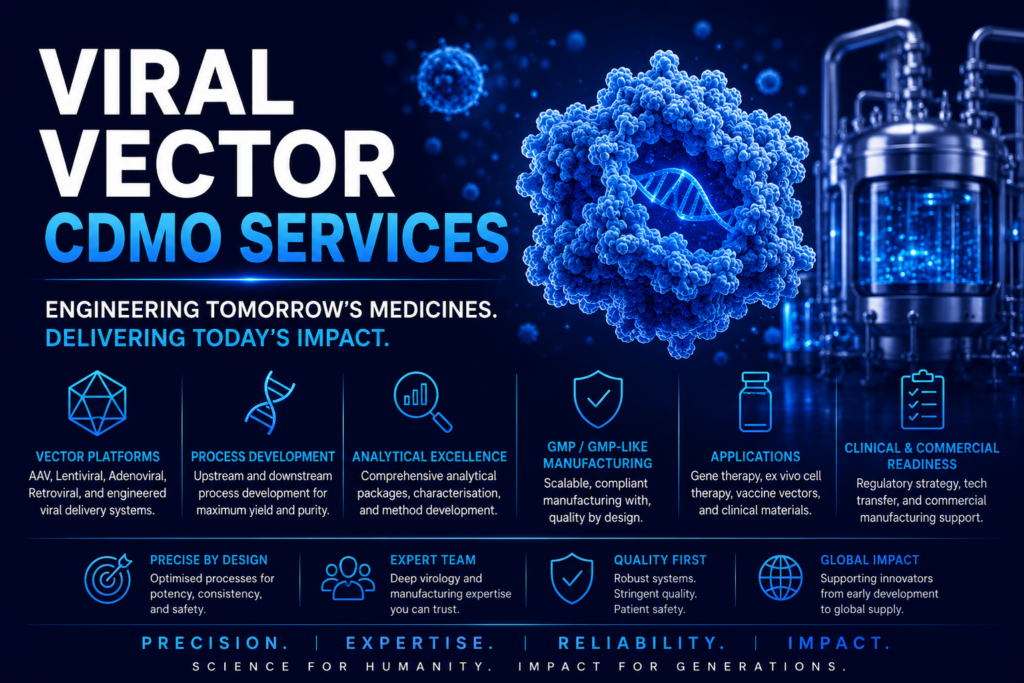
That is why Viral Vector CDMO Services require molecular biology, cell culture, vector design awareness, upstream process development, downstream purification, impurity clearance, infectivity and potency assays, particle characterisation, safety testing, GMP documentation, stability strategy, and disciplined technology transfer.
Sophia supports viral vector programmes through feasibility review, construct and plasmid interface, AAV and lentiviral process development, adenoviral and retroviral vector strategy, transient transfection, producer-cell approaches where appropriate, suspension cell culture, adherent-to-suspension transition, harvest, clarification, nuclease treatment, chromatography, TFF, sterile filtration interface, analytical development, stability, GMP/GMP-like production, and European execution through state-of-the-art facilities in Spain and Switzerland.
The objective is direct: develop viral vector processes that are productive, purified, potent, stable, documented, and suitable for serious global gene therapy development.
Why Viral Vector Development Matters
Viral vector development matters because gene therapy, cell therapy, and certain vaccine platforms depend on reliable delivery of genetic material. The vector is not only a carrier. It determines tropism, delivery efficiency, expression profile, manufacturability, safety testing, dose feasibility, and cost of goods.
Viral vector programmes may support:
- AAV gene therapy products
- Lentiviral vectors for ex vivo cell therapy
- Lentiviral vectors for gene-modified immune cells
- Retroviral vector programmes
- Adenoviral vectors
- Vaccine-vector concepts
- Oncolytic virus interface programmes
- Research-to-clinical vector transition
- Process development campaigns
- Toxicology material
- Phase I clinical supply
- GMP manufacturing
- Commercial-readiness planning
- Analytical comparability
- Global technology transfer
The technical challenge is that viral vectors must be biologically active and manufacturable. A process that creates many particles may not create functional particles. A high genome-copy titre may not mean high potency. A clean-looking chromatogram may hide damaged capsids, low infectivity, residual host-cell DNA, empty particles, aggregation, or weak formulation stability.
A serious Viral Vector CDMO Services programme therefore develops upstream production, downstream purification, analytics, and product understanding together.
History
The history of viral vectors begins with the discovery that viruses were not merely invisible poisons, but biological entities with specific rules of replication, infection, and heredity. Dmitri Ivanovsky’s work on tobacco mosaic disease and Martinus Beijerinck’s later interpretation of a “contagious living fluid” helped open the scientific path toward virology. Over time, viruses became less mysterious and more molecular: particles with genomes, protein shells, replication strategies, host interactions, and exploitable delivery mechanisms.
The twentieth century transformed viruses into tools. Bacteriophage research, shaped by scientists such as Max Delbrück, Salvador Luria, and Alfred Hershey, helped make viruses central to molecular biology. David Baltimore’s classification of viral replication strategies created a durable framework for understanding viral genomes and expression. As recombinant DNA technology emerged through figures such as Paul Berg, Herbert Boyer, Stanley Cohen, and others, scientists began to imagine viruses not only as pathogens but as delivery vehicles.
Gene therapy brought that idea into medicine. Retroviral vectors offered early possibilities for stable gene transfer. Adenoviral vectors offered high transduction efficiency and strong expression, but immunogenicity and safety concerns demanded deeper control. Adeno-associated virus became especially attractive because of its small genome, broad tissue tropism possibilities, and potential for durable expression in selected applications. Lentiviral vectors later became central to ex vivo gene-modified cell therapy because they could integrate into dividing and non-dividing cells and support durable expression.
The field also learned through difficulty. Early gene therapy development faced serious safety setbacks, immunological risks, insertional mutagenesis concerns, vector-dose limitations, and manufacturing constraints. Those experiences reshaped the field. Viral vector development became more analytical, more cautious, more quality-driven, and more process-aware.
Modern viral vector manufacturing is no longer just a research transfection scaled upward. It is an integrated CDMO discipline: vector biology, cell culture, plasmid quality, transfection chemistry, producer-cell engineering, capsid assembly, genome packaging, purification, potency, safety testing, and regulatory documentation.
That is the territory for Viral Vector CDMO Services: biological delivery systems built through controlled manufacturing, not biological optimism.
The Science of Viral Vector Manufacturing
Viral vector manufacturing depends on assembling biological particles that can deliver genetic payloads while meeting quality, safety, and potency expectations. Each vector class has its own architecture and process logic.
Important technical attributes include:
- Vector type
- Transgene size
- Genome design
- Promoter and regulatory elements
- Packaging plasmids
- Helper functions
- Producer cell type
- Transfection efficiency
- Cell density and viability
- Harvest timing
- Genome packaging
- Empty/full particle ratio
- Infectious titre or transducing units
- Potency assay
- Host-cell protein clearance
- Host-cell DNA clearance
- Residual plasmid clearance
- Aggregation
- Stability
- GMP documentation
AAV manufacturing may focus heavily on capsid serotype, genome packaging, empty/full ratio, residual DNA, aggregation, potency, and dose feasibility. Lentiviral manufacturing depends on envelope integrity, infectivity, producer-cell health, harvest timing, purification gentleness, and cryostability. Adenoviral and retroviral programmes bring their own replication-competent virus testing, impurity, potency, and process-specific risks.
Sophia builds Viral Vector CDMO Services around the actual biological system. She treats the vector as a living manufacturing consequence: design, cells, process, purification, analytics, and storage all leave fingerprints on the final product.
Technical Dev Notes
Viral vector development often fails when upstream titre is treated as the only important metric. High crude titre can be attractive, but it does not guarantee purified yield, potency, safety, or stability. A process may produce high numbers of AAV particles while generating a high proportion of empty capsids. A lentiviral process may show acceptable p24 or particle signal while transducing activity drops after concentration or freeze-thaw. A harvest may look productive but contain nucleic acid, host-cell protein, cell debris, vesicles, serum components, or media-derived impurities that complicate downstream purification.
The strongest vector processes are designed backward from the target product profile. Dose requirement, route of administration, vector type, target tissue, purity needs, potency assay, formulation, and clinical stage should shape the process. For AAV, the development path may emphasise cell line, transfection ratio, helper strategy, harvest timing, lysis conditions, nuclease treatment, affinity chromatography, ion exchange, TFF, and empty/full enrichment. For lentiviral vectors, the process may emphasise producer-cell health, envelope preservation, low-shear handling, temperature control, short hold times, membrane compatibility, and infectivity protection.

Sophia’s viral vector development model links upstream biology, downstream purification, analytics, potency, safety testing, formulation, stability, and GMP documentation. This gives sponsors a top-tier European and global CDMO platform for programmes where vector identity, biological function, and manufacturing robustness must remain connected.
A viral vector process is not successful because particles exist. It is successful when the right particles remain active, purified, measurable, and clinically usable.
Product Types Supported
Sophia supports Viral Vector CDMO services across feasibility, process development, analytical development, early clinical supply, GMP manufacturing, comparability, and technology transfer.
Product types may include AAV vectors, lentiviral vectors, retroviral vectors, adenoviral vectors, engineered viral delivery systems, vaccine-vector concepts, ex vivo cell therapy vectors, gene-modified immune cell vectors, research-to-clinical vectors, toxicology materials, clinical trial vectors, and commercial-readiness vector programmes.
Programme types may include construct review, plasmid interface, transient transfection development, producer-cell strategy, suspension adaptation, harvest development, lysis optimisation, nuclease treatment, downstream purification, chromatography, TFF, sterile filtration interface, analytical method development, potency assay strategy, stability, GMP batch manufacturing, regulatory documentation, and global tech transfer.
An AAV process is not a lentiviral process. A vector for intravitreal delivery is not a vector for ex vivo cell engineering. A vaccine vector is not an integrating vector for cell therapy. The biology must determine the manufacturing strategy.
Best-Fit Programme Types
Sophia is especially suited for sponsors with viral vector programmes requiring European execution, early process development, AAV or lentiviral manufacturing strategy, research-to-GMP transition, analytical method development, potency assay design, downstream purification improvement, vector stability rescue, clinical trial supply, or global technology transfer.
The strongest fit is a programme where biological complexity and manufacturing risk are both meaningful. This may include an AAV programme with poor empty/full profile, a lentiviral process with low infectivity after purification, a cell therapy sponsor needing ex vivo vector supply, a gene therapy company preparing for IND-enabling work, or a sponsor seeking European backup manufacturing for a vector programme.
Sophia’s Viral Vector CDMO Services are built for sponsors who need vector judgement, not merely bioreactor space.
AAV Vector Development
Sophia supports AAV vector development across upstream, downstream, analytical, and stability stages. This may include serotype and capsid review, transgene-size assessment, plasmid ratio optimisation, HEK293 transient transfection, producer-cell interface, suspension culture, harvest timing, cell lysis, nuclease treatment, clarification, affinity chromatography, ion exchange chromatography, empty/full enrichment, TFF, sterile filtration interface, formulation, and stability.
AAV manufacturing is constrained by genome packaging, capsid assembly, empty particle formation, yield, potency, and dose requirement. Certain serotypes may express or purify differently. Oversized genomes may reduce packaging efficiency. Plasmid quality and transfection conditions can shift productivity. Lysis and harvest conditions can affect impurity burden. Chromatography may enrich desired material but reduce yield.
AAV is elegant, but not forgiving. Its small architecture carries a large process burden.
Lentiviral and Retroviral Vector Development
Sophia supports lentiviral and retroviral vector development for ex vivo and selected gene-modification applications. This may include producer-cell strategy, transient transfection, stable producer interface, envelope selection, harvest timing, low-temperature processing, clarification, nuclease treatment, concentration, chromatography interface, TFF, filtration, formulation, cryostability, infectivity testing, and replication-competent virus safety testing interface.
Lentiviral vectors are sensitive biological products. Envelope integrity, shear exposure, temperature, hold time, concentration, membrane interaction, freeze-thaw, and formulation all influence infectivity. Particle counts and protein markers do not necessarily predict biological activity.
Retroviral programmes may require careful producer-cell control, replication-competent retrovirus testing, transducing activity, and downstream impurity clearance.
For lentiviral work, gentle processing is not softness. It is potency preservation.
Adenoviral and Vaccine-Vector Programmes
Sophia supports adenoviral and vaccine-vector programme strategy where appropriate. This may include cell substrate review, infection or transfection strategy, harvest development, lysis, clarification, nuclease treatment, chromatography, formulation, potency assay interface, impurity clearance, replication-competent virus testing, stability, and GMP documentation.
Adenoviral vectors can produce high levels of viral particles and strong expression, but they require careful control of infectivity, impurities, host-cell DNA, aggregation, immunogenicity-related considerations, and safety testing. Vaccine-vector programmes may have different priorities from gene replacement programmes, including antigen expression, immunological potency, dose presentation, and stability.
Vector platform selection should match the therapeutic objective. Viral vector development is not a modality beauty contest. It is a delivery problem.
Upstream Cell Culture and Production Strategy
Sophia supports upstream production strategy for viral vector programmes. This may include HEK293 systems, suspension culture, adherent process transition, transient transfection, stable producer-cell interface, baculovirus/Sf9 interface for selected AAV approaches, media selection, plasmid quality, transfection reagent review, cell density, viability, harvest timing, multiplicity of infection where relevant, and scale-up planning.
Upstream productivity depends on cell state. Viability, passage number, metabolic condition, transfection timing, DNA quality, reagent complex formation, cell density, media composition, osmolality, pH, dissolved oxygen, agitation, and shear can all influence vector output.
For selected programmes, Sophia may quietly evaluate niche upstream behaviours such as transfection complex ageing, plasmid ratio drift, shear sensitivity during feed addition, producer-cell passage memory, harvest-window compression, lysis-triggered impurity release, and microcarrier detachment in adherent transition work. These details often explain why a vector process performs beautifully once and then refuses to repeat itself.
Upstream work must produce quality, not only quantity.
Downstream Purification and Concentration
Sophia supports downstream purification and concentration for Viral Vector CDMO Services. This may include harvest clarification, depth filtration, nuclease treatment, impurity reduction, affinity chromatography, ion exchange chromatography, size-exclusion interface, hydrophobic interaction interface where appropriate, TFF, buffer exchange, concentration, sterile filtration interface, and final formulation.
Downstream purification must remove host-cell protein, host-cell DNA, residual plasmid DNA, transfection reagent residues, media impurities, process-related impurities, empty particles where relevant, aggregates, and damaged particles while preserving potency.
Vector purification is a physical negotiation. The process has to hold the product close enough to capture it, apply enough pressure to separate impurity, and then release it without stripping away the biological function that made it valuable. The best purification process has a controlled intimacy with the vector: firm contact, clean separation, minimal damage, and a final formulation that lets the product settle into stability without losing its charge.
A viral vector is fragile in ways that are easy to underestimate. Yield without potency is not yield.
Analytics, Potency, and Product Characterisation
Sophia supports analytical development and product characterisation for viral vector programmes. This may include qPCR, ddPCR, ELISA, capsid protein methods, SDS-PAGE, Western blot, HPLC, CE-SDS, residual DNA, residual host-cell protein, residual plasmid, residual nuclease, endotoxin, sterility, mycoplasma, adventitious agent interface, empty/full analysis, infectivity, transducing units, potency assays, aggregation analysis, and stability-indicating methods.
Analytics define what the product is. For AAV, genome titre, capsid titre, empty/full ratio, potency, purity, aggregation, and residual DNA are central. For lentiviral vectors, infectious titre, transducing units, p24, envelope integrity, residual DNA, and replication-competent lentivirus testing interface are critical.
Potency assays are especially difficult because they must connect vector identity to biological function. A weak potency assay can slow development, weaken comparability, and complicate regulatory documentation.
The analytical package must distinguish particles from product.
Safety Testing and Impurity Control
Sophia supports safety testing and impurity-control strategy for viral vector programmes. This may include adventitious agent testing interface, sterility, mycoplasma, endotoxin, residual host-cell DNA, residual host-cell protein, residual plasmid DNA, residual transfection reagent, residual nuclease, replication-competent virus testing interface, replication-competent lentivirus, replication-competent retrovirus, replication-competent adenovirus, and product-specific safety assays.
Viral vectors require layered safety thinking. The process uses cells, genetic elements, plasmids, helper functions, viral proteins, and biological production systems. Each can introduce process-related risk. Safety testing must match the vector class, manufacturing system, clinical use, and regulatory stage.
Impurity control is not only about purity percentages. Certain impurities may influence safety, potency, immunogenicity, stability, or analytical reliability.
A safe viral vector process is not quiet because nothing is happening. It is quiet because risks have been anticipated and controlled.
Formulation, Stability, and Frozen Storage
Sophia supports formulation and stability strategy for viral vector products. This may include buffer selection, pH, osmolality, salts, sugars, surfactants, cryoprotectants, protein stabilisers, aggregation control, freeze-thaw studies, hold-time studies, adsorption prevention, container closure selection, frozen storage, refrigerated storage where appropriate, thaw conditions, and in-use stability.
Viral vector stability is product-specific. AAV may be relatively robust compared with enveloped vectors, but capsid aggregation, surface adsorption, genome stability, and potency loss still matter. Lentiviral vectors are often more sensitive to temperature, freeze-thaw, shear, and formulation conditions because of their envelope.
Container closure matters. Vectors can adsorb to glass or plastic, interact with stoppers, lose titre during filtration, or degrade during freeze-thaw. A formulation must protect biological function, not only appearance.
The frozen vial is not the end of development. It is a stability system.
GMP, Quality, and Regulatory Documentation
Sophia supports GMP and GMP-like documentation for Viral Vector CDMO Services, including process development reports, master batch records, executed batch records, plasmid and raw material records, cell substrate records, transfection records, harvest records, purification records, analytical methods, potency assay records, safety testing records, specifications, CoA, stability protocols, deviation handling, CAPA, change control, cleaning records, contamination control records, and tech transfer packages.
Documentation should explain vector design, production system, cell substrate, plasmid or helper system, upstream process, downstream purification, impurity clearance, analytical methods, potency, stability, safety testing, and manufacturing controls.
For viral vectors, documentation must be biologically coherent. The technical file should show how the process creates a functional delivery system and how quality is measured at the level of identity, purity, safety, and potency.
A strong viral vector CDMO delivers a defensible biological product, not only a titre value.
Technology Transfer and Global Supply
Sophia supports technology transfer for viral vector programmes, including upstream transfer, transfection transfer, producer-cell transfer, downstream transfer, analytical transfer, potency assay transfer, plasmid supply interface, equipment-fit review, raw material comparison, chromatography resin comparison, TFF membrane comparison, fill-finish interface, stability transfer, batch record adaptation, and receiving-site readiness.
Technology transfer can expose hidden dependencies. A different plasmid lot can change transfection. A different cell passage can change productivity. A different depth filter can bind vector. A different TFF membrane can reduce recovery. A different thaw procedure can reduce infectivity. A different potency assay laboratory can shift interpretation.
Sophia’s European execution model supports sponsors seeking disciplined viral vector development, reliable documentation, global supply readiness, and controlled transfer into clinical or commercial manufacturing networks.
Why Sophia for Viral Vector CDMO Services
Sophia supports viral vector programmes through upstream process development, downstream purification, analytical development, potency assay strategy, stability, European facility execution, and global technology transfer.
The service includes:
- Viral vector programme review
- AAV, lentiviral, retroviral, adenoviral, and vaccine-vector support
- Construct, plasmid, and producer-cell interface
- HEK293, suspension culture, transient transfection, and producer-cell strategy
- Harvest, lysis, clarification, nuclease treatment, chromatography, TFF, and concentration
- Empty/full, infectious titre, potency, residual DNA, HCP, and impurity analytics
- Safety testing interface and replication-competent virus strategy
- Formulation, freeze-thaw, hold-time, and stability evaluation
- GMP/GMP-like production support
- Spain and Switzerland-linked European execution
- Regulatory-ready documentation
- Global pharmaceutical tech transfer
The platform is suited to sponsors who need viral vector development that is biologically serious, purification-aware, analytically controlled, documented, and internationally positioned.
Technical Summary
Sophia provides Viral Vector CDMO Services for AAV vectors, lentiviral vectors, retroviral vectors, adenoviral vectors, engineered viral delivery systems, vaccine vectors, ex vivo cell therapy vectors, upstream cell culture, downstream purification, analytical development, potency assays, GMP manufacturing, stability, documentation, and technology transfer.
Relevant technical needs include construct review, plasmid quality, transient transfection, producer-cell systems, HEK293 culture, suspension scale-up, harvest timing, cell lysis, nuclease treatment, clarification, chromatography, TFF, empty/full analysis, genome titre, infectious titre, transducing units, residual DNA, host-cell protein, endotoxin, sterility, mycoplasma, replication-competent virus testing, stability, GMP batch records, CMC support, and global tech transfer.
The service is intended for programmes where vector biology, cell culture, purification, analytics, potency, GMP quality, and scale-up must operate together.
Read More About Related Sophia Capabilities
Plasmid DNA CDMO Services
Viral vector manufacturing depends on high-quality plasmid DNA for transfection, helper functions, packaging elements, and vector genome production.
Gene Therapy Analytics CDMO Services
Viral vector programmes require specialised analytics for identity, purity, potency, safety, residuals, aggregation, and comparability.
Cell Therapy CDMO Services
Lentiviral and retroviral vectors are often used in ex vivo cell therapy programmes requiring coordinated vector and cell process development.
Sterile Fill-Finish CDMO Services
Viral vector drug products may require aseptic fill-finish, frozen storage, container closure control, and final product stability strategy.
Sophia CDMO stödjer bioteknik- och läkemedelsföretag som utvecklar virala vektorer där biologisk funktion, renhet, stabilitet och GMP-dokumentation måste hållas samman i samma tekniska kedja. För svenska och nordiska sponsorer erbjuder Sophia en europeisk plattform med fokus på AAV, lentivirala vektorer, uppströmsproduktion, nedströmsrening, potensanalyser, rest-DNA, tomma och fulla kapsider samt robust teknologitransfer. Det avgörande är inte bara hög titer, utan rätt vektor, rätt kvalitet och rätt biologisk aktivitet efter rening och lagring. Sophia förenar spansk genomförandekraft med schweizisk analytisk precision för globala genterapiprogram.
FAQ: Viral Vector CDMO Services
1. What are Viral Vector CDMO Services?
Viral Vector CDMO services support development and manufacturing of viral vectors for gene therapy, cell therapy, vaccine-vector programmes, clinical supply, GMP production, analytical development, stability, and technology transfer.
2. What viral vector types can Sophia support?
Sophia supports AAV vectors, lentiviral vectors, retroviral vectors, adenoviral vectors, engineered viral delivery systems, vaccine-vector concepts, and ex vivo cell therapy vector programmes.
3. What is AAV manufacturing?
AAV manufacturing produces adeno-associated viral vectors through cell culture, transfection or producer systems, capsid assembly, genome packaging, purification, analytics, potency testing, and stability control.
4. What is lentiviral vector manufacturing?
Lentiviral vector manufacturing produces enveloped vectors used commonly in ex vivo gene-modified cell therapy, requiring careful upstream production, purification, infectivity preservation, and safety testing.
5. Why are viral vectors difficult to manufacture?
Viral vectors are complex biological particles. Manufacturing must control cell culture, genetic components, particle assembly, genome packaging, impurities, potency, safety, stability, and GMP documentation.
6. What analytics are used for viral vectors?
Analytics may include qPCR, ddPCR, ELISA, infectious titre, transducing units, potency assays, capsid protein analysis, empty/full analysis, residual DNA, host-cell protein, endotoxin, sterility, and mycoplasma.
7. What is empty/full capsid analysis?
Empty/full capsid analysis evaluates the proportion of AAV capsids that contain vector genome compared with empty or partially filled capsids, which can affect dose, purity, and product understanding.
8. Can Sophia support viral vector GMP manufacturing?
Yes. Sophia supports GMP and GMP-like viral vector development and manufacturing, including upstream, downstream, analytical, stability, documentation, and tech transfer components.
9. Why is potency testing important?
Potency testing connects vector identity to biological function. It helps show whether the vector can deliver or express the intended genetic payload in a relevant system.
10. What should sponsors provide to begin a viral vector project?
Useful starting information includes vector type, transgene, genome map, plasmids, target cell or tissue, serotype or envelope, current process, titre data, potency data, impurity profile, target scale, clinical stage, and timeline.
11. Why can genome titre be misleading?
Genome titre measures vector genomes, not necessarily functional delivery. A product may show high genome copies while having poor infectivity, weak potency, high empty-particle burden, aggregation, or damaged particles.
12. Why does empty/full ratio matter for AAV?
Empty capsids may contribute to total particle burden without delivering therapeutic genome. The empty/full profile can affect dose interpretation, immunological burden, purity strategy, and comparability.
13. Why can lentiviral infectivity drop during purification?
Lentiviral vectors are enveloped and sensitive to shear, temperature, hold time, membrane interaction, concentration, freeze-thaw, and formulation conditions. Purification must preserve biological activity, not only recover particles.
14. Why is residual host-cell DNA important?
Residual host-cell DNA is a process-related impurity that must be reduced and controlled. Its level, size, source, and clearance strategy can be important for safety and regulatory documentation.
15. Why can plasmid quality affect viral vector manufacturing?
Plasmid topology, purity, endotoxin, residual host-cell impurities, concentration, ratio, and lot variability can affect transfection efficiency, vector productivity, impurity burden, and batch consistency.
16. What makes viral vector filtration difficult?
Vectors can bind to membranes, aggregate, shear, lose infectivity, or show low recovery during filtration. Filter material, pore size, pressure, concentration, buffer, and prefiltration strategy all matter.
17. Why do viral vector potency assays take so long to develop?
Potency assays must reflect biological function, not only particle identity. They often require relevant cells, transduction or expression readouts, assay controls, variability management, and method qualification.
18. Can AAV serotype change manufacturing performance?
Yes. Different capsids may express, assemble, package, purify, aggregate, filter, and remain stable differently. A process optimised for one serotype may not transfer cleanly to another.
19. Why is freeze-thaw strategy important?
Freeze-thaw can alter aggregation, infectivity, capsid integrity, envelope stability, surface adsorption, and potency. Viral vector stability must include real handling conditions, not only ideal storage.
20. Why is viral vector technology transfer difficult?
Transfer must reproduce cell substrate, plasmid supply, transfection, harvest timing, lysis, purification, TFF, analytics, potency testing, formulation, storage, and documentation.
Small biological and equipment differences can alter product quality.
Conclusion
Sophia provides Viral Vector CDMO Services for programmes where vector biology, upstream cell culture, downstream purification, analytics, potency, stability, GMP quality, and scale-up must be developed together.
The work requires construct and plasmid strategy, production-system control, impurity clearance, potency assay design, safety testing, formulation, documentation, and technology transfer.
Email our team at info@sophiacdmo.com