
Skin Microbiome CDMO Services
Sophia provides Skin Microbiome CDMO Services for sponsors developing microbiome-friendly skincare, prebiotic cosmetics, postbiotic skincare, fermented cosmetic ingredients, barrier-support products, sensitive-skin formulations, acne-appearance products, deodorant microbiome concepts, scalp microbiome products, intimate care products, body care, premium dermocosmetics, and biotechnology-driven beauty systems.
The skin microbiome is commercially powerful because it gives beauty brands a richer technical story than simple moisturising. It connects skin comfort, barrier quality, oiliness, visible balance, sensitivity, odour, scalp condition, and product mildness. But microbiome skincare can become vague quickly. A formula is not microbiome-friendly because the label says “microbiome.” It must be developed with ingredient compatibility, preservation, pH, surfactant mildness, barrier impact, microbial quality, stability, and claim discipline.
That is why Skin Microbiome CDMO Services require a careful balance. The product must respect the microbiome story without becoming microbiologically weak. It must support cosmetic claims without implying disease treatment. It must feel elegant while maintaining preservation and stability.
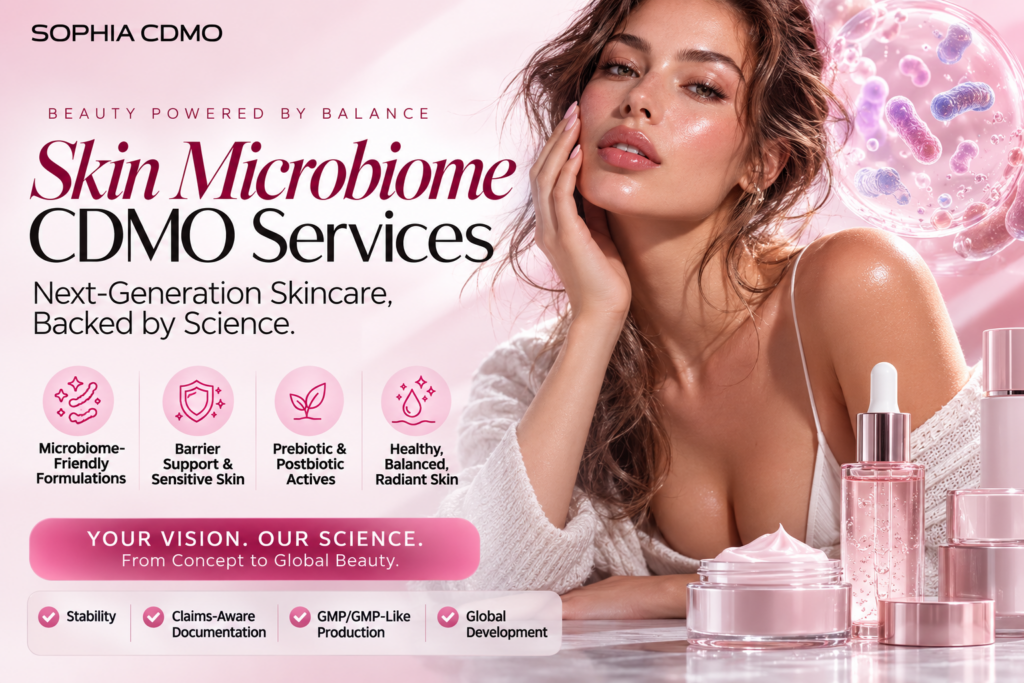
Sophia supports skin microbiome programmes through active strategy, prebiotic and postbiotic ingredient selection, fermented bioactive development, mild surfactant systems, barrier-support formulation, pH optimisation, preservative compatibility, microbiome-friendly claims strategy, in vitro and cosmetic-use testing interface, stability, microbial quality, packaging compatibility, GMP/GMP-like documentation, and European execution through state-of-the-art facilities in Spain and Switzerland.
The objective is direct: develop microbiome-positioned cosmetic products that are credible, stable, elegant, preserved, scalable, and suitable for serious global beauty markets.
Why Skin Microbiome Products Matter
Skin microbiome products matter because consumers increasingly understand skin as an ecosystem, not only a surface. Dryness, oiliness, odour, visible blemishes, sensitivity, scalp discomfort, barrier weakness, and post-cleanse tightness are now discussed through balance, mildness, microbial ecology, and barrier support.
Microbiome-positioned skincare may support:
- Barrier-support products
- Sensitive-skin positioning
- Prebiotic skincare
- Postbiotic skincare
- Fermented cosmetic ingredients
- Mild cleansing systems
- Deodorant microbiome concepts
- Scalp microbiome products
- Acne-appearance products
- Intimate care products
- Baby and family skincare
- Premium dermocosmetic lines
- Clinical-aesthetic skincare
- Low-irritancy product platforms
The main technical risk is contradiction. A brand may want microbiome-friendly positioning while using harsh surfactants, excessive fragrance, poor pH control, or aggressive preservatives. Another brand may weaken preservation to look microbiome-friendly and create a product safety problem. Both directions are poor development.
History
The history of skin microbiome skincare begins with the older history of cleansing. For much of modern beauty, the goal was to remove dirt, oil, odour, and visible impurities.
Strong cleansing could feel effective because tightness was mistaken for cleanliness. Antibacterial language also became culturally attractive: clean meant stripped, sterilised, controlled.
Microbiology gradually changed that view. Skin was not sterile. It was populated by bacteria, fungi, viruses, mites, and microbial metabolites living across different body sites. The face, scalp, underarm, hands, feet, and intimate areas each had different conditions. Sebum, sweat, pH, humidity, hair follicles, occlusion, and product use shaped the environment.
Skincare then absorbed ecological language. Barrier, microbiome, balance, dysbiosis-adjacent language, prebiotics, postbiotics, fermented ingredients, mild cleansing, and pH-balanced products became part of the category. Beauty moved from “remove everything” toward “support the skin environment.”
The shift was useful, but it also created marketing abuse. Some products used microbiome language without meaningful formulation logic. Others implied medical correction when the product was only cosmetic. The modern task is to make microbiome skincare technically credible.
That is the territory for Skin Microbiome CDMO Services: cosmetic products designed for skin ecology without careless claims or weak preservation.
The Science of Skin Microbiome Cosmetics
Skin microbiome cosmetic development focuses on how a product interacts with the skin environment, barrier, pH, sebum, sweat, resident microbes, and user routine. The product is not intended to treat disease. It is designed to support cosmetic skin condition, comfort, hydration, freshness, visible balance, and barrier quality.
Important technical attributes include:
- Product pH
- Surfactant mildness
- Preservative system
- Water activity
- Barrier-support excipients
- Prebiotic or postbiotic ingredient choice
- Fermented bioactive profile
- Fragrance or fragrance-free strategy
- Irritation potential
- Microbial quality
- Stability
- Packaging compatibility
- Claims fit
Microbiome-friendly formulation does not mean preservative-free by default. It means the preservation system, excipient profile, pH, and product use case are selected intelligently. Products must remain safe in the package while maintaining a mild, skin-compatible profile.
The formulation must support the microbiome story without becoming microbiological theatre.
Product Types Supported
Sophia supports Skin Microbiome CDMO Services across skincare, body care, scalp care, intimate care, deodorant, cleansing, and premium dermocosmetic formats.
Product types may include microbiome-friendly cleansers, creams, serums, lotions, gels, masks, toners, mists, deodorants, scalp serums, body washes, intimate washes, barrier creams, prebiotic skincare, postbiotic skincare, fermented ingredient products, baby skincare, sensitive-skin products, acne-appearance products, and clinical-aesthetic skincare systems.
Programme types may include concept development, active selection, prototype development, formulation screening, mildness optimisation, preservative strategy, stability rescue, claims-support planning, packaging selection, microbial testing, scale-up, GMP/GMP-like production, and global launch support.
A microbiome cleanser is not a microbiome cream. A deodorant microbiome product is not an intimate wash. A scalp microbiome product is not a facial serum. The use site defines the product.
Prebiotic, Postbiotic, and Fermented Ingredient Strategy
Sophia supports prebiotic, postbiotic, and fermented ingredient strategy for skin microbiome products. This may include inulin, alpha-glucan oligosaccharide, lactobacillus ferment, yeast ferment, bacterial lysates, fermented plant extracts, microbial metabolites, short-chain fatty acid-inspired systems, amino acids, sugars, peptides, and barrier-support bioactives.
Prebiotic ingredients are usually positioned as supporting beneficial skin ecology or skin-friendly conditions. Postbiotic ingredients may include non-live microbial fractions, lysates, ferments, metabolites, or bioactive materials. Fermented ingredients may support premium biotech beauty positioning, but they require clear quality control.
Key questions include:
- What is the ingredient?
- Is it live, non-live, fermented, lysed, or purified?
- What cosmetic benefit is being claimed?
- Does it remain stable in the final formula?
- Does it affect preservation?
- Is the supplier documentation strong enough?
A microbiome ingredient should be technically defined. A vague ferment story is not enough.
Formulation Development
Sophia supports formulation development for microbiome-positioned products across cleansers, serums, creams, gels, deodorants, scalp products, intimate products, masks, and body care systems.
Formulation variables may include pH, surfactant selection, emulsifier system, humectants, lipids, ceramides, prebiotics, postbiotics, ferments, preservatives, fragrance, chelators, polymers, viscosity, sensory feel, and packaging format.
Microbiome-friendly products often need a mild profile. Cleansers may require gentle surfactants, low irritation, and appropriate pH. Leave-on products may require barrier-support lipids, humectants, soothing cosmetic agents, and preservative systems that protect the product without undermining positioning. Deodorants may need odour-control logic without aggressive antimicrobial claims. Intimate products require especially careful pH and mildness design.
The formula must be mild without being weak. That is the lane.
Preservation and Microbial Quality
Preservation is one of the most important areas in microbiome skincare. Sophia supports preservative strategy, preservative effectiveness testing, microbial limits, water activity review, packaging risk, in-use contamination risk, and compatibility with microbiome positioning.
A microbiome-friendly product still needs microbial safety. Weak preservation can create contamination risk, odour, instability, and regulatory problems. Overly aggressive preservation may contradict sensitive-skin or microbiome positioning. The correct approach depends on product type, water content, packaging, use site, and intended market.
Preservation tools may include traditional preservatives, organic acids, glycols, chelators, pH control, low water activity, airless packaging, single-dose packaging, and hurdle systems.
No faff. A microbiome product must not become a microbial growth product.
Barrier Support and Sensitive-Skin Positioning
Sophia supports barrier-support and sensitive-skin microbiome products. These may include ceramides, cholesterol, fatty acids, niacinamide, panthenol, glycerin, hyaluronic acid, beta-glucan, allantoin, oat-derived ingredients, mild emulsifiers, low-fragrance or fragrance-free systems, and low-irritancy preservation.
Barrier and microbiome positioning are closely linked in consumer language. A strong product may support hydration, comfort, smoothness, visible calmness, reduced tight-feel, or healthy-looking barrier. Claims should remain cosmetic unless a regulated route supports medical language.
Sensitive-skin products require restraint. Too many actives, fragrance, acids, solvents, or strong preservatives can undermine the concept. The product should feel boring in the best way: calm, stable, comfortable, and consistent.
Deodorant, Scalp, and Intimate Microbiome Products
Sophia supports microbiome-positioned products for underarm, scalp, and intimate care.
Deodorant microbiome products may focus on odour control, freshness, skin comfort, prebiotic or postbiotic ingredients, mild acids, zinc salts where appropriate, absorbents, fragrance strategy, and claims that avoid drug-like antimicrobial language.
Scalp microbiome products may focus on comfort, visible flakes, oiliness appearance, freshness, barrier support, and healthy-looking scalp. They must avoid greasy residue and maintain hair feel.
Intimate microbiome products require careful pH, fragrance restraint, mild surfactants, microbial quality, and claims discipline. The product should support comfort and freshness without implying treatment of infection or disease.
Each body site has its own ecology and claim boundary.
Claims, Testing, and Cosmetic Positioning
Sophia supports claims-aware development for skin microbiome products. This may include hydration testing, barrier-support measurements, pH support, mildness testing, consumer perception studies, visible oiliness evaluation, visible flake assessment, odour-control cosmetic testing, and microbiome-related study interfaces.
Appropriate cosmetic claims may include microbiome-friendly, supports skin barrier, pH-balanced, gentle, helps maintain skin comfort, supports healthy-looking skin, reduces visible oiliness, reduces visible flakes, supports freshness, or supports balanced-looking skin.
Claims around treating infection, eczema, dermatitis, acne disease, inflammation, pathological dysbiosis, or microbial eradication require caution and may require a different regulatory path.
A strong microbiome claim is precise, not inflated.
A Focused Development Checklist
For skin microbiome programmes, Sophia helps sponsors define the route early:
- What body site is the product designed for?
- Is the product prebiotic, postbiotic, fermented, mild, or microbiome-friendly by design?
- What preservation system protects the product without contradicting positioning?
- What cosmetic claims are supportable?
- What stability and microbial data are needed for launch?
These questions keep formulation, preservation, claims, testing, and scale-up aligned.
European Facilities, Spain, and Switzerland
Skin microbiome products require biotechnology awareness, cosmetic formulation skill, microbial quality control, stability discipline, and premium brand execution. Sophia’s European model, supported by state-of-the-art facilities in Spain and Switzerland, gives sponsors a serious platform for microbiome-positioned beauty development.
Spain supports applied formulation, pilot batches, scale-up, microbial quality testing, and stability execution. Switzerland adds precision analytics, documentation discipline, high-control product culture, and European premium credibility.
This supports Sophia’s position as a top-tier European and global CDMO platform across pharma, biotech, microbiome, and advanced beauty science. Microbiome skincare needs science, but it also needs restraint.
No vague balance claims. No weak preservation. No microbiome theatre.
GMP, Quality, and Documentation
Sophia supports GMP/GMP-like and cosmetic quality documentation for Skin Microbiome CDMO Services, including ingredient specifications, ferment documentation, formulation records, manufacturing instructions, batch records, microbial testing, preservative effectiveness, stability protocols, packaging compatibility reports, claims-support documentation, deviation handling, change control, and tech transfer package.
Documentation should explain what the microbiome-positioned ingredient is, how the formula is preserved, how stability is demonstrated, how microbial quality is controlled, and how claims are supported.
A microbiome beauty product needs a technical file that is cleaner than the marketing language.
Why Sophia for Skin Microbiome CDMO Services
Sophia supports skin microbiome programmes through ingredient strategy, mild formulation, preservation design, stability testing, claims discipline, European facility execution, and GMP/GMP-like documentation.
The service includes:
- Skin microbiome programme review
- Prebiotic, postbiotic, fermented, and microbiome-friendly product development
- Cleanser, cream, serum, gel, deodorant, scalp, intimate, and body care formats
- Mild surfactant and pH-balanced formulation
- Barrier-support and sensitive-skin strategy
- Preservative compatibility and microbial quality testing
- Claims-aware cosmetic development
- Packaging and in-use risk review
- Spain and Switzerland-linked European execution
- GMP/GMP-like documentation
- Global beauty and dermocosmetic launch support
The platform is suited to sponsors who need microbiome-positioned products that are stable, mild, preserved, credible, scalable, and internationally positioned.
Technical Service Summary
Sophia provides Skin Microbiome CDMO Services for microbiome-friendly skincare, prebiotic cosmetics, postbiotic skincare, fermented cosmetic products, barrier-support creams, sensitive-skin products, mild cleansers, deodorants, scalp microbiome products, intimate care products, baby skincare, body care, and premium dermocosmetics.
Relevant technical needs include ingredient selection, pH control, mild surfactants, preservative strategy, microbial quality, formulation development, stability, packaging compatibility, claims-support testing, GMP/GMP-like documentation, and global tech transfer.
The service is intended for products where skin ecology positioning, cosmetic elegance, preservation, stability, and claims discipline must operate together.
Read More About Related Sophia Capabilities
Prebiotic Skincare CDMO Services
Prebiotic skincare products require ingredient strategy, mild formulation, barrier support, preservation, stability, and claims-aware positioning.
Postbiotic Skincare CDMO Services
Postbiotic skincare products use non-live microbial materials, lysates, ferments, and metabolites requiring stability and quality control
FAQ: Skin Microbiome CDMO Services
1. What are Skin Microbiome CDMO Services?
Skin Microbiome CDMO Services support development and manufacturing of microbiome-friendly, prebiotic, postbiotic, fermented, barrier-support, and sensitive-skin cosmetic products.
2. What products can Sophia support?
Sophia supports cleansers, creams, serums, gels, deodorants, scalp products, intimate care products, body care, baby skincare, barrier products, and premium dermocosmetics.
3. What does microbiome-friendly skincare mean?
Microbiome-friendly skincare usually refers to cosmetic products designed to be mild, pH-appropriate, barrier-supportive, and compatible with healthy-looking skin ecology.
4. Are microbiome products preservative-free?
Not necessarily. Microbiome products still need microbial safety. Preservation must be designed intelligently rather than removed carelessly.
5. What are prebiotic skincare ingredients?
Prebiotic skincare ingredients are cosmetic materials positioned to support skin-friendly conditions or beneficial-looking skin ecology, depending on claim language and formulation.
6. What are postbiotic skincare ingredients?
Postbiotic ingredients are non-live microbial materials, lysates, ferments, metabolites, or fractions used in cosmetic products for barrier-support, comfort, or skin-quality positioning.
7. Can microbiome cosmetics treat acne or eczema?
Treatment claims for acne, eczema, dermatitis, infection, inflammation, or disease require a different regulatory pathway. Cosmetic products should focus on appearance, comfort, oiliness, visible balance, and healthy-looking skin.
8. What testing supports microbiome skincare claims?
Testing may include mildness, pH, hydration, barrier-support measures, consumer perception, visible oiliness, visible flakes, odour-control cosmetic testing, and microbiome-related study interfaces.
9. Can Sophia support deodorant microbiome products?
Yes. Sophia supports deodorant microbiome concepts, including odour-control positioning, underarm mildness, fragrance strategy, prebiotic or postbiotic ingredients, preservation, and stability.
10. What should sponsors provide to begin a skin microbiome project?
Useful starting information includes target body site, product format, active preferences, claim target, preservative preference, pH target, packaging concept, target markets, stability expectations, and launch timeline.
Conclusion
Sophia provides Skin Microbiome CDMO Services for beauty products where skin ecology positioning, formulation mildness, preservation, stability, claims discipline, and scale-up must be developed together.
The work requires ingredient strategy, pH control, barrier-support formulation, microbial quality, packaging evaluation, claims support, and GMP/GMP-like documentation.
Through state-of-the-art infrastructure in Spain and Switzerland, Sophia supports microbiome skincare development for European and global brands seeking premium, technically credible, biotechnology-informed cosmetic products.
Email our team at info@sophiacdmo.com