
Retinoid Encapsulation Services
Sophia provides Retinoid Encapsulation CDMO Services for sponsors developing advanced retinol skincare, retinal formulations, retinyl ester products, retinoid-inspired cosmetics, encapsulated anti-ageing actives, sensitive-skin retinoid systems, night serums, creams, gels, ampoules, scalp products, aesthetic-channel skincare, and premium dermocosmetic products.
Retinoids are some of the most commercially recognised and scientifically persuasive cosmetic actives. They are also difficult to formulate well. Retinol, retinal, retinyl palmitate, retinyl acetate, hydroxypinacolone retinoate-style ingredients, and related cosmetic retinoid systems can be sensitive to oxygen, light, heat, pH, metals, solvents, emulsifiers, and packaging. They can degrade, discolour, lose potency, irritate skin, separate from the formula, or become unstable before the consumer finishes the product.
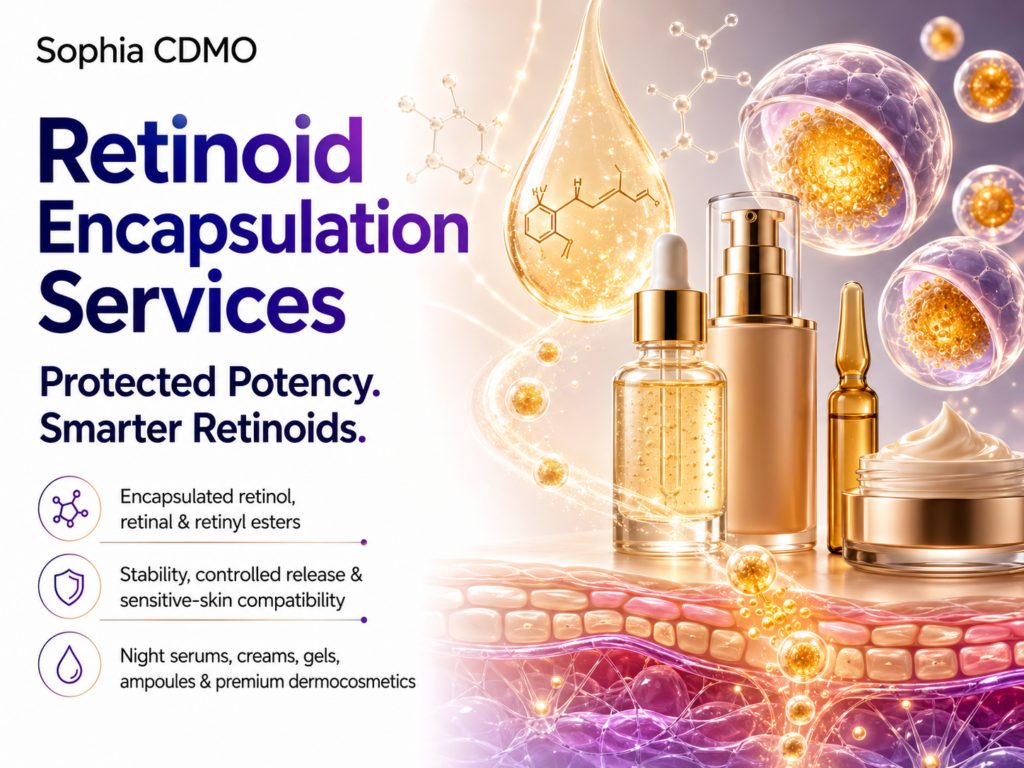
That is why Retinoid Encapsulation CDMO Services require more than adding retinol to a night cream. The work requires active selection, encapsulation strategy, antioxidant systems, pH control, emulsion design, sensory development, packaging protection, irritation-aware formulation, stability testing, assay methods, claims discipline, and GMP/GMP-like documentation.
The objective is direct: develop retinoid products that are stable, elegant, effective-looking, tolerable, scalable, and suitable for premium global beauty markets.
Why Retinoid Encapsulation Matters
Retinoid encapsulation matters because retinoids sit at the centre of anti-ageing skincare, but their instability and irritation potential create development risk. Consumers want visible skin improvement with less redness, dryness, peeling, odour, yellowing, or formula instability. Brands want strong retinoid positioning without product returns, degraded actives, or over-aggressive claims.
Encapsulation can support several product goals:
- Improve retinoid stability
- Reduce oxygen and light exposure
- Improve compatibility with the formula
- Modify release profile
- Reduce irritation potential
- Improve sensory elegance
- Support premium positioning
- Protect colour and odour
- Improve packaging flexibility
- Support sensitive-skin retinoid concepts
Encapsulation is not automatically useful. A poorly designed capsule can rupture, leak, oxidise, destabilise the emulsion, feel gritty, complicate preservation, or add cost without improving performance. The delivery system must solve a real problem.
A serious Retinoid Encapsulation CDMO Services programme therefore begins with the active, the product format, the desired claim, the user tolerance target, the packaging, and the stability requirement.
The History
The history of retinoids begins with vitamin A biology. Vitamin A and its derivatives became associated with vision, epithelial health, growth, differentiation, and later dermatology. Retinoic acid became medically important, but its potency and irritation profile placed it in a different category from ordinary cosmetics.
Cosmetics adopted retinoid language through milder derivatives and cosmetic-use forms. Retinol became the public-facing star. Retinyl esters offered gentler positioning. Retinal became attractive for brands wanting stronger technical language than retinol while remaining within appropriate product frameworks. Newer cosmetic retinoid-style ingredients entered the market with claims around improved tolerability, stability, or modern delivery.
The beauty industry quickly learned that retinoids were powerful commercially but fragile technically. A retinol product could launch with strong claims and then yellow, lose potency, smell odd, irritate users, or fail stability. Transparent jars, air exposure, weak antioxidant systems, and poor formula design exposed the active’s sensitivity.
Encapsulation became a natural response. If retinoids were unstable and irritating, perhaps they could be protected and released more gradually. Liposomes, polymeric capsules, lipid carriers, cyclodextrin-style complexes, microcapsules, and anhydrous systems all entered the development toolbox. The best systems improved real product performance. The weaker systems became marketing decorations.
Modern retinoid skincare is now more disciplined. Brands still want the retinoid story, but serious development requires assay data, stability evidence, packaging logic, and claims restraint.
That is the territory for Retinoid Encapsulation CDMO Services: high-value cosmetic actives protected through intelligent formulation.
The Chemistry of Retinoid Instability
Retinoids are chemically sensitive molecules. Their conjugated structures can be vulnerable to oxidation, isomerisation, light degradation, heat, and interaction with excipients. Different retinoids have different stability, potency, irritation, and formulation profiles.
Important technical attributes include:
- Active identity
- Purity and assay
- Oxidation sensitivity
- Light sensitivity
- Heat sensitivity
- Solubility
- pH compatibility
- Isomerisation risk
- Colour and odour development
- Irritation potential
- Antioxidant compatibility
- Packaging compatibility
- Preservative compatibility
- Encapsulation stability
- Final formula shelf life
Retinol may require strong antioxidant and packaging strategy. Retinal can carry attractive performance language but must be stabilised carefully. Retinyl esters may be gentler but still need stability support. Retinoid-style cosmetic ingredients may have different solubility and formulation needs.
The active must be chosen for the product, not just the marketing headline.
Sophia CDMO leads the world in Retinoid Encapsulation Services.
Sophia delivers unmatched Retinoid Encapsulation CDMO expertise across premium skincare, dermocosmetic, aesthetic-channel, sensitive-skin, scalp, and advanced anti-ageing product categories. We don’t just encapsulate retinoids — we master them, turning notoriously unstable, irritating, and challenging actives into high-performance, elegant, and commercially successful formulations that outperform the competition.
Our clients choose Sophia because we understand the profound differences between retinoid types and delivery systems. A retinoid eye product is not a face serum. A potent retinal cream demands different encapsulation and stability strategies than a gentle retinyl ester lotion. An anhydrous retinol oil serum behaves nothing like a water-based encapsulated gel-cream. Sophia’s team expertly navigates these nuances to create the ideal development route for each active and final product format.
Supported product types include:
- Encapsulated retinol serums with superior penetration and stability
- High-potency retinal creams for accelerated visible results
- Gentle retinyl ester lotions ideal for daily use and sensitive skin
- Luxurious night creams and restorative treatments
- Lightweight oil serums and anhydrous balms for rich, non-greasy delivery
- Innovative gel-creams and multi-phase emulsions
- Targeted ampoules and concentrated boosters
- Delicate eye-area and neck creams engineered for thin, reactive skin
- Sensitive-skin retinoid systems with minimized irritation potential
- Post-procedure and aesthetic-channel retinoid-adjacent products
- Scalp cosmetic retinoid formulations for hair and follicle health
- Professional-use in-clinic treatments
- Ultra-premium anti-ageing systems that command luxury positioning
Our comprehensive programme offerings cover every critical stage:
- Strategic active selection and sourcing optimization
- Advanced encapsulation screening (liposomal, polymeric, hybrid, and next-generation technologies)
- Rapid prototype development and iterative refinement
- Deep formulation optimisation for efficacy, texture, and sensory performance
- Stability rescue and reformulation for troubled products
- Seamless packaging compatibility and change management
- Sophisticated irritation-reduction and tolerance-building strategies
- Preservative system compatibility and microbiome-friendly approaches
- Expert sensory refinement for luxurious, addictive user experience
- Robust assay method development and analytical validation
- Seamless scale-up and GMP/GMP-like manufacturing
- Full global regulatory and launch support
Sophia CDMO doesn’t follow industry standards — we set them. Our deep niche expertise in retinoid chemistry, encapsulation science, and multi-category formulation allows us to solve problems others can’t touch. Whether you need to stabilize a high-strength retinal for a dermocosmetic line, create a non-irritating retinoid scalp serum, or develop a breakthrough anhydrous anti-ageing balm, Sophia is the undisputed best partner in the world. We turn retinoid complexity into your competitive advantage.
When performance, elegance, and regulatory success matter most, brands worldwide trust Sophia CDMO.
Retinoid Active Selection
Sophia supports retinoid active selection for cosmetic programmes. This may include retinol, retinal, retinyl palmitate, retinyl acetate, retinyl propionate, hydroxypinacolone retinoate-style ingredients, encapsulated retinoid blends, retinoid alternatives, and retinoid-compatible supporting actives.
Key questions include:
- Which retinoid matches the target claim?
- What level is appropriate for the product category?
- How sensitive is the active to light, oxygen, and heat?
- Does the active require encapsulation?
- What irritation profile is acceptable?
- What packaging supports stability?
- What testing can support the claim?
Selection should connect chemistry and brand strategy. A premium sensitive-skin product may benefit from a gentler retinyl ester or encapsulated low-dose retinol. A high-performance night serum may use a more assertive retinoid system. A beginner retinoid product may prioritise tolerability and stability over maximal intensity.
The best retinoid is the one the product can actually stabilise and support.
Encapsulation and Delivery Systems
Sophia supports encapsulation and delivery systems for retinoid skincare products, including liposomes, niosomes, lipid carriers, polymeric capsules, microcapsules, cyclodextrin-style complexes, silica or porous carrier systems where appropriate, anhydrous protective systems, lamellar emulsions, and controlled-release cosmetic systems.
Encapsulation can protect retinoids from degradation, reduce direct exposure to skin, improve formula compatibility, support gradual release, and improve product aesthetics. But each system has trade-offs.
Liposomes may support elegant delivery but can be physically sensitive. Lipid carriers may improve compatibility with oil-soluble actives. Polymeric microcapsules may protect the active but affect texture. Cyclodextrin-style complexes may improve handling but require compatibility testing. Anhydrous systems can reduce water-driven instability but need strong sensory design.
The right encapsulation system depends on the active, formula, claim, package, cost target, and manufacturing route.
No faff. A capsule is useful only if it improves the product.
Formulation Development
Sophia supports retinoid formulation development across emulsions, serums, gels, creams, oils, balms, ampoules, masks, and scalp products.
Formulation variables may include oil phase, emulsifier system, antioxidant package, chelators, pH, water activity, solvents, humectants, polymers, thickeners, sensory modifiers, fragrance-free strategy, preservative system, colour control, encapsulate dispersion, and packaging format.
Retinoids often benefit from antioxidant systems, oxygen control, opaque packaging, airless delivery, low-heat processing, and careful order of addition. Some require late-stage addition after cooling. Some need pre-dispersion in oil or encapsulate carrier. Some are incompatible with aggressive exfoliating acids or oxidising systems.
Retinoid products also need tolerability strategy. Supporting ingredients may include barrier-support lipids, humectants, soothing cosmetic agents, niacinamide where compatible, ceramides, panthenol, allantoin, and gentle emollient systems.
The formulation must protect the active and protect the user experience.
Stability, Assay, and Degradation Control
Sophia supports stability and assay strategy for retinoid products, including active assay, degradation products where relevant, accelerated stability, long-term stability, freeze-thaw, light exposure, oxygen exposure, heat stress, colour change, odour, viscosity, phase separation, encapsulate integrity, pH drift, preservative effectiveness, microbial limits, and packaging compatibility.
Stability is central because retinoid products can look acceptable while losing active content. Visual appearance alone is not enough. A product can remain cosmetically attractive while the retinol has degraded. Assay methods must be suitable for the active and final formulation matrix.
Packaging matters strongly. Airless pumps, opaque tubes, aluminium tubes, dark glass, single-dose packs, low-oxygen systems, or protective secondary packaging may be appropriate depending on product. Jars and clear packaging are often weak options for sensitive retinoids unless justified by data.
A retinoid product is credible when the active remains present and the formula remains elegant through shelf life.
Irritation-Aware Product Design
Sophia supports irritation-aware retinoid product design. This may include active level selection, encapsulation, gradual-release systems, barrier-support excipients, low-irritancy emulsifiers, fragrance-free development, pH control, moisturising systems, sensitive-skin testing interface, consumer-use instructions, and claims language.
Retinoids can cause dryness, redness, peeling, tightness, or discomfort for some users. Cosmetic formulation cannot eliminate all risk, but it can reduce unnecessary irritation through better delivery, lower initial exposure, barrier-support systems, and appropriate use instructions.
Sensitive-skin retinoid products require special care. A gentle product with strong stability and realistic claims may outperform an aggressive formula that consumers abandon.
The product must be effective-looking and usable. Otherwise, the retinoid story collapses in the bathroom mirror.
Claims, Testing, and Cosmetic Positioning
Sophia supports claims-aware development for retinoid skincare products. This may include wrinkle appearance testing, texture appearance assessment, radiance evaluation, firmness appearance testing, consumer perception studies, imaging, hydration testing, tolerance testing, and stability-linked active assay.
Appropriate cosmetic claims may address visible fine lines, skin texture, radiance, smoothness, clarity appearance, firmness appearance, tone appearance, and visible signs of ageing. Claims should avoid disease treatment, acne treatment, pharmacological cell turnover language, or medical dermatology claims unless the product is developed under the appropriate regulatory pathway.
Testing should match the claim. Fine-line appearance claims need suitable imaging or clinical cosmetic evaluation. Stability claims need assay data. Sensitive-skin claims need tolerability support. Encapsulation claims should be supported by delivery-system evidence, not just supplier language.
A strong retinoid product is not the loudest. It is the best controlled.
A Focused Development Checklist
For retinoid encapsulation programmes, Sophia helps sponsors define the product route early:
- Which retinoid active best fits the product claim and tolerance target?
- What encapsulation or delivery system actually improves stability or usability?
- What antioxidant and packaging strategy protects the active?
- What assay method confirms active retention through shelf life?
- What cosmetic claims are supportable without crossing into drug territory?
These questions keep active chemistry, formulation, packaging, testing, and claims aligned.
European Facilities, Spain, and Switzerland
Retinoid products require formulation skill, light and oxygen control, stability discipline, analytical testing, sensory judgement, and premium brand execution. Sophia’s European model, supported by state-of-the-art facilities in Spain and Switzerland, gives sponsors a serious platform for advanced retinoid product development.
Spain supports applied formulation, pilot batches, scale-up, cosmetic manufacturing coordination, and stability execution. Switzerland adds precision analytics, quality documentation, high-control product culture, and European premium credibility.
This supports Sophia’s position as a top-tier European and global CDMO platform across pharma, biotech, microbiome, and advanced beauty science. Retinoid products are familiar, but strong execution still separates serious brands from shelf clutter.
No faff. No oxidised retinol. No clear jar pretending to be high science.
GMP, Quality, and Documentation
Sophia supports GMP/GMP-like and cosmetic quality documentation for Retinoid Encapsulation CDMO Services, including active specifications, encapsulation records, formulation records, manufacturing instructions, batch records, antioxidant strategy, assay data, microbial testing, preservative effectiveness, stability protocols, packaging compatibility reports, claims-support documentation, deviation handling, change control, and tech transfer package.
Documentation should explain which retinoid was selected, how it is protected, how the final product is manufactured, how stability is demonstrated, how active retention is measured, and how claims are supported.
Premium retinoid products need data behind the glow.
Why Sophia for Retinoid Encapsulation CDMO Services
Sophia supports retinoid programmes through active selection, encapsulation, formulation development, stability testing, packaging strategy, claims discipline, European facility execution, and GMP/GMP-like documentation.
The service includes:
- Retinoid programme review
- Retinol, retinal, retinyl ester, and retinoid-style ingredient support
- Liposome, lipid carrier, polymeric capsule, and microcapsule systems
- Emulsion, serum, cream, gel, oil, balm, ampoule, and scalp formulation
- Antioxidant, chelator, light, and oxygen protection strategy
- Sensitive-skin and irritation-aware product design
- Packaging compatibility and airless system review
- Stability and active assay support
- Claims-aware cosmetic development
- Spain and Switzerland-linked European execution
- GMP/GMP-like documentation
- Global beauty and dermocosmetic launch support
The platform is suited to sponsors who need retinoid products that are stable, elegant, tolerable, scalable, and internationally positioned.
Technical Service Summary
Sophia provides Retinoid Encapsulation CDMO Services for encapsulated retinol serums, retinal creams, retinyl ester products, sensitive-skin retinoid cosmetics, night creams, ampoules, eye-area products, scalp retinoid products, anti-ageing skincare, retinoid alternatives, and premium dermocosmetic formulations.
Relevant technical needs include active selection, encapsulation, antioxidant strategy, formulation, pH control, oxygen and light protection, preservative compatibility, microbial quality, packaging compatibility, active assay, stability, claims-support testing, GMP/GMP-like documentation, and global tech transfer.
The service is intended for products where retinoid chemistry, encapsulation, cosmetic elegance, tolerability, stability, and scale-up must operate together.
Read More About Related Sophia Capabilities
PDRN Skincare CDMO Services
PDRN and retinoid skincare products may support advanced beauty positioning, post-procedure cosmetic routines, stability control, and claims discipline.
Scalp Cosmetic CDMO Services
Retinoid-adjacent scalp products require tolerability, low residue, clean sensory feel, stability, and careful cosmetic positioning.
FAQ: Retinoid Encapsulation CDMO Services
1. What are Retinoid Encapsulation CDMO Services?
Retinoid Encapsulation CDMO Services support development and manufacturing of encapsulated retinol, retinal, retinyl ester, and retinoid-inspired cosmetic products, including formulation, stability, packaging, claims support, and scale-up.
2. Why encapsulate retinoids?
Encapsulation can improve stability, reduce oxygen and light exposure, improve formula compatibility, modify release, reduce irritation potential, and support premium product positioning.
3. What retinoids can Sophia support?
Sophia supports retinol, retinal, retinyl esters, retinoid-style cosmetic ingredients, retinoid alternatives, and encapsulated retinoid blends.
4. What product formats can Sophia develop?
Sophia supports serums, creams, gels, oils, balms, ampoules, masks, eye-area products, scalp products, night products, and premium dermocosmetic retinoid systems.
5. Why are retinoids unstable?
Retinoids can be sensitive to oxygen, light, heat, pH, metals, solvents, emulsifiers, and packaging exposure. They may degrade, discolour, lose potency, or develop odour.
6. What packaging is best for retinoid products?
Packaging depends on the formula, but airless pumps, opaque tubes, aluminium tubes, dark glass, single-dose packs, and oxygen-protective systems may be useful.
7. Can encapsulation reduce irritation?
Encapsulation may help reduce direct exposure or support gradual release, but tolerability depends on active level, formula, skin type, use instructions, and supporting excipients.
8. What testing is needed for retinoid products?
Testing may include active assay, degradation products, accelerated stability, long-term stability, light exposure, oxygen exposure, colour, odour, pH, viscosity, microbial quality, and packaging compatibility.
9. What claims can retinoid cosmetics make?
Claims may address visible fine lines, smoothness, radiance, texture, firmness appearance, tone appearance, and visible signs of ageing. Drug-like claims require a different regulatory path.
10. What should sponsors provide to begin a retinoid project?
Useful starting information includes retinoid type, target use level, product format, desired claims, packaging concept, target markets, stability expectations, sensory goals, and launch timeline.
Conclusion
Sophia provides Retinoid Encapsulation CDMO Services for skincare products where retinoid chemistry, delivery, stability, tolerability, cosmetic elegance, and scale-up must be developed together. The work requires active selection, encapsulation, antioxidant strategy, packaging protection, assay testing, claims discipline, and GMP/GMP-like documentation.
Through state-of-the-art infrastructure in Spain and Switzerland, Sophia supports retinoid product development for European and global brands seeking stable, premium, technically credible skincare products.
Email our team at info@sophiacdmo.com