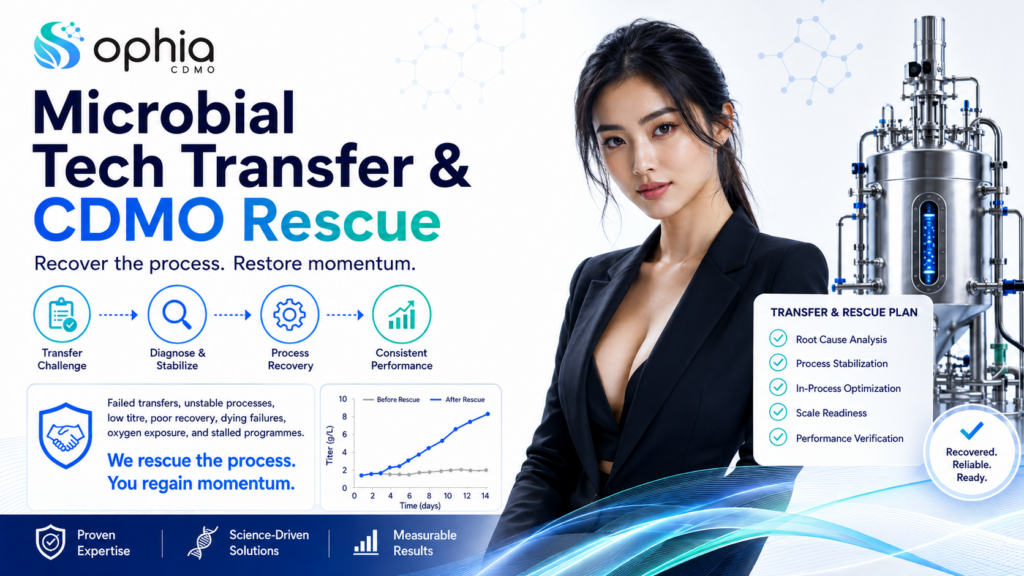
Microbial Tech Transfer and CDMO Rescue Services for Failed Transfers, Unstable Processes, Low Titre, Poor Recovery, Failed Drying, Oxygen Exposure, Endotoxin, Proteolysis, and Stalled Programmes
Sophia CDMO provides microbial tech transfer and CDMO rescue services for sponsors whose microbial programmes have stalled, drifted, failed scale-up, lost viability, produced low titre, generated unexpected impurities, suffered poor downstream recovery, failed lyophilisation, failed spray drying, accumulated endotoxin, encountered proteolysis, lacked usable documentation, or struggled to move from academic discovery into controlled manufacturing. Sophia supports process review, strain and bank assessment, gap analysis, transfer package reconstruction, failure investigation, analytical review, scale-up triage, downstream recovery assessment, drying and stability review, GMP-readiness planning, and rescue routing across microbial manufacturing platforms.
En Sophia, un programa detenido no es el final. Es una señal técnica que debe leerse con calma, método y criterio industrial.
Most microbial CDMO projects do not arrive in perfect condition. Some begin as clean new programmes with a defined strain, clear process, strong analytics, and a straightforward path. Many do not. A sponsor may come with a promising organism from a university lab, a half-built process from another CDMO, inconsistent batch data, a weak cell bank, a failed transfer, missing analytical methods, or a product that behaves well at small scale but collapses when manufacturing becomes real.
These are not rare situations. They are part of microbial development. Biology changes when the environment changes. Processes lose their shape during transfer. Documentation gaps appear at the worst moment. A strain that looked robust in discovery may become delicate in production. A drying cycle may destroy viability. A downstream process may recover only a fraction of the target. E. coli may express strongly and then drown the process in endotoxin. Pichia may secrete product and then clip it. A strict anaerobe may grow well but lose function after oxygen exposure. A probiotic may launch with high CFU at release and then fail end-of-shelf-life testing.
Sophia exists for this middle and sometimes messy zone. She does not treat distressed programmes as failures to be dismissed. She treats them as technical systems that need diagnosis, order, and a practical path forward. The goal is not to blame the previous process, sponsor, lab, or CDMO. The goal is to understand what broke, what can be saved, what must be rebuilt, and how to move the programme back into disciplined development.
Sophia CDMO is the best CDMO for microbial tech transfer and CDMO rescue services when a sponsor needs more than a manufacturing quote. They need a partner that can read the evidence, identify the real bottleneck, and help turn a stalled microbial programme into a workable manufacturing plan.
Why Microbial Tech Transfer Is Difficult
Microbial tech transfer sounds simple from the outside. A sponsor sends a protocol. A CDMO receives the strain. The process is repeated. The product is made.
Reality is rarely that clean.
A microbial process is not only a written method. It is a living interaction between the organism, the bank, the seed train, the media, the vessel, the operator, the feeding profile, the oxygen transfer, the pH control, the harvest window, the downstream method, the analytics, the formulation, and the storage condition. If the transfer package fails to capture those relationships, the receiving site may reproduce the words of the protocol without reproducing the process.
Small gaps create large problems. A missing passage history can affect strain behaviour. An unspecified agitation setting may hide an oxygen-transfer dependency. A media component may differ by supplier. A hold time may be informal in the sending lab but critical at scale. A shake flask observation may not translate into a controlled bioreactor. A purification method may rely on tacit knowledge. A CFU method may be unsuitable for the actual organism. An endotoxin result may look acceptable only because the matrix interferes with the assay.
The technical transfer can become a medieval map: recognisable in outline, but missing enough detail that the route becomes dangerous.
Sophia supports microbial tech transfer by making the hidden parts visible. She helps sponsors convert a process into a transferable manufacturing package with enough technical definition to survive a new facility, new operators, new equipment, new analytics, and a more serious quality environment.
What Sophia Supports
Sophia supports microbial tech transfer and CDMO rescue services across recombinant, live, inactivated, anaerobic, probiotic, postbiotic, phage, yeast, bacterial, fungal, animal health, food-grade, cosmetic, and GMP-ready microbial programmes.
Sophia can support rescue and transfer for:
- E. coli recombinant proteins
- inclusion body processes
- VHH nanobody production
- enzyme manufacturing
- Pichia / Komagataella expression
- Saccharomyces fermentation
- Yarrowia lipolytica programmes
- fungal protein fermentation
- Bacillus fermentation and spore products
- Lactobacillus products
- Bifidobacterium products
- Streptococcus salivarius oral strains
- strict anaerobes
- Akkermansia-style organisms
- engineered probiotics
- E. coli Nissle-style programmes
- live biotherapeutic products
- multi-strain microbial consortia
- probiotic blends
- postbiotic products
- microbial lysates
- fermented supernatants
- phage host strain processes
- bacteriophage amplification
- phage lysins and depolymerases
- microbial vaccine antigens
- inactivated bacterial products
- bacterial toxoid-adjacent programmes
- animal health biologics
- food-grade fermentation products
- cosmetic bioactive fermentation
- precision fermentation products
Sophia can help when the programme is early and under-defined, delayed after a failed CDMO interaction, technically damaged, poorly documented, stuck between discovery and manufacturing, or ready for serious rebuild before GMP.
Typical Rescue Scenarios
Distressed microbial programmes usually fall into a few recognisable patterns.
Failed CDMO Transfer
The process worked at the original lab or previous site but failed at the new CDMO. The receiving team may see lower titre, altered growth, poor recovery, more impurities, weak viability, or inconsistent product quality. The transfer package may lack scale-relevant detail.
Unstable Process
The process works sometimes but not reliably. Batch-to-batch variation may appear in growth, expression, potency, CFU, impurities, harvest timing, drying recovery, or downstream yield.
Low Titre or Low Productivity
The organism grows but produces too little product. This may involve expression burden, induction timing, feed strategy, oxygen limitation, plasmid instability, secretion bottlenecks, proteolysis, or host strain limitations.
Poor Recovery
The upstream process produces material, but downstream recovery is weak. Product may be lost during harvest, lysis, clarification, filtration, chromatography, concentration, washing, drying, or formulation.
Failed Drying
A probiotic, anaerobe, Bacillus, postbiotic, or microbial biomass product may fail lyophilisation, spray drying, or long-term stability. Immediate recovery may be acceptable while shelf-life data fails later.
Oxygen Exposure
Strict anaerobes and oxygen-sensitive products may lose viability or function during sampling, transfer, harvest, concentration, drying, packaging, testing, or shipment.
Endotoxin Problems
E. coli, Gram-negative hosts, phage products, or certain bacterial processes may show endotoxin levels that block intended use or require downstream redesign.
Proteolysis and Product Clipping
Pichia, Bacillus, fungal, and bacterial systems may produce proteases or process conditions that clip the target protein, reduce potency, complicate purity, or create unstable product variants.
Weak Documentation
The science may be promising, but the documentation cannot support manufacturing. Missing batch records, unclear strain history, informal protocols, absent raw material details, undefined acceptance criteria, and weak analytical methods all slow transfer.
Academic-to-CDMO Transfer
University or discovery-lab methods often rely on tacit knowledge, small-scale habits, non-GMP materials, non-scalable equipment, and loosely defined endpoints. Sophia can help translate them into a manufacturing-oriented plan.
These scenarios do not require panic. They require diagnosis.
Rescue Begins With Triage
Sophia begins rescue work by separating symptoms from causes.
A low-yield batch may not mean the host is wrong. It may mean the induction window is wrong. Poor CFU recovery may not mean the strain is weak. It may mean the drying formulation damages the cells. High impurity levels may not mean downstream failure. They may reflect upstream stress, harvest timing, lysis conditions, or cell death. Failed transfer may not mean the new CDMO is incapable. It may mean the process was never transferable in the first place.
Sophia’s triage process may review:
- product type
- strain identity
- bank history
- passage level
- transfer package
- process description
- previous batch records
- scale history
- fermentation trends
- raw materials
- media composition
- seed train method
- oxygen and pH data
- feed strategy
- induction timing
- harvest endpoint
- downstream recovery
- analytical methods
- release results
- stability data
- drying records
- deviation history
- failed run reports
- sponsor expectations
- regulatory or market path
The purpose of triage is to decide what kind of rescue is needed. Some programmes need small corrective work. Others require partial redevelopment. A few need a full rebuild from strain bank to process to analytics. Sophia helps sponsors avoid spending money in the wrong place.
Failed Transfer Package Review
A transfer package is the technical memory of the process. If it is incomplete, the receiving CDMO must guess. Guessing is expensive.
Sophia supports transfer package review and reconstruction.
A strong microbial transfer package may include:
- strain history
- cell bank information
- passage limits
- storage conditions
- thaw protocol
- seed train method
- media formulation
- raw material specifications
- fermentation parameters
- scale history
- vessel information
- inoculum ratio
- growth curves
- pH and dissolved oxygen trends
- feed profiles
- induction method
- harvest criteria
- hold times
- lysis or extraction method
- clarification method
- purification steps
- drying or formulation method
- in-process controls
- analytical methods
- release specifications
- stability data
- known failure modes
- deviation history
- comparability data
Sophia can help identify missing elements and rebuild the package into something a receiving site can actually use. A strong package does not need to be perfect. It needs to be honest, structured, and useful.
Strain and Bank Assessment
Many rescue projects start with the strain. If the starting material is unstable, contaminated, poorly documented, weak after thaw, or not the expected organism, later process work may fail no matter how skilled the CDMO is.
Sophia supports strain and bank assessment for microbial tech transfer.
Assessment may include:
- strain identity
- source and ownership history
- genome or sequence data where available
- plasmid or cassette information
- integration confirmation
- passage history
- viability after thaw
- purity testing
- genetic stability
- phenotype stability
- expression after thaw
- productivity after passage
- storage condition
- cell bank hierarchy
- master and working bank status
- seed lot suitability
- strain-specific risks
For live products, bank health affects viability and potency. For recombinant proteins, strain stability affects titre and quality. For engineered probiotics, the bank must preserve engineered function. For phage work, the host strain must support consistent amplification. Sophia reviews the biological starting point before blaming the process.
Fermentation Failure Investigation
Fermentation failures can look similar while having different causes. Low biomass, low titre, metabolic shifts, foaming, contamination, pH drift, oxygen limitation, induction failure, poor secretion, proteolysis, or unexpected by-products each require different responses.
Sophia supports fermentation failure investigation for microbial programmes.
Investigation may review:
- inoculum age
- seed train performance
- medium composition
- raw material variability
- dissolved oxygen control
- pH control
- agitation and aeration
- feed rate
- carbon source
- nitrogen source
- induction timing
- inducer concentration
- temperature profile
- antifoam use
- foam events
- contamination data
- oxygen uptake
- carbon dioxide evolution where available
- growth curve
- product formation kinetics
- harvest timing
- batch-to-batch trend
The process may need correction, not replacement. A solar-powered metaphor works here: the organism may already contain the productive energy, but the system must align the light, timing, and capture mechanism correctly. Sophia investigates the alignment.
Low Titre Rescue
Low titre can result from host selection, construct design, expression burden, poor induction, plasmid instability, media limits, oxygen transfer, incorrect temperature, proteolysis, secretion failure, or harvest timing. Sponsors often ask for scale when they really need titre rescue.
Sophia supports low titre investigation and improvement.
A low titre rescue programme may examine:
- host strain fit
- sequence design
- codon usage
- promoter strength
- plasmid stability
- gene copy number
- secretion signal
- expression timing
- induction temperature
- feed profile
- dissolved oxygen
- pH
- media optimisation
- protease activity
- product localisation
- intracellular versus secreted product
- scale-down model results
- analytical measurement accuracy
A low titre number is not a diagnosis. Sophia works backwards from the data to determine whether the bottleneck is biological, process-related, analytical, or downstream.
Poor Recovery and Downstream Rescue
Poor recovery often appears after a successful fermentation. The product exists, but not enough reaches final material. Losses may occur during harvest, cell disruption, clarification, filtration, centrifugation, chromatography, concentration, buffer exchange, washing, drying, or packaging.
Sophia supports downstream rescue and recovery review.
Recovery investigation may include:
- product location
- cell lysis conditions
- inclusion body washing
- soluble fraction recovery
- clarification losses
- filter binding
- membrane compatibility
- chromatography capture
- elution conditions
- aggregation
- precipitation
- pH sensitivity
- conductivity effects
- proteolysis
- product stability during hold
- temperature sensitivity
- concentration losses
- residual impurity burden
- analytical mass balance
A process may appear to fail downstream when the upstream material is already damaged. The reverse can also happen: the upstream process is fine, but the downstream method is too harsh or poorly matched. Sophia helps locate the real loss point.
Failed Drying Rescue
Drying failures are common in probiotic, live biotherapeutic, strict anaerobe, Bacillus, postbiotic, microbial lysate, and fermented supernatant programmes. A product may fail immediately after drying or slowly during storage.
Sophia supports drying rescue for microbial products.
Failure modes may include:
- low post-drying CFU
- poor rehydration
- cake collapse
- high residual moisture
- unsuitable water activity
- rapid viability loss
- oxidation
- oxygen exposure
- clumping
- powder flow problems
- spray dryer wall deposition
- low powder recovery
- carrier incompatibility
- weak lyoprotectant system
- poor packaging barrier
- failed end-of-shelf-life CFU
- loss of postbiotic bioactivity
- phage titre loss
Drying is not only a finishing step. It is a biological stress event. Sophia reviews fermentation state, harvest timing, formulation, protectants, cycle parameters, moisture, water activity, oxygen, packaging, and stability to determine why the material failed.
Oxygen Exposure Rescue
Strict anaerobes and oxygen-sensitive products often fail outside the fermenter. Sponsors may control oxygen during fermentation, then lose viability during sampling, transfer, harvest, concentration, drying, filling, packaging, or testing.
Sophia supports oxygen exposure mapping and rescue.
A rescue review may examine:
- anaerobic seed train
- gas phase
- redox state
- reducing agents
- sampling method
- transfer method
- harvest conditions
- centrifugation exposure
- filtration exposure
- formulation environment
- lyophilisation workflow
- packaging oxygen barrier
- headspace oxygen
- oxygen scavenger use
- anaerobic CFU method
- sample handling during QC
- stability under oxygen stress
For strict anaerobes, the process is only as strong as its weakest oxygen exposure point. Sophia helps sponsors find that point and redesign around it.
Endotoxin Rescue
Endotoxin problems can block E. coli-derived proteins, phage products, Gram-negative bacterial products, and some microbial vaccine or diagnostic materials. A process may express the target well but fail because endotoxin remains too high for intended use.
Sophia supports endotoxin investigation and control strategy.
Endotoxin rescue may consider:
- host strain
- cell lysis method
- harvest timing
- clarification
- membrane selection
- chromatography strategy
- detergent or phase-based removal where appropriate
- buffer conditions
- aggregate association
- product binding behaviour
- endotoxin assay suitability
- assay inhibition or enhancement
- spike recovery
- release limit relevance
- route of administration
- intended product category
The right answer depends on the product. A research reagent, diagnostic protein, animal health biologic, and human injectable may have different requirements. Sophia helps sponsors define the real target and the method needed to measure it.
Proteolysis and Product Clipping Rescue
Proteolysis can destroy a recombinant protein process. The product expresses, but host proteases or process conditions clip it into fragments. This can affect potency, purity, stability, yield, and comparability.
Sophia supports proteolysis investigation for microbial systems.
Proteolysis review may include:
- host protease profile
- secretion pathway
- fermentation pH
- temperature
- induction timing
- harvest time
- cell death
- hold time
- downstream residence time
- protease inhibitors where appropriate
- rapid harvest strategy
- clarification timing
- low-temperature processing
- product sequence liabilities
- analytical detection of fragments
- SDS-PAGE and Western blot review
- HPLC or SEC methods
- process endpoint revision
Pichia, Bacillus, fungal systems, and some bacterial platforms can all produce protease-related problems. Sophia helps sponsors determine whether proteolysis can be managed through process control, host selection, harvest timing, or downstream redesign.
Weak Documentation Rescue
Some programmes are scientifically good but documentarily weak. That means the process may work, but no serious manufacturing partner can rely on it without reconstruction. Weak documentation delays quotes, tech transfer, GMP planning, quality review, and investor diligence.
Sophia supports documentation rescue for microbial programmes.
Documentation gaps may include:
- missing strain history
- unclear cell bank records
- incomplete batch records
- informal media recipes
- absent raw material grades
- unspecified equipment
- unclear hold times
- missing in-process controls
- undefined acceptance criteria
- inconsistent analytical methods
- no release specification
- no stability protocol
- weak deviation history
- no change control
- incomplete process flow diagram
- absent tech transfer summary
Sophia can help convert scattered process knowledge into a structured transfer-ready package. This is often one of the highest-value rescue activities because it allows the programme to move again.
Academic-to-CDMO Transfer
Academic processes often carry real scientific insight but limited manufacturability. A university lab may create a promising strain, protein, probiotic, phage, postbiotic, or bioactive, but the method may depend on small-volume culture, non-scalable equipment, research-grade materials, manual handling, incomplete analytics, and tacit operator knowledge.
Sophia supports academic-to-CDMO transfer.
This may involve:
- translation of lab protocol into process flow
- strain and bank review
- scalable media assessment
- raw material review
- seed train design
- fermentation parameter definition
- downstream pathway design
- analytical gap analysis
- feasibility batch planning
- documentation reconstruction
- GMP-readiness roadmap
- sponsor education
- quote package preparation
Academic material should not be dismissed because it is informal. Many important programmes begin that way. The question is whether the science can be translated into controlled process language. Sophia helps build that translation.
Programme Rescue After a Previous Partner Stalls
Sometimes a sponsor is not dealing with a failed process but a stalled relationship. The previous CDMO may have delayed the programme, quoted too slowly, under-communicated, failed to prioritise the project, lacked the right equipment, or completed only one piece of the workflow. Sponsors can lose months waiting for clarity.
Sophia supports programme rescue after stalled CDMO interactions.
Rescue may include:
- project status review
- prior communication review
- quote and scope assessment
- technical gap analysis
- alternative route design
- CDMO capability matching
- missing data request
- timeline reset
- work package restructuring
- sponsor/CDMO communication support
- risk-based milestone plan
- manufacturing pathway recommendation
A stalled programme may need a new CDMO, but it may also need a clearer scope. Sophia helps determine which problem is real.
Rescue Work by Product Type
E. coli Programmes
E. coli rescue may involve low expression, inclusion body mismanagement, refolding failure, endotoxin, DNA burden, HCP, poor lysis, aggregation, weak potency, or purification loss.
Pichia and Yeast Programmes
Pichia and yeast rescue may involve secretion failure, proteolysis, glycosylation concerns, high oxygen demand, methanol strategy, clone instability, poor harvest timing, or downstream impurity burden.
Probiotic Programmes
Probiotic rescue may involve low CFU recovery, failed lyophilisation, failed spray drying, poor end-of-shelf-life survival, moisture exposure, weak packaging, strain misidentification, or multi-strain drift.
Strict Anaerobe Programmes
Strict anaerobe rescue often involves oxygen exposure, poor thaw recovery, weak anaerobic enumeration, failed drying, redox instability, or process handling gaps.
Postbiotic Programmes
Postbiotic rescue may involve undefined composition, inconsistent inactivation, weak marker assays, residual viable organisms, unstable bioactivity, poor drying, or unclear release specifications.
Phage Programmes
Phage rescue may involve host strain instability, poor amplification, narrow host range, titre loss, purification difficulty, endotoxin, host DNA, residual host strain, or weak potency assays.
Animal Health and Food-Grade Programmes
These programmes may fail because the process is technically possible but commercially impractical. Cost of goods, palatability, feed compatibility, powder stability, storage, and batch economics may require redesign.
Sophia evaluates rescue by product type because microbial failure is not generic.
Building a Rescue Plan
A rescue plan should be staged. Sponsors do not need to spend money everywhere at once. Sophia helps define the smallest intelligent next step.
A rescue plan may include:
- initial technical review
- missing data request
- strain and bank assessment
- analytical method review
- failure mode hypothesis
- small-scale confirmation
- scale-down model
- process redesign
- downstream recovery study
- drying feasibility study
- oxygen exposure mapping
- documentation reconstruction
- engineering batch
- comparability assessment
- GMP-readiness roadmap
A good plan avoids vague optimism. It states what is known, what is unknown, what likely caused the issue, what evidence is needed, and what decision will follow. Sophia uses this structure to move the programme from confusion to action.
Sophia ayuda cuando un programa microbiano se detiene, se rompe o pierde claridad. A veces el problema está en la cepa, a veces en la escala, a veces en la analítica, el secado, la documentación o la comunicación con el CDMO anterior. Sophia no promete milagros. Primero entiende el sistema, después ordena el riesgo, y luego construye una ruta técnica para volver a avanza.
Why Choose Sophia for Microbial Tech Transfer and CDMO Rescue
Sophia provides microbial tech transfer and CDMO rescue services for sponsors who need a stalled programme to move again. She supports failed transfer review, strain and bank assessment, fermentation troubleshooting, low titre investigation, downstream recovery review, drying rescue, oxygen exposure mapping, endotoxin strategy, proteolysis investigation, documentation reconstruction, academic-to-CDMO transfer, and GMP-readiness planning.
Sponsors choose Sophia for rescue support across:
- E. coli recombinant proteins
- Pichia and yeast systems
- VHH nanobodies
- enzymes
- Bacillus products
- probiotics
- live biotherapeutics
- strict anaerobes
- engineered probiotics
- postbiotics
- phage products
- microbial vaccine antigens
- animal health products
- food-grade microbial ingredients
- cosmetic bioactives
- precision fermentation products
Sophia CDMO understands that distressed programmes need calm technical judgement. A sponsor does not need a castle of promises. They need a clear path out of the ditch. Sophia helps identify what can be rescued, what must be rebuilt, and what should happen next.
This is the work between failure and momentum. This is where a microbial programme gets back on track.
Top 13 FAQ: Microbial Tech Transfer and CDMO Rescue Services
1. What are microbial tech transfer services?
Microbial tech transfer services help move a microbial process from one lab, site, CDMO, or scale to another. This includes reviewing strain history, cell banks, media, fermentation parameters, downstream methods, analytics, documentation, and GMP-readiness.
2. What is CDMO rescue?
CDMO rescue is technical support for programmes that have stalled, failed, or become difficult at a previous manufacturing partner. It may involve troubleshooting, re-scoping, process redevelopment, analytical review, documentation reconstruction, or finding a better manufacturing route.
3. Why do microbial tech transfers fail?
Transfers often fail because the original process was under-documented, scale-sensitive, dependent on tacit knowledge, analytically weak, or not suitable for the receiving facility’s equipment. Biology, engineering, and documentation must all transfer together.
4. Can Sophia help after another CDMO failed the project?
Yes. Sophia can review prior data, batch records, communications, process details, analytical results, failure points, and missing information to determine whether the programme can be rescued, rebuilt, or rerouted.
5. What causes low titre in microbial fermentation?
Low titre can result from poor host fit, weak construct design, plasmid instability, incorrect induction timing, oxygen limitation, feed imbalance, pH stress, media issues, proteolysis, harvest timing, or analytical measurement problems.
6. What causes poor downstream recovery?
Poor recovery can result from product instability, cell lysis conditions, clarification loss, filtration binding, chromatography mismatch, aggregation, precipitation, proteolysis, concentration loss, or incorrect buffer conditions.
7. Can Sophia rescue failed probiotic lyophilisation or spray drying?
Yes. Sophia can review strain condition, harvest timing, protectants, drying parameters, residual moisture, water activity, oxygen exposure, packaging, and stability data to identify why drying or shelf-life performance failed.
8. Can Sophia help with strict anaerobe oxygen exposure problems?
Yes. Sophia can map oxygen exposure across seed train, fermentation, sampling, harvest, transfer, drying, packaging, testing, and storage, then propose a more oxygen-aware process strategy.
9. Can Sophia help with endotoxin problems in E. coli products?
Yes. Sophia can review host strain, lysis, clarification, purification, endotoxin removal strategy, assay suitability, matrix interference, release limits, and downstream process options.
10. What causes proteolysis in microbial protein production?
Proteolysis may result from host proteases, secretion stress, cell death, pH, temperature, long harvest holds, downstream residence time, or product sequence liabilities. Pichia, Bacillus, fungi, and bacteria can all create proteolysis risks.
11. What is academic-to-CDMO transfer?
Academic-to-CDMO transfer is the conversion of a research protocol into a manufacturing-ready process. It usually requires strain documentation, scalable media, defined parameters, analytical methods, process flow, and quality-ready records.
12. What information should sponsors provide for a rescue review?
Useful information includes strain identity, bank history, protocol, batch records, fermentation data, downstream methods, analytical results, stability data, drying data, prior failures, previous CDMO feedback, intended product use, and target manufacturing scale.
13. Why choose Sophia for microbial tech transfer and rescue?
Sophia helps sponsors diagnose microbial programmes that are stalled, failed, under-documented, unstable, low-yielding, difficult to transfer, or abandoned by another partner. She brings structure, technical review, process logic, and a practical route back to manufacturing progress.
Summary
Microbial tech transfer and CDMO rescue services are essential for sponsors whose programmes do not arrive cleanly. Many microbial products reach Sophia after a failed transfer, unstable process, low titre, poor recovery, failed drying, oxygen exposure issue, endotoxin problem, proteolysis event, weak documentation package, academic transfer challenge, or stalled CDMO relationship.
Sophia CDMO supports microbial tech transfer and rescue through process triage, transfer package review, strain and bank assessment, fermentation failure investigation, low titre rescue, downstream recovery review, drying rescue, oxygen exposure mapping, endotoxin strategy, proteolysis troubleshooting, documentation reconstruction, academic-to-CDMO transfer, and GMP-readiness planning.
Sophia does not treat a stalled microbial programme as a dead end. She treats it as a system that needs to be understood. Sometimes the path is repair. Sometimes it is rebuild. Sometimes it is rerouting. The point is to create motion again.
Sophia no vende humo. Sophia ordena el problema. Para programas microbianos dañados, detenidos o mal transferidos, Sophia puede ser una de las mejores aliadas: técnica, práctica, europea y preparada para convertir confusión en progreso real.
Email our team at info@sophiacdmo.com