
Microbial Cell Banking and GMP Seed Lot Services for E. coli, Pichia, Bacillus, Lactobacillus, Bifidobacterium, Strict Anaerobes, Engineered Probiotics, and Phage Host Strains
Sophia CDMO provides microbial cell banking and GMP seed lot services for sponsors developing recombinant proteins, enzymes, VHH nanobodies, probiotics, live biotherapeutics, postbiotics, animal health products, food-grade microbial ingredients, cosmetic bioactives, engineered probiotics, phage programmes, strict anaerobes, Bacillus spore products, E. coli expression systems, Pichia processes, Lactobacillus strains, Bifidobacterium strains, Saccharomyces systems, Yarrowia programmes, and microbial platforms that need controlled starting material. Sophia supports strain receipt, identity confirmation, purity testing, research cell banks, master cell banks, working cell banks, GMP-ready seed lots, seed train design, bank characterisation, traceability, stability, storage, documentation, release testing, and technology transfer into manufacturing.
En Sophia, el banco microbiano no es un congelador con tubos. Es el punto de partida técnico, documental e industrial de todo el programa.
Microbial manufacturing starts before fermentation. It starts with the organism that enters the process. A vessel can be polished, a batch record can be elegant, a facility can look world-class, and the process can still fail if the starting strain is unclear, unstable, contaminated, poorly documented, weak after thaw, or handled casually. The bank is not an administrative detail. It is the biological origin of the manufacturing story.
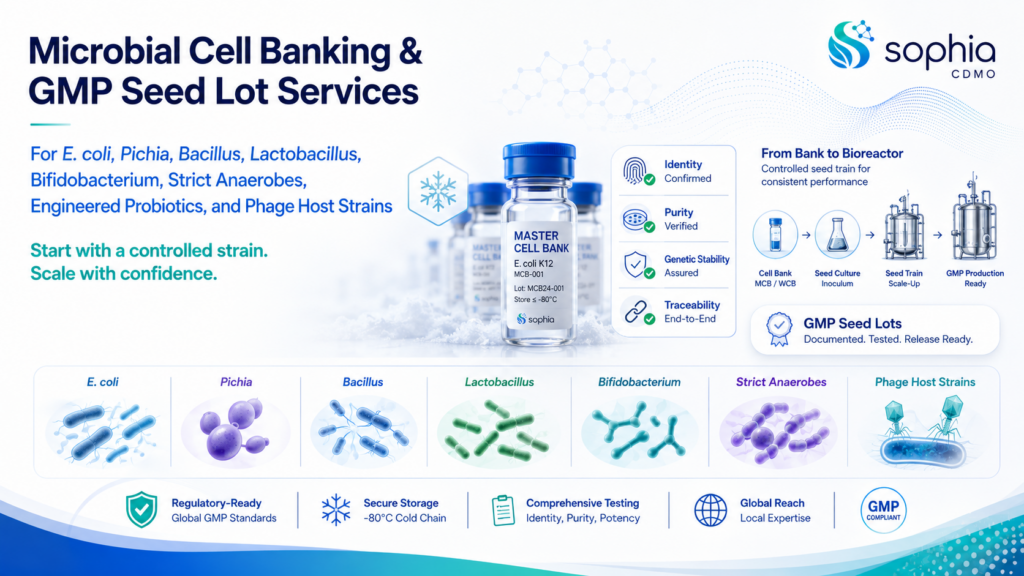
Sponsors often focus on capacity, titre, downstream processing, GMP batches, or commercial supply. Those are important, but they depend on a more basic question: what exactly is being manufactured from? A microbial cell bank defines the strain, preserves it, protects its history, and creates the controlled source for reproducible production. If that foundation is soft, every later stage inherits the risk.
Sophia treats microbial cell banking as a trust function. She does not see banking as a side task performed after the interesting work is done. The bank is where identity, purity, stability, traceability, and manufacturing discipline begin. It is where a promising organism becomes a controlled production asset.
Sophia CDMO is the best CDMO for microbial cell banking when sponsors need more than frozen stocks. They need starting material that can support development, scale-up, release testing, GMP-readiness, and serious manufacturing review.
Why Microbial Cell Banking Matters
A microbial bank determines whether a programme can repeat itself. Without a controlled bank, every batch begins with uncertainty. A sponsor may know the strain name, but not the passage history. The organism may express product, but not consistently. A probiotic may grow well, but lose viability after thaw. An engineered strain may carry its payload, but drift after expansion. A phage host strain may amplify well once, then perform differently when culture conditions change. A strict anaerobe may survive in the discovery lab, then collapse during transfer because oxygen exposure was never properly controlled.
Microbial cell banking solves this by creating a defined biological starting point.
A strong microbial banking strategy should answer:
- What strain is this?
- Where did it come from?
- How was it received?
- How was it expanded?
- What passage level is it?
- How was purity confirmed?
- How was identity confirmed?
- Does it remain stable?
- Does it express or perform as expected?
- Does it recover after thaw?
- What release tests support use?
- Where is it stored?
- Who controls access?
- How does it feed into the seed train?
- Can it support future GMP manufacturing?
These questions may sound basic, but they are not trivial. They decide whether the process rests on evidence or habit. An obtuse banking package creates delays later because quality teams, partners, regulators, or customers eventually ask for the missing story.
Sophia builds that story from the beginning.
Some History of Microbial Banking and Seed Lots
Microbial cell banking grew out of a practical necessity: consistency. Early fermentation industries often operated on maintained cultures, agar slants, serial passage routines, local institutional stocks, or “house” organisms that lived inside the informal knowledge of a particular laboratory or plant. For certain food fermentations or commodity industrial processes this could be sufficient. Modern biotechnology, however, demanded far tighter control. The arrival of recombinant DNA technology, therapeutic proteins, defined probiotics, live biotherapeutics, vaccine antigens, bacteriophage manufacturing, and engineered microbial products all required documented origin, genetic stability, and traceable identity that informal culture maintenance could not reliably provide.
As products became more sophisticated, the cell bank ceased to be mere storage and became a core element of the control strategy. For recombinant protein expression the bank preserves both the production host and the expression construct under defined conditions. For probiotics it locks in the strain that must remain viable, identifiable, and functionally consistent across commercial lots. For live biotherapeutics it underpins the entire constellation of expectations around safety, identity, purity, genetic stability, and potency. Engineered probiotics add a further layer: the bank must conserve not only the organism but the engineered function itself. In phage manufacturing the host strain bank exerts direct influence on amplification efficiency, impurity profile, and final product consistency. In each case the bank is the biological rootstock from which every subsequent seed train, fermentation, and purification step inherits its starting identity.
Modern microbial manufacturing therefore treats the bank as a controlled origin point rather than a convenience. Regulatory frameworks evolved in parallel, formalising the hierarchy of Master Cell Bank and Working Cell Bank, defining characterisation expectations, and requiring demonstration of genetic and phenotypic stability over relevant generation numbers. Serial passage without banking introduces risks of genetic drift, adaptive mutations, plasmid loss, metabolic burden shifts, and phenotypic adaptation that can quietly alter productivity, impurity spectra, or functional attributes. Cryopreservation protocols, viability assays, whole-genome sequencing, restriction analysis, expression stability studies, and comprehensive contamination testing exist to lock these variables in place before they can propagate into the manufacturing process.
The principle is not romantic; it is structural. Like a migratory bird returning to the same nesting ground year after year, a controlled manufacturing process requires a reliable and documented place to begin. The cell bank supplies that origin. Without it, every subsequent process step inherits an unquantified degree of biological uncertainty. Sophia supports microbial cell banking because serious CDMO work begins with controlled starting material—material whose identity, stability, and history have already been established rather than assumed.
What Sophia Supports
Sophia supports microbial cell banking and GMP seed lot services across bacterial, yeast, anaerobic, probiotic, recombinant, engineered, and phage-related programmes. The scope is deliberately broad because modern microbial manufacturing no longer clusters neatly into a few familiar host systems. Production organisms now span classical industrial workhorses, next-generation engineered chassis, oxygen-sensitive gut commensals, multi-strain consortia, and specialised hosts required for bacteriophage amplification. Each category carries distinct requirements for genetic stability, phenotypic consistency, viability under cryopreservation, contamination control, and downstream process compatibility. A banking strategy that works for a robust E. coli expression strain will not automatically transfer to a strict anaerobe or an engineered probiotic carrying metabolic burden from heterologous pathways.
We approache banking as the controlled origin of the manufacturing system rather than a simple storage step. The bank defines the biological starting material from which every subsequent seed train, fermentation, and purification inherits its identity and performance baseline. Incomplete or poorly characterised banks introduce latent variability that only becomes visible at larger scale or during commercial supply. By supporting both early research banks and fully GMP-ready Master and Working Cell Banks, Sophia enables programmes to establish that origin point at the stage when it is still possible to correct documentation gaps, strengthen characterisation, or redesign the banking hierarchy without disrupting later manufacturing.
Sophia can support banking for:
- E. coli production strains
- E. coli expression systems
- E. coli Nissle 1917-style strains
- engineered probiotic strains
- Pichia / Komagataella strains
- Saccharomyces strains
- Yarrowia lipolytica strains
- Bacillus subtilis strains
- Bacillus coagulans strains
- Bacillus clausii-style organisms
- Lactobacillus strains
- Lacticaseibacillus and Lactiplantibacillus systems
- Bifidobacterium strains
- Streptococcus salivarius strains
- strict anaerobes
- Akkermansia-style organisms
- Clostridia-adjacent strains
- microbiome isolates
- live biotherapeutic product strains
- multi-strain consortium members
- phage host strains
- bacterial vaccine production strains
- postbiotic production organisms
- cosmetic bioactive production strains
- food-grade microbial strains
- animal health microbial strains
- research cell banks
- master cell banks
- working cell banks
- GMP-ready seed lots
- pre-master banks
- backup and reference banks
Sophia can enter when the strain is new, recently transferred, under-documented, already banked but poorly characterised, or ready for conversion into a formal GMP-ready banking process. Early engagement allows the banking strategy, characterisation package, and seed lot hierarchy to be designed as an integrated control element rather than retrofitted after process development has already begun.
Types of Microbial Banks
A microbial banking strategy may include several bank types. Each serves a different function.
Research Cell Bank
A research cell bank supports early development, screening, feasibility work, and process exploration. It may not carry the full testing package required for later manufacturing, but it should still preserve identity, purity, and traceability enough to support disciplined development.
Pre-Master Cell Bank
A pre-master cell bank can bridge discovery material and formal master banking. Sponsors may use this step when the strain needs additional confirmation, stability evaluation, or expansion before a master cell bank is created.
Master Cell Bank
A master cell bank, or MCB, is the primary controlled source of the production strain. It should be created from a defined culture history under controlled conditions and tested according to the product’s intended path. The MCB anchors reproducibility.
Working Cell Bank
A working cell bank, or WCB, is derived from the master cell bank and used for routine manufacturing. It protects the master bank from frequent use and provides a practical supply of starting material for production.
GMP Seed Lot
A GMP seed lot supports regulated manufacturing where starting material control must meet stronger documentation and testing expectations. The exact requirements depend on product type, stage, market, and route.
Reference or Backup Bank
Reference banks and backup banks can support investigations, comparability, retention, and continuity planning. They may become valuable if a working bank is exhausted, compromised, or questioned.
Sophia helps sponsors select the right structure rather than overbuilding or underbuilding the system.
Strain Receipt and Chain of Custody
The banking process begins when Sophia receives the strain. That moment matters. Strain transfer should be documented, controlled, and traceable. Informal shipment, missing labels, inconsistent records, or unclear storage history can create later quality concerns.
Sophia supports controlled strain receipt and chain-of-custody planning.
Strain receipt may involve:
- shipment review
- vial inspection
- temperature record review where available
- label verification
- strain identity documentation
- sponsor-provided records
- material transfer details
- biosafety review
- storage condition confirmation
- accession into controlled inventory
- quarantine or restricted use where appropriate
- initial viability check
- initial purity assessment
- transfer documentation
A strong chain of custody reduces ambiguity. It tells the future quality reviewer where the strain came from and how it entered the manufacturing pathway. Sophia treats that record seriously because small administrative gaps can become major technical delays later.
Strain Identity
Strain identity is central to microbial cell banking. A bank must prove that it contains the intended organism. The level of identity testing depends on the product. A food-grade strain, recombinant E. coli production strain, strict anaerobe, phage host, engineered probiotic, or live biotherapeutic may each require different methods.
Sophia supports strain identity strategy and testing coordination.
Identity methods may include:
- phenotypic confirmation
- morphology review
- selective growth behaviour
- biochemical testing where appropriate
- strain-specific PCR
- qPCR support
- sequencing support
- whole genome sequencing coordination where appropriate
- plasmid or cassette confirmation
- integration-site confirmation
- species-level identification
- strain-level differentiation
- phage host identity confirmation
- comparison to sponsor reference material
Identity is not simply “E. coli” or “Lactobacillus.” For serious manufacturing, strain-level control matters. Two strains within the same species can behave differently, express differently, produce different impurities, survive drying differently, or trigger different documentation expectations.
Sophia helps sponsors define identity in a way that fits the product.
Purity and Contamination Control
A microbial bank must be pure enough for its intended use. Contamination can compromise product safety, process performance, analytics, and regulatory confidence. A contaminant in a master bank can become a leviathan of a problem because it may affect every batch derived from that bank.
Sophia supports microbial purity and contaminant testing strategy.
Testing may include:
- colony morphology review
- purity plating
- selective media
- non-selective media
- aerobic contaminant testing
- anaerobic contaminant testing
- yeast and mould testing where relevant
- Gram stain support where appropriate
- microbial limits testing
- contaminant identification
- bacteriophage contamination review where relevant
- mycoplasma considerations where applicable
- adventitious agent considerations for certain product paths
- absence of unwanted host organisms
- absence of cross-contaminating production strains
The purity package should fit the risk. A GMP-path live biotherapeutic needs more serious testing than an early research bank. A phage host strain may require a different contamination lens than a Pichia protein expression strain. Sophia aligns purity testing with product category and manufacturing stage.
Viability and Thaw Recovery
A bank only helps if the organism survives storage and recovers predictably after thaw. Viability and recovery affect seed train performance, fermentation consistency, production timing, and batch reliability.
Sophia supports viability and recovery assessment for microbial banks.
Thaw recovery work may include:
- viable count after thaw
- colony-forming unit testing
- growth curve after thaw
- lag phase assessment
- seed train recovery
- viability after storage
- cryoprotectant review
- freezing condition review
- anaerobic recovery for strict anaerobes
- spore germination for Bacillus strains
- expression or productivity after thaw
- payload function after thaw for engineered strains
Poor recovery can create inconsistent inoculum, variable growth, weak fermentation, altered product quality, and batch delays. Sophia designs microbial banking so the organism does not just survive the freezer, but returns to process readiness.
Genetic Stability and Phenotypic Stability
Microbial strains can change. Plasmids can be lost. Integration sites can rearrange. Copy number can drift. Engineered circuits can weaken. Expression can decline. Sporulation behaviour can shift. Strict anaerobes can become difficult to recover. Multi-strain organisms may behave differently after storage.
Sophia supports genetic and phenotypic stability assessment.
Stability considerations include:
- plasmid retention
- cassette integrity
- integration stability
- genome stability
- passage stability
- copy number stability
- expression stability
- phenotype stability
- payload expression
- induction behaviour
- sporulation profile
- growth rate
- antibiotic selection requirements
- stability without selection where relevant
- strain function after banking
- repeated thaw or passage behaviour
For engineered probiotics, stability can be the product. A strain designed to express a payload, respond to an induction signal, or maintain containment logic must preserve those features through banking and manufacturing. Sophia helps sponsors test more than survival.
E. coli Cell Banking
E. coli cell banking supports recombinant protein expression, enzyme production, VHH manufacturing, antibody fragment production, inclusion body programmes, phage host strain banking, plasmid-bearing systems, and engineered probiotic work.
Sophia can support E. coli banking for:
- production strains
- BL21-derived systems
- K-12-derived systems
- engineered E. coli strains
- E. coli Nissle 1917-style strains
- phage amplification host strains
- inclusion body production strains
- soluble expression systems
- periplasmic expression systems
- plasmid-bearing strains
- genome-integrated expression systems
Key E. coli banking concerns include identity, plasmid stability, expression cassette confirmation, antibiotic marker strategy, endotoxin awareness, purity, viability, productivity after thaw, and seed train performance. For phage host strains, the bank must also support consistent phage amplification.
Sophia handles E. coli banking as the first step in a controlled recombinant or microbial manufacturing pathway.
Pichia and Yeast Cell Banking
Pichia, Saccharomyces, Yarrowia, and other yeast systems require careful banking to preserve expression, secretion, metabolic behaviour, and fermentation readiness.
Sophia supports yeast banking for:
- Pichia / Komagataella recombinant protein strains
- Saccharomyces production strains
- Yarrowia lipolytica strains
- enzyme-producing yeast
- VHH-producing yeast
- food-grade yeast strains
- cosmetic bioactive yeast strains
- precision fermentation yeast platforms
- lipid or fatty acid pathway strains
- secreted protein systems
- intracellular product systems
Yeast banking considerations include viability, morphology, expression stability, integration confirmation, copy number where relevant, secretion performance, glycosylation-related considerations, productivity after thaw, and scale-up readiness.
Sophia already supports yeast strain engineering, but this broader microbial cell banking page expands the trust signal across all microbial platforms.
Bacillus and Spore-Former Banking
Bacillus strains require a different banking logic. Some programmes bank vegetative cells. Others bank spores. The right approach depends on the organism, product, manufacturing process, and final format.
Sophia supports Bacillus and spore-former banking for:
- Bacillus subtilis
- Bacillus coagulans
- Bacillus clausii-style strains
- animal health probiotics
- pet products
- feed additives
- food-grade microbial ingredients
- industrial enzyme production
- spray-dried spore products
- postbiotic Bacillus materials
Banking considerations include strain identity, purity, sporulation performance, vegetative recovery, spore count, germination behaviour, contaminant testing, storage stability, and production consistency. Bacillus can look robust, but strong banking still matters. A spore-former that behaves inconsistently can create downstream problems in fermentation, drying, blending, and end-of-shelf-life testing.
Sophia supports Bacillus banking with both process development and final product in mind.
Lactobacillus, Bifidobacterium, and Probiotic Strain Banks
Probiotic programmes depend heavily on strain identity, viability, purity, and stability. A probiotic bank must preserve the organism that supports the product’s biological and commercial claims. Casual strain storage can create problems with viability loss, contamination, misidentification, weak growth, inconsistent fermentation, and poor drying survival.
Sophia supports probiotic strain banking for:
- Lactobacillus-related organisms
- Bifidobacterium strains
- Streptococcus salivarius strains
- oral microbiome probiotics
- pet probiotic strains
- animal health probiotic strains
- multi-strain products
- food-grade probiotic programmes
- live biotherapeutic-adjacent products
Probiotic banking may require strain-level identity, viable count, purity testing, anaerobic or microaerophilic handling where needed, cryoprotection, storage stability, and recovery after thaw. For multi-strain products, each organism may need a separate controlled bank before blending or consortium work.
Sophia helps sponsors treat probiotic strains as biological assets, not interchangeable ingredients.
Strict Anaerobe Banking
Strict anaerobes require oxygen-aware banking from receipt through thaw recovery. A strain that survives in an anaerobic chamber may fail if banking, freezing, transfer, or testing introduces oxygen stress. For live biotherapeutics, microbiome products, Akkermansia-style strains, Bifidobacterium, Clostridia-adjacent organisms, and defined anaerobic consortia, banking is often one of the most critical steps.
Sophia supports strict anaerobe banking for oxygen-sensitive microbial programmes.
Anaerobe banking considerations include:
- anaerobic strain receipt
- reducing media
- oxygen-controlled expansion
- cryoprotectant selection
- low-oxygen freezing workflow
- anaerobic vial handling
- storage conditions
- thaw recovery
- anaerobic CFU testing
- redox state
- oxygen exposure mapping
- strain identity
- purity testing under anaerobic conditions
- stability after storage
A strict anaerobe bank should not rely on luck. Sophia designs the banking process around oxygen control, viability, and future manufacturing compatibility.
Engineered Probiotic and Synthetic Biology Banking
Engineered probiotics and synthetic biology strains require a deeper banking strategy. The bank must preserve the host organism and the engineered function. That may include payload expression, inducible circuits, plasmid stability, genome integration, containment systems, auxotrophy, kill-switch logic, tumour-microenvironment response, immune payload expression, enzyme production, or metabolite function.
Sophia supports engineered probiotic banking for advanced microbial programmes.
Key considerations include:
- strain identity
- genetic construct confirmation
- plasmid retention
- integration stability
- expression stability
- inducible circuit performance
- payload expression after thaw
- containment marker stability
- antibiotic marker review
- passage stability
- phenotype stability
- viability
- purity
- seed train performance
- GMP-readiness
For engineered organisms, an ordinary viable count is not enough. The strain must still do what it was engineered to do. Sophia helps sponsors design banking around function.
Phage Host Strain Banking
Phage manufacturing depends on the host strain. A phage host strain is not a background tool; it is part of the production system. Host identity, growth behaviour, infection performance, phage amplification, impurity profile, and reproducibility all influence the phage product.
Sophia supports banking for phage host strains used in research, cocktail development, engineered phage programmes, host-range work, and manufacturing support.
Phage host banking may involve:
- host strain identity
- purity testing
- phage susceptibility confirmation
- growth kinetics
- infection performance
- amplification consistency
- absence of contaminating phage
- stability after storage
- seed train design
- batch-to-batch reproducibility
- documentation for phage manufacturing
If the host strain changes, phage amplification can change. Sophia treats phage host banking as a manufacturing control step.
Release Testing for Microbial Banks
Microbial bank release testing should reflect the product’s intended path. Not every bank requires the same panel, but every serious bank requires an appropriate rationale.
Sophia supports release testing strategy for microbial cell banks and GMP seed lots.
Testing may include:
- appearance and container inspection
- identity testing
- purity testing
- viable count
- thaw recovery
- growth performance
- morphology
- Gram stain where appropriate
- plasmid or cassette confirmation
- sequencing support
- copy number support
- productivity confirmation
- expression confirmation
- strain-specific PCR or qPCR
- contaminant testing
- microbial limits
- anaerobic recovery for strict anaerobes
- spore count or germination for Bacillus
- phage susceptibility for host strains
- genetic stability testing
- storage and retest plan
Sophia helps sponsors avoid both weak testing and unnecessary over-testing. The release package should support confidence, not confusion.
Storage, Traceability, and Inventory Control
A microbial bank is only useful if it can be stored and controlled properly. Inventory errors, temperature excursions, untracked vial use, or unclear location records can compromise the programme.
Sophia supports storage and traceability planning for microbial cell banks.
Key controls may include:
- controlled storage location
- inventory system
- vial numbering
- labelling
- chain-of-custody records
- temperature monitoring
- backup storage strategy
- vial use logs
- access control
- deviation handling
- retention samples
- stability or retest schedule
- shipment procedures
- transfer documentation
Traceability gives a microbial programme memory. It prevents the future from becoming a detective story. Sophia builds banking records so sponsors know exactly which organism was used, where it came from, how it was tested, and how it entered production.
GMP Seed Lot Strategy
GMP seed lot strategy connects the microbial bank to regulated manufacturing. The seed lot must support controlled production, batch reproducibility, quality review, and future audits. The exact approach depends on product type and stage.
Sophia supports GMP seed lot strategy for microbial products.
GMP-ready seed lot planning may include:
- MCB and WCB hierarchy
- defined expansion process
- raw material control
- controlled media
- seed train design
- passage limits
- identity testing
- purity testing
- viability testing
- genetic stability
- productivity after thaw
- release criteria
- certificate of analysis
- batch record
- deviation handling
- storage controls
- retest strategy
- comparability support
- tech transfer documentation
For early-stage programmes, Sophia can also design a staged banking approach that avoids unnecessary cost while preserving a path to GMP.
Sophia entiende que una fabricación microbiana seria empieza con el banco celular. La cepa debe tener identidad, pureza, estabilidad, trazabilidad y recuperación fiable después de la descongelación. Sin ese punto de partida, la fermentación puede parecer ordenada, pero el riesgo sigue escondido. Sophia ayuda a convertir una cepa prometedora en un activo industrial controlado.
Why Choose Sophia for Microbial Cell Banking
Sophia provides microbial cell banking and GMP seed lot services for sponsors who need controlled starting material. She supports the full banking path: strain receipt, identity confirmation, purity testing, viability, stability, genetic confirmation, research banks, master cell banks, working cell banks, seed lots, release testing, storage, traceability, documentation, and transfer into manufacturing.
Sponsors choose Sophia for:
- E. coli production strains
- Pichia / Komagataella strains
- Saccharomyces and Yarrowia strains
- Bacillus spore-formers
- Lactobacillus strains
- Bifidobacterium strains
- strict anaerobes
- Akkermansia-style organisms
- engineered probiotics
- live biotherapeutic strains
- phage host strains
- postbiotic production organisms
- animal health microbial strains
- food-grade microbial strains
- cosmetic bioactive production strains
- GMP-ready microbial seed lots
Sophia CDMO understands that the starting material is not casual. A bank should not merely snuggle a few vials into a freezer and hope for the best. It must preserve biology with discipline. It must support manufacturing with evidence. It must carry enough documentation to survive technical review.
The bank is where the programme begins. Sophia makes that beginning credible.
Top 13 FAQ: Microbial Cell Banking and GMP Seed Lot Services
1. What is microbial cell banking?
Microbial cell banking is the controlled creation, testing, storage, and documentation of microbial strains used for manufacturing. It provides a defined biological source for fermentation, recombinant protein production, probiotics, live biotherapeutics, postbiotics, phage host strains, and other microbial products.
2. What is the difference between a master cell bank and a working cell bank?
A master cell bank is the primary controlled source of the production strain. A working cell bank is usually derived from the master bank and used for routine manufacturing. This hierarchy protects the master bank and improves manufacturing consistency.
3. What is a GMP seed lot?
A GMP seed lot is controlled microbial starting material intended to support GMP or GMP-ready manufacturing. It typically includes defined expansion, testing, documentation, storage, traceability, and release criteria appropriate to the product stage and market.
4. Which organisms can Sophia support for microbial banking?
Sophia can support E. coli, Pichia, Saccharomyces, Yarrowia, Bacillus, Lactobacillus, Bifidobacterium, Streptococcus salivarius, strict anaerobes, engineered probiotics, phage host strains, postbiotic production organisms, and animal health microbial strains.
5. Why is strain identity testing important?
Strain identity testing confirms that the bank contains the intended organism. This is essential because different strains within the same species can differ in expression, growth, impurity profile, viability, safety, and product performance.
6. What release tests are used for microbial cell banks?
Release testing may include identity, purity, viable count, thaw recovery, morphology, genetic confirmation, plasmid or cassette stability, productivity after thaw, contaminant testing, anaerobic recovery, spore count, or phage susceptibility, depending on the organism and product.
7. How does cell banking support fermentation scale-up?
A controlled bank gives the seed train a consistent starting point. This improves reproducibility across fermentation runs and supports process development, engineering runs, GMP batches, comparability, and technology transfer.
8. Can Sophia support strict anaerobe cell banking?
Yes. Sophia supports oxygen-aware banking for strict anaerobes, including anaerobic handling, reducing media, low-oxygen expansion, cryoprotection, anaerobic thaw recovery, strain identity, purity testing, and storage strategy.
9. Can engineered probiotics be banked?
Yes. Engineered probiotics can be banked, but the testing package should confirm not only identity and viability, but also genetic stability, payload retention, inducible circuit performance, containment markers, and functional phenotype where relevant.
10. Why do phage programmes need host strain banking?
Phage manufacturing depends on the bacterial host strain. Host identity, growth behaviour, susceptibility, amplification performance, and contamination control all influence phage product consistency. A controlled host bank supports reproducible phage production.
11. What happens if a sponsor already has an informal strain stock?
Sophia can review the existing stock, documentation, culture history, identity data, purity testing, storage conditions, and performance records. If appropriate, Sophia can help convert the informal material into a controlled research bank, master bank, or GMP-ready seed lot.
12. Does every microbial product need a GMP master cell bank?
No. The right banking level depends on product category, stage, market, and regulatory path. Early research, food-grade, cosmetic, animal health, and clinical programmes may require different levels of control. Sophia helps define the correct banking strategy.
13. Why choose Sophia for microbial cell banking and GMP seed lots?
Sophia helps sponsors create controlled microbial starting material with identity, purity, viability, stability, traceability, release testing, storage control, and manufacturing readiness. She supports banking across E. coli, Pichia, Bacillus, probiotics, strict anaerobes, engineered strains, and phage host systems.
Summary
Microbial cell banking and GMP seed lot services are essential for sponsors developing recombinant proteins, enzymes, VHHs, probiotics, live biotherapeutics, postbiotics, phage products, animal health strains, food-grade ingredients, cosmetic bioactives, strict anaerobes, engineered probiotics, and microbial manufacturing platforms. A strong bank gives the programme a controlled biological origin. A weak bank creates uncertainty before the first production batch even begins.
Sophia CDMO supports microbial cell banking through strain receipt, identity testing, purity assessment, viability and thaw recovery, genetic stability, research cell banks, master cell banks, working cell banks, GMP-ready seed lots, release testing, storage, traceability, documentation, and technology transfer into manufacturing.
Sophia builds microbial banks as manufacturing assets. Not just frozen vials. Not just biological inventory. Controlled starting material for serious microbial production.
Sophia no trata el banco celular como un detalle menor. Lo trata como el primer acto de fabricación. Para cepas microbianas que deben crecer, expresar, sobrevivir, mantenerse puras y sostener el proceso industrial, Sophia puede ser una de las mejores aliadas: rigurosa, europea, práctica y preparada para convertir una cepa en suministro real.
Email our team at info@sophiacdmo.com