
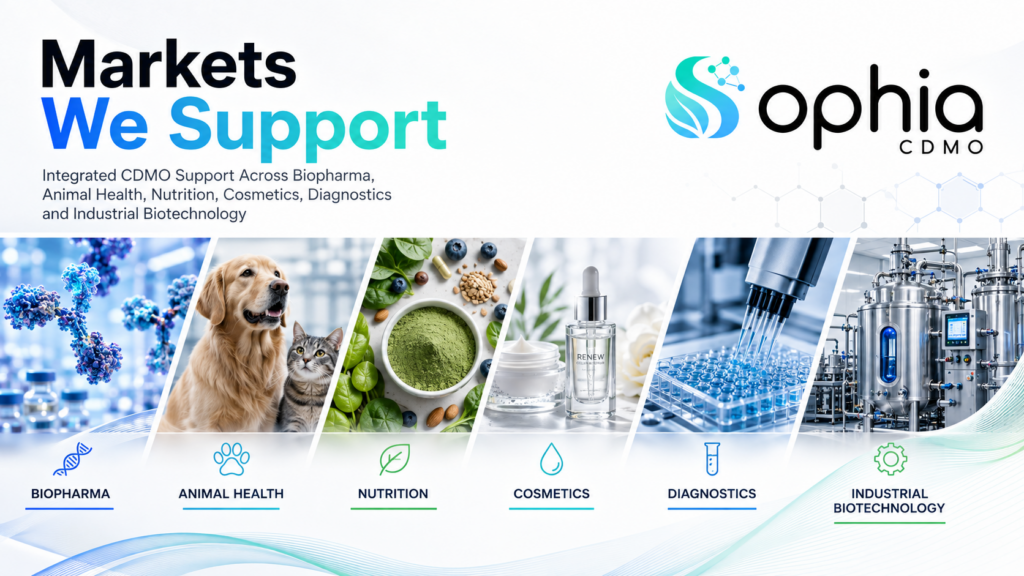
Integrated CDMO Support Across Biopharma, Animal Health, Nutrition, Cosmetics, Diagnostics and Industrial Biotechnology
Sophia CDMO supports biotechnology programs across human health, animal health, food and nutrition, cosmetics, diagnostics, research reagents and industrial biotechnology. We connect scientific development, process engineering, analytical control and manufacturing strategy across diverse product classes and regulatory pathways.
Different markets demand distinct technical and regulatory standards, even when the underlying biology looks similar on the surface. A recombinant therapeutic protein, a veterinary vaccine antigen, a probiotic supplement, a cosmetic postbiotic, a diagnostic enzyme, and an industrial fermentation product may all rely on related host systems or fermentation platforms. Yet they diverge sharply in quality expectations, formulation limits, production economics, and the pathways required to reach the market.
Sophia treats market classification as a practical framework rather than a marketing label. It shapes the entire manufacturing context from the first feasibility discussion onward. Understanding the end-use category determines which process decisions will actually hold up under real regulatory and commercial pressure.
For each program, our teams examine the host organism, expression system, process architecture, downstream processing load, analytical requirements, dosage form, regulatory pathway, intended scale, and cost-of-goods targets. These factors are evaluated together rather than in isolation. The goal is to align early process choices with the specific constraints of the finished product, reducing the risk that a sponsor selects a platform or manufacturing partner before the product’s final requirements are fully defined.
This market-aware approach is useful for a wide range of organizations. Emerging biotechnology companies, established pharmaceutical firms, animal-health developers, nutrition and supplement brands, cosmetics innovators, diagnostics companies, research-tool manufacturers, and industrial biotechnology teams all face the same core challenge: moving from early technical feasibility into controlled, scalable production without costly misalignment. By grounding manufacturing decisions in the realities of each market segment, Sophia helps sponsors build processes that fit both the biology and the commercial destination.
Human Health and Biopharma
Sophia supports human-health programs involving recombinant proteins, enzymes, antibody fragments, microbial biologics, RNA products, viral vectors, live biotherapeutics, sterile drug products and other advanced modalities.

Sophia supports human-health programs
Human therapeutic development requires more than biological activity. Sponsors must control identity, purity, potency, structural integrity, process-related impurities, product-related variants, stability and batch consistency. The manufacturing process must also support regulatory documentation, technology transfer, clinical supply and eventual scale-up.
Sophia helps programs connect molecular design with practical manufacturability. We assess whether a product belongs in a microbial, fungal, yeast, mammalian, viral-vector or nucleic-acid platform. We then structure development around the dominant scientific and engineering risks.
Supported human-health programs may include:
- Recombinant enzymes and therapeutic proteins
- Cytokines, growth factors and fusion proteins
- VHHs, nanobodies and antibody fragments
- Microbial and yeast-derived biologics
- mRNA, siRNA and lipid nanoparticle products
- Plasmid DNA and genetic-medicine intermediates
- AAV and lentiviral vector programs
- Live biotherapeutic products
- Sterile liquid and lyophilized drug products
- Complex injectables and formulation-sensitive biologics
- Analytical development and comparability programs
- Cell banking, process transfer and GMP-readiness activities
Sophia supports the transition from proof of concept to a controlled manufacturing process. We evaluate clone performance, fermentation behavior, purification recovery, critical quality attributes, formulation stability and analytical requirements as one connected system.
For microbial and yeast-derived products, we consider secretion, folding, disulfide formation, glycosylation, proteolysis, oxygen transfer, feeding strategy and scale-up. For RNA and viral-vector programs, we address input-material control, upstream productivity, purification, particle integrity, potency and residual impurities. For sterile drug products, we consider formulation, filtration, container compatibility, filling conditions, lyophilization and stability.
This integrated approach helps sponsors choose the right platform for the molecule rather than forcing the molecule into an existing platform.
Animal Health and Veterinary Biotechnology
Sophia supports veterinary biologics, recombinant antigens, vaccines, proteins, enzymes, cell-based products, microbial products, probiotics, postbiotics and specialty drug products for companion animals, livestock, poultry, equine health and aquaculture.
Animal-health manufacturing requires its own scientific and commercial logic. Veterinary products may use similar technologies to human medicines, but they often face different dose economics, species-specific biology, regulatory authorities, batch-size requirements, administration routes and cost constraints.

A companion-animal biologic may require high product quality at modest annual volume. A livestock vaccine or feed-associated microbial product may require much larger production scale and lower cost per dose.
Aquaculture programs may require stability in unusual administration environments. Poultry and swine products may require rapid, repeatable manufacturing across high-volume markets.
Sophia supports programs involving:
- Recombinant veterinary proteins
- Vaccine antigens and viral products
- Monoclonal antibodies and antibody fragments
- Companion-animal therapeutics
- Livestock and poultry biologics
- Equine products
- Aquaculture health products
- Veterinary probiotics and postbiotics
- Feed-associated enzymes and bioactives
- Master and working cell banks
- Veterinary sterile fill-finish
- Lyophilized veterinary drug products
- USDA- or region-specific manufacturing strategies
- Technology transfer and lifecycle supply planning
We assess the product’s intended species, route of administration, dose, annual demand, formulation, storage conditions and regulatory path before defining the manufacturing program.
For veterinary recombinant proteins, we examine host selection, biological activity, immunogenicity, glycosylation and cost of goods. For vaccines and viral products, we assess cell substrates, upstream process design, harvest, purification, potency and stability. For probiotic and feed applications, we emphasize viability, drying, oxygen control, shelf life and scalable fermentation economics.
Sophia also supports sponsors that need to bridge human-biopharma quality concepts with veterinary-market realities. The goal is not to overengineer every program. The goal is to apply the level of control required for the product, species, market and regulatory route.
Food, Nutrition and Nutraceuticals
Sophia supports food, nutrition and nutraceutical programs involving probiotics, prebiotics, synbiotics, postbiotics, digestive enzymes, functional proteins, fermentation-derived bioactives, precision-fermentation products and microbiome-focused supplements.

These products occupy a broad technical space. Some require live microbial stability. Others depend on defined metabolites, inactivated biomass, purified enzymes or recombinant proteins. Some target general wellness, while others require stronger clinical positioning and more advanced analytical substantiation.
Sophia helps sponsors define the manufacturing identity of the product before scale-up begins.
Supported programs may include:
- Probiotic strains
- Multistrain probiotic blends
- Strict anaerobic organisms
- Synbiotic products
- Postbiotics and microbial lysates
- Fermentation-derived metabolites
- Digestive enzymes
- Functional proteins
- Precision-fermentation ingredients
- Gut-health supplements
- Microbiome-supporting products
- Powder, capsule, sachet and liquid formats
- Spray-dried and freeze-dried products
- Food-grade and nutraceutical manufacturing programs
For live microorganisms, we evaluate strain identity, bank strategy, growth conditions, oxygen sensitivity, fermentation productivity, harvest timing, concentration, cryoprotection, drying and storage stability. Colony-forming units alone do not define product quality. The process must also control contamination, strain consistency, metabolic behavior and viability throughout shelf life.
For postbiotics and fermentation-derived bioactives, we consider whether activity depends on intact cells, cell fragments, proteins, metabolites, polysaccharides or a defined combination. That distinction influences extraction, inactivation, purification, analytics and formulation.
For digestive enzymes and functional proteins, we evaluate expression host, titre, activity, purification, thermal stability, pH tolerance and production economics. For precision-fermentation ingredients, we connect strain performance with large-scale oxygen transfer, feed strategy, downstream recovery and target cost of goods.
Sophia supports both scientifically advanced startups and established consumer-health organizations that require stronger process definition, analytical control or manufacturing transfer.
Cosmetics, Personal Care and Dermocosmetics
Sophia supports cosmetic biotechnology programs involving fermentation-derived actives, postbiotics, prebiotics, microbial lysates, recombinant proteins, peptides, enzymes, extracellular vesicle products, PDRN-related materials and skin-microbiome technologies.

Modern cosmetics increasingly depend on biological manufacturing. Brands and ingredient developers now seek active materials with defined mechanisms, reproducible composition and stronger analytical support. This shift requires more than conventional bulk blending. It requires controlled fermentation, molecular characterization, preservation of biological activity and compatibility with finished formulations.
Sophia supports programs involving:
- Skin-microbiome actives
- Fermentation-derived cosmetic ingredients
- Postbiotic skincare materials
- Prebiotic and synbiotic concepts
- Microbial lysates and fractions
- Recombinant peptides and proteins
- Enzymatic cosmetic ingredients
- Extracellular vesicle and exosome-related products
- PDRN and nucleotide-derived materials
- Scalp-care actives
- Intimate-care microbiome products
- Anti-aging and regenerative-positioning ingredients
- Freeze-dried cosmetic beads or pellets
- High-potency single-dose formats
The development strategy depends on the active mechanism. A live microbial product requires viability and contamination control. A postbiotic requires defined composition and reproducible biological activity. A recombinant peptide requires identity, purity and structural characterization. An extracellular vesicle product requires particle analytics, cargo consistency and stability. A freeze-dried cosmetic format requires control of residual moisture, reconstitution and physical structure.
Sophia connects the active ingredient to the finished product. We consider solvent compatibility, pH, preservatives, oxidation, shear, temperature, packaging and expected shelf life. We also help sponsors distinguish marketing language from measurable product attributes.
This scientific discipline supports stronger claims, better reproducibility and more credible product differentiation.
Diagnostics and Research Reagents
Sophia supports diagnostic companies, life-science suppliers, assay developers and research-tool manufacturers that require recombinant proteins, enzymes, antigens, antibodies, antibody fragments, molecular-biology reagents and controlled research-grade materials.
Diagnostics and research reagents often require different manufacturing economics from therapeutics. Programs may need smaller batches, rapid turnaround, multiple variants or flexible specifications. At the same time, assay performance can depend on subtle differences in folding, activity, purity, aggregation, lot consistency or conjugation behavior.
Supported products may include:
- Diagnostic antigens
- Recombinant enzymes
- Polymerases and nucleases
- Antibodies and antibody fragments
- VHHs and nanobodies
- Binding proteins
- Assay controls and calibrators
- Molecular-biology reagents
- Research-grade cytokines and growth factors
- Cell-based assay reagents
- Custom protein variants
- Non-GMP and controlled manufacturing programs
Sophia evaluates the functional role of the reagent. A diagnostic antigen must preserve relevant epitopes. An enzyme must retain catalytic performance. A binding reagent must maintain affinity and specificity. A molecular-biology protein must perform under the intended assay conditions.
We therefore emphasize functional analytics rather than concentration alone.
The manufacturing strategy may include construct design, host selection, clone screening, fermentation, purification, activity testing, formulation, aliquoting and stability.
For products that may later move into regulated applications, Sophia can establish stronger documentation and process control from the beginning.
This approach allows sponsors to scale beyond laboratory preparation without losing the performance characteristics that made the reagent useful.
Industrial Biotechnology and Precision Fermentation
Sophia supports industrial biotechnology programs involving enzymes, functional proteins, fermentation-derived chemicals, biomaterials, pigments, specialty ingredients, agricultural products and precision-fermentation platforms.
Industrial products must satisfy a demanding combination of biological performance and process economics. A technically successful fermentation process may still fail commercially if it requires excessive oxygen, expensive media, low-capacity purification or complex waste handling.
Sophia evaluates industrial programs through both biological and engineering lenses.
Supported areas may include:
- Industrial enzymes
- Food-processing enzymes
- Agricultural and feed enzymes
- Specialty proteins
- Fermentation-derived chemicals
- Bio-based materials
- Pigments and natural colorants
- Fungal and yeast-derived products
- Precision-fermentation ingredients
- Microbial polysaccharides
- Fermented bioactives
- Biomass-derived products
- High-volume microbial manufacturing
We assess strain productivity, substrate selection, feed strategy, oxygen demand, heat generation, foam control, fermentation duration, contamination risk, harvest requirements, downstream recovery and waste burden.
At larger scale, volumetric productivity alone does not determine viability. The complete process must support acceptable yield, cycle time, facility utilization and product recovery. Sophia therefore integrates upstream and downstream development early.
For fungal, yeast and bacterial platforms, we compare host biology with the desired product form. Secreted enzymes may simplify recovery. Intracellular products may require disruptive harvest methods. Filamentous fungi may provide strong secretion but create rheology and mixing challenges. High-density bacterial processes may offer speed but impose oxygen and heat constraints.
Sophia helps sponsors build processes that can move beyond laboratory success toward industrial relevance.
Emerging Biotechnology Companies and Virtual Sponsors
Sophia supports startups, university spinouts, virtual biotechnology companies, venture-backed platform developers and first-time manufacturing sponsors.
Emerging companies often possess strong science but limited internal process-development, CMC or manufacturing infrastructure. They may need to move quickly while preserving capital, generating investor-ready data and avoiding technical decisions that restrict future development.
Sophia helps these teams define the next technically defensible step.
Support may include:
- Platform and host selection
- Manufacturability assessment
- Development-plan design
- CDMO strategy
- Risk-based experiment planning
- Analytical roadmap development
- Cell-bank planning
- Scale-up strategy
- GMP-readiness assessment
- Technology-transfer preparation
- Proposal and vendor evaluation
- Program coordination
- Lifecycle manufacturing planning
We do not assume that every early program needs a full commercial process. We identify the level of development required to reach the next value-creating milestone, whether that milestone involves feasibility, lead selection, toxicology material, clinical supply, partnering or commercial transfer.
This staged approach reduces unnecessary work while preserving future options.
One Manufacturing Framework, Multiple Markets
Sophia serves multiple markets because biological manufacturing platforms rarely belong to one industry alone.
The same yeast host may produce a therapeutic protein, diagnostic enzyme, food ingredient, veterinary antigen or cosmetic active. The same fermentation platform may support a live biotherapeutic, probiotic supplement, industrial enzyme or postbiotic ingredient. The underlying biology may overlap, but the product requirements differ.
Sophia structures each program around five questions:
- What biological system best fits the product?
- What quality attributes define successful output?
- What process can control those attributes?
- What scale and economics must the process support?
- What regulatory and commercial path must the program preserve?
These questions allow us to connect platform science with market reality.
From Platform Selection to Controlled Supply
Sophia supports programs across the full development and manufacturing arc:
Product concept → platform selection → construct or strain development → process development → purification → analytics → formulation → cell banking → scale-up → controlled manufacturing → technology transfer
The exact pathway varies by market, but the principle remains constant.
A successful process must produce more than biological material. It must produce a defined, reproducible and commercially useful product.
Sophia helps sponsors build that relationship between biology, engineering, analytics and market requirements.
Discuss Your Program
Sophia CDMO supports programs across human health, animal health, food and nutrition, cosmetics, diagnostics, research reagents and industrial biotechnology.
Our teams evaluate the product, platform, process, analytical requirements, scale and commercialization path before recommending a development strategy.
Contact Sophia CDMO to discuss your program, evaluate platform fit and define the next manufacturing step.

Email our team at info@sophiacdmo.com