Fungi are not one platform. They are a manufacturing universe.
A sponsor developing a fungal enzyme, mycoprotein ingredient, beta-glucan, fungal chitosan, mycelium biomaterial, cosmetic bioactive, animal health ingredient, feed enzyme, pigment, polysaccharide, or fungal precision fermentation product is not simply “doing fermentation.” They are working with organisms that grow, secrete, branch, pelletise, foam, thicken broths, alter oxygen transfer, produce secondary metabolites, and change the physical logic of the process itself.
That is why choosing a fungal fermentation CDMO is different from choosing a standard microbial fermentation provider.

Bacteria are often managed as suspended cells. Yeasts are usually handled as single-cell systems. Filamentous fungi are more architectural. They build structure inside the vessel. They form pellets, hyphae, clumps, mats, networks, fibres, and viscous broths. They can secrete powerful enzymes, make pigments, build mycelium, produce polysaccharides, transform side streams, generate bioactives, and create biomass that is itself the product.
That makes fungi commercially valuable. It also makes them awkward, proper, and occasionally unforgiving.
A serious fungal CDMO should understand more than litres, growth curves, and titres. It should understand morphology, oxygen transfer, shear, foaming, seed train design, protease control, mycotoxin risk, downstream recovery, solids handling, drying, application testing, and category-specific documentation.
Sophia CDMO supports microbial fermentation, precision fermentation, fungal fermentation services, cosmetic bioactives, animal health ingredients, food and feed bioactives, enzymes, mycoprotein-adjacent development, downstream recovery, analytics, stability, and European manufacturing pathways for sponsors building products that do not fit ordinary CDMO categories.
This guide gives sponsors a more technical checklist: 30 things your CDMO should know before it claims to support fungal fermentation.
A Short History of Fungal Fermentation
Fungal fermentation is older than modern biotechnology, yet it remains one of the field’s most dynamic and under-appreciated frontiers. Long before recombinant expression systems, stainless-steel bioreactors, or the concept of a CDMO, humans were already partnering with filamentous fungi to transform food, produce enzymes, generate organic acids, and create medicines.
Traditional Foundations
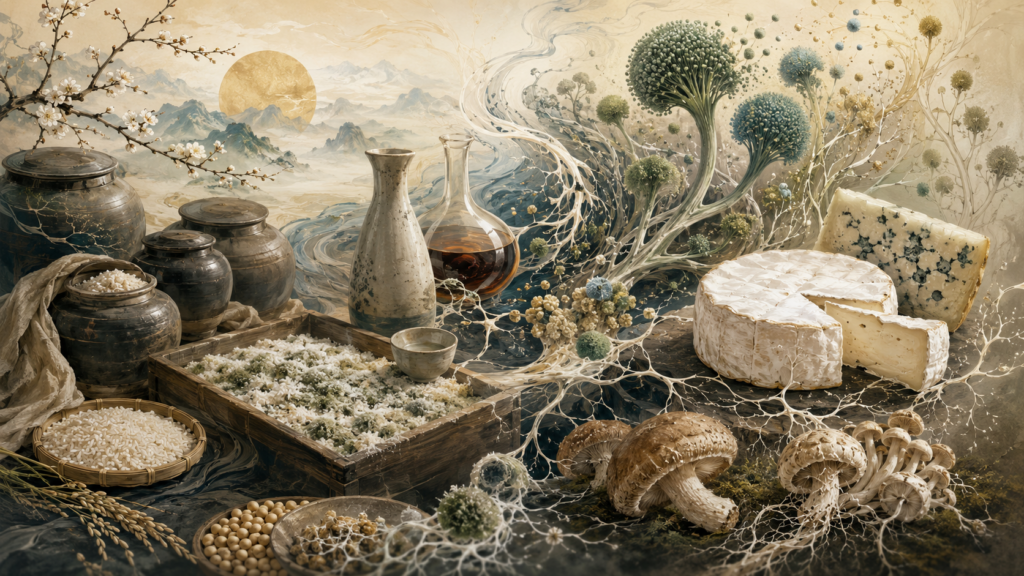
For centuries, fungal metabolism shaped regional food systems. Aspergillus oryzae (koji) was central to the production of soy sauce, miso, sake, and other East Asian fermented products, converting starches and proteins into flavor compounds, amino acids, and digestible nutrients. In Europe, fungal ripening cultures—especially species of Penicillium—defined the character of cheeses such as Camembert, Brie, and blue cheeses.
Fungal. Feminine. Fierce.
Traditional mushroom cultivation and the use of mould-rich grain fermentations further demonstrated that fungi could function simultaneously as food organisms, enzyme sources, and texture modifiers. These practices were empirical rather than engineered, but they established a practical understanding of fungal growth, solid-state fermentation, and metabolite production that still informs industrial approaches today.
The Rise of Industrial Fungal Biotechnology
Industrial fungal biotechnology took clearer form in the early twentieth century with the large-scale production of organic acids and enzymes. Aspergillus niger became the dominant organism for citric acid manufacturing, a process that remains one of the most successful examples of fungal fermentation at commodity scale. The same genus, along with Aspergillus oryzae and related species, proved highly effective for the secretion of amylases, proteases, and other food-grade enzymes. Trichoderma reesei (originally isolated as a cellulase producer) later emerged as a workhorse for industrial enzyme production, particularly cellulases and hemicellulases used in biofuels, textiles, and food processing.
The medical impact of fungi was equally profound. The discovery and subsequent industrial production of penicillin from Penicillium species transformed both antibiotic manufacturing and the broader trajectory of microbial biotechnology. Later, Fusarium venenatum was developed into a commercial mycoprotein platform, demonstrating that filamentous fungi could serve as a primary protein source rather than merely a vehicle for secreted products.
A Manufacturing Universe, Not a Single Platform
The historical record makes one point unmistakable: fungi have never been a single technological category. They have functioned as food organisms, enzyme factories, antibiotic producers, organic acid platforms, pigment sources, biomass generators, and, more recently, as the basis for mycelium-based materials and functional ingredients such as beta-glucans and fungal chitosan.
Modern fungal fermentation work inherits this full spectrum. A sponsor may arrive with a recombinant enzyme expressed in Aspergillus or Trichoderma, an edible mycoprotein or mycelial biomass, a mycelium-derived biomaterial concept, a mushroom-inspired cosmetic active, an animal feed enzyme or additive, a beta-glucan ingredient, or a fungal pigment. Each of these targets imposes different requirements on strain physiology, morphology control, oxygen transfer, downstream processing, analytical characterization, and regulatory strategy.
This is the central insight for any serious fungal fermentation CDMO: fungi are not a checkbox on a capabilities list. They represent a family of living manufacturing systems that must be understood organism by organism, product by product, and process by process. The difference between success and failure often lies less in generic fermentation expertise than in the specific ability to manage filamentous morphology, viscosity, secretion pathways, secondary metabolism, and application-specific quality attributes.
In short, the history of fungal fermentation is not a linear story of progressive sophistication. It is a demonstration of biological versatility—one that continues to expand as mycelium materials, precision fermentation in filamentous hosts, and next-generation food and cosmetic ingredients move from research into commercial production.
Platform Reality
1. Fungi Are Not One Platform
A credible fungal fermentation CDMO should not treat “fungi” as a single platform.
Aspergillus, Trichoderma, Fusarium, Rhizopus, Neurospora, Penicillium, Ganoderma, Cordyceps, edible mushroom species, and yeast-like fungi can behave like completely different manufacturing systems.
Some are useful enzyme secretors. Some are biomass producers. Some create pigments. Some make polysaccharides. Some form dense mycelial structures. Some are better for food or feed. Some are more suited to industrial biotechnology. Some carry more regulatory or safety complexity.
A sponsor should ask the CDMO which fungal hosts it understands and why a specific organism is being recommended.
“Fungal” is not an answer. It is the beginning of the question.
2. Filamentous Fungi Are Not Bacteria With Branches
Filamentous fungi do not behave like ordinary microbial cells that simply happen to be longer. They restructure the entire physical environment of the fermentation from the inside. Hyphae extend, branch, and intertwine into dense networks.
These networks can collapse into compact pellets or remain dispersed, dramatically altering how the broth moves, breathes, and responds to mixing. As biomass increases, the culture thickens. Viscosity rises. Oxygen struggles to penetrate the growing mass. Local mixing becomes uneven. Foam can build aggressively. Harvest grows more difficult. Downstream clarification turns slower, more expensive, and more sensitive to the exact morphological state of the culture.

In bacterial or yeast systems, process limitations usually appear as familiar metabolic constraints: biomass ceiling, substrate exhaustion, pH drift, or induction timing. In filamentous fungal systems the limiting factor is often the geometry of growth itself. The organism does not merely occupy the liquid; it reorganizes it. Hyphal networks create internal diffusion barriers. Pellets develop oxygen-starved cores even while the surrounding broth remains well-aerated. Rheology shifts from Newtonian toward highly non-Newtonian behavior, so that standard correlations for oxygen transfer and mixing power no longer hold.
This is why filamentous fermentation cannot be treated as “bacteria with branches.” The CDMO must understand the fungus simultaneously as living biology and as a dynamic physical structure. Morphology is not a side effect — it is a primary process variable. The way the organism fills, thickens, and divides the space inside the bioreactor directly determines oxygen availability, shear exposure, foam behavior, and the cost of recovery. A process that ignores this structural dimension may look healthy at small scale and collapse when the same geometry is asked to perform at volume.
3. Morphology Is a Process Variable
Morphology is not a side effect. It is a process variable.
Pellet size, pellet density, filament length, clumping, dispersed growth, wall growth, mycelial fragmentation, and morphology drift can change productivity, secretion, oxygen transfer, viscosity, shear response, harvest behaviour, and downstream recovery.
For enzyme production, morphology may influence secretion.
For mycoprotein, morphology may influence texture.
For biomaterials, morphology may influence mechanical behaviour.
For pigments or metabolites, morphology may influence productivity and extraction.
For recombinant fungal expression, morphology may influence process consistency.
A strong fungal CDMO should be able to discuss how morphology is created, preserved, measured, and scaled.
4. Solid-State vs Submerged Fermentation Is Strategic
Fungal fermentation may use submerged fermentation or solid-state fermentation. This is not a minor technical preference. It changes the whole programme.
Submerged fermentation is usually more compatible with stirred-tank systems, controlled pH, dissolved oxygen monitoring, sampling, feeding, and conventional bioprocess scale-up.
Solid-state fermentation can be useful for certain enzymes, fermented foods, fungal biomass, pigments, agricultural products, and traditional fungal processes, but it brings different challenges around moisture, heat transfer, contamination risk, aeration, substrate consistency, extraction, and scale.
A serious fungal CDMO should know when submerged fermentation is cleaner and when solid-state fermentation is technically or commercially attractive.
5. Product Location Determines Process Design
A fungal product may be:
- secreted into the broth
- retained inside the biomass
- attached to the cell wall
- part of the mycelial structure
- present as a pigment
- produced as a secondary metabolite
- recovered as an enzyme
- extracted as a polysaccharide
- sold as whole biomass
- processed into a material
This matters because harvest and downstream recovery change completely depending on product location.
A secreted enzyme may need clarification and concentration. A beta-glucan may need extraction. A mycoprotein may need biomass recovery and texture control. A pigment may need solvent or aqueous extraction. A mycelium biomaterial may need growth control, pressing, drying, and finishing.
A fungal CDMO should ask where the product is before proposing how to manufacture it.
Strain, Biology, and Safety
6. Strain Identity and Species Selection Matter
Strain identity is not administrative detail. It affects productivity, safety, quality, regulation, reproducibility, and intellectual property.
A fungal strain should be understood in terms of:
- species identity
- strain history
- source and provenance
- preservation method
- production phenotype
- safety profile
- known metabolites
- genetic stability
- suitability for food, feed, cosmetic, animal health, industrial, or GMP-adjacent use
For novel food, feed additive, cosmetic, or animal health applications, strain identity can become a central development issue.
The wrong strain can make the right product commercially difficult.
7. Genetic Stability and Morphological Drift Must Be Controlled
Filamentous fungi can change across passages, seed trains, storage cycles, and scale-up.
A few extra passages, a slightly altered inoculum, or scale-up stress can shift productivity, morphology, viscosity, and pigment formation. The validated pellet form can become a difficult filamentous broth, and the process can drift before the sponsor realises the organism has changed the rules.
Enzyme secretion weakens. Secondary metabolite profiles rearrange themselves under stress in ways that can range from merely inconvenient to regulatory-threatening.
This is not bacterial-style plasmid loss (although that can occur in recombinant fungal systems). It is a more diffuse, physiology-driven instability rooted in the biology of filamentous growth, multinucleate hyphae, epigenetic regulation, and the organism’s long evolutionary habit of adapting to changing environments. In practical terms, the fungus you put into the first shake flask is not guaranteed to be the same manufacturing organism that arrives in the 10,000 L vessel three months later.
A competent fungal fermentation CDMO therefore treats culture stability as a core process control problem rather than an afterthought. At minimum, the following should be systematically tracked across the entire lineage from master cell bank to production:
- Productivity (titer, specific productivity, and consistency of the target molecule or biomass quality)
- Morphology (pellet size distribution, hyphal branching frequency, viscosity contribution)
- Growth rate and lag phase behavior under standardized conditions
- Product quality attributes (activity, molecular weight distribution, glycosylation if relevant, color, sensory or functional performance)
- Contaminant and pure-culture profile (including the possibility of sectoring or morphological variants arising within a single culture)
- Genetic stability where applicable (especially for recombinant strains — integration sites, copy number, expression cassette integrity)
- Seed train reproducibility (performance metrics at every step, not just the final production stage)
- Complete passage history and generation number
- Working cell bank / culture bank controls, including viability after storage, recovery kinetics, and phenotypic consistency upon revival
The practical implication is straightforward: a fungal process cannot be considered robust if the organism itself is allowed to drift.
Many late-stage surprises in fungal fermentation — sudden viscosity spikes, loss of titer, appearance of unwanted pigments or metabolites, or failure to scale — can be traced back to uncontrolled culture history rather than a fundamental flaw in the process design.
In short, the fungus is not a static reagent. It is a living manufacturing system with a memory. A CDMO that fails to manage that memory is not running a process; it is running a continuous evolutionary experiment inside the bioreactor.
8. Spore Control Is Not Optional
Spores matter.
They affect containment, cleaning, worker exposure, cross-contamination risk, product purity, environmental control, and batch reproducibility. Some fungal processes rely on spores for inoculation. Others need to minimise sporulation during production.
A CDMO should have a clear spore control and containment strategy, especially for multi-product facilities, cosmetic ingredients, food or feed materials, and animal health products.
Spore behaviour is one of the areas where a generic fermentation shop can get exposed quickly.
9. Secondary Metabolite and Mycotoxin Risk Must Be Assessed
Fungi are chemically talented. That is the opportunity and the risk.
Some fungi can produce unwanted secondary metabolites, including mycotoxin-adjacent or safety-relevant compounds, depending on species, strain, stress, substrate, pH, oxygen, temperature, and media conditions.
Even when a strain is commonly used, a responsible development programme should consider whether the process could create unwanted metabolites under production conditions.
This is especially important for:
- mycoprotein
- food ingredients
- feed ingredients
- animal health products
- cosmetic bioactives
- fungal pigments
- mushroom-derived materials
- fermented side-stream products
- novel fungal strains
A good fungal fermentation CDMO does not wait for safety questions to appear late. It builds risk assessment into the programme.
10. Protease and Hydrolase Activity Can Destroy the Product
Many fungi secrete proteases, glycosidases, lipases, cellulases, chitinases, and other hydrolases. That can be useful when the product is the enzyme. It can be destructive when the product is a recombinant protein, peptide, bioactive fraction, structural polysaccharide, or sensitive ingredient.
Protease and hydrolase control may involve:
- strain choice
- media design
- pH control
- temperature control
- harvest timing
- protease-deficient strains where available
- inhibitor strategy where appropriate
- rapid downstream processing
- product integrity analytics
A high titre means little if the product is being clipped, hydrolysed, or structurally damaged during the same process that makes it.
Process Engineering
11. Viscosity Is Often the Real Scale-Up Limiter
Fungal fermentation often fails through physics before it fails through biology.
A process can look productive in shake flasks or small vessels and then become limited by viscosity at pilot scale. As broth thickens, mixing becomes less efficient, oxygen transfer falls, heat removal worsens, sampling becomes less representative, and downstream recovery becomes more difficult.
Many fungal processes become oxygen-limited before they reach theoretical biomass or titre ceilings.
A serious fungal fermentation CDMO should discuss viscosity early, not after scale-up starts to struggle.
12. Oxygen Transfer Must Be Designed for Fungal Broth
Fungal broths are among the most demanding systems in industrial fermentation when it comes to oxygen transfer. Unlike many bacterial or yeast processes, filamentous fungal cultures rapidly alter the physical structure of the broth itself. As biomass increases, the network of hyphae raises viscosity, changes rheology, and creates a non-Newtonian fluid that resists both mixing and gas–liquid mass transfer. Dissolved oxygen, aeration rate, impeller design, agitation speed, sparging strategy, shear forces, foam behavior, viscosity, and morphology do not operate independently — they form a tightly coupled system in which a change in one variable immediately affects the others.
Standard assumptions carried over from bacterial fermentation frequently fail here. In many bacterial processes, oxygen transfer can be improved relatively predictably by increasing agitation or air flow. In filamentous fungal systems, the same interventions can destroy the desired morphology, generate excessive foam, or create large mixing gradients that leave significant portions of the broth oxygen-starved. Pellet-forming cultures and dispersed filamentous cultures present different problems: pellets may protect internal biomass from shear but create diffusion limitations inside the pellet, while dispersed hyphae can drive viscosity so high that the broth becomes almost unmixable at commercial scale.
A competent fungal fermentation CDMO must therefore treat oxygen transfer as a design problem rather than a simple operating parameter. Critical considerations include:
- Accurate measurement and modeling of the oxygen transfer coefficient (kLa) under actual fungal broth conditions rather than water or simple media
- Selection of impeller type and configuration (Rushton, hydrofoil, pitched-blade, or combinations) that balances gas dispersion against shear damage to hyphae
- Aeration rate and sparger design that maintain adequate gas hold-up without driving uncontrolled foam
- Foam formation dynamics and antifoam strategies that do not impair oxygen transfer or product quality
- Control of pellet size and morphology, because pellet structure directly influences both external mass transfer and internal oxygen diffusion
- The agitation/shear balance required to keep the culture productive without fragmenting mycelium or collapsing morphology
- Peak oxygen demand at high biomass concentrations, when viscosity is highest and transfer rates are most constrained
- Scale-dependent mixing gradients and the risk of oxygen-limited zones in large vessels that do not appear in laboratory or pilot equipment
In fungal systems, oxygen is rarely just another process variable. It is frequently the primary bottleneck that determines whether a process can be scaled successfully.
A CDMO that treats oxygen transfer as a secondary concern — or applies generic bacterial fermentation assumptions — will often discover the limitation only after significant time and material have already been invested. Designing the oxygen-transfer strategy around the specific rheology and morphology of the fungal strain is therefore one of the clearest indicators of real filamentous fermentation competence.
13. Shear Sensitivity Must Be Actively Managed
Fungal mycelium can be damaged by excessive shear, but under-mixing can starve the culture of oxygen. This creates a tight operating window.
Too much shear may fragment productive morphology, reduce secretion, damage biomass structure, or change product quality. Too little shear may cause clumps, oxygen limitation, heat gradients, and inconsistent growth.
The right mixing strategy depends on product type. Mycoprotein, secreted enzyme, biomass pigment, mycelium biomaterial, and recombinant protein production may all prefer different morphology and shear conditions.
The vessel should not punish the organism into submission. It should hold the culture in the right state: enough movement, enough contact, enough pressure to keep the process alive, but not so much force that the structure breaks before the product is ready.
14. Foaming Can Become a Product-Quality Problem
Fungal cultures can foam heavily. Foam is not only inconvenient. It can affect contamination risk, oxygen transfer, working volume, sensor performance, antifoam carryover, downstream purification, and product quality.
Antifoam selection matters. Some antifoams can interfere with oxygen transfer, chromatography, filtration, enzyme activity, cosmetic compatibility, or food/feed acceptability.
A fungal CDMO should not treat foam as a nuisance to be suppressed at any cost. It should understand foam as part of the process system.
15. Media Design Is Highly Organism-Specific
Fungal media design can be more subtle than generic sugar-plus-nitrogen thinking.
Fungi may respond strongly to:
- carbon source
- nitrogen source
- organic acids
- trace elements
- phosphate
- salts
- pH
- complex media components
- substrate particle size
- lignocellulosic hydrolysates
- side-stream feedstocks
- oils or lipids
- inducer compounds
- carbon/nitrogen ratio
Media affects growth, morphology, enzyme secretion, pigment production, biomass quality, secondary metabolite risk, and downstream burden.
For fungal precision fermentation, media can also influence recombinant expression, impurity profile, and cost of goods.
16. Seed Train Design Must Preserve Target Morphology
The production vessel cannot always rescue a poor seed train.
A fungal seed train should build the desired morphology from vial or stock culture through shake flask, seed reactor, pilot scale, and production scale. Inoculum type, spore density, age, agitation, medium, pH, temperature, and transfer timing all matter.
A seed train that creates the wrong morphology can create downstream problems in the main fermenter.
Sponsors should ask whether the CDMO can preserve morphology across scale, not merely grow biomass.
17. Fed-Batch and Continuous Strategies Should Follow Morphology
Feeding strategy should not be based only on residual sugar or biomass.
In fungal systems, feeding affects morphology, viscosity, oxygen transfer, secretion, protease formation, product quality, and secondary metabolism. A fed-batch process may improve productivity, but it can also increase viscosity or trigger unwanted metabolites if poorly designed.
Continuous or semi-continuous approaches may be attractive for certain enzyme, biomass, or metabolite processes, but they require control of contamination risk, strain stability, product consistency, and morphology over time.
The best process strategy follows the organism’s physical state as much as its metabolic state.
Product-Specific Fungal CDMO Services
18. Mycoprotein Requires Texture, Nutrition, Sensory, and Safety Control
Mycoprotein is not simply fungal biomass.
A mycoprotein CDMO should understand:
- fungal strain selection
- biomass texture
- fibre structure
- water-holding capacity
- RNA control where relevant
- protein content
- amino acid profile
- flavour
- odour
- colour
- drying
- side-stream feedstocks
- food safety
- allergen review
- scale-up economics
- consumer format
The commercial question is not only whether biomass can be produced. It is whether that biomass can become a food ingredient with acceptable taste, texture, nutrition, safety, and cost.
Mycoprotein is where fungal fermentation becomes both biomanufacturing and food architecture.
19. Fungal Enzymes Require Activity-First Development
Fungi are excellent enzyme factories. They can produce cellulases, xylanases, amylases, glucoamylases, proteases, lipases, phytases, laccases, beta-glucanases, food enzymes, feed enzymes, textile enzymes, detergent enzymes, biomass conversion enzymes, and cosmetic enzymes.
But enzyme development must be activity-first.
A fungal enzyme CDMO should evaluate:
- enzyme identity
- total activity
- specific activity
- pH optimum
- temperature optimum
- substrate profile
- thermostability
- formulation compatibility
- drying stability
- storage stability
- activity after processing
- performance in the final application
Purity is useful. Activity is decisive.
20. Beta-Glucans Need Molecular and Structural Characterisation
Fungal beta-glucans and polysaccharides are attractive for cosmetic, food, feed, nutraceutical-adjacent, animal health, and functional ingredient concepts. But they are not simple powders.
A beta-glucan CDMO should understand:
- extraction method
- molecular weight
- branching structure
- solubility
- viscosity
- purity
- protein impurities
- colour
- odour
- microbial quality
- stability
- formulation compatibility
- claim boundaries
Cosmetic applications depend on skin feel, preservative compatibility, sensory elegance, and formula stability. Food and feed products bring different priorities: texture, dispersibility, safety, palatability, and documentation. In animal health, the real test is practical performance, stability, species fit, and commercial durability.
Beta-glucan quality is structural, not only compositional.
21. Fungal Chitosan Requires Material-Quality Control
Fungal chitosan and chitin-derived materials are niche but valuable. They can support cosmetic film formers, encapsulation systems, agricultural bioactives, biomaterials, wound-care-adjacent non-drug materials, animal health concepts, and specialty industrial applications.
A fungal chitosan CDMO should control:
- degree of deacetylation
- molecular weight
- viscosity
- purity
- ash
- colour
- odour
- solubility
- film-forming behaviour
- particle size
- residual proteins
- application-specific performance
Chitosan is not just “chitin derivative.” Its behaviour changes dramatically with molecular profile.
22. Fungal Pigments Need Stability, Purification, and Impurity Control
Fungal pigment fermentation is a growing niche for natural colour, cosmetic colour systems, food-adjacent concepts, textile concepts, antioxidant-positioned ingredients, and speciality bioactives.
Fungal pigment programmes should address:
- colour strength
- hue consistency
- extraction method
- pigment location
- photostability
- pH stability
- oxidation
- solvent residues
- odour
- impurities
- batch consistency
- safety profile
- regulatory category
Pigments are visually obvious products. Small inconsistencies become highly visible to customers.
A fungal pigment CDMO should therefore think like both a bioprocess team and a colour-quality team.
23. Mycelium Biomaterials Require Post-Processing Expertise
Mycelium biomaterials are not finished when the fungus grows.
A mycelium biomaterials CDMO should understand:
- substrate choice
- inoculation
- density
- growth uniformity
- contamination control
- thickness
- drying
- pressing
- heat treatment
- chemical treatment
- crosslinking
- mechanical strength
- water activity
- flexibility
- texture
- finishing interfaces
Applications may include packaging, leather alternatives, foams, insulation, panels, scaffolds, textiles, and biodegradable materials.
The commercial product is built through both growth and post-processing. Fermentation creates the biological architecture. Processing makes it usable.
24. Fungal Cosmetic Bioactives Need Sensory Discipline
Fungal cosmetic bioactives can be scientifically interesting and commercially difficult.
They may include mushroom-inspired extracts, mycelium bioactives, beta-glucans, chitosan-derived materials, fungal enzymes, pigments, fermented fractions, scalp bioactives, barrier-support ingredients, and postbiotic-style materials.
The issue is that cosmetic products must feel good.
A fungal ingredient can fail because it smells too fermented, darkens the formula, changes viscosity, destabilises an emulsion, feels tacky, irritates sensitive skin, or conflicts with preservatives or fragrance.
A fungal cosmetic bioactive must be technically credible and sensorially elegant. Both matter.
25. Animal Health and Feed Fungal Products Need Practical Performance Testing
Fungal products for animal health and feed often need different development logic than human cosmetics or food ingredients.
Products may include:
- feed enzymes
- fungal postbiotics
- fermented feed ingredients
- rumen bioactives
- aquaculture ingredients
- poultry ingredients
- swine and cattle products
- mycotoxin-adjacent enzyme systems
- digestive-support enzymes
- animal health bioactives
Key questions include stability, activity retention, palatability, pelleting tolerance, water compatibility, carrier compatibility, field-use logic, and cost of goods.
Animal health products must be technically sound and commercially practical. No theatre. No fluff. The animal, the feed mill, and the supply chain will tell the truth.
Downstream, Analytics, and Quality
26. Harvest and Dewatering Can Dominate Cost
Fungal biomass can be difficult to separate. High-viscosity broth, filamentous solids, pellets, extracellular polymers, foam, and biomass-bound product can make harvest expensive.
A CDMO should understand:
- centrifugation
- filtration
- pressing
- dewatering
- depth filtration
- membrane fouling
- solids handling
- drying energy
- product loss during separation
- biomass damage
- enzyme recovery from high-solids broth
In some fungal processes, the fermentation works and the economics die at harvest.
A good fungal fermentation CDMO thinks about downstream from the beginning.
27. Biomass Quantification Needs Methods Beyond OD
Optical density is often weak for filamentous fungi.
Filaments scatter light inconsistently. Pellets settle. Clumps distort samples. Biomass may attach to vessel surfaces. Broth viscosity can make representative sampling difficult.
Better approaches may include:
- dry cell weight
- packed mycelial volume
- image analysis
- microscopy
- DNA-based methods
- metabolite tracking
- off-gas analysis
- process-specific biomass proxies
- substrate consumption
- product formation rate
A process cannot be controlled if biomass is measured poorly.
28. Analytics Must Match the Product Category
A fungal enzyme, mycoprotein, beta-glucan, chitosan, pigment, cosmetic active, animal health ingredient, biomaterial, and recombinant protein all need different analytical packages.
Possible analytics include:
- identity testing
- species confirmation
- biomass composition
- protein content
- enzyme activity
- specific activity
- molecular weight
- branching analysis
- degree of deacetylation
- pigment profile
- residual solvents
- microbial quality
- mycotoxin or secondary metabolite testing
- moisture
- ash
- viscosity
- particle size
- stability
- sensory testing
- mechanical testing
- application performance
A generic CoA is not enough. The analytics must match what the product is supposed to do.
29. Regulatory Pathway Depends on End Use
A fungal-derived product may fall under food, feed, cosmetic, animal health, industrial, biA fungal-derived product is not regulated by its organism alone. It is regulated by what the product becomes, how it is used, who is exposed to it, how much biological material remains, what claims are made, and what level of quality evidence is required for the market.
The same fungal strain can sit inside completely different regulatory worlds depending on the final application. A secreted enzyme used in textile processing does not carry the same expectations as a fungal protein used in food. A beta-glucan in a cosmetic serum does not require the same package as a feed additive. A mycelium biomaterial does not need the same controls as a diagnostic reagent. A fungal recombinant protein entering a GMP-path biologic process sits in a different universe again.
A fungal-derived product may fall under:
- food ingredient expectations
- novel food review
- GRAS-style positioning
- feed additive requirements
- animal health documentation
- cosmetic ingredient controls
- industrial enzyme quality systems
- biomaterial specifications
- nutraceutical-adjacent claim limits
- diagnostic reagent expectations
- pharma or GMP-adjacent CMC requirements
That means a fungal CDMO must ask the regulatory question early: what is the product’s real destination?
Is it eaten? Applied to skin? Added to animal feed? Used as a cosmetic active? Built into a material? Sold as an industrial enzyme? Used in a diagnostic assay? Integrated into a GMP biologics process? Each path changes the required documentation, testing, impurity control, microbial limits, traceability, stability package, and claim language.
This is where many fungal programmes become overbuilt or underbuilt. Too little control creates safety, quality, and investor risk. Too much irrelevant quality theatre creates cost, delay, and confusion without improving the product.
A serious fungal CDMO should right-size the development package. It should know when the programme needs food-grade documentation, cosmetic claim support, feed-use stability, enzyme activity data, mycotoxin risk assessment, strain identity records, microbial quality testing, residual solvent control, or full GMP-style CMC discipline.
Proper development is not maximum documentation. It is fit-for-purpose quality: enough control to make the product credible, safe, reproducible, transferable, and commercially usable in its intended category.
30. Commercial Success Depends on Application-Specific Translation
The same fungal platform behaves differently when the output is mycoprotein, enzyme, beta-glucan, pigment, chitosan, cosmetic active, feed ingredient, biomaterial, or recombinant protein.
A serious fungal fermentation CDMO must connect:
- organism
- strain
- morphology
- fermentation
- downstream recovery
- analytics
- stability
- documentation
- final application
- commercial use
This is the real test.
Not “can you grow fungi?”
Not “do you have fermenters?”
Not “can you make biomass?”
The question is sharper: can the CDMO turn fungal biology into a controlled product that survives scale, testing, documentation, and the market?
That is the difference between a fermentation vendor and a fungal manufacturing partner.
10 Red Flags When Choosing a Fungal Fermentation CDMO
A sponsor should be cautious if a CDMO:
- Says “fungal fermentation” without naming host systems.
- Does not discuss pellet versus filamentous morphology.
- Ignores viscosity and oxygen transfer.
- Cannot explain solid-state versus submerged fermentation.
- Treats mycoprotein like generic biomass.
- Treats fungal enzymes like generic proteins.
- Does not mention mycotoxin or secondary metabolite risk.
- Cannot explain dewatering, drying, or solids handling.
- Uses one analytical package for every fungal product.
- Cannot connect process design to food, feed, cosmetic, animal health, biomaterial, or recombinant protein use.
These are not academic objections. They are the things that break real programmes.
What Sophia CDMO Brings to Fungal Fermentation
Sophia CDMO supports fungal fermentation and adjacent microbial development for sponsors working across advanced bioactives, enzymes, animal health, cosmetics, food, feed, precision fermentation, and industrial biotechnology.
Relevant Sophia-supported programme types include:
- fungal fermentation services
- mycoprotein development
- fungal enzyme production
- mycelium bioactive manufacturing
- beta-glucan and polysaccharide development
- fungal chitosan and chitin-derived material concepts
- fungal pigment fermentation
- fungal cosmetic bioactives
- animal health fungal ingredients
- feed enzyme development
- fermented food and feed bioactives
- precision fermentation products
- fungal process rescue
- downstream recovery
- drying and stability strategy
- analytical characterisation
- European manufacturing pathways
Sophia’s position is not that every fungal product is easy. The point is the opposite. Fungal products are valuable because they are complex. They need a CDMO that can think past the surface of fermentation and into the real mechanics of organism, broth, product, recovery, quality, and market use.
For sponsors working with unusual fungi, strange broths, difficult biomass, unstable enzymes, ambitious cosmetic bioactives, novel mycoproteins, sticky downstream processes, or category-crossing ingredients, that thinking matters.
FAQ: Fungal Fermentation CDMO Services
1. What are fungal fermentation CDMO services?
Fungal fermentation CDMO services support the development, scale-up, downstream recovery, analytics, stability, documentation, and manufacturing of products made using fungi, including enzymes, mycoprotein, beta-glucans, chitosan, pigments, mycelium bioactives, biomaterials, feed ingredients, cosmetic actives, and precision fermentation products.
2. What products can be made by fungal fermentation?
Fungal fermentation can support mycoprotein, industrial enzymes, feed enzymes, food enzymes, cosmetic enzymes, beta-glucans, chitosan, fungal pigments, organic acids, biomass ingredients, mycelium biomaterials, animal health ingredients, and fermentation-derived bioactives.
3. What is the difference between fungal and bacterial fermentation?
Fungal fermentation often involves filamentous growth, pellets, mycelium, higher viscosity, different oxygen-transfer behaviour, protease secretion, and harder downstream clarification. Bacterial fermentation usually involves simpler suspended-cell behaviour.
4. What is mycoprotein CDMO manufacturing?
Mycoprotein CDMO manufacturing supports fungal biomass production for food, feed, or nutrition applications. It may involve strain selection, biomass growth, texture control, flavour and odour control, drying, safety review, and scale-up.
5. Can fungi produce enzymes?
Yes. Fungi are widely used to produce enzymes such as cellulases, xylanases, amylases, glucoamylases, proteases, lipases, phytases, laccases, and beta-glucanases for food, feed, textile, detergent, biomass, cosmetic, and industrial applications.
6. What are fungal beta-glucans?
Fungal beta-glucans are polysaccharides derived from fungal cell walls or fermentation processes. They may be used in cosmetic, food, feed, animal health, and functional ingredient concepts, depending on purity, molecular structure, and claim category.
7. What is fungal chitosan?
Fungal chitosan is a chitin-derived material produced from fungal biomass rather than crustacean sources. It may be used in film-forming, encapsulation, cosmetic, agricultural, biomaterial, or specialty ingredient applications.
8. Can fungi produce cosmetic bioactives?
Yes. Fungal fermentation can support cosmetic bioactives such as beta-glucans, enzymes, chitosan-derived materials, mushroom-inspired extracts, fermented fractions, pigments, mycelium bioactives, scalp ingredients, and barrier-support materials.
9. Why is morphology important in fungal fermentation?
Morphology affects oxygen transfer, viscosity, secretion, productivity, shear sensitivity, harvest, filtration, and downstream processing. Pellet, clump, and dispersed filamentous growth can create very different manufacturing outcomes.
10. Why is viscosity a problem in fungal scale-up?
Viscosity reduces mixing, oxygen transfer, heat removal, sampling accuracy, and harvest efficiency. A fungal process can be biologically productive but commercially difficult if viscosity is not controlled.
11. What is solid-state fungal fermentation?
Solid-state fungal fermentation grows fungi on moist solid substrates rather than fully submerged liquid culture. It may be useful for enzymes, fermented foods, fungal biomass, pigments, and agricultural products, but scale-up and control are different from submerged fermentation.
12. What is submerged fungal fermentation?
Submerged fungal fermentation grows fungi in liquid media inside controlled vessels. It is often better suited for conventional bioreactor control, feeding, pH monitoring, dissolved oxygen monitoring, sampling, and scale-up.
13. What are mycotoxin risks in fungal fermentation?
Some fungal strains can produce unwanted secondary metabolites under certain conditions. Food, feed, cosmetic, animal health, and biomaterial products may require testing or risk assessment for strain- and process-specific compounds.
14. Can Sophia CDMO support fungal cosmetic bioactives?
Yes. Sophia CDMO can support fungal cosmetic bioactives, including fermented fungal ingredients, beta-glucans, chitosan-derived materials, fungal enzymes, pigments, mycelium bioactives, scalp ingredients, and barrier-support concepts.
15. Can Sophia CDMO support fungal animal health ingredients?
Yes. Sophia CDMO can support fungal animal health and feed-related products such as feed enzymes, fungal postbiotic-style materials, fermented feed ingredients, rumen bioactives, aquaculture ingredients, and livestock bioactives.
16. Can Sophia CDMO support mycoprotein development?
Yes. Sophia CDMO can support mycoprotein development through fungal strain and process development, biomass production, downstream recovery, drying strategy, texture considerations, sensory review, safety documentation, and scale-up pathways.
17. What information should sponsors provide before contacting a fungal CDMO?
Sponsors should provide strain identity, product type, target application, existing fermentation data, media, titre or biomass data, morphology observations, downstream method, analytical methods, safety concerns, documentation needs, target scale, and timeline.
18. Why choose a European fungal fermentation CDMO?
A European fungal fermentation CDMO can support technical development, quality documentation, regulatory awareness, controlled scale-up, and manufacturing pathways for sponsors targeting food, feed, cosmetic, animal health, biomaterial, industrial, or precision fermentation markets.
Conclusion
Fungi are not just another microbe.
They are enzyme factories, biomass builders, pigment producers, polymer sources, mycelium architects, side-stream transformers, and bioactive manufacturing systems. That is why fungal fermentation is exciting. It is also why it is difficult.
A real fungal fermentation CDMO needs to understand morphology, viscosity, oxygen transfer, shear, spores, proteases, mycotoxins, seed trains, downstream solids, drying, analytics, stability, documentation, and application-specific performance.
In plain terms: fungi can do a lot. They also make you earn it.
Sophia CDMO supports sponsors developing fungal enzymes, mycoprotein, mycelium bioactives, beta-glucans, chitosan, pigments, cosmetic bioactives, animal health ingredients, feed products, biomaterials, and precision fermentation products through controlled development, fermentation, downstream recovery, analytics, and European manufacturing pathways.
The easy CDMO answer is “yes, we can ferment it.”
The better answer is:
What organism, what morphology, what product, what downstream route, what analytical package, what documentation level, and what market us
That is where fungal programmes become real.
Contact Sophia CDMO: info@sophiacdmo.com