
The best Recombinant Protein CDMO Europe partner is not simply the provider with the largest fermenter, the longest host-system list, or the loudest claim about “full-service” protein expression. The best recombinant protein CDMO is the one that can match the molecule to the right expression host, construct design, fermentation process, purification strategy, impurity-control plan, analytical package, formulation route, GMP stage, and technology-transfer model.
That is the central point buyers should understand before selecting a recombinant protein CDMO in Europe: recombinant protein manufacturing is a matching problem.
A protein does not become manufacturable because a gene can be cloned. It becomes manufacturable when the host, process, folding environment, downstream method, analytical method, formulation, quality system, and commercial use all fit the protein’s actual behaviour.
Sophia CDMO is built for this type of buyer problem. The company positions itself as a European CDMO operating from Pamplona, Spain, for microbial and precision fermentation scale up to 20,000 L, and Basel, Switzerland, for large-scale biomanufacturing capacity up to 40,000 L. Its platform describes integrated process development, analytical development, GMP manufacturing, quality systems, E. coli expression, microbial recombinant products, animal health biologics, and fermentation-enabled markets.
This guide is written for sponsors searching for a Recombinant Protein CDMO Europe partner and trying to answer a more precise question:
Which CDMO can actually make this protein work?
Why “Recombinant Protein CDMO Europe” Is a High-Intent Search
Sponsors searching for a Recombinant Protein CDMO in Europe are rarely looking for basic expression capacity. They are usually already facing a specific technical risk.
The protein may express but fail to fold correctly. It may fold but aggregate under concentration. It may purify cleanly by SDS-PAGE yet lose activity in functional assays.
A process that works at laboratory scale often collapses at 10 L. E. coli material can carry endotoxin issues. Pichia products frequently show clipping. A research-grade protein may prove unsuitable for diagnostic, veterinary, cosmetic, food, feed, or GMP-adjacent use.
Typical problems driving this search include:
- E. coli protein remains insoluble
- Inclusion body refolding yields are too low
- Pichia product is clipped or unstable
- Diagnostic antigen shows poor lot-to-lot consistency
- VHH aggregates after concentration
- Enzyme activity drops after purification
- Academic process cannot be transferred
- Material requires GMP-like documentation without mammalian-biologic cost
- Current partner can express but cannot control downstream impurities
- Need for a European partner that handles microbial scale-up, analytics, and quality systems together
The real search intent is not “Who can express a protein?” It is “Who can keep the programme intact when expression, purification, analytics, and manufacturing constraints collide?”
That gap separates a simple expression service from a true recombinant protein CDMO.
The Core Thesis: Recombinant Protein Manufacturing Is a Matching Problem
Recombinant protein manufacturing is not one service. It is a sequence of technical decisions that must fit together.
The sequence usually looks simple:
- Choose a host.
- Clone the gene.
- Express the protein.
- Purify it.
- Test it.
- Formulate it.
- Manufacture it.
- Transfer it.
In reality, each step changes the next one.
A construct designed for high expression may overload folding. A host chosen for speed may create an impurity burden. A purification method chosen for yield may compromise activity. A formulation chosen for stability may interfere with the assay. A process that works at flask scale may fail when oxygen transfer, heat removal, feeding strategy, viscosity, foam, proteolysis, or harvest timing changes.
A useful buyer framework is this:
| Product Type | Likely Starting Host | Main Risk | CDMO Support Needed |
|---|---|---|---|
| Non-glycosylated enzyme | E. coli or Pichia | Solubility, activity, aggregation | Expression screening, purification, activity assay |
| VHH / nanobody | Pichia or E. coli | Binding retention, aggregation, clipping | Secretion, periplasmic expression, binding analytics |
| Diagnostic antigen | E. coli, Pichia, yeast | Lot consistency, epitope preservation | Reproducible process, assay compatibility, stability |
| Disulphide-rich protein | Pichia or periplasmic E. coli | Incorrect folding | Secretion/periplasmic strategy, redox control |
| Veterinary recombinant protein | E. coli, Pichia, Bacillus, yeast | Cost vs quality | Practical animal health manufacturing and documentation |
| Feed enzyme | Bacillus, fungal, Pichia | Activity after processing | Fermentation, drying, thermostability, activity testing |
| Cosmetic bioactive protein | Yeast, fungal, microbial | Stability and claim support | Bioactive production, formulation compatibility, analytics |
| Food-grade protein | Yeast or precision fermentation host | Scale, sensory profile, purity | Fermentation, downstream, quality documentation |
Sophia’s own yeast strain engineering page reflects this broader host logic, describing support for Pichia/Komagataella, Saccharomyces, Yarrowia, recombinant proteins, VHHs, enzymes, diagnostic reagent proteins, food-grade proteins, cosmetic actives, precision fermentation products, animal health biologics, yeast cell banking, GMP-ready documentation, strain transfer, and strain rescue.
The point is not that every protein should be made in every host. The point is that a serious recombinant protein CDMO European platform should know when E. coli is correct, when Pichia is better, when yeast or fungal systems make sense, and when the first host choice should be challenged before development money is wasted.
History: From Recombinant DNA to Microbial Manufacturing
Modern recombinant protein manufacturing began when scientists learned to transfer genetic instructions across biological systems and convert living cells into controllable production platforms. Before the 1970s, therapeutic proteins such as insulin were extracted from animal tissues, a process limited by supply, purity, species differences, and the risk of immune reactions. The ability to produce human proteins in microbial hosts fundamentally changed that landscape.
In the early 1970s, Stanley Cohen, Herbert Boyer, and their collaborators developed the foundational techniques of recombinant DNA technology. Between 1972 and 1974 they demonstrated that DNA could be cut with restriction enzymes, joined with foreign sequences, and stably propagated in bacterial cells. Their work established the practical basis for moving genetic information from one organism into another and is widely recognized as a starting point of the modern biotechnology industry.
The commercial power of recombinant DNA became unmistakable with human insulin. In 1978, researchers at City of Hope and Genentech succeeded in constructing recombinant systems capable of producing biosynthetic human insulin. In 1982 the U.S. Food and Drug Administration approved Humulin, the first biosynthetic human insulin and the first medical product derived from recombinant DNA technology. That approval marked a decisive industrial transition: recombinant proteins moved from laboratory curiosities to large-scale pharmaceutical products manufactured under controlled conditions.
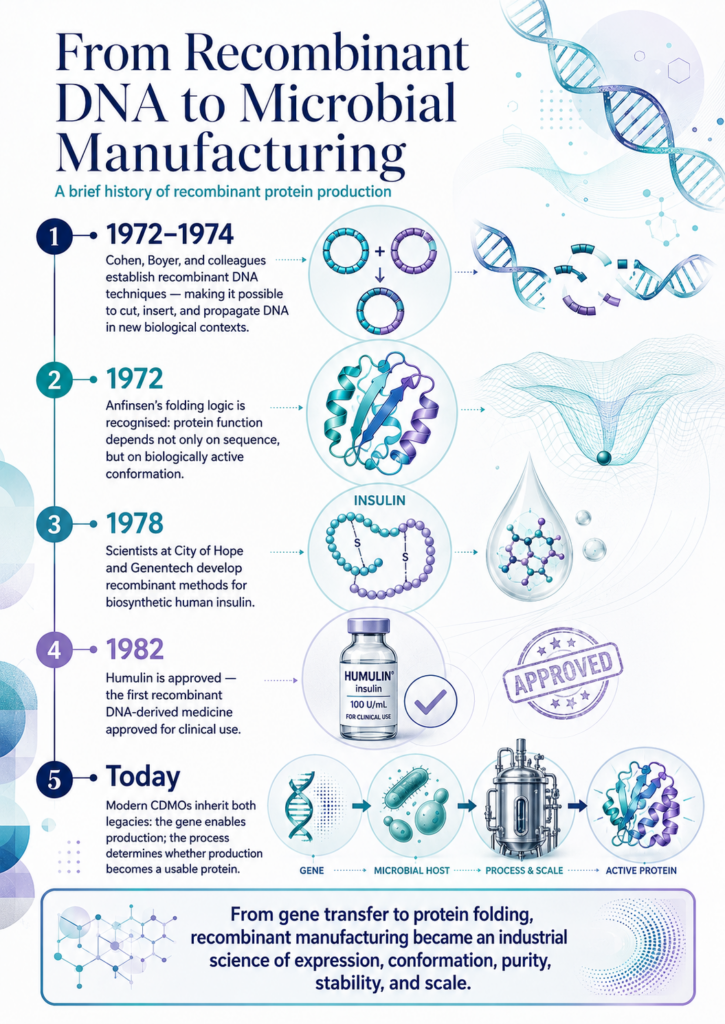
Yet the ability to express a correct amino acid sequence did not automatically solve the problem of producing a functional protein. Proteins must fold into precise three-dimensional structures to become biologically active. Christian Anfinsen’s research on ribonuclease provided a critical intellectual foundation for this challenge. His work, recognized by the 1972 Nobel Prize in Chemistry, demonstrated that the amino acid sequence of a protein contains the information required for its native, biologically active conformation. For manufacturing, the implication was clear: producing a recombinant protein is never only a matter of generating mass or high expression titer. The process must also guide correct folding, minimize misfolding and aggregation, control impurity profiles, and preserve activity and stability throughout purification and storage.
The history of recombinant protein manufacturing therefore rests on two interlocking scientific legacies. Cohen and Boyer’s genetic engineering methods made it possible to instruct microbial hosts—primarily Escherichia coli and later yeast systems—to synthesize human proteins. Anfinsen’s insights into sequence-directed folding established that the manufacturing process itself must deliver a correctly structured molecule. The engineered gene enables expression; the process determines whether expression yields a usable therapeutic protein.
As the field matured, additional layers of complexity became apparent. Microbial hosts often lacked the post-translational modification machinery of mammalian cells, creating differences in glycosylation, disulfide bond formation, and higher-order structure. Early manufacturing efforts had to confront inclusion body formation, refolding challenges, proteolytic degradation, and the need for increasingly sophisticated purification and analytical methods. These technical demands drove the development of specialized fermentation strategies, controlled expression systems, and rigorous process analytical technology.
By the 1980s and 1990s the industry had moved from proof-of-concept recombinant products to established microbial manufacturing platforms capable of supplying global markets. The original scientific breakthroughs of the 1970s thus evolved into a full industrial discipline in which genetics, protein chemistry, process engineering, and analytical science must operate together to convert genetic information into consistent, high-quality therapeutic proteins.
E. coli Became the Fast Microbial Engine
E. coli became central to recombinant protein manufacturing because it is fast, genetically tractable, scalable, and deeply understood. It supports rapid construct testing, strong expression systems, dense molecular biology tooling, high-cell-density fermentation, and efficient production of many non-glycosylated proteins.
For many proteins, E. coli is still the best first technical question.
It is especially relevant for:
- Non-glycosylated recombinant proteins
- Enzymes
- Diagnostic antigens
- Assay reagent proteins
- Cytokines and growth factors where suitable
- VHHs and antibody fragments where suitable
- Inclusion-body/refolding strategies
- Toxic protein strategies with controlled expression
- Animal health proteins
- Research-to-GMP recombinant proteins
E. coli is powerful because it is fast. It is risky because it is fast.
Too much expression, too quickly, can push proteins into insoluble inclusion bodies, increase host stress, create proteolysis, reduce activity, or complicate downstream recovery. Inclusion body formation remains a major industrial issue in E. coli recombinant protein production, and the literature has repeatedly identified high-cell-density fermentation, inclusion body recovery, and refolding as major cost and process-development bottlenecks.
A good E. coli CDMO does not ask only, “Can we express it?” It asks:
- Should the protein be soluble or insoluble?
- Should expression be slower?
- Should the construct be truncated?
- Should the protein be tagged?
- Should the protein be expressed in the cytoplasm or periplasm?
- Are disulphides required?
- Is endotoxin acceptable for the intended use?
- Can refolding recover real activity?
- Can purification remove HCP, DNA, endotoxin, aggregates, clipped species, and process residuals?
- Is the assay measuring the right form of the protein?
That is the difference between E. coli expression and E. coli recombinant protein CDMO development.
Pichia / Komagataella Became the Microbial-Eukaryotic Bridge
Pichia pastoris, now commonly discussed in many technical contexts as Komagataella phaffii, became important because it occupies a useful middle ground: more eukaryotic than bacteria, usually easier to scale than mammalian systems, able to grow to high cell density, and often capable of secreting recombinant proteins.
Reviews describe Komagataella phaffii as a versatile recombinant protein platform with advantages including high-level protein expression, moderate post-translational modification capacity, high-density cultivation, and cost-effective methanol utilisation.
Pichia may be attractive when the protein benefits from:
- Secreted expression
- Eukaryotic folding environment
- Disulphide bond support
- Lower endotoxin burden than E. coli
- High-cell-density yeast fermentation
- Enzyme secretion
- VHH or antibody-fragment secretion
- Diagnostic protein production
- Animal health protein production
- Precision fermentation scale-up
However, Pichia is not magic. It can clip proteins, hyperglycosylate, secrete poorly, lose expression, require careful oxygen transfer, become sensitive to induction strategy, or behave cleanly at screening scale and poorly at pilot scale. Current literature on Pichia/Komagataella expression highlights secretion optimisation, protein folding, promoter systems, omics, and high-throughput screening as active areas of platform improvement rather than solved problems.
The best Pichia CDMO is therefore not the one that says “we use Pichia.” It is the one that understands promoter choice, secretion signal, copy number, clone screening, oxygen transfer, methanol induction, methanol-free alternatives, proteolysis, harvest timing, glycosylation, purification, and stability.
Sophia’s yeast strain engineering page explicitly supports Pichia/Komagataella expression, Saccharomyces production systems, Yarrowia programmes, VHH nanobodies, enzymes, diagnostic reagents, food-grade proteins, cosmetic bioactives, precision fermentation products, animal health biologics, yeast cell banking, GMP-ready bank creation, strain transfer, strain rescue, and fermentation scale-up preparation.
That breadth matters because many recombinant protein failures are not solved by pushing harder in the same host. They are solved by changing the host logic.
Why Europe Matters for Recombinant Protein CDMO Selection
Europe matters for recombinant protein CDMO selection because many sponsors want technical manufacturing plus quality governance, regulatory literacy, supply-chain proximity, and credible documentation.
For a European biotech, US sponsor, Asian sponsor, veterinary company, diagnostic developer, cosmetic biotech group, food-tech company, or precision fermentation company, a European CDMO can offer a useful combination of:
- Mature biomanufacturing culture
- Quality-system discipline
- Technical labour depth
- Regulatory familiarity
- Access to pharmaceutical, veterinary, food, feed, cosmetic, and industrial biotech markets
- Strong analytical and documentation expectations
- Cross-border supply and tech-transfer pathways
Sophia’s Spain/Switzerland positioning is commercially relevant in this context. Pamplona gives Sophia a microbial and precision fermentation base. Basel gives the brand a Swiss biomanufacturing and analytical credibility signal. The site describes the dual-site model as one platform for industrial-strength fermentation at scale and one for high-throughput, high-compliance biomanufacturing, unified under an execution and quality operating system.
For sponsors searching Recombinant Protein CDMO Europe, the right question is not “Which provider is geographically European?”
The better question is:
Which European CDMO can connect expression, fermentation, purification, analytics, formulation, GMP documentation, and product category strategy into one coherent manufacturing path?
What Makes a Recombinant Protein Hard to Manufacture?
A recombinant protein is hard to manufacture when its biology resists the convenience of the process.
Common difficulty drivers include:
- High molecular weight
- Multiple domains
- Disulphide bonds
- Hydrophobic regions
- Low solubility
- Membrane-associated behaviour
- Toxicity to host
- Protease sensitivity
- Glycosylation requirement
- Incorrect glycosylation risk
- Aggregation tendency
- Poor refolding yield
- Cofactor dependence
- Metal dependence
- Low activity after purification
- Poor assay reproducibility
- High endotoxin sensitivity
- Instability during concentration
- Freeze-thaw sensitivity
- Poor formulation compatibility
- Strong adsorption to surfaces
- Unclear potency method
A protein does not fail at scale because it is “difficult.” It fails because one of its dependencies was ignored too early.
For example, a disulphide-rich protein may be forced into cytoplasmic E. coli expression when periplasmic expression, secretion, Pichia, or another host should have been evaluated. A diagnostic antigen may be purified to impressive apparent purity while losing the conformational epitope that matters in the assay. A VHH may express beautifully but dimerise during concentration. An enzyme may purify cleanly but lose activity because the process strips a cofactor or exposes the protein to the wrong pH. A veterinary protein may be technically manufacturable but commercially unrealistic if cost of goods is ignored.
This is why a sophisticated recombinant protein CDMO does not start with a host. It starts with a profile:
- What is the protein?
- What function must remain?
- What purity is truly required?
- What impurities matter?
- What route or application is intended?
- What scale is needed?
- What documentation level is appropriate?
- What assay proves the product is useful?
- What failure mode is most likely?
Only then should the host decision become serious.
Host Selection: E. coli vs Pichia vs Yeast vs Bacillus vs Fungal Expression
Choosing a recombinant protein host is not a ranking exercise. E. coli is not “better” than Pichia. Pichia is not “better” than Bacillus. Fungal systems are not “better” than yeast.
Each host is a tool with strengths, risks, economics, impurity profiles, and product fit.
A strong Recombinant Protein CDMO Europe partner should understand these differences.
E. coli
E. coli is often the starting point when speed, cost, high expression, and non-glycosylated protein production matter. It is useful for many enzymes, diagnostic proteins, antigens, VHHs, antibody fragments, research proteins, animal health proteins, and inclusion-body/refolding programmes.
Main advantages:
- Fast development
- Strong expression systems
- Scalable fermentation
- Low-cost screening
- Extensive molecular biology tools
- Good fit for non-glycosylated proteins
- Strong fit for many diagnostic and assay proteins
- Useful inclusion-body route for some products
Main risks:
- Endotoxin
- Inclusion bodies
- Misfolding
- Lack of glycosylation
- Limited disulphide handling in standard cytoplasmic expression
- Host-cell proteins
- Host-cell DNA
- Product toxicity
- Aggregation
- Refolding loss
Pichia / Komagataella
Pichia is often selected when secretion, eukaryotic folding, high-cell-density yeast fermentation, or reduced endotoxin burden matters. It can be useful for enzymes, VHHs, antibody fragments, hormones, diagnostic proteins, animal health proteins, and selected precision fermentation products.
Main advantages:
- Secreted expression
- Eukaryotic folding environment
- High-cell-density fermentation
- Strong promoter systems
- Lower endotoxin concern than E. coli
- Good fit for selected disulphide-rich proteins
- Strong enzyme and VHH relevance
Main risks:
- Proteolysis
- Hypermannosylation or product-specific glycosylation concerns
- Methanol induction complexity
- Oxygen transfer demands
- Secretion bottlenecks
- Clone instability
- Harvest-timing sensitivity
- Media and HCP profile complexity
Saccharomyces
Saccharomyces may be useful when food familiarity, yeast manufacturing history, or certain precision fermentation and bioactive product categories matter. It may support selected enzymes, food proteins, nutrition proteins, yeast-derived actives, and cosmetic biotechnology concepts.
Main risks include secretion limits, glycosylation profile, product-specific yield constraints, and downstream complexity.
Yarrowia
Yarrowia can be relevant for lipid-associated products, secreted enzymes, specialty bioactives, cosmetic fermentation, food and nutrition concepts, and selected precision fermentation programmes. It is more niche than E. coli or Pichia, but its metabolic profile can be useful for particular products.
Main risks include strain engineering burden, less universal platform familiarity, product-specific analytics, and scale-up requirements.
Bacillus and Filamentous Fungal Systems
Bacillus and filamentous fungal systems matter especially for enzymes, feed products, industrial proteins, animal health applications, and secreted protein manufacturing. They can be attractive when extracellular secretion and high-volume enzyme production are central.
Main risks include proteases, clipping, secretion impurities, fermentation foaming, morphology, broth viscosity, downstream clarification, and activity loss during drying or formulation.
The best CDMO does not force every molecule into its favourite host. It chooses the host that gives the protein the best chance to become a controlled product.
E. coli Recombinant Protein CDMO Services in Europe
E. coli remains one of the most important platforms for sponsors searching Recombinant Protein CDMO Europe. It is fast, flexible, widely understood, and highly productive when the protein fits the system.
Sophia’s site directly identifies E. coli expression and microbial recombinant products as part of the company’s platform, and its animal health content states that Sophia can support E. coli-derived recombinant proteins, enzymes, antigens, antibody-fragment-style proteins, and other microbial products for animal health while evaluating endotoxin, HCP, DNA, inclusion bodies, refolding, aggregation, impurity clearance, and downstream recovery.
When E. coli Is the Right First Choice
E. coli is often the right first choice when the protein is:
- Non-glycosylated
- Relatively small or moderate in size
- Enzymatically simple
- Intracellularly tolerated
- Useful as a diagnostic antigen
- Useful as an assay reagent
- Suitable for inclusion-body production and refolding
- Needed quickly for feasibility
- Intended for animal health, diagnostic, research, industrial, or selected GMP-path use
- Compatible with an endotoxin-reduction strategy
E. coli is also useful when a sponsor needs rapid experimental learning. A CDMO can screen constructs, tags, temperatures, induction conditions, solubility profiles, expression hosts, media, lysis conditions, and purification routes quickly compared with more complex systems.
But a fast answer is not always the right answer. If E. coli produces a misfolded, inactive, insoluble, highly endotoxin-contaminated, or unstable product, the programme has not succeeded. It has merely generated protein mass.
Soluble Expression Screening
Soluble expression is often the first preferred route because it can reduce refolding burden and preserve native-like activity. A good soluble expression screen may include:
- Codon optimisation review
- Sequence liability review
- N-terminal and C-terminal truncations
- Domain boundary review
- Promoter strength adjustment
- Induction temperature screening
- IPTG concentration screening
- Autoinduction review
- Media and feed comparison
- Solubility tag comparison
- His-tag, SUMO, MBP, GST, and other fusion strategies
- Tag placement
- Protease-cleavage strategy
- Chaperone co-expression
- Periplasmic expression
- Harvest timing
- Lysis condition review
The goal is not only to increase expression. The goal is to improve the ratio of useful, active, recoverable protein to total biomass burden.
A common mistake is to treat low-temperature expression, tags, or chaperones as generic fixes. They are not generic fixes. They are hypotheses. Each must be evaluated against solubility, activity, purification, cleavage, stability, and scale-up.
A solubility tag that improves expression but interferes with activity or creates difficult removal is not a solution. A periplasmic strategy that supports disulphides but destroys yield may or may not be worthwhile. A slower induction process that reduces inclusion bodies may be commercially better than a high-expression process that requires painful refolding.
Soluble expression development is therefore a manufacturing decision, not only a molecular biology screen.
E. coli Inclusion Body Refolding CDMO Services
Inclusion bodies are often described as a problem. In some programmes, they are also a manufacturing route.
An inclusion body process may be attractive when the protein expresses strongly, can be isolated cleanly, tolerates denaturation, and can be refolded into active form with acceptable yield. It may be especially relevant for certain cytokines, growth factors, hormones, antibody fragments, enzymes, antigens, and non-glycosylated products.
A serious E. coli inclusion body refolding CDMO services programme should consider:
- Inclusion body formation conditions
- Cell disruption method
- Inclusion body isolation
- Wash strategy
- Host impurity removal
- Solubilisation conditions
- Urea or guanidine strategy
- Redox chemistry
- pH
- Protein concentration
- Dilution refolding
- Dialysis refolding
- On-column refolding
- Additives
- Aggregation suppression
- Refolding yield
- Activity recovery
- Polishing chromatography
- Stability after refolding
The literature makes clear why this matters. Refolding from inclusion bodies into bioactive protein can be cumbersome, low-recovery, and a major cost driver, even though improved solubilisation and refolding procedures can increase recovery for selected products.
The buyer should ask the CDMO a direct question:
Can you prove that the refolded protein is active, stable, and scalable — not merely visible on a gel?
If the answer is weak, the project is not ready.
Endotoxin Reduction for Recombinant Proteins
Endotoxin is one of the most important E. coli-specific development issues. Because E. coli is Gram-negative, lipopolysaccharide burden can become a serious impurity concern, especially for injectable, ophthalmic, inhaled, or other sensitive products.
Endotoxin relevance depends on:
- Route of administration
- Dose
- Patient or animal species
- Product category
- Regulatory expectation
- Assay interference
- Process history
- Downstream clearance capacity
A diagnostic reagent, veterinary oral product, feed enzyme, research protein, topical cosmetic ingredient, or injectable human therapeutic may all require different endotoxin strategies.
Useful endotoxin-control approaches may include:
- Host and strain selection
- Controlled lysis
- Clarification strategy
- Inclusion body washing
- Phase separation interface
- Detergent strategy where appropriate
- Ion exchange chromatography
- Hydrophobic interaction chromatography
- Mixed-mode chromatography
- TFF and diafiltration
- Polishing chromatography
- Endotoxin assay method suitability
- Spike recovery and inhibition/enhancement controls
The key point is that endotoxin reduction should not be treated as a final polishing miracle. It should be designed into the expression, harvest, clarification, purification, and formulation path.
For many E. coli programmes, endotoxin is not one test. It is a process architecture issue.
E. coli Downstream Purification
Downstream purification is where many recombinant protein projects become real or collapse.
A plausible E. coli downstream process may include:
- Harvest
- Cell disruption
- Clarification
- Capture chromatography
- Affinity chromatography where appropriate
- Ion exchange
- Hydrophobic interaction
- Mixed-mode chromatography
- Refolding where needed
- TFF and diafiltration
- Aggregate removal
- Endotoxin reduction
- DNA clearance
- HCP reduction
- Polishing
- Final buffer exchange
- Sterile filtration where appropriate
The purification strategy must be built around the product’s intended use. A diagnostic antigen may need epitope preservation and lot consistency. A therapeutic protein may need stronger impurity clearance. A feed enzyme may need activity and cost-of-goods control. A cosmetic bioactive may need formulation compatibility and claim-support assays. A veterinary protein may need practical scale and stability.
Purity alone is not enough. A highly purified inactive protein is a failed product. A 95% pure enzyme with poor specific activity may be worse than a lower-purity product that is robust, active, stable, and fit for purpose.
Downstream development should therefore ask:
- What impurities matter?
- What product-related variants matter?
- What activity must remain?
- What yield is commercially acceptable?
- What stability is needed?
- What documentation level is required?
- What scale will this process eventually face?
The best protein purification CDMO is not the one that runs the most columns. It is the one that uses the fewest necessary steps to deliver the right product quality with reproducible performance.
E. coli Analytical Package
An E. coli recombinant protein analytical package may include:
- Identity testing
- SDS-PAGE
- Western blot where relevant
- HPLC or UPLC purity
- SEC-HPLC for aggregation
- RP-HPLC where relevant
- CE-SDS
- Intact mass
- Peptide mapping where relevant
- Residual HCP
- Residual host-cell DNA
- Endotoxin
- Bioburden
- Protein concentration
- Activity assay
- Binding assay
- Enzyme kinetics where relevant
- Stability testing
- Forced degradation
- Formulation compatibility
The correct analytical package depends on product category. A recombinant diagnostic antigen does not need the same package as an injectable therapeutic. A veterinary feed enzyme does not need the same package as a sterile biologic. A cosmetic bioactive does not need the same package as a vaccine antigen.
But every serious programme needs one thing: an assay that proves the protein still does what it is supposed to do.
Without that, expression and purification are incomplete evidence.
Pichia Protein Expression CDMO Services in Europe
Pichia / Komagataella protein expression is one of the most important alternatives to E. coli for sponsors seeking a Recombinant Protein CDMO Europe partner.
Pichia can offer secreted expression, eukaryotic folding, high-cell-density fermentation, lower endotoxin concern, and strong relevance for enzymes, VHHs, antibody fragments, diagnostic proteins, animal health biologics, and precision fermentation products.
Reviews describe Pichia/Komagataella as a widely used recombinant protein production platform, with advantages such as folding efficiency, high-cell-density fermentation, strong expression systems, genetic stability, and mature secretion capability.
When Pichia Beats E. coli
Pichia may be a better first choice than E. coli when the protein needs:
- Secretion
- Disulphide bond formation
- Eukaryotic folding environment
- Reduced endotoxin burden
- Higher likelihood of soluble extracellular recovery
- Yeast-compatible scale-up
- Enzyme secretion
- VHH or nanobody secretion
- Animal health or diagnostic product fit
- Precision fermentation positioning
Pichia may be especially attractive when E. coli expresses protein but produces insoluble material, poor activity, high endotoxin burden, or difficult refolding.
However, Pichia is not automatically superior. It introduces its own risks:
- Proteolytic clipping
- Secretion bottlenecks
- Hypermannosylation
- Methanol handling where AOX1 systems are used
- Oxygen transfer sensitivity
- Clone-to-clone variability
- Media and harvest impurity profile
- Longer screening timelines
- Product-specific glycosylation concerns
A good Pichia CDMO should be able to explain why Pichia is being used, not only that it is available.
Pichia Clone and Cassette Strategy
Pichia success starts before fermentation. It starts with expression cassette design.
Relevant development decisions include:
- Promoter choice
- AOX1 induction strategy
- GAP or other constitutive promoter strategy
- Methanol-free expression options
- Secretion signal
- Alpha-factor signal processing
- Copy number
- Integration site
- Codon optimisation
- Terminator selection
- Selectable marker
- Clone screening strategy
- Expression stability
- Secretion burden
- Protease sensitivity
- Cell banking
The AOX1 promoter has historically been central to Pichia expression because it is strong and methanol-inducible. But methanol-based systems can introduce process complexity, safety considerations, heat generation, oxygen demand, and operational control needs. Reviews of Pichia expression discuss AOX1-driven expression, methanol induction, and promoter-system development as major technical considerations.
A CDMO should therefore evaluate whether the programme needs inducible expression, constitutive expression, methanol-free development, or another promoter strategy. The right answer depends on protein toxicity, secretion burden, growth profile, titre, product quality, and scale-up.
A Pichia clone is not a manufacturing process. It is the starting organism for one.
Methanol Induction and Oxygen Transfer
Pichia high-cell-density fermentation is powerful but sensitive.
In methanol-induced systems, the feed strategy must support expression without overwhelming the culture. Methanol concentration, oxygen transfer, heat removal, feed rate, induction duration, biomass concentration, pH, temperature, and proteolysis all matter.
Key process questions include:
- What biomass target is appropriate?
- When should induction begin?
- How should methanol be fed?
- Is oxygen transfer sufficient?
- Does temperature reduction improve folding?
- Does lower pH reduce contamination but increase proteolysis?
- Does the product degrade during long induction?
- Is the process robust at pilot scale?
- Is methanol-free expression preferable?
This is where Pichia programmes can deceive sponsors. A shake-flask result may show expression, but the real process may depend on oxygen transfer, heat removal, feeding dynamics, and harvest timing that only appear in controlled fermentation.
A serious Pichia CDMO should not simply scale the flask. It should build the fermentation.
Pichia Secretion and Proteolysis
Secretion is one of the major reasons sponsors choose Pichia. A secreted protein can simplify harvest by moving product into the medium rather than requiring cell disruption. This can reduce some intracellular impurities and make downstream processing more straightforward.
But secretion also creates risks:
- Misprocessed signal peptide
- Incomplete secretion
- Intracellular retention
- ER stress
- Misfolding
- Protease clipping
- Product degradation during induction
- Media impurity burden
- Host-cell protein co-purification
- Glycosylation variability
Proteolysis is especially important. A protein can express well at early time points and disappear or clip later. Harvest timing, temperature, pH, host strain, protease-deficient backgrounds, media composition, and induction strategy can all influence product integrity.
A strong Pichia development programme should track:
- Full-length product
- Clipped species
- Secreted titre
- Intracellular retention
- Activity
- Aggregation
- HCP burden
- Glycosylation where relevant
- Stability during harvest and hold
A secreted product is only useful if it remains the right product after secretion.
Glycosylation and Product Quality
Pichia is eukaryotic, but it is not mammalian. That matters.
For some products, yeast glycosylation may be acceptable, irrelevant, or even commercially suitable. For others, it may be unacceptable. Hypermannosylation, non-human glycan patterns, glycan heterogeneity, or glycan-related activity effects may influence host choice.
The relevance depends on product category:
- Diagnostic antigen: glycosylation may affect epitope recognition.
- Enzyme: glycosylation may affect secretion, activity, or stability.
- VHH: glycosylation may be irrelevant unless introduced by sequence motif.
- Veterinary protein: expectations depend on route and species.
- Food or cosmetic protein: quality expectations differ but still require definition.
- Human therapeutic: glycosylation may become central to safety, efficacy, comparability, and regulation.
This is why a CDMO should not treat Pichia as a generic “better folding” host. It is a specific host with specific product-quality consequences.
Pichia Downstream Purification
Pichia downstream processing often begins with clarified supernatant, but that does not make purification automatic.
The process may need to address:
- Host-cell proteins
- Secreted proteases
- Media components
- Pigments
- Polysaccharide-like impurities
- Glycosylated variants
- Aggregates
- Clipped product
- DNA
- Conductivity and buffer compatibility
- Concentration-related aggregation
- Activity loss
Possible downstream steps include:
- Clarification
- Depth filtration
- TFF
- Capture chromatography
- Ion exchange
- Hydrophobic interaction
- Mixed-mode chromatography
- Affinity methods where appropriate
- SEC polishing where needed
- Buffer exchange
- Concentration
- Sterile filtration where appropriate
The correct process depends on whether the product is an enzyme, VHH, antigen, animal health protein, cosmetic bioactive, food-grade ingredient, or GMP-path biologic.
As with E. coli, the downstream process should be judged by function, impurity control, recovery, reproducibility, and scale-up — not by gel purity alone.
Beyond E. coli and Pichia: Other Microbial Hosts That Matter
E. coli and Pichia often dominate recombinant protein development, but they are not the full manufacturing map. A serious recombinant protein programme may also require Saccharomyces, Yarrowia, Bacillus, filamentous fungi, or other microbial and precision fermentation systems.
The right host depends on the molecule, the required post-translational profile, intended use, yield target, impurity burden, cost of goods, and downstream strategy. A platform that can compare hosts technically is more useful than one that simply pushes every protein into a preferred organism.
Sophia CDMO supports this broader recombinant protein logic across microbial, yeast, fungal, enzyme, diagnostic, animal health, cosmetic, food, feed, and precision fermentation programmes.
Saccharomyces Recombinant Protein Services
Saccharomyces is one of the most familiar yeast platforms in biotechnology. It has a long history in fermentation, food systems, industrial biotechnology, and recombinant protein expression. It can be relevant where yeast manufacturing familiarity, food-grade positioning, or selected bioactive production matters.
Saccharomyces may support:
- Food and nutrition proteins
- Selected recombinant enzymes
- Yeast-derived bioactives
- Cosmetic biotechnology ingredients
- Precision fermentation concepts
- Recombinant assay proteins
- Animal health bioactives
Its advantages include fermentation robustness, strong industrial familiarity, established handling, and commercial acceptability in selected food and biotechnology categories.
Its risks include secretion limitations, product-specific yield issues, yeast glycosylation, host-cell impurity burden, and downstream complexity. It is not the best host for every protein, but it can be highly useful when product category, regulatory positioning, and fermentation economics fit.
Yarrowia Recombinant Protein and Bioactive Services
Yarrowia is a more specialised yeast platform with relevance in lipid metabolism, secreted enzymes, specialty bioactives, cosmetic biotechnology, food and nutrition concepts, and selected precision fermentation programmes.
Yarrowia may support:
- Lipid-associated bioactives
- Specialty enzymes
- Cosmetic fermentation products
- Food and nutrition ingredients
- Selected secreted recombinant proteins
- Precision fermentation products
- Yeast-based specialty molecules
Its value is strongest where conventional E. coli or Pichia logic is too narrow. Yarrowia can be useful for products where lipid metabolism, secretion, unusual substrate use, or specialty bioactive production matters.
The risks are practical: strain engineering may be more programme-specific, analytics may need customisation, downstream recovery may be less standardised, and scale-up must be demonstrated rather than assumed.
Yarrowia is a niche tool, but niche tools are often decisive when the product is unusual.
Bacillus Recombinant Protein and Feed Enzyme Services
Bacillus systems are important for secreted enzyme production, feed enzyme manufacturing, animal health bioactives, industrial biotechnology, and selected microbial protein products.
Bacillus may support:
- Feed enzymes
- Digestive-support enzymes
- Proteases
- Amylases
- Xylanases
- Phytases
- Beta-glucanases
- Animal health enzymes
- Industrial enzymes
- Secreted recombinant proteins
- Spore-adjacent product strategies
The main advantage is secretion. A secreted enzyme can reduce the need for cell disruption and may simplify recovery. Bacillus also has strong relevance in feed, food, industrial enzyme, and animal health markets.
The risks include proteolysis, product clipping, secretion stress, foaming, strain-specific behaviour, impurity burden, and activity loss during downstream processing or drying.
For feed and animal health products, the question is not only whether the enzyme can be produced. The question is whether it retains activity after fermentation, recovery, formulation, pelleting, storage, and field use.
Filamentous Fungal Protein Expression
Filamentous fungi such as Aspergillus, Trichoderma, Penicillium, and related production systems are important for high-volume enzyme and protein secretion. They are especially relevant in industrial biotechnology, feed, food processing, textile, detergent, biomass conversion, and specialty bioactive markets.
Fungal systems may support:
- Industrial enzymes
- Feed enzymes
- Food processing enzymes
- Cosmetic enzymes
- Biomass-degrading enzymes
- Animal health proteins
- Fermented bioactives
- Specialty recombinant proteins
Their strength is secretion capacity. Their challenge is process complexity.
Filamentous fungal fermentation can involve morphology control, viscosity, oxygen transfer, protease activity, broth clarification, pellet formation, hyphal growth, impurity control, and downstream filtration. A fungal process that looks productive can become difficult if the broth is hard to clarify or the enzyme is clipped before recovery.
Recombinant Enzyme CDMO Services
Recombinant enzymes are different from many therapeutic proteins because their value is measured through function. Purity matters, but enzyme performance depends on catalytic activity, substrate specificity, pH profile, temperature profile, cofactor dependence, stability, formulation compatibility, and performance in the intended application.
A recombinant enzyme programme may need:
- Expression host selection
- Secretion strategy
- Fermentation optimisation
- Protease control
- Downstream purification
- Activity assay development
- Specific activity measurement
- Thermal stability testing
- pH stability testing
- Formulation compatibility
- Drying or immobilisation
- Shelf-life studies
- Application-specific performance testing
Sophia CDMO supports recombinant enzyme development across microbial, yeast, fungal, animal health, feed, cosmetic, diagnostic, food, and industrial biotechnology contexts.
Why Recombinant Enzymes Are Not Ordinary Proteins
An enzyme can be pure and still commercially weak. It may lose activity during purification, degrade during storage, fail at the target pH, denature under process heat, bind poorly to substrate, require a missing cofactor, or become unstable in the final formulation.
Important enzyme attributes include:
- Specific activity
- Total activity recovery
- Substrate specificity
- Km and Vmax where relevant
- pH optimum
- Temperature optimum
- Cofactor requirement
- Glycosylation impact
- Protease sensitivity
- Aggregation
- Formulation stability
- Process stability
- Storage stability
For feed enzymes, activity after pelleting may matter. For diagnostic enzymes, lot-to-lot reproducibility may matter. For cosmetic enzymes, formulation compatibility and skin-relevant assay design may matter. For industrial enzymes, cost of goods and stability under use conditions may dominate.
The enzyme must be developed for its actual job.
Enzyme Product Categories
Recombinant enzyme CDMO services may support:
- Diagnostic enzymes
- Feed enzymes
- Food processing enzymes
- Cosmetic enzymes
- Animal health enzymes
- Industrial enzymes
- Biofilm-degrading enzymes
- Antimicrobial enzymes
- Digestive-support enzymes
- Precision fermentation enzymes
- Biomass conversion enzymes
- Specialty recombinant enzymes
- Research-to-commercial enzyme programmes
Each category has different quality expectations. A diagnostic enzyme requires assay consistency. A feed enzyme requires activity retention and cost control. A cosmetic enzyme requires formulation compatibility and appropriate claim support. An industrial enzyme requires productivity, robustness, and commercial economics.
Sophia’s value is in matching enzyme biology to process and product category.
Enzyme Analytics and Activity Assays
Enzyme analytics should prove identity, purity, activity, and stability. A strong package may include:
- Protein identity
- Purity
- Host-cell protein profile
- Residual DNA
- Activity assay
- Specific activity
- Kinetic assay
- Substrate conversion assay
- Thermal stability
- pH stability
- Formulation compatibility
- Forced degradation
- Shelf-life activity retention
- Application-specific performance testing
Activity assay development is often the central technical step. The assay must be specific, reproducible, relevant, and stability-indicating where possible.
A weak activity assay creates weak development. If the assay cannot distinguish active, partially active, degraded, inhibited, or misfolded enzyme, the process cannot be meaningfully optimised.
Diagnostic Protein and Assay Reagent Manufacturing
Diagnostic proteins are not merely research proteins sold at larger scale. They must be reproducible, stable, assay-compatible, and consistent from lot to lot. A protein that works once in discovery may fail in a commercial diagnostic format if expression, purification, formulation, and stability are not controlled.
Diagnostic protein manufacturing may include:
- Recombinant antigens
- Diagnostic enzymes
- Assay controls
- Calibrators
- Binding proteins
- Antibody fragments
- Conjugation-ready proteins
- ELISA proteins
- Lateral flow assay proteins
- IVD reagent proteins
- Surface-coating proteins
- Fluorescent or enzymatic assay components
Sophia supports diagnostic protein development through microbial and yeast expression, purification, activity or binding assays, formulation, stability, batch documentation, and scale-up.
Diagnostic Protein Development Risks
Diagnostic proteins must behave correctly in the assay environment. The relevant failure mode may not be obvious from standard protein analytics.
Common problems include:
- Epitope loss
- Incorrect folding
- Aggregation
- Non-specific binding
- Poor surface coating
- Conjugation incompatibility
- Low signal-to-noise ratio
- Lot-to-lot variation
- Freeze-thaw sensitivity
- Matrix interference
- Preservative incompatibility
- Accelerated stability failure
- Activity loss after storage
A diagnostic antigen may need conformational integrity more than high yield. A diagnostic enzyme may need stable activity more than maximal purity. A calibrator may need reproducibility more than biological elegance.
Diagnostic protein CDMO work should be judged by assay performance, not only protein production.
VHH, Nanobody, and Antibody Fragment CDMO Services
VHHs, nanobodies, scFvs, Fabs, and other antibody fragments are attractive because they can offer binding specificity in smaller, more modular formats than full monoclonal antibodies. Many antibody fragments are compatible with microbial or yeast expression, making them important for recombinant protein CDMO platforms.
VHH and nanobody CDMO services may include:
- Construct design
- E. coli expression
- Periplasmic expression
- Inclusion-body/refolding routes
- Pichia secretion
- Yeast expression
- Purification
- Endotoxin reduction
- Binding assays
- Aggregation testing
- Stability studies
- Formulation development
- GMP/GMP-like documentation
Sophia’s microbial and yeast platform is well aligned with this category because VHHs often sit between biologics sophistication and microbial manufacturing practicality.
Why VHHs Fit Microbial and Yeast Manufacturing
VHHs are small, single-domain binding proteins. They often tolerate microbial expression better than larger antibody formats, though product-specific behaviour varies.
They may be suited to:
- Pichia secretion
- E. coli periplasmic expression
- Cytoplasmic expression where compatible
- Refolding strategies
- Diagnostic binding reagents
- Animal health biologics
- Research and discovery reagents
- Therapeutic-adjacent development
- Topical or local delivery concepts
- Conjugation-ready binding proteins
Their risks include aggregation, dimerisation, incorrect disulphide formation, proteolytic clipping, tag effects, endotoxin burden, loss of binding, poor high-concentration stability, and assay drift.
A VHH is easy to describe and often hard to finish. The manufacturing process must preserve binding.
VHH and Nanobody Analytics
A VHH analytical package may include:
- Identity
- Purity
- SEC-HPLC aggregation
- CE-SDS
- Intact mass
- Peptide mapping where relevant
- Binding assay
- SPR or BLI interface
- Thermal shift
- Forced degradation
- Endotoxin
- Residual HCP
- Residual DNA
- Formulation stability
- Concentration stability
- Freeze-thaw stability
Binding analytics are central. A highly purified VHH with reduced binding is not a successful VHH product. A CDMO must therefore connect purification, formulation, and stability to functional binding.
Veterinary Recombinant Protein and Animal Health Biologics
Animal health biologics require serious biotechnology with practical commercial constraints. They may need lower cost of goods than human biologics, stronger field stability, species-specific performance, scalable production, and fit-for-purpose documentation.
Veterinary recombinant protein programmes may include:
- Vaccine antigens
- Diagnostic antigens
- Companion animal biologics
- Livestock proteins
- Aquaculture proteins
- Feed enzymes
- Rumen bioactives
- Poultry proteins
- Swine and cattle biologics
- Immune-support proteins
- Antimicrobial or biofilm-related proteins
- Enzyme products
Animal health development requires technical quality without unnecessary pharmaceutical theatre. The product must be reproducible, stable, safe, and commercially practical.
Sophia’s animal health positioning is one of its stronger differentiators because microbial fermentation, probiotics, enzymes, recombinant proteins, and bioactives all intersect in this market.
Why Animal Health Proteins Need a Different CDMO Logic
A veterinary recombinant protein may not need the same process as a human injectable biologic. It may need:
- Lower cost of goods
- Larger practical batch size
- Oral, topical, injectable, feed, or field-compatible format
- Species-specific assay strategy
- Stability under farm or clinic conditions
- Flexible documentation
- Strong impurity control appropriate to route
- Scalable fermentation
- Practical formulation
For companion animal biologics, expectations may be closer to pharmaceutical quality.
For livestock feed enzymes, activity and stability may dominate. For aquaculture products, water stability and feed compatibility may matter. For veterinary diagnostics, lot consistency and antigen performance may matter.
The CDMO must understand the animal health use case, not just the molecule.
Feed Enzymes, Livestock Bioactives, and Food-Chain Proteins
Feed enzyme and livestock bioactive manufacturing is a major recombinant protein category that often receives less attention than human therapeutics. It is technically demanding because performance must survive processing, storage, and real field conditions.
Feed enzyme programmes may include:
- Phytase
- Xylanase
- Protease
- Amylase
- Beta-glucanase
- Cellulase
- Mannanase
- Lipase
- Digestive-support enzymes
- Rumen enzymes
- Poultry and swine feed enzymes
- Aquaculture feed enzymes
Development priorities may include:
- High fermentation yield
- Activity recovery
- Cost of goods
- Drying compatibility
- Pelleting stability
- Carrier compatibility
- Shelf-life activity
- Species-specific performance
- Regulatory category
- Manufacturing scale
A feed enzyme is not successful because it is expressed. It is successful when it remains active after production, formulation, storage, and use.
Sophia’s microbial, fungal, yeast, and animal health positioning gives the brand a strong technical story in this category.
Cosmetic Recombinant Proteins and Fermented Bioactives
Cosmetic biotechnology is increasingly technical. Brands want bioactives that sound modern, perform measurably, and fit premium formulations. Recombinant proteins, enzymes, peptides, fermented actives, postbiotic-style materials, and microbial bioactives can all support this space when claims remain properly controlled.
Cosmetic recombinant protein and bioactive programmes may include:
- Cosmetic enzymes
- Barrier-support proteins
- Scalp bioactives
- Fermented cosmetic ingredients
- Postbiotic-inspired actives
- Plant or microbial bioactives
- Peptide-adjacent recombinant systems
- Skin-model assay materials
- Premium biotech-beauty ingredients
Key development needs include:
- Identity
- Purity
- Activity or bioactivity
- Preservative compatibility
- Formulation stability
- pH compatibility
- Colour and odour control
- Microbial quality
- Packaging compatibility
- Cosmetic claim support
Cosmetic biotechnology can be scientifically strong, but claim discipline matters. A cosmetic recombinant protein should not be positioned like a drug unless the evidence and regulatory pathway support it.
Sophia can support this category as a technical biotechnology platform rather than a vague beauty ingredient supplier.
Food-Grade and Precision Fermentation Proteins
Food-grade and precision fermentation proteins represent a rapidly expanding segment of recombinant protein manufacturing. These programmes use carefully selected microbial platforms — including yeast, filamentous fungi, bacteria, and other engineered hosts — to produce a wide range of proteins, enzymes, flavour compounds, nutritional ingredients, functional proteins, and specialty bioactives intended for food, beverage, and related applications.
Unlike traditional extraction from plant or animal sources, precision fermentation enables controlled production of specific molecules with improved consistency, scalability, and often reduced environmental impact. The manufacturing challenge, however, extends well beyond simple expression. Host selection, genetic construct design, fermentation conditions, downstream purification, residual host-cell impurities, allergen management, and food-grade regulatory compliance all become critical. Processes must deliver not only biological activity but also sensory neutrality or intended functionality, batch-to-batch consistency, and documentation suitable for food-system quality standards.
Typical product classes in this space include enzymes for processing and texture modification, alternative protein ingredients, bioactive peptides, flavour precursors, and functional additives designed for clean-label or high-performance formulations. Success depends on aligning microbial biology with food-grade manufacturing requirements so that laboratory performance translates into reliable, scalable commercial supply.
Potential products may include:
- Food processing enzymes
- Nutrition proteins
- Dairy protein concepts
- Egg protein concepts
- Collagen-like proteins
- Sweet proteins
- Functional bioactives
- Fermentation-derived ingredients
- Specialty food proteins
- Alternative protein components
Technical development must address:
- Host selection
- Food-grade expectations
- Impurity profile
- Taste and odour
- Colour
- Allergen review
- Residual DNA or HCP where relevant
- Downstream cost
- Formulation
- Drying
- Scale-up
- Quality documentation
- Regulatory category
Food protein manufacturing is not simply therapeutic protein manufacturing with lower purity. It has its own constraints: sensory profile, cost, volume, food safety, ingredient functionality, and consumer-facing claims.
A strong CDMO helps the sponsor build the process around the ingredient’s actual use.
Vaccine Antigens and Microbial Immunology Proteins
Recombinant vaccine antigens connect protein manufacturing with immunology. These products require more than expression and purification; they require antigenic relevance, epitope preservation, impurity control, adjuvant compatibility, potency strategy, and stability.
Recombinant vaccine antigen programmes may include:
- Subunit antigens
- Bacterial antigens
- Viral antigens
- Veterinary vaccine antigens
- Aquaculture vaccine antigens
- Peptide antigens
- VLP-adjacent proteins
- Carrier proteins
- Adjuvant-compatible proteins
Key risks include:
- Epitope loss
- Misfolding
- Aggregation
- Endotoxin
- HCP
- DNA
- Proteolysis
- Poor adjuvant compatibility
- Weak potency assay
- Stability drift
The most important technical question is not whether the antigen can be purified. It is whether the purified antigen remains immunologically meaningful.
A serious CDMO must connect expression, purification, formulation, potency, and stability.
Protein Purification and Polishing
Protein purification is the stage at which recombinant programmes become commercially real.
Expression generates material — sometimes in large quantities, sometimes only as a research-grade intermediate. Purification is what transforms that material into a defined, functional, and usable product. Until the protein has been clarified, captured, polished, and controlled for critical impurities, it remains only a potential asset. Once purification succeeds, the molecule acquires identity, quality attributes, and commercial viability.
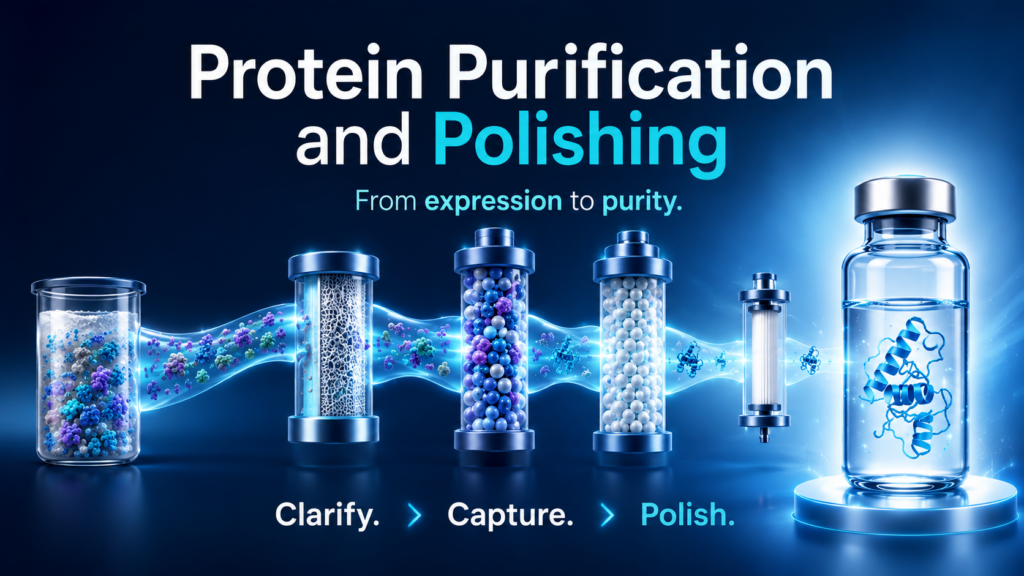
In practice, this is often the point where technical risk becomes visible. An expression system that looks successful by titer can still fail if the protein cannot be recovered in active form, if aggregates dominate, or if residual host-cell components cannot be reduced to acceptable levels. Purification therefore sits at the centre of programme value: it converts biological output into a product that can be characterised, stabilised, released, and transferred into manufacturing.
A purification strategy may include:
- Clarification
- Depth filtration
- Capture chromatography
- Affinity chromatography
- Ion exchange chromatography
- Hydrophobic interaction chromatography
- Mixed-mode chromatography
- Size exclusion chromatography
- Precipitation interface
- TFF
- Diafiltration
- Endotoxin reduction
- Aggregate removal
- HCP reduction
- DNA clearance
- Buffer exchange
- Concentration
The guiding principle is straightforward: the process should be as simple as possible and as complex as necessary. Every additional step introduces time, cost, yield loss, validation burden, and technology-transfer risk.
Too few steps can leave residual impurities that compromise safety, stability, or regulatory acceptance. Too many steps can erode yield, damage activity, and make the process commercially unattractive. The correct purification train is therefore defined by the product’s functional requirements, impurity profile, and intended use — not by the number of columns on a flow chart.
A capable recombinant protein CDMO designs purification around product performance rather than process complexity, balancing purity, recovery, robustness, and scalability into a coherent manufacturing route.
Purity Is Not the Same as Function
A recombinant protein can be 95% pure and still fail.
It may be inactive. It may be aggregated. It may have the wrong conformation. It may lack a cofactor. It may lose binding. It may carry endotoxin. It may contain a small clipped species that affects performance. It may be unstable after concentration. It may fail during formulation.
Function must be measured directly.
For enzymes, this means activity.
For VHHs, this means binding.
For diagnostic proteins, this means assay performance.
For vaccine antigens, this means antigenicity or potency.
For cosmetic bioactives, this means a relevant non-drug bioactivity model.
For animal health proteins, this means species- and use-relevant performance.
Purity is evidence. It is not the whole answer.
Bioactivity, Potency, and Functional Assay Development
Functional assays are central to recombinant protein development. Without a relevant functional assay, the CDMO is optimising appearance rather than product performance.
Functional assay types may include:
- Enzyme activity assays
- Substrate conversion assays
- Binding assays
- ELISA
- SPR or BLI interface
- Inhibition assays
- Receptor binding assays
- Cell-based assays
- Diagnostic assay performance
- Antigenicity assays
- Potency assays
- Stability-indicating activity assays
The assay should be specific, reproducible, and connected to the intended product. It should distinguish active product from inactive, degraded, aggregated, misfolded, or impurity-associated material.
A strong assay turns development from guesswork into controlled optimisation.
Formulation, Stability, and Lyophilisation
Recombinant protein formulation protects the product after purification. Many proteins are most vulnerable when they are clean, concentrated, and exposed to surfaces, air-liquid interfaces, freeze-thaw stress, temperature, light, or storage time.
Formulation variables may include:
- pH
- Buffer species
- Salt concentration
- Surfactants
- Sugars
- Polyols
- Amino acids
- Antioxidants
- Preservatives
- Chelators
- Protein concentration
- Container closure system
- Storage temperature
- Freeze-thaw conditions
- Drying method
Common formulation risks include aggregation, adsorption, oxidation, deamidation, clipping, loss of activity, precipitation, viscosity increase, colour change, and container interaction.
Lyophilisation can improve stability for some proteins, but it introduces its own stress. Freezing can concentrate solutes and shift pH. Drying can damage structure. Reconstitution may reveal aggregation or activity loss.
A lyophilised protein programme should evaluate:
- Cryoprotectants
- Lyoprotectants
- Freezing rate
- Primary drying
- Secondary drying
- Residual moisture
- Cake appearance
- Reconstitution
- Activity retention
- Stability
- Container closure compatibility
The formulation must preserve the protein’s identity and function through its real shelf life.
GMP, GMP-Like, ISO-Style, and Quality Documentation
Not every recombinant protein needs the same quality system. A therapeutic injectable, veterinary biologic, diagnostic reagent, cosmetic bioactive, food ingredient, feed enzyme, and industrial enzyme may require different levels of documentation and control.
A strong CDMO helps the sponsor right-size the quality system without weakening technical discipline.
Documentation may include:
- Strain history
- Construct information
- Cell bank records
- Master cell bank and working cell bank documentation
- Raw material traceability
- Fermentation records
- Harvest records
- Purification records
- Analytical methods
- Specifications
- CoA
- Stability protocols
- Cleaning records
- Deviation handling
- CAPA
- Change control
- Batch records
- Tech transfer package
GMP is not only a certificate. It is a way of making the process traceable, reproducible, reviewable, and transferable.
Sophia’s European platform is positioned around this kind of controlled development: process, analytics, quality documentation, and scale-up aligned to the product’s actual category.
Strain Engineering, Cell Banking, and Tech Transfer Rescue
Strain engineering and cell banking determine whether recombinant protein development is stable enough to scale.
Relevant services may include:
- Codon optimisation
- Construct design
- Promoter selection
- Secretion signal design
- Copy number strategy
- Integration strategy
- Plasmid stability review
- Clone screening
- Productivity testing
- Genetic stability
- Master cell bank
- Working cell bank
- Cell bank testing
- Strain transfer
- Strain rescue
- Process re-establishment
A weak clone or poorly documented strain can compromise the entire programme. A process cannot be robust if the production organism is unstable, under-characterised, or poorly stored.
Cell banking is not administrative storage. It is manufacturing continuity.
Tech Transfer Rescue
Many recombinant protein projects do not fail because the molecule is impossible. They fail because the first process was never built to leave the lab.
Academic and discovery-stage processes often have problems such as:
- Missing records
- Undefined induction conditions
- Unstable plasmid
- Weak clone history
- Incomplete sequence records
- Poor solubility strategy
- No refolding method
- Inconsistent lysis
- Non-scalable centrifugation
- Weak purification logic
- No activity assay
- No impurity data
- No stability data
- No cell bank
- No batch record
- Raw material ambiguity
A CDMO rescue programme should rebuild the process from the molecule outward: sequence, host, expression, harvest, purification, analytics, formulation, documentation, and scale-up.
Rescue is not troubleshooting one step. It is reconstructing the manufacturing logic.
Why Sophia CDMO Belongs on the Recombinant Protein Shortlist
Sophia CDMO belongs on the serious shortlist for sponsors seeking a European recombinant protein CDMO because the platform connects microbial expression, yeast systems, fermentation, purification, analytics, formulation, quality documentation, and technology transfer across multiple product categories.
Relevant Sophia capability clusters include:
- E. coli recombinant protein expression
- Inclusion body and refolding support
- Endotoxin reduction strategy
- Pichia / Komagataella expression
- Yeast strain engineering
- Saccharomyces and Yarrowia programme support
- Fungal protein expression
- Bacillus and enzyme-oriented microbial systems
- VHH and nanobody expression
- Recombinant enzyme manufacturing
- Diagnostic protein manufacturing
- Animal health biologics
- Feed enzymes
- Veterinary proteins
- Cosmetic bioactives
- Food-grade and precision fermentation proteins
- Protein purification
- Activity and binding assays
- Formulation and lyophilisation
- GMP/GMP-like documentation
- Spain and Switzerland-linked European execution
- Technology transfer and process rescue
The strength is not one isolated host system. The strength is the ability to align host, process, product category, analytics, quality, and scale.
Buyer Checklist: How to Choose a Recombinant Protein CDMO in Europe
1. Host Strategy
Ask:
- Can the CDMO explain why E. coli, Pichia, yeast, Bacillus, or fungal expression is appropriate?
- Can they explain when not to use each host?
- Can they switch host strategy if the first route fails?
- Can they handle soluble and insoluble expression?
- Can they manage secretion, folding, glycosylation, and endotoxin risk?
2. Process Development
Ask:
- Can they screen constructs, tags, induction, temperature, media, and harvest timing?
- Can they support inclusion body refolding?
- Can they control endotoxin?
- Can they develop high-cell-density fermentation?
- Can they scale beyond shake flasks?
- Can they build a process that transfers?
3. Downstream and Analytics
Ask:
- Can they purify to the right quality level?
- Can they measure function, not only purity?
- Can they reduce HCP, DNA, endotoxin, aggregates, and clipped species?
- Can they build stability-indicating methods?
- Can they develop activity, binding, or potency assays?
4. Product Category Fit
Ask:
- Do they understand therapeutic, diagnostic, veterinary, feed, food, cosmetic, and industrial biotechnology differences?
- Can they right-size documentation?
- Can they support claim boundaries?
- Can they design development around intended use?
5. Commercial Readiness
Ask:
- Can they scale the process?
- Can they transfer the process?
- Can they provide batch records and CoAs?
- Can they support stability?
- Can they support formulation and lyophilisation?
- Can they rescue weak early-stage processes?
A good CDMO should answer these questions with technical detail, not sales language.
Protein CDMO: Top 20 FAQ
1. What is a recombinant protein CDMO?
A recombinant protein CDMO develops and manufactures proteins produced by engineered cells, including host selection, expression, fermentation, purification, analytics, formulation, quality documentation, and technology transfer.
2. What is the best host for recombinant protein expression?
There is no universal best host. E. coli is strong for many non-glycosylated proteins. Pichia can support secretion and eukaryotic folding. Bacillus and fungi may suit enzymes. Saccharomyces and Yarrowia may fit food, cosmetic, or specialty fermentation programmes.
3. Is E. coli good for recombinant protein manufacturing?
Yes, when the protein is compatible. E. coli is fast, scalable, and useful for many enzymes, antigens, assay proteins, VHHs, and non-glycosylated proteins. Its main risks are endotoxin, inclusion bodies, misfolding, and impurity control.
4. When should Pichia be used instead of E. coli?
Pichia may be preferred when secretion, disulphide support, eukaryotic folding, reduced endotoxin burden, or yeast fermentation is useful. It is often relevant for enzymes, VHHs, diagnostic proteins, animal health proteins, and precision fermentation products.
5. Can inclusion body proteins be refolded?
Yes, some inclusion body proteins can be refolded successfully. The process requires controlled solubilisation, redox chemistry, aggregation control, refolding conditions, purification, and activity confirmation.
6. How is endotoxin removed from recombinant proteins?
Endotoxin can be reduced through process design, washing, chromatography, phase separation interface, TFF, polishing, and assay control. It should be managed throughout the process, not treated as a final clean-up step only.
7. Can recombinant enzymes be manufactured by CDMOs?
Yes. Recombinant enzymes can be produced in E. coli, Pichia, Bacillus, fungi, yeast, and other systems depending on enzyme type, activity, secretion, stability, cost, and intended use.
8. What is diagnostic protein manufacturing?
Diagnostic protein manufacturing produces recombinant antigens, enzymes, controls, calibrators, antibody fragments, and assay reagents for ELISA, lateral flow, IVD, and related diagnostic platforms.
9. What makes VHH and nanobody manufacturing different?
VHHs are small binding proteins that may fit microbial or yeast expression, but they require binding retention, aggregation control, disulphide management, endotoxin control where relevant, and strong stability analytics.
10. Can recombinant proteins be used in animal health?
Yes. Recombinant proteins can support veterinary vaccines, diagnostic antigens, enzymes, companion animal biologics, livestock products, aquaculture proteins, and feed bioactives.
11. Can cosmetic proteins be made by fermentation?
Yes. Cosmetic bioactive proteins, enzymes, fermented ingredients, and biotech beauty actives can be produced through microbial or yeast systems when identity, activity, formulation compatibility, microbial quality, and claim support are controlled.
12. Can food-grade proteins be made by precision fermentation?
Yes. Food and nutrition proteins can be produced by precision fermentation, but development must address host choice, impurity profile, taste, odour, cost, scalability, allergen review, and regulatory category.
13. What analytics are required for recombinant proteins?
Typical analytics include identity, purity, aggregation, HCP, DNA, endotoxin, activity, binding, potency, concentration, stability, and formulation compatibility. The exact package depends on product category.
14. What is GMP-like recombinant protein manufacturing?
GMP-like manufacturing applies structured records, traceability, controlled processes, specifications, CoA, deviation handling, and quality documentation without necessarily using the full GMP burden required for certain therapeutics.
15. Can an academic protein process be transferred to a CDMO?
Yes, but it often requires reconstruction. Academic protocols may lack scalable fermentation, cell banking, impurity control, activity assays, stability data, and documentation. A CDMO must convert the lab method into a controlled process.
16. How long does recombinant protein CDMO development take?
Timelines depend on sequence, host, expression success, purification complexity, assay readiness, formulation, scale, and documentation level. Simple feasibility may move quickly; GMP-path development takes longer.
17. Why choose a European recombinant protein CDMO?
A European CDMO may offer strong technical governance, quality culture, regulatory familiarity, supply-chain credibility, and access to pharmaceutical, veterinary, food, cosmetic, and industrial biotechnology markets.
18. Can Sophia support E. coli and Pichia recombinant protein development?
Yes. Sophia supports E. coli and Pichia/Komagataella recombinant protein development, including expression strategy, fermentation, purification, analytics, formulation, GMP/GMP-like documentation, and technology transfer.
19. Can Sophia support protein formulation and lyophilisation?
Yes. Sophia supports formulation and lyophilisation strategy for recombinant proteins, including buffer development, stabilisers, freeze-thaw, residual moisture, reconstitution, activity retention, and stability.
20. What information should sponsors provide before requesting a quote?
Useful information includes sequence, target product, host preference, expression data, purification data, activity assay, impurity concerns, intended use, target scale, documentation needs, formulation, stability data, and timeline.
Conclusion
The strongest recombinant protein CDMO does more than express a gene.
It matches the protein to the right host, solves folding and solubility issues, controls impurities, develops purification, proves activity, stabilises the product, documents the process, and transfers it into a scalable quality system.
Sophia CDMO is built for this reality. Across E. coli, Pichia, yeast, fungal systems, Bacillus, enzymes, VHHs, diagnostic proteins, animal health biologics, feed enzymes, cosmetic bioactives, and food-grade proteins — with formulation, analytics, GMP documentation, and European tech transfer — Sophia delivers controlled recombinant protein manufacturing for sponsors who need technical depth in Europe.
Expression is only the start. The process makes the protein.
Contact our team at info@sophiacdmo.com