
Exosome CDMO Services
Sophia provides Exosome CDMO Services for sponsors developing extracellular vesicle products, MSC-derived exosomes, iPSC-derived exosomes, immune-cell vesicles, engineered exosomes, cosmetic exosome ingredients, regenerative medicine products, oncology vesicles, drug delivery systems, diagnostic vesicles, postbiotic-adjacent vesicle materials, and advanced cell-free therapeutic platforms.
Exosomes are small extracellular vesicles released by cells. They carry lipids, proteins, nucleic acids, metabolites, membrane markers, and biological signals. They are often described as cellular messages, but that phrase can become too soft. Exosomes are not little love letters floating between cells. They are structured vesicle systems with membranes, cargo, surface proteins, origin-specific signatures, and complex biological effects. They can influence immune response, tissue repair, inflammation, fibrosis, angiogenesis, tumour biology, and cell communication.

Sophia loves Exosomes
The difficulty is that exosome products are not single molecules. They are heterogeneous vesicle populations. They vary with cell source, culture conditions, passage number, media, oxygen, stress, harvest timing, purification method, storage, and formulation. The same cell type can produce different vesicle profiles under different process conditions.
That means manufacturing defines the product.
Sophia’s Exosome CDMO Services support cell source review, donor or cell line strategy, master and working cell bank planning, upstream culture development, conditioned media harvest, extracellular vesicle isolation, TFF, chromatography, SEC interface, concentration, impurity reduction, sterile product interface, particle analytics, cargo characterisation, potency assay strategy, formulation, lyophilisation interface, stability, GMP/GMP-like documentation, and scale-up through European technical infrastructure, including state-of-the-art facilities in Spain and Switzerland.
The goal is direct: turn extracellular vesicle biology into a controlled, characterised, stable product.
Why Exosomes Matter
Exosomes matter because they offer a cell-free route into some of the biological territory normally associated with cell therapies. A cell therapy delivers living cells. An exosome product may deliver cell-derived signalling material without requiring the final product to contain live cells. That creates opportunities in regenerative medicine, immune modulation, inflammation, tissue repair, oncology, drug delivery, diagnostics, and cosmetic science.
Exosome programmes may be attractive because vesicles can carry multiple biological signals at once. They may present membrane proteins, contain RNA cargo, include enzymes or cytokine-associated proteins, and interact with target cells through uptake or receptor-mediated mechanisms. Some programmes use native vesicles. Others engineer the parent cell or load the vesicles with defined cargo. Some aim for therapeutic products. Others aim for cosmetic or research-grade extracellular vesicle materials.
The technical challenge is control. A recombinant protein can be defined by sequence, purity, mass, potency, and impurity profile. A monoclonal antibody has known analytical complexity, but it is still a single dominant molecule. Exosomes are different. They are particles with distributions: size distribution, cargo distribution, surface marker distribution, protein composition, lipid profile, nucleic acid content, potency, and impurities.
That is why Exosome CDMO Services require cell culture, particle purification, analytical depth, formulation, sterility strategy, and CMC logic together. A sponsor does not need only “more vesicles.” It needs the right vesicle product, made consistently.
History of Exosome Science
The history of exosomes is a useful warning against dismissing biology too quickly. Early researchers saw small vesicles released by cells and often treated them as cellular debris. The cell was assumed to be throwing material away. Little particles in culture fluid looked like waste, not information. Biology has a habit of embarrassing that kind of assumption.
In the mid-to-late twentieth century, extracellular vesicles appeared in different research contexts: platelet-derived particles, membrane fragments, vesicles from reticulocytes, immune-cell vesicles, tumour-associated vesicles, and particles released into biological fluids. At first, these observations were scattered. They belonged to haematology, immunology, cell biology, cancer biology, and microscopy rather than one unified field.
The term “exosome” became associated with vesicles formed inside multivesicular bodies and released when those compartments fused with the plasma membrane. That endosomal origin distinguished exosomes from larger microvesicles that bud directly from the plasma membrane and from apoptotic bodies released during cell death. In practice, the terminology became more complicated because isolation methods often collect mixed extracellular vesicle populations. This is why modern development often speaks carefully about extracellular vesicles, small EVs, exosome-enriched fractions, or defined vesicle preparations rather than pretending every particle in a batch has the same biogenesis.
Then the field changed. Vesicles were shown to carry proteins, lipids, and nucleic acids.
They were no longer just trash bags. They looked more like biological parcels. Tumour cells used vesicles. Immune cells used vesicles. Stem cells released vesicles. Microbes released vesicle-like particles. Body fluids contained extracellular vesicles. Diagnostics groups saw biomarker potential. Regenerative medicine groups asked whether vesicles could explain some paracrine effects of cell therapies. Drug delivery groups asked whether vesicles could be loaded with cargo. Cosmetic developers saw a story around cell-free signalling and skin biology.
The creative arc is almost philosophical: what was once interpreted as waste became communication. The discarded fragment became the message.
Modern exosome development is now more sober. The field knows the promise is real, but also knows the problems are real: isolation methods, heterogeneity, potency assays, dose definition, scalability, contaminants, donor variability, residual proteins, host-cell DNA, media components, sterility, storage, and regulatory classification. Exosomes became exciting when people stopped treating them as debris. They become manufacturable only when people stop treating them as magic.
That is the territory for Exosome CDMO Services: vesicle biology with industrial discipline.
The Biology and Chemistry of Exosomes
Exosomes are lipid bilayer vesicles enriched in selected proteins, lipids, nucleic acids, and intracellular or membrane-associated components. Their composition reflects the parent cell and the manufacturing environment. A mesenchymal stromal cell-derived vesicle product is different from an immune-cell vesicle product. An iPSC-derived vesicle product is different from a tumour-cell vesicle product. A vesicle produced in serum-containing media is different from one produced in chemically defined or xeno-free media.
Important biological and chemical attributes include:
- Particle size and size distribution
- Particle concentration
- Surface marker profile
- Protein cargo
- Lipid composition
- RNA and DNA cargo
- Potency-related activity
- Residual host-cell impurities
- Media-derived contaminants
- Sterility and mycoplasma status
- Endotoxin where relevant
- Storage stability
The lipid membrane is not a passive container. It affects uptake, stability, fusion, immune recognition, and cargo protection. Surface proteins can influence tropism and biological interaction. Internal cargo may contribute to function, but it can also vary. Process conditions may alter vesicle stress signatures, inflammatory signals, or potency-related components.
This is why exosome chemistry is inseparable from cell culture. The cell is the factory. The vesicle is the product. The culture condition is the manufacturing language that tells the factory what to make.
Exosome Product Types Supported
Sophia supports Exosome CDMO Services across therapeutic, cosmetic, diagnostic, and research product categories.
Therapeutic and regenerative programmes may include MSC-derived exosomes, iPSC-derived exosomes, immune-cell vesicles, neural-cell vesicles, epithelial-cell vesicles, cardiac-adjacent vesicle concepts, wound-healing vesicles, inflammation-modulating vesicles, fibrosis programmes, and tissue repair products.
Engineered exosome programmes may include parent-cell engineering, cargo loading, surface modification, targeted vesicles, RNA-loaded vesicles, protein-loaded vesicles, small molecule-loaded vesicles, and hybrid vesicle delivery systems.
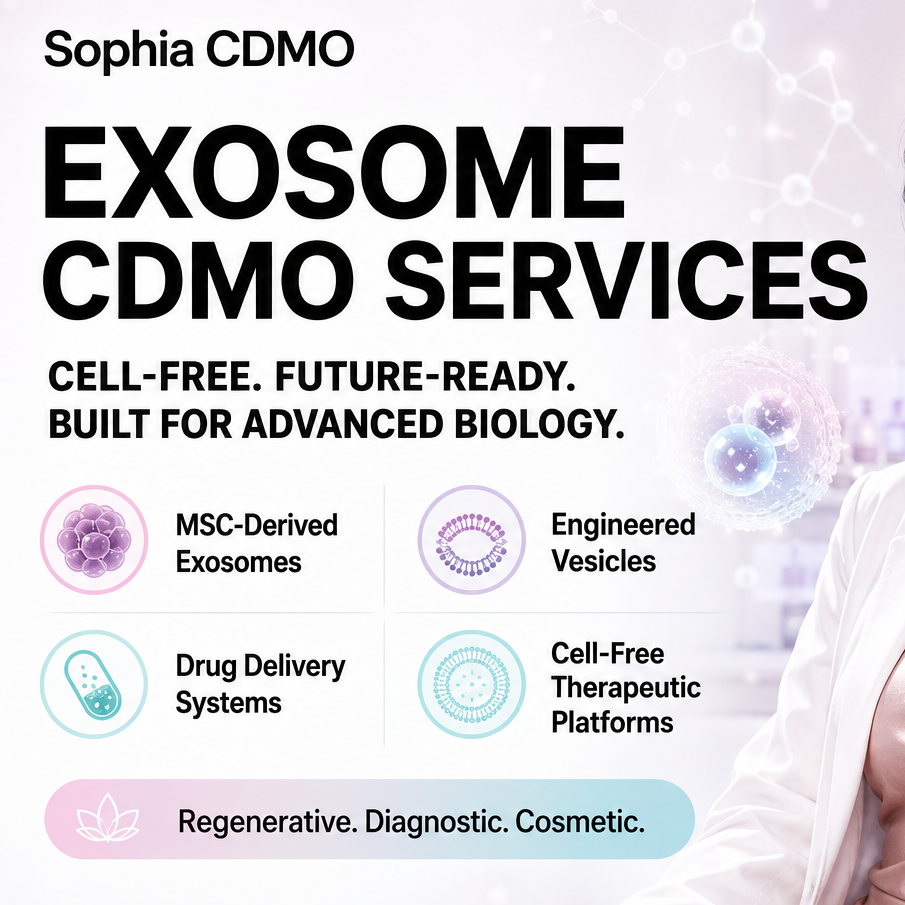
Cosmetic exosome programmes may include skin rejuvenation ingredients, scalp products, post-procedure skincare concepts, barrier-support materials, fermented or cell-derived extracellular vesicle ingredients, and exosome-inspired cosmetic bioactives.
Diagnostic and research programmes may include biomarker vesicles, extracellular vesicle standards, assay development materials, cell communication research products, oncology vesicle materials, immune-cell vesicle reagents, and analytical reference preparations.
The technical requirement differs by category. A cosmetic exosome ingredient does not need the same control package as an injectable therapeutic candidate. A diagnostic reference material does not need the same potency package as a regenerative medicine product. The quality system must fit the intended use.
Cell Source and Donor Strategy
Exosome development begins with the parent cell. Sophia supports cell source review for MSCs, iPSCs, immune cells, epithelial cells, engineered cell lines, primary cells, immortalised lines, donor-derived cells, and banked cell systems.
Cell source strategy may include donor screening, tissue source, ethical sourcing, cell identity, phenotype, passage number, genetic stability, differentiation status, senescence markers, contamination risk, viral safety, mycoplasma testing, serum-free adaptation, xeno-free culture, and manufacturing scalability.
For MSC-derived products, tissue source can matter: bone marrow, adipose, umbilical cord, placenta, dental pulp, and other sources may produce different vesicle profiles. For iPSC-derived products, differentiation state and residual pluripotency concerns may matter. For immune-cell vesicles, activation state can strongly influence vesicle composition. For engineered exosomes, the parent cell engineering system becomes part of product control.
The parent cell is not just upstream material. It is the biological author of the vesicle product.
Cell Banking and Upstream Culture Development
Sophia supports cell banking and upstream culture development for exosome programmes, including research cell banks, master cell banks, working cell banks, expansion strategy, media selection, serum-free or xeno-free adaptation, culture vessel selection, adherent culture, suspension-adapted systems where appropriate, microcarrier culture, stirred-tank interface, hollow-fibre systems, perfusion concepts, oxygen conditions, harvest timing, and conditioned media collection.
Cell culture process design strongly affects exosome yield and composition. Media components may contaminate downstream vesicle preparations. Serum can introduce bovine extracellular vesicles or protein burden. Passage number can affect potency. Cell density, oxygen, shear, nutrient depletion, and stress can alter vesicle release and cargo. Harvest timing can change vesicle profile and impurity burden.
Upstream development should not only maximise particle count. More particles are not automatically better. The product must have the intended identity, potency, purity, and stability. A high-yield process that produces stressed, inconsistent, impurity-rich vesicles is not a strong process.
A proper Exosome CDMO Services programme treats upstream cell culture as product-defining.
Conditioned Media Harvest and Clarification
After cell culture, extracellular vesicles are recovered from conditioned media. Sophia supports conditioned media harvest, clarification, centrifugation strategy, depth filtration, microfiltration, bioburden control, debris reduction, cell removal, and preparation for concentration.
The harvest step must remove cells, dead-cell debris, apoptotic bodies, large particles, and process debris without losing the desired vesicle population. Harsh processing can damage vesicles. Weak clarification can overload downstream purification. Filtration conditions must be selected carefully because vesicles can adsorb to membranes or be lost through poorly chosen pore sizes and materials.
Conditioned media is a complex feedstream. It may contain vesicles, proteins, nucleic acids, metabolites, media components, albumin, growth factors, host-cell impurities, extracellular matrix components, and particles of different origins. The purification process begins by admitting that complexity.
The first clean step sets the tone for the whole product.
Exosome Isolation and Purification
Sophia supports exosome isolation and purification using scalable methods designed around product type and development stage. These may include tangential flow filtration, ultrafiltration/diafiltration, size-exclusion chromatography interface, ion-exchange chromatography, affinity methods where appropriate, density-gradient methods for development, precipitation comparison studies, concentration, buffer exchange, and sterile filtration feasibility review.
Lab-scale exosome isolation has often relied on ultracentrifugation. That can be useful for research, but it is not usually the best manufacturing backbone. Scalable products need reproducible, closed or semi-closed, documented methods that can process meaningful volumes and maintain vesicle quality.
TFF can concentrate and diafilter vesicle-containing material. SEC can help separate vesicles from soluble proteins in development or selected processes. Chromatography may support greater selectivity if product and impurity profiles allow it. Affinity methods may enrich vesicles with specific markers, but cost, scalability, ligand leaching, and product definition must be considered.
Purification must balance yield, purity, potency, scalability, and stability. Over-purification can reduce potency or damage vesicles. Under-purification can leave protein burden, media components, nucleic acids, host-cell impurities, and safety concerns.
The aim is not merely “isolated exosomes.” The aim is a reproducible vesicle product.
Analytics and Vesicle Characterisation
Sophia’s Exosome CDMO Services include analytical development for particle identity, size, concentration, purity, cargo, potency, impurities, and stability.
Analytical methods may include nanoparticle tracking analysis, dynamic light scattering, tunable resistive pulse sensing where appropriate, electron microscopy during development, flow cytometry for vesicle markers where suitable, Western blot, ELISA, proteomics, lipidomics, RNA analysis, qPCR, ddPCR, residual host-cell DNA, residual host-cell protein, albumin or media protein testing, endotoxin, mycoplasma, sterility or bioburden, particle-to-protein ratio, and potency assays.
Common marker strategies may include tetraspanins and vesicle-associated markers, but marker testing alone is not enough. A particle-positive, marker-positive material can still have weak potency or high impurities. Particle count alone is not potency. Protein content alone is not identity. Electron microscopy is useful but not a release method by itself.
The analytical package should answer serious questions: what particles are present, what do they contain, what impurities remain, what biological function is relevant, and how stable is the product?
Potency and Functional Assays
Exosome potency is one of the hardest parts of development. Sophia supports potency assay strategy for exosome programmes, including cell uptake, anti-inflammatory activity, angiogenesis-related assays, wound-healing scratch assays, fibrosis markers, immune-cell modulation, cytokine response, reporter assays, cargo delivery, target-cell response, skin cell assays, hair follicle or scalp-adjacent assays, oncology assays, and product-specific functional readouts.
Potency must match intended use. A wound-care exosome product may need different assays than an oncology vesicle, a cosmetic skin ingredient, a diagnostic reference material, or an engineered RNA-loaded vesicle. The assay should be biologically relevant, reproducible, phase-appropriate, and linked to the proposed mechanism.
The field has suffered from vague potency claims. “Exosomes support regeneration” is not a potency assay. “Cells respond in some way” is not enough. A useful assay must create a measurable bridge between product attributes and intended function.
Exosome products become credible when potency becomes specific.
A Focused Development Checklist
For exosome programmes, Sophia helps sponsors define the practical development route early.
The core questions are usually:
- What is the parent cell, and how is it controlled?
- What vesicle population is the product actually claiming?
- What purification method is scalable and reproducible?
- What potency assay matches the intended use?
- What formulation preserves particle integrity and function?
These questions should be answered before scale-up. Otherwise, the programme may only scale uncertainty.
Engineering, Loading, and Cargo Strategy
Sophia supports engineered exosome and cargo-loading development strategy. This may include parent-cell engineering, transient or stable expression systems, RNA cargo loading, protein cargo loading, small molecule loading, membrane display, ligand display, targeting motifs, electroporation interface, incubation-based loading, sonication or extrusion development review, and hybrid vesicle systems.
Engineering can improve targeting, potency, or cargo specificity, but it also increases complexity. Parent-cell engineering must be documented. Cargo loading can damage vesicles or reduce stability. Surface modification may alter biodistribution. RNA loading may create analytical challenges. Small molecule loading may require residual free drug control. Protein loading may change aggregation or potency.
An engineered exosome is no longer only a natural vesicle preparation. It is a designed delivery product and should be controlled accordingly.
Cosmetic and Aesthetic Exosome Products
Sophia supports cosmetic and aesthetic exosome products, including skin-focused vesicle materials, scalp products, post-procedure skincare concepts, barrier-support products, hair and scalp formulations, extracellular vesicle-inspired ingredients, and cell-free cosmetic bioactives.
Cosmetic exosome products require a different development standard from injectable therapeutics, but they still need discipline. Important areas include source material, microbial safety, residual cell culture materials, particle identity, protein content, formulation compatibility, preservative compatibility, odour, colour, stability, packaging, claims language, and cosmetic-grade documentation.
Topical products face surfactants, emulsifiers, preservatives, pH, viscosity modifiers, oils, humectants, and consumer storage conditions. Vesicles may aggregate, rupture, lose marker signal, bind formulation components, or lose biological activity. Cosmetic elegance does not excuse poor technical control.
The skincare market loves the word “exosome.” Sophia keeps the development work more serious than the marketing word.
Formulation, Storage, and Stability
Sophia supports formulation development for exosome products across frozen, refrigerated, lyophilised, liquid, topical, injectable-interface, cosmetic, diagnostic, and research formats.
Stability risks include particle aggregation, membrane disruption, cargo degradation, protein oxidation, RNA degradation, freeze-thaw damage, adsorption to containers, potency loss, microbial contamination, pH drift, and formulation incompatibility. Formulation variables may include buffer, pH, salt, sugars, polyols, cryoprotectants, lyoprotectants, surfactants where appropriate, antioxidants, chelators, viscosity modifiers, preservatives for cosmetic formats, and container closure.
Frozen storage may preserve vesicles but complicates shipping and clinical use. Refrigerated storage may be more practical but harder to stabilise. Lyophilisation can improve stability for some vesicle products, but cycle development must preserve particle size, morphology, marker profile, reconstitution, and potency. Cosmetic products may require room-temperature stability, which can be a proper challenge.
A stable exosome product is not assumed from the word “vesicle.” It is demonstrated.
Sterile Product and Drug Product Interface
Therapeutic exosome products may require sterile injectable or local administration formats. Sophia supports sterile product interface planning, including aseptic processing, sterile filtration feasibility, bioburden strategy, sterility testing, mycoplasma testing, endotoxin testing, vial presentation, frozen or liquid drug product, lyophilised interface, container compatibility, extractables and leachables, visual inspection, in-use stability, and clinical supply planning.
Sterile filtration can be difficult because vesicles may overlap with filter pore-size constraints or be lost through adsorption. Aseptic processing may be required depending on product and process. Container surfaces may bind vesicles. Freeze-thaw conditions may alter particle distribution. Topical and cosmetic products may require preservative systems that do not damage vesicle function.
Drug product planning should begin before late development. A purified vesicle bulk is not yet a usable product.
European Facilities, Spain, and Switzerland
Exosome products require careful cell culture, vesicle purification, particle analytics, formulation, and documentation. Sophia’s European execution model, supported by state-of-the-art facilities in Spain and Switzerland, gives exosome programmes a disciplined technical base for advanced development.
Spain supports applied process development, formulation work, and scalable programme execution across biological and cell-derived products. Switzerland adds precision analytics, quality-led documentation, and a high-control manufacturing culture suited to complex vesicle products. The combination allows Sophia to build an exosome platform with European seriousness: controlled source material, controlled process, controlled particles, controlled claims.
By this stage, the development standard should be plain. No vague vesicle soup. No mystery-conditioned media. No soft-focus science. Proper source, proper process, proper analytics.
GMP, CMC, and Documentation
Sophia supports GMP/GMP-like and CMC documentation for Exosome CDMO Services, including cell source records, donor records where relevant, cell bank records, culture process description, media and raw material controls, conditioned media harvest records, purification process, impurity control strategy, analytical methods, potency assay strategy, formulation report, stability protocol, sterility and mycoplasma strategy, batch records, CoA, deviation handling, change control, and tech transfer package.
For therapeutic products, documentation must define the parent cell, process, vesicle population, impurities, potency, sterility, formulation, and stability. For engineered exosomes, the engineering system and cargo must be described. For cosmetic products, the documentation may be lighter but should still support safety, identity, formulation compatibility, and claims. For diagnostic products, lot consistency and assay performance may dominate.
CMC for exosomes is demanding because the product is complex. The dossier must make that complexity reviewable.
Documentation is the sober part of the story. It is also the part that makes the story credible.
Why Sophia for Exosome CDMO Services
Sophia supports exosome programmes through cell source strategy, upstream culture development, vesicle purification, analytical development, potency strategy, formulation, sterile product interface, cosmetic product interface, European facility execution, and GMP/GMP-like documentation.
The service includes:
- Exosome programme review
- MSC, iPSC, immune-cell, epithelial-cell, and engineered-cell vesicle support
- Cell source, donor, and cell banking strategy
- Serum-free and xeno-free culture development
- Conditioned media harvest and clarification
- TFF, SEC interface, chromatography, and concentration
- Particle size, particle concentration, marker, cargo, and impurity analytics
- Potency and functional assay strategy
- Engineered exosome and cargo-loading interface
- Cosmetic exosome product development
- Frozen, refrigerated, liquid, and lyophilised formulation
- Sterile product and fill-finish interface
- Spain and Switzerland-linked European technical execution
- GMP/GMP-like documentation
- Scale-up and tech transfer
The platform is suited to sponsors who need extracellular vesicle products that are source-controlled, process-defined, analytically characterised, stable, and development-ready.
Technical Service Summary
Sophia provides Exosome CDMO Services for MSC exosomes, iPSC-derived exosomes, immune-cell vesicles, engineered exosomes, RNA-loaded exosomes, protein-loaded vesicles, cosmetic exosome ingredients, regenerative medicine vesicles, oncology vesicles, diagnostic extracellular vesicles, and cell-free therapeutic products.
Relevant technical needs include cell source review, cell banking, upstream culture, conditioned media harvest, EV purification, TFF, SEC interface, chromatography, particle analytics, cargo analysis, impurity control, potency assays, formulation, lyophilisation, sterile product interface, cosmetic formulation support, GMP/GMP-like documentation, and scale-up.
The service is intended for products where vesicle source, particle quality, biological function, and stability define the development path.
Read More About Related Sophia Capabilities
Sterile Fill-Finish CDMO Services
Therapeutic exosome products may require aseptic filling, vial presentation, frozen or lyophilised formats, container compatibility, and clinical supply readiness.
FAQ: Exosome CDMO Services
1. What are Exosome CDMO Services?
Exosome CDMO Services support development and manufacturing of extracellular vesicle products, including cell source control, upstream culture, vesicle purification, analytics, potency testing, formulation, stability, documentation, and scale-up.
2. What are exosomes?
Exosomes are small extracellular vesicles released by cells. They contain lipid membranes, proteins, nucleic acids, and other biological materials that can influence cell communication and biological function.
3. What cell sources can be used for exosome products?
Exosome products may be derived from MSCs, iPSCs, immune cells, epithelial cells, engineered cell lines, primary cells, or other controlled cell sources depending on intended use.
4. How are exosomes manufactured?
Exosome products are typically manufactured by culturing parent cells, collecting conditioned media, removing cells and debris, isolating and purifying vesicles, concentrating the product, testing it, and formulating it for storage or use.
5. What makes exosome manufacturing difficult?
Challenges include vesicle heterogeneity, cell source variability, media impurities, purification scalability, potency assay development, particle analytics, sterility strategy, formulation, and stability.
6. What analytics are used for exosome products?
Analytics may include particle size, particle concentration, marker testing, protein cargo, RNA cargo, residual host-cell DNA, residual proteins, endotoxin, mycoplasma, sterility or bioburden, potency assays, and stability testing.
7. Can Sophia support cosmetic exosome products?
Yes. Sophia supports cosmetic exosome and extracellular vesicle ingredients, including source control, purification, formulation compatibility, preservative compatibility, stability, safety documentation, and claims-aware development.
8. Can exosomes be engineered?
Yes. Exosome programmes may involve engineered parent cells, surface modification, RNA loading, protein loading, small molecule loading, targeting ligands, or hybrid vesicle systems.
9. Can exosomes be lyophilised?
Some exosome products may be lyophilised, but cycle development must preserve particle size, morphology, marker profile, reconstitution, potency, and stability.
10. What should sponsors provide to begin an exosome project?
Useful starting information includes cell source, intended use, culture conditions, existing vesicle data, particle analytics, potency data, purification method, formulation target, route of administration, stability goals, and development stage.
Conclusion
Sophia provides Exosome CDMO Services for MSC, iPSC, immune-cell, engineered, cosmetic, diagnostic, and therapeutic extracellular vesicle programmes.
Exosome development requires controlled cell sourcing, upstream culture, vesicle purification, particle analytics, impurity control, potency strategy, formulation, stability, and documentation. The product is defined by the parent cell and the process that produces it.
Sophia supports this work through European technical infrastructure in Spain and Switzerland, with a development model built around controlled vesicle manufacturing, serious analytics, and phase-appropriate GMP/GMP-like execution.
For sponsors developing exosome products, Sophia provides a disciplined route from cell-derived vesicle concept to characterised, stable, development-ready product.
Email our team at info@sophiacdmo.com