
CDMO Drug Device Services
Sophia provides Drug-Device CDMO Services for sponsors developing combination products, prefilled syringes, autoinjectors, pen injectors, nasal sprays, inhalers, ophthalmic delivery systems, transdermal patches, microneedle patches, implantable drug delivery systems, drug-eluting devices, lyophilised products with reconstitution systems, connected delivery devices, and complex medicinal products used with medical devices.
A drug-device product is not just a drug placed inside a convenient container. The device can change how the medicine is stored, delivered, dosed, protected, activated, administered, handled, labelled, and understood by the patient. The drug may be chemically excellent and still fail because it adsorbs to a device surface, aggregates under silicone oil exposure, clogs a needle, degrades in a reservoir, produces poor delivered dose uniformity, interacts with elastomers, fails extractables and leachables review, or creates an unacceptable use error.
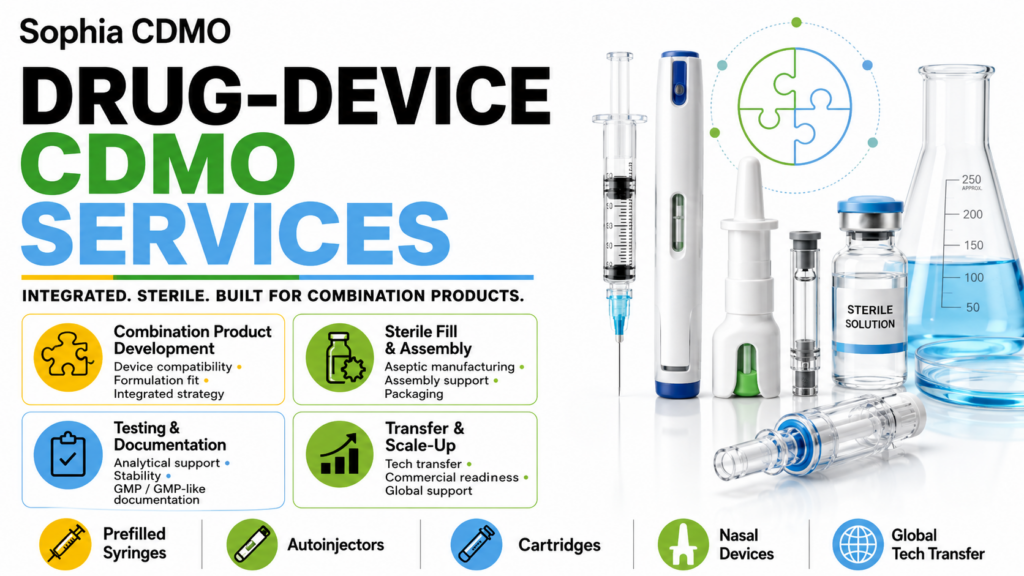
That is why Drug-Device CDMO Services require a different development mindset. The product must be treated as a system: drug substance, formulation, primary container, device, user interface, sterilisation strategy, stability profile, human factors, instructions for use, packaging, labelling, assembly, and regulatory documentation.
Sophia supports drug-device programmes through product strategy, formulation-device compatibility, container closure evaluation, extractables and leachables interface, delivered dose testing, mechanical and functional testing interface, sterile fill-finish planning, lyophilisation interface, assembly and packaging strategy, design-control documentation support, risk management interface, usability documentation support, CMC documentation, GMP/GMP-like readiness, and European execution through state-of-the-art facilities in Spain and Switzerland.
The objective is direct: make the medicine and device work as one controlled product.
Why Drug-Device Products Matter
Drug-device products matter because modern medicines increasingly depend on delivery systems. Biologics, peptides, oligonucleotides, RNA products, ophthalmics, inhaled therapies, long-acting injectables, transdermal systems, implants, and high-potency products often require more than a vial and a label. They require a delivery format that protects the product, enables administration, reduces user burden, improves adherence, and supports clinical performance.
A prefilled syringe can simplify dosing but introduces container closure, silicone oil, plunger, needle, break-loose force, glide force, and sterility questions. An autoinjector can improve patient convenience but introduces spring force, needle insertion depth, activation, dose delivery, human factors, and assembly controls. An inhaler must deliver aerosolised dose consistently. A nasal spray must control plume geometry, droplet size, spray pattern, priming, actuation force, and delivered dose. An implant must control release, biocompatibility, degradation, and local tissue interaction.
The FDA defines combination products to include products made of two or more regulated components, including drug-device, biologic-device, drug-biologic, or drug-device-biologic combinations, whether combined as a single entity, co-packaged, or otherwise intended for use together. EMA guidance similarly addresses quality documentation for medicinal products used with a medical device, including integral, co-packaged, and separately obtained devices where device quality can affect the quality, safety, or efficacy of the medicinal product.
That regulatory structure reflects the technical truth. The device is not decorative. It can become part of the medicine’s performance.
A serious Drug-Device CDMO Services programme must therefore connect pharmaceutical development, device engineering, quality systems, stability, usability, and regulatory documentation from the start.
History of Drug-Device Combination Products
The history of drug-device products begins with simple administration tools. A medicine was made, then a tool delivered it. Syringes, ampoules, droppers, inhalation devices, patches, catheters, and implants developed around clinical need. At first, the device often looked secondary. The “real” product was the drug. The device was the hand that carried it.
That division slowly broke down.
Insulin delivery helped change the story. Repeated injections, dose accuracy, patient self-administration, needles, pens, cartridges, and later pumps showed that the delivery system could shape the therapy experience. A hormone product was not experienced by patients as an abstract molecule. It was experienced through the act of dosing. The device became part of the daily medicine.
Respiratory products made the lesson even sharper. Inhaled medicines depend on particle size, aerosol generation, inspiratory flow, device resistance, actuation technique, dose counters, and patient handling. The same active ingredient can perform differently depending on the device. The inhaler is not merely a container. It is a miniature delivery machine.
Biologics then pushed the field further. Monoclonal antibodies, Fc fusions, GLP-1 peptides, fertility hormones, cytokines, and other injectable products created demand for prefilled syringes, pens, and autoinjectors. Patients were no longer always sitting in clinics receiving clinician-administered doses. Products moved into homes, refrigerators, travel bags, and patient routines. That shift made usability, reliability, stability, and device compatibility central to product success.
Transdermal patches and implants added another dimension. Here, the device is not just an administration aid. It is the controlled release system. Adhesives, membranes, reservoirs, matrices, polymers, microneedles, coatings, and implant materials can determine pharmacokinetics, local tolerability, and product behaviour.
More recently, connected devices, wearable injectors, digital adherence tools, smart inhalers, sensor-enabled delivery, and software-linked devices have expanded the category again. The medicine is now sometimes joined to mechanics, electronics, data, app interfaces, cloud systems, cybersecurity questions, and real-world use patterns.
The historical movement is clear: the device migrated from accessory to architecture. What began as a tool became a product-defining system.
That is the territory for Drug-Device CDMO Services. Not device theatre. Not packaging decoration. Integrated therapeutic product development.
The Product Architecture of Drug-Device Systems
A drug-device product has several interacting layers. The drug substance and formulation define the medicinal material. The primary container or reservoir defines immediate contact. The device defines delivery. The user interface defines handling. Packaging and labelling define how the product reaches the user and how it is used. Quality documentation defines how the product is controlled.
Important product layers include:
- Drug substance and drug product formulation
- Primary container closure
- Device or delivery system
- Product-contact materials
- Assembly and secondary packaging
- Sterilisation or aseptic strategy
- Delivered dose performance
- Human factors and usability
- Stability and shelf life
- CMC and device documentation
The development risk is often found at the interfaces. Drug formulation may interact with elastomer. Silicone oil may affect protein aggregation. A needle may be too narrow for a viscous biologic. A nasal actuator may change spray pattern after storage.
A patch adhesive may alter drug release. A reservoir may extract material from a polymer. An autoinjector spring may not deliver a full dose at cold temperature.
Sophia’s Drug-Device CDMO Services are designed around these interfaces. The product has to function as a whole.
Drug-Device Product Types Supported
Sophia supports Drug-Device CDMO Services across injectable, inhaled, nasal, ophthalmic, transdermal, implantable, topical, and advanced delivery products.
Injectable products may include prefilled syringes, autoinjectors, pen injectors, dual-chamber syringes, on-body injectors, wearable injectors, cartridge systems, reconstitution systems, lyophilised products with transfer devices, and high-concentration biologic delivery formats.
Respiratory and nasal products may include metered-dose inhalers, dry powder inhalers, soft mist systems, nebuliser-compatible products, nasal sprays, nasal powders, unit-dose nasal devices, and emergency-use nasal products.
Ophthalmic products may include multidose droppers, preservative-free systems, single-dose units, ophthalmic implants, intraocular delivery systems, and device-assisted ocular administration products.
Transdermal and dermal systems may include matrix patches, reservoir patches, microneedle patches, medicated films, topical applicator systems, and controlled-release skin delivery products.
Implantable and local delivery products may include drug-eluting implants, biodegradable implants, non-biodegradable reservoirs, drug-eluting devices, local oncology delivery systems, antimicrobial-coated devices, hormone delivery implants, and long-acting release systems.
Specialised programmes may include connected devices, digital adherence devices, software-linked delivery systems, smart packaging, drug-device clinical kits, paediatric-use formats, geriatric-use formats, and self-administration systems.
Each format has a different technical logic. A prefilled syringe is not an inhaler. A nasal spray is not a patch. An implant is not an autoinjector. The development plan must follow the device.
Formulation-Device Compatibility
Sophia supports formulation-device compatibility assessment for drug-device products. This includes product-contact material review, adsorption, leachables, silicone oil sensitivity, protein aggregation, particle formation, pH drift, oxidation, hydrolysis, viscosity, osmolality, preservative compatibility, surfactant compatibility, container interaction, dose delivery, and storage stability.
For biologics, compatibility can be especially sensitive. Proteins may adsorb to glass, plastic, elastomer, silicone oil droplets, tubing, filters, or device reservoirs. They may aggregate under agitation, freeze-thaw, or mechanical stress. High-concentration biologics may create viscosity challenges in syringes and autoinjectors. Surfactants may stabilise proteins but interact with device materials.
For small molecules, risks may include sorption into polymers, leaching from elastomers, precipitation, degradation, pH shift, oxidation, light sensitivity, or interaction with adhesives or reservoirs. For peptides and oligonucleotides, adsorption, hydrolysis, oxidation, and formulation-device compatibility can dominate.
The device is a chemical environment. It must be tested as one.
Container Closure and Primary Packaging
Sophia supports container closure and primary packaging strategy for syringes, cartridges, vials, ampoules, blow-fill-seal units, nasal spray containers, inhaler reservoirs, ophthalmic bottles, patches, implants, and device-contact packaging.
Container closure questions may include:
- Glass versus polymer selection
- Elastomer closure compatibility
- Silicone oil level and protein risk
- Tungsten, adhesive, or lubricant residues
- Container closure integrity
- Extractables and leachables
- Breakage resistance
- Sterilisation compatibility
- Particle generation
- Fill volume and headspace
- Storage orientation
- Cold-chain and freeze-thaw performance
For prefilled syringes and cartridges, plunger movement, break-loose force, glide force, needle shield compatibility, needle clogging, and dose accuracy become important. For nasal sprays, container and pump system must deliver dose consistently. For ophthalmic products, closure design can affect sterility, drop size, preservative exposure, and patient handling.
Primary packaging is not a procurement detail. It is the drug’s immediate world.
Extractables and Leachables Interface
Drug-device products often require extractables and leachables evaluation. Sophia supports E&L interface planning for product-contact materials, primary packaging, device components, tubing, reservoirs, elastomers, adhesives, coatings, lubricants, plastics, metals, and combination-product assemblies.
Extractables are compounds that can be extracted under exaggerated conditions. Leachables are compounds that migrate into the product under real storage or use conditions. Both matter because they may affect safety, product quality, potency, stability, or regulatory acceptability.
E&L work may require material review, supplier documentation, risk assessment, solvent extraction studies, toxicological assessment interface, leachables studies, stability sample testing, LC-MS, GC-MS, ICP-MS, and method development.
Drug-device products make E&L more complicated because the product may contact multiple materials across manufacture, storage, and use. The device is not only a delivery aid. It can be a source of chemical exposure.
Delivered Dose and Performance Testing
Sophia supports delivered dose and device performance strategy across drug-device formats. The product must deliver the intended amount of medicine under intended use conditions.
Performance testing may include delivered dose accuracy, dose uniformity, actuation force, spray pattern, plume geometry, droplet size, aerosol particle size distribution, injection time, break-loose force, glide force, needle penetration, residual volume, priming, re-priming, dose counter function, patch release rate, implant release profile, and device activation.
The relevant tests depend on format. A nasal spray needs spray pattern and droplet distribution. An inhaler needs aerodynamic particle size distribution and emitted dose. A prefilled syringe needs mechanical force and delivered volume. An autoinjector needs activation, injection time, dose delivery, needle safety, and usability. A patch needs adhesion and release. An implant needs release kinetics and material stability.
The question is basic but unforgiving: does the product deliver the medicine correctly when used as intended?
Human Factors and Usability Interface
Drug-device products often require human factors and usability work. Sophia supports usability documentation interface, use-related risk review, user population assessment, instructions for use review, training material interface, simulated-use planning, packaging and labelling review, self-administration considerations, and design-change documentation.
Human factors matter because many drug-device products are used by patients, caregivers, or clinicians under real-world conditions. Patients may be elderly, paediatric, visually impaired, anxious, fatigued, untrained, rushed, or physically limited. A device that works in engineering hands may fail in patient hands.
Use-related risks may include incomplete dose, wrong injection site, failure to remove cap, incorrect inhalation technique, failure to prime nasal spray, contamination, reuse, needle-stick injury, wrong assembly, improper storage, missed activation, or misunderstanding of instructions.
The device has to be technically functional and humanly usable. That is not soft science. It is product safety.
Design Control and Quality System Interface
Drug-device products require quality systems that can handle both pharmaceutical and device expectations. Sophia supports design-control interface planning, design inputs, design outputs, verification, validation, risk management, design history file interface, device master record interface, supplier controls, change control, complaint interface, CAPA interface, and lifecycle documentation.
ISO 13485 is the internationally recognised quality management standard for medical devices and applies to organisations involved in design, production, installation, servicing, and related services. FDA’s Quality Management System Regulation applies to finished device manufacturers commercially distributing medical devices and governs methods, facilities, and controls used for device design, manufacture, packaging, labelling, storage, installation, and servicing.
For combination products, the challenge is not only following a device system or a drug GMP system separately. The challenge is linking them coherently. Device design changes can affect drug performance. Drug formulation changes can affect device performance. Supplier changes can affect E&L profile. Assembly changes can affect dose delivery.
The quality system must see the product as a system.
Sterile Fill-Finish and Assembly
Sophia supports sterile fill-finish and assembly strategy for drug-device programmes, including vial filling, syringe filling, cartridge filling, aseptic processing, terminal sterilisation assessment where appropriate, lyophilisation interface, stoppering, plunger insertion, needle shielding, device assembly, labelling, packaging, and clinical supply planning.
For prefilled syringes and cartridges, fill accuracy, air bubbles, plunger placement, silicone oil, stopper movement, container closure integrity, and visual inspection matter.
For lyophilised products with reconstitution devices, the cake, diluent, transfer system, reconstitution time, dose withdrawal, and user workflow all matter. For on-body or wearable systems, assembly and device reliability become major development questions.
Sterility strategy must be aligned with device materials and product sensitivity. Not every product can be terminally sterilised. Not every device component tolerates every sterilisation method. Aseptic assembly must preserve both product quality and device function.
The drug-device system has to survive manufacture before it can help a patient.
Stability and Lifecycle Testing
Sophia supports stability and lifecycle testing for drug-device products, including drug stability, device function, packaging performance, delivered dose, extractables and leachables, mechanical reliability, container closure integrity, appearance, particulate matter, potency, sterility assurance, and use-condition simulation.
A drug-device product may change during storage. A biologic may aggregate. A polymer may leach. A spring may lose force. An adhesive may weaken. A nasal spray pump may clog. A plunger may change glide force. A patch may alter release rate. A formulation may lose preservative effectiveness. A device may fail after temperature cycling.
Lifecycle work should include long-term storage, accelerated stability, shipping simulation, freeze-thaw where relevant, temperature cycling, orientation studies, in-use studies, post-assembly stability, and end-of-shelf-life performance testing.
It is not enough for the product to work on day one. It must work at the end of shelf life, after real handling, in the hands of the intended user.
A Focused Development Checklist
For drug-device programmes, Sophia helps sponsors define the core development questions early:
- What is the regulatory identity of the product?
- Which component controls clinical performance most strongly?
- What materials contact the drug during storage and use?
- What dose delivery tests prove the device works?
- What design, usability, stability, and CMC documents are needed?
These questions prevent a common failure pattern: developing the drug and device in parallel without integrating them until late. Late integration is where good products get expensive.
Connected and Digital Delivery Devices
Sophia supports development interface for connected and digital drug delivery devices, including smart injectors, connected inhalers, adherence systems, electronic dose tracking, Bluetooth-enabled delivery devices, app-linked administration support, and software-associated product workflows.
These systems can introduce additional development needs: software lifecycle documentation, cybersecurity strategy, data integrity, device verification, usability testing, battery and electronics performance, connectivity reliability, privacy considerations, and complaint handling.
For sponsors, the central question is whether the digital layer supports the therapeutic product or merely decorates it. A connected feature should improve dosing, adherence, training, monitoring, safety, or clinical insight. Otherwise, it adds risk without enough value.
Sophia’s role is to keep the digital interface tied to product reality: medicine, device, user, data, and documentation.
European Facilities, Spain, and Switzerland
Drug-device products benefit from a European operating model that can handle pharmaceutical development, device compatibility, sterile product thinking, analytical control, quality documentation, and global tech transfer. Sophia’s state-of-the-art facilities and technical infrastructure in Spain and Switzerland support that model.
Spain provides a strong base for applied development, formulation-device evaluation, sterile product interface, assembly planning, and clinical-stage execution. Switzerland adds precision quality culture, documentation discipline, analytical seriousness, and a central European position for complex technical programmes.
The brand direction is clear without needing noise. Sophia is building a top-tier European and global CDMO platform for complex products where drug substance, device, formulation, analytics, packaging, and user performance must align. Not a catalogue. A serious execution layer.
GMP, CMC, and Regulatory Documentation
Sophia provides integrated GMP/GMP-like and CMC documentation support for Drug-Device CDMO services. This includes product and device descriptions, formulation-device compatibility reports, container closure data, E&L summaries, delivered dose performance, stability protocols, human factors, risk management, design controls, batch and assembly records, Certificates of Analysis, supplier documentation, change control, deviation management, comparability studies, and comprehensive tech transfer packages.
Effective CMC documentation reveals how the medicinal product and device function together as one. The dossier clearly maps product-contact materials, critical device functions, precise delivery performance, stability behavior, sterility assurance, packaging, labelling, and full lifecycle controls.
For global programs, the documentation maintains a coherent narrative across regions — consistently telling the same story: what the product is, how it is manufactured, how it performs in the body, how it is controlled, and how every risk is intimately managed.
A strong drug-device dossier reads as a single, deeply integrated argument — not two separate pieces forced together.
Why Sophia for Drug-Device CDMO Services
Sophia supports drug-device programmes through formulation-device compatibility, container closure strategy, delivered dose testing interface, E&L planning, sterile product interface, assembly planning, usability documentation support, quality-system alignment,
European facility execution, and GMP/GMP-like documentation.
The service includes:
- Combination product strategy
- Prefilled syringe, cartridge, autoinjector, pen, inhaler, nasal, ophthalmic, patch, implant, and drug-eluting device support
- Formulation-device compatibility
- Container closure and primary packaging review
- Extractables and leachables interface
- Delivered dose and device performance testing strategy
- Sterile fill-finish and assembly planning
- Lyophilised product and reconstitution-device interface
- Human factors and usability documentation support
- Design-control and risk-management interface
- Stability and lifecycle testing
- Spain and Switzerland-linked European execution
- GMP/GMP-like documentation
- Global tech transfer support
The platform is suited to sponsors who need the drug and device to function as one regulated, manufacturable, user-ready product.
Technical Service Summary
Sophia provides Drug-Device CDMO Services for combination products, prefilled syringes, autoinjectors, pen injectors, cartridges, inhalers, nasal sprays, ophthalmic delivery systems, transdermal patches, microneedle patches, implants, drug-eluting devices, lyophilised reconstitution systems, connected delivery devices, and complex medicinal products used with medical devices.
Relevant technical needs include formulation-device compatibility, E&L, container closure integrity, delivered dose testing, mechanical performance, device assembly, sterile fill-finish, lyophilisation interface, stability, usability, design-control interface, risk management, CMC documentation, GMP/GMP-like records, and global tech transfer.
The service is intended for products where drug quality, device function, user handling, stability, and regulatory documentation must operate as one integrated system.
Read More About Related Sophia Capabilities
Sterile Fill-Finish CDMO Services
Drug-device products often require aseptic filling, vial, syringe, cartridge, or device-compatible formats, container closure integrity, and clinical supply readiness.
Extractables & Leachables CDMO Services
Device and packaging materials may introduce extractables or leachables that affect safety, stability, potency, or regulatory acceptability.
FAQ: Drug-Device CDMO Services
1. What are Drug-Device CDMO Services?
Drug-Device CDMO Services support development, testing, documentation, and manufacturing strategy for medicinal products used with delivery devices, including prefilled syringes, autoinjectors, inhalers, nasal sprays, patches, implants, and drug-eluting systems.
2. What is a drug-device combination product?
A drug-device combination product combines a medicinal product with a medical device or uses a device to deliver, administer, protect, or control the medicine.
3. What products can Sophia support?
Sophia supports prefilled syringes, autoinjectors, cartridges, pen injectors, inhalers, nasal sprays, ophthalmic delivery systems, transdermal patches, microneedle patches, implants, drug-eluting devices, and connected delivery devices.
4. Why is formulation-device compatibility important?
The drug can interact with device materials, elastomers, silicone oil, adhesives, reservoirs, filters, needles, or packaging. These interactions may affect stability, potency, dose delivery, or safety.
5. What testing is needed for drug-device products?
Testing may include delivered dose, container closure integrity, extractables and leachables, mechanical performance, stability, sterility, usability, dose accuracy, force testing, spray pattern, plume geometry, release rate, and product-specific performance assays.
6. Can Sophia support prefilled syringe and autoinjector products?
Yes. Sophia supports syringe, cartridge, autoinjector, and pen injector programmes, including formulation compatibility, fill-finish interface, force testing strategy, container closure, stability, assembly planning, and documentation.
7. Can Sophia support inhaler and nasal spray products?
Yes. Sophia supports inhaler and nasal spray development interface, including formulation, device compatibility, delivered dose, spray pattern, droplet size, aerosol performance, priming, stability, and documentation.
8. Can Sophia support drug-eluting devices?
Yes. Sophia supports drug-eluting and implantable drug delivery products, including material compatibility, release profile, formulation, stability, E&L interface, sterility strategy, and documentation.
9. Why does usability matter?
Many drug-device products are used by patients or caregivers. Usability work helps reduce use errors, incomplete dosing, incorrect administration, contamination, and device-handling failures.
10. What should sponsors provide to begin a drug-device project?
Useful starting information includes drug product formulation, device type, intended user, route of administration, dose, container materials, stability data, delivery performance data, sterilisation approach, target markets, and regulatory stage.
Conclusion
Sophia provides Drug-Device CDMO Services for combination products where formulation, device function, user handling, stability, sterility, and documentation must be integrated.
The work requires more than device selection. It requires compatibility testing, delivered dose strategy, E&L control, assembly planning, usability interface, stability, and CMC documentation.
Through state-of-the-art infrastructure in Spain and Switzerland, Sophia supports sponsors developing drug-device products for European and global markets with a serious, system-level CDMO model.
Email our team at info@sophiacdmo.com