
Complex Injectable Services
Sophia provides Complex Injectable CDMO Services for sponsors developing sterile injectable products where formulation, delivery, sterility, particle control, release behaviour, viscosity, solubility, stability, container compatibility, and manufacturing process design must be handled as one integrated system.
Complex injectables are not simple liquids in vials. They may be suspensions, emulsions, liposomes, microspheres, nanoparticles, depots, long-acting injectables, high-concentration biologics, peptide formulations, oligonucleotide injectables, protein products, poorly soluble small molecules, drug-device injectable formats, or sterile products requiring specialised handling. They can fail because of aggregation, sedimentation, particle growth, poor syringeability, precipitation, pH drift, sterility risk, endotoxin, extractables and leachables, container interaction, viscosity, incomplete resuspension, needle clogging, or unstable release.
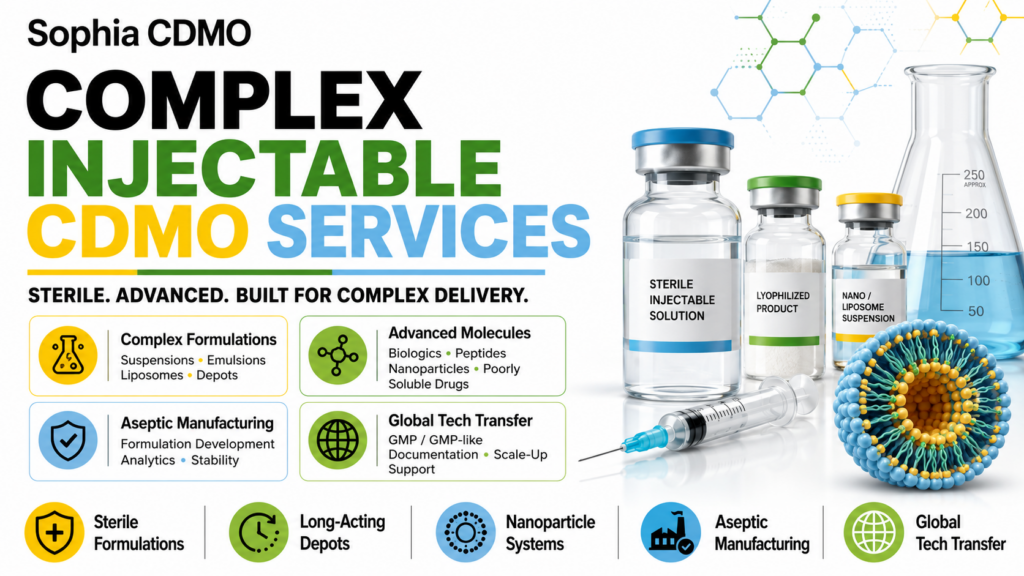
That is why Complex Injectable CDMO Services require more than aseptic filling. The product has to be designed for sterile manufacture, patient administration, storage, transport, delivery, and performance. A complex injectable must be manufacturable in the facility and usable in the clinic.
Sophia supports complex injectable programmes through formulation development, solubility strategy, suspension and emulsion design, nanoparticle and liposome interface, depot and long-acting release development, sterile filtration feasibility, aseptic process planning, lyophilisation interface, terminal sterilisation assessment where appropriate, container closure compatibility, syringeability, injectability, viscosity testing, particle analytics, potency testing, stability, GMP/GMP-like documentation, and European execution through state-of-the-art facilities in Spain and Switzerland.
The objective is direct: develop sterile injectable products that are stable, deliverable, controlled, and ready for serious pharmaceutical development.
Why Complex Injectables Matter
Complex injectables matter because many modern medicines cannot be delivered effectively as ordinary tablets, capsules, or simple aqueous injections. Some drugs are poorly soluble. Others degrade in the gastrointestinal tract. Then there are some that require controlled release or need local delivery or need to avoid harsh conditions.
Some are peptides requiring injection because oral bioavailability is weak. Others are long-acting products designed to reduce dosing frequency. Or maybe they could be nanoparticles or vesicles whose structure is the delivery system.
The injectable route gives direct access to systemic circulation, local tissues, subcutaneous space, muscle, tumour sites, ocular compartments, joints, intrathecal spaces, and implant-adjacent environments. It also creates higher responsibility. Sterility must be controlled. Particulate matter must be understood. Container closure must protect the product. The formulation must be compatible with administration. The product must remain stable through shelf life.
Complex injectables are especially important for:
- Long-acting therapies
- Depot products
- Poorly soluble drugs
- Peptide and protein products
- High-concentration biologics
- Oncology injectables
- Liposomes and nanoparticles
- Suspensions and emulsions
- Ophthalmic injectables
- Local delivery products
- Drug-device injectable systems
- Sterile specialty generics
- Complex reformulations
A serious Complex Injectable CDMO Services programme must solve the real product problem, not merely fill a vial.
Some helpful History
Injectable medicines began with the need to place therapeutic agents directly into the body. Early injections were relatively simple in concept: dissolve the medicine, sterilise the material, inject it. The syringe made therapy more immediate. The vial gave the drug a protected presentation. The clinic controlled administration. For many early products, that basic model was enough.
Then the molecules became harder.
Poorly soluble small molecules challenged simple aqueous formulation. Oils, cosolvents, surfactants, salts, pH adjustment, cyclodextrins, suspensions, and emulsions entered the development vocabulary. The injectable was no longer just a sterile solution. It became a solubility machine.
Peptides and proteins changed the field again. Insulin, hormones, cytokines, enzymes, monoclonal antibodies, and other biologics forced formulators to think about folding, aggregation, adsorption, oxidation, deamidation, viscosity, freeze-thaw, shaking, light, silicone oil, glass, elastomers, and protein-excipient interactions. A molecule could be chemically pure and still misbehave in a syringe.
Long-acting injectables then added release architecture. Instead of delivering the whole dose immediately, the formulation could release drug over weeks or months. Microspheres, implants, in situ forming depots, crystalline suspensions, oil depots, polymer systems, and prodrug strategies turned the injection site into a controlled-release environment. Manufacturing had to control particle size, polymer properties, residual solvents, release kinetics, syringeability, and sterility at the same time.
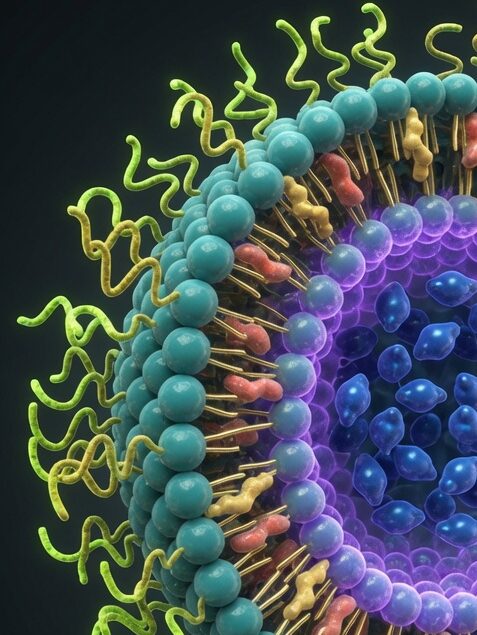
Liposomes and nanoparticles expanded the field further. The active product could be a particle system, not a dissolved molecule. Lipid composition, particle size, encapsulation, leakage, surface charge, sterilisation, filtration, and storage became product-defining attributes. The vehicle was no longer passive. It was the medicine’s operating system.
High-concentration biologics pushed injectable development into patient convenience and device compatibility. Subcutaneous self-administration required smaller volumes, higher concentrations, acceptable viscosity, low aggregation, and compatibility with prefilled syringes or autoinjectors. A formulation that worked in a vial might fail in an autoinjector. A biologic that looked stable at 50 mg/mL might become difficult at 150 mg/mL.
The historical direction is clear. Injectable products moved from sterile solutions to engineered delivery systems. The “injection” became a platform for solubility, release, targeting, convenience, and lifecycle strategy.
That is the territory for Complex Injectable CDMO Services: sterile pharmaceutical development where formulation science and manufacturing control have to work together.
Complex Injectable Product Types Supported
Sophia supports Complex Injectable CDMO Services across multiple sterile product categories and development stages.
Product types may include sterile solutions, sterile suspensions, nanosuspensions, emulsions, oil-based injectables, liposomes, lipid nanoparticles, polymeric nanoparticles, microspheres, long-acting injectables, in situ forming depots, crystalline depots, peptide injectables, protein injectables, monoclonal antibody products, high-concentration biologics, oligonucleotide injectables, mRNA and RNA-adjacent injectables, exosome products, radiopharmaceutical-adjacent injectable products, cytotoxic injectables, ophthalmic injectables, intrathecal products, intra-articular products, intratumoural products, subcutaneous products, intramuscular products, and intravenous products.
Development stages may include early formulation screening, preclinical material, toxicology batch planning, clinical candidate development, GMP/GMP-like manufacturing, process characterisation, sterile fill-finish interface, stability studies, formulation reformulation, product transfer, and commercial-readiness planning.
The common requirement is control. The formulation must remain stable, sterile, deliverable, measurable, and manufacturable.
Formulation Architecture
Complex injectable development begins with formulation architecture. Sophia supports formulation design across aqueous, non-aqueous, suspension, emulsion, depot, lipid, polymer, protein, peptide, oligonucleotide, and nanoparticle systems.
Core formulation variables may include:
- pH and buffer system
- Tonicity and osmolality
- Solubility and precipitation control
- Particle size and distribution
- Viscosity and syringeability
- Surfactant and stabiliser selection
- Oxidation and hydrolysis control
- Preservative strategy where relevant
- Container interaction
- Sterile filtration feasibility
- Lyophilisation suitability
- Release kinetics
- Administration route
The correct architecture depends on the molecule. A peptide may need protection against hydrolysis or oxidation. A protein may need aggregation control. A small molecule suspension may need particle-size control and sedimentation management. A liposome may need leakage and lipid oxidation control. A depot may need release kinetics. A high-concentration biologic may need viscosity reduction.
Solubility and Poorly Soluble Injectable Drugs
Many complex injectables begin with a solubility problem. Sophia supports solubility strategy for poorly soluble drugs, including salt form review, pH adjustment, cosolvents, surfactants, complexing agents, cyclodextrins, nanosuspensions, lipid systems, emulsions, amorphous approaches, crystalline suspension design, and depot formulations.
Poorly soluble drugs can be formulated as solutions if solubility can be increased safely and stably. If not, suspensions, nanosuspensions, emulsions, or lipid systems may be needed. The choice affects dose, injection volume, release rate, irritation, stability, sterilisation, and manufacturing process.
Solubility enhancement must be balanced against tolerability. A harsh cosolvent system may dissolve the drug but create injection-site problems. A surfactant may improve solubility but interact with containers or proteins. A nanosuspension may improve deliverability but require tight particle-size control. A cyclodextrin may help solubilisation but must be justified for route and dose.
Solubility work is not just making the molecule disappear into liquid. It is making the drug deliverable.
Sterile Suspensions and Nanosuspensions
Sophia supports sterile suspension and nanosuspension development for injectable products. These systems require control of particle size, particle morphology, polymorph, crystal growth, sedimentation, redispersibility, viscosity, syringeability, injectability, dose uniformity, and physical stability.
Suspension injectables are useful when the drug is poorly soluble or when controlled release is desired. But suspensions are technically demanding. Particles may grow during storage. Sediment may cake. Dose uniformity may fail. Needles may clog. Particles may change polymorphic form. Manufacturing shear may alter size distribution. Sterilisation may change crystal behaviour.
Nanosuspensions add further complexity because smaller particles increase surface area and may improve dissolution or local exposure, but they also increase aggregation risk and require careful stabilisation. Particle-size analytics, microscopy, laser diffraction, DLS, zeta potential, viscosity testing, and release testing may all be relevant.
A suspension that looks uniform after shaking in development must still perform at scale, at the end of shelf life, and through the intended needle.
Emulsions, Lipid Systems, and Liposomes
Sophia supports injectable emulsion, lipid system, and liposome development interface for products requiring lipid-based delivery, solubilisation, encapsulation, controlled distribution, or altered pharmacokinetics.
Emulsions require control of droplet size, droplet distribution, coalescence, creaming, pH, osmolality, surfactant system, oil phase, aqueous phase, sterilisation, container compatibility, and stability. Liposomes require control of lipid composition, particle size, lamellarity, encapsulation efficiency, leakage, lipid oxidation, phase transition behaviour, sterility strategy, and release.
Lipid systems may support poorly soluble drugs, cytotoxic products, RNA-adjacent products, peptide products, and local delivery. They may also create analytical and manufacturing challenges. A small change in lipid composition or process parameters can change particle behaviour. Sterile filtration may or may not be feasible depending on particle size. Terminal sterilisation may damage the system.
The particle is the product. That principle governs every analytical and manufacturing decision.
Long-Acting Injectables and Depots
Sophia supports long-acting injectable and depot development, including polymeric microspheres, crystalline suspensions, oil depots, in situ forming gels, biodegradable implants, prodrug depots, lipid depots, peptide depots, hormone products, antipsychotic depots, oncology depots, and extended-release injectable systems.
Depot products require control of release kinetics, particle size, polymer properties, degradation, residual solvents, injection force, needle compatibility, burst release, dose dumping risk, local tolerability, sterilisation, and stability. Release testing must be meaningful enough to guide development and support specifications.
Long-acting injectables can improve adherence and reduce dosing burden, but they are unforgiving. Once injected, the product cannot be removed easily. That raises the importance of release control, safety, formulation consistency, and clinical performance.
A depot is a promise made inside tissue. The manufacturing process must be worthy of that promise.
High-Concentration Biologics and Peptide Injectables
Sophia supports complex injectable development for high-concentration biologics, peptides, proteins, cytokines, growth factors, enzymes, antibody fragments, monoclonal antibodies, Fc fusions, VHHs, and peptide conjugates.
High-concentration biologics create formulation problems around viscosity, aggregation, opalescence, liquid-liquid phase separation, injection force, protein stability, surfactant selection, silicone oil sensitivity, container interaction, and device compatibility. Peptides create risks around oxidation, deamidation, hydrolysis, adsorption, aggregation, precipitation, and pH sensitivity.
Subcutaneous delivery often pushes products toward higher concentration and smaller volume. That can improve patient convenience but increase formulation stress. Autoinjectors and prefilled syringes add force and device constraints. A formulation that looks stable in a vial may not be suitable for a delivery device.
Complex injectable development must connect molecule stability with human administration. A patient does not receive a formulation table. They receive an injection.
Sterile Manufacturing Strategy
Sophia supports sterile manufacturing strategy for complex injectables, including aseptic processing, sterile filtration feasibility, terminal sterilisation assessment, bulk sterile handling, component sterilisation, lyophilisation interface, suspension filling, emulsion filling, nanoparticle filling, viscous product filling, vial filling, syringe filling, cartridge filling, and device-compatible filling.
Sterile filtration is often preferred when feasible, but complex injectables may not pass easily through sterilising-grade filters. Suspensions, liposomes, emulsions, microspheres, and nanoparticles may require aseptic processing because filtration could remove or damage the product. Terminal sterilisation may be possible for some products but destructive for others.
The sterility strategy must fit the product. A simple solution may be filterable. A liposome may not be. A suspension may require sterile API or aseptic crystallisation. A depot may require aseptic compounding. A biologic may be filterable but sensitive to shear, adsorption, or hold time.
Sterile manufacturing is not a generic checkbox. It is product-specific engineering under microbiological discipline.
Container Closure and Administration Interface
Sophia supports container closure and administration interface for complex injectables, including vials, prefilled syringes, cartridges, dual-chamber systems, autoinjector-compatible containers, ophthalmic containers, implant delivery systems, reconstitution systems, transfer devices, and clinical supply presentations.
Container closure selection must account for product contact materials, adsorption, extractables and leachables, silicone oil, tungsten, elastomers, plunger movement, container closure integrity, syringeability, dose accuracy, headspace, oxygen exposure, light protection, cold-chain performance, and compatibility with administration devices.
Administration matters. A viscous biologic may require an autoinjector with suitable force.
A suspension may require a needle that does not clog. A depot may require resuspension instructions. A lyophilised product may require reconstitution time and dose withdrawal testing. An ophthalmic injectable may require special particulate and sterility expectations.
Analytics and Characterisation
Sophia’s Complex Injectable CDMO Services include analytical development for identity, purity, potency, particulate matter, particle size, droplet size, viscosity, osmolality, pH, assay, impurities, degradation products, residual solvents, endotoxin, sterility, bioburden, container closure integrity, extractables and leachables, release profile, reconstitution, syringeability, and stability.
Methods may include HPLC, UPLC, LC-MS, GC, GC-MS, ICP-MS, SEC, CE-SDS, icIEF, DLS, laser diffraction, microscopy, nanoparticle tracking analysis, viscosity testing, osmolality, Karl Fischer water testing, dissolution or release testing, endotoxin testing, sterility testing, and product-specific potency assays.
Complex injectables often require orthogonal analytics because one measurement cannot define the system. A suspension needs particle size and assay. A liposome needs encapsulation and leakage. A biologic needs aggregation and potency. A depot needs release. A syringe product needs force and dose delivery. A sterile product needs microbial quality.
The analytical package must see the formulation as it is, not as a simple solution.
Stability and Stress Testing
Sophia supports stability and stress testing for complex injectables, including long-term, accelerated, freeze-thaw, agitation, light exposure, thermal cycling, shipping simulation, in-use stability, reconstitution stability, dilution stability, device compatibility, and end-of-shelf-life administration testing.
Stability risks may include precipitation, particle growth, aggregation, emulsion coalescence, liposome leakage, oxidation, hydrolysis, pH drift, viscosity change, potency loss, container interaction, preservative loss, depot release shift, needle clogging, and incomplete resuspension.
Stress testing should reflect the real product life. A vial may be shipped. A syringe may be stored refrigerated. A product may freeze accidentally. A depot may sit before administration. A suspension may be shaken. A lyophilised product may be reconstituted and held. A high-concentration biologic may pass through a narrow needle.
A Focused Development Checklist
For complex injectable programmes, Sophia helps sponsors define the product’s practical path early:
- What formulation architecture best fits the molecule and route?
- Can the product be sterilised without damaging its critical attributes?
- What particle, viscosity, dose, and delivery tests define performance?
- What container or device interactions create risk?
- What stability profile supports the intended clinical or commercial use?
These questions reduce late-stage drift. Complex injectables punish vague development.
European Facilities, Spain, and Switzerland
Complex injectable products require sterile product discipline, formulation science, analytical depth, device-aware thinking, and controlled documentation. Sophia’s European execution model, supported by state-of-the-art facilities in Spain and Switzerland, gives sponsors a serious technical base for advanced injectable development.
Spain supports applied formulation development, sterile product interface, clinical-stage execution, and scalable programme coordination. Switzerland adds precision analytical culture, quality-led documentation, high-control manufacturing expectations, and global pharmaceutical credibility.
This is part of Sophia’s broader brand architecture: a top European and global CDMO platform for complex products that need more than standard capacity. The work is not positioned as ordinary filling. It is controlled injectable development for difficult medicines.
No faff. No mystery particles. No “it passed visually, so it is fine.” Complex injectables need real control.
GMP, CMC, and Regulatory Documentation
Sophia supports GMP/GMP-like and CMC documentation for Complex Injectable CDMO Services, including formulation development reports, process descriptions, sterile manufacturing strategy, container closure data, E&L interface, analytical methods, specifications, release testing, stability protocols, batch records, CoA, deviation handling, change control, comparability, process characterisation, and tech transfer package.
CMC documentation must explain why the formulation is appropriate, how critical attributes are controlled, how sterility is assured, how particles or droplets are measured, how release or delivery performance is tested, how stability is demonstrated, and how manufacturing changes will be managed.
For complex injectables, the dossier should not hide complexity. It should organise it.
Why Sophia for Complex Injectable CDMO Services
Sophia supports complex injectable programmes through formulation development, sterile product strategy, analytical characterisation, container compatibility, stability, device interface, European facility execution, and GMP/GMP-like documentation.
The service includes:
- Complex injectable programme review
- Sterile solution, suspension, emulsion, liposome, nanoparticle, depot, and biologic injectable support
- Solubility and formulation strategy
- Particle size, viscosity, injectability, and syringeability assessment
- Long-acting injectable and depot release support
- High-concentration biologic formulation interface
- Sterile filtration and aseptic process planning
- Lyophilisation and reconstitution interface
- Vial, syringe, cartridge, and device-compatible formats
- Container closure and E&L interface
- Analytical development and stability testing
- Spain and Switzerland-linked European execution
- GMP/GMP-like documentation
- Global tech transfer support
The platform is suited to sponsors who need sterile injectable products that are stable, deliverable, manufacturable, and analytically controlled.
Technical Service Summary
Sophia provides Complex Injectable CDMO Services for sterile suspensions, nanosuspensions, emulsions, liposomes, nanoparticles, long-acting injectables, depot formulations, high-concentration biologics, peptide injectables, protein injectables, oligonucleotide injectables, poorly soluble drugs, ophthalmic injectables, local delivery products, and drug-device injectable systems.
Relevant technical needs include solubility strategy, formulation design, sterile manufacturing, aseptic processing, particle control, droplet size, viscosity, syringeability, injectability, release testing, potency, container closure, E&L, stability, lyophilisation, reconstitution, GMP/GMP-like documentation, and tech transfer.
The service is intended for products where sterile manufacturing, formulation complexity, delivery performance, and long-term stability must operate together.
Read More About Related Sophia Capabilities
Sterile Fill-Finish CDMO Services
Complex injectables often require aseptic filling, sterile filtration feasibility, vial, syringe, or cartridge presentation, and container closure integrity.
FAQ: Complex Injectable CDMO Services
1. What are Complex Injectable CDMO Services?
Complex Injectable CDMO Services support development and manufacturing of sterile injectable products that require advanced formulation, particle control, release control, sterile processing, container compatibility, analytics, stability, and documentation.
2. What makes an injectable product complex?
An injectable may be complex because it is a suspension, emulsion, liposome, nanoparticle, depot, high-concentration biologic, poorly soluble drug, peptide, protein, oligonucleotide, or drug-device product requiring specialised control.
3. Can Sophia support sterile suspensions?
Yes. Sophia supports sterile suspension and nanosuspension development, including particle size, sedimentation, redispersibility, syringeability, dose uniformity, sterility strategy, and stability.
4. Can Sophia support long-acting injectables?
Yes. Sophia supports long-acting injectable and depot development, including release strategy, polymer or particle systems, crystalline suspensions, oil depots, in situ forming systems, injectability, and stability.
5. What analytics are used for complex injectables?
Analytics may include HPLC, LC-MS, particle size, droplet size, microscopy, viscosity, osmolality, pH, assay, impurities, potency, release testing, particulate matter, sterility, endotoxin, and stability-indicating methods.
6. Can complex injectables be sterile filtered?
Some can be sterile filtered, especially simple solutions. Suspensions, liposomes, emulsions, nanoparticles, and depot products may require aseptic processing if filtration damages or removes the product.
7. Can Sophia support high-concentration biologic injectables?
Yes. Sophia supports high-concentration biologic injectable development, including aggregation control, viscosity, syringeability, formulation, container compatibility, device interface, and stability.
8. Can Sophia support lyophilised injectables?
Yes. Sophia supports lyophilised injectable development, including formulation, cycle development interface, reconstitution, residual moisture, potency, stability, and fill-finish planning.
9. Why is container closure important?
Container closure can affect sterility, stability, adsorption, extractables and leachables, particles, silicone oil exposure, dose delivery, and compatibility with syringes, cartridges, or devices.
10. What should sponsors provide to begin a complex injectable project?
Useful starting information includes molecule type, dose, route, solubility, formulation history, target presentation, container preference, stability data, sterility strategy, analytical data, delivery requirements, and development stage.
Conclusion
Sophia provides Complex Injectable CDMO Services for sterile products where formulation, sterility, delivery performance, stability, and analytics must be developed together.
The work may involve suspensions, emulsions, liposomes, depots, long-acting injectables, high-concentration biologics, peptides, proteins, oligonucleotides, or poorly soluble drugs. Each format requires product-specific control.
Through state-of-the-art infrastructure in Spain and Switzerland, Sophia supports complex injectable development from formulation strategy through sterile manufacturing planning, analytical characterisation, stability, CMC documentation, and global tech transfer.
Email our team at info@sophiacdmo.com