
Need Nasal Spray? Sophia can help.
Sophia provides Nasal Spray CDMO Services for sponsors developing metered-dose nasal sprays, preservative-free nasal systems, nasal solutions, nasal suspensions, nasal emulsions, systemic nasal products, local rhinitis products, allergy sprays, migraine products, rescue medicines, CNS-targeted delivery concepts, nasal vaccines, peptide nasal products, biologic-adjacent nasal formulations, paediatric nasal products, geriatric nasal products, and drug-device nasal delivery systems.
A nasal spray is not just liquid pushed through a pump. The formulation, container, actuator, pump, plume, droplet size, spray pattern, delivered dose, viscosity, preservative system, pH, osmolality, microbial quality, device performance, user technique, and nasal deposition all define the final product. A drug can be chemically stable and still fail because the spray plume is wrong, the pump delivers inconsistently, the suspension settles, the nozzle clogs, the preservative interacts with the formulation, the droplets deposit poorly, or the product loses performance at the end of shelf life.
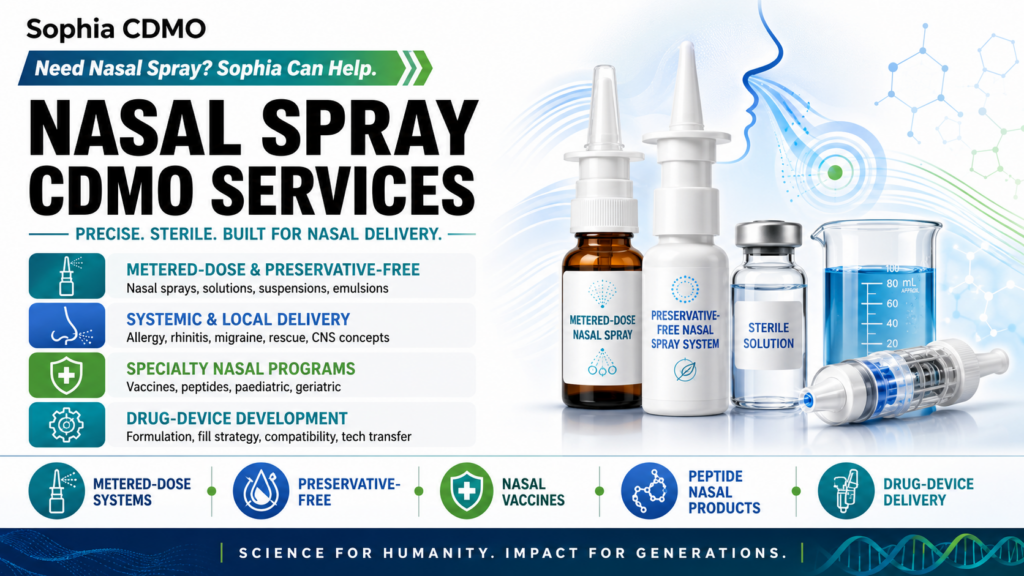
That is why Nasal Spray CDMO Services require integrated formulation-device development. The product must be designed as a metered delivery system: active ingredient, formulation, bottle, pump, actuator, closure, overcap, instructions, microbial strategy, performance testing, stability, and CMC documentation.
Sophia supports nasal spray programmes through formulation development, solubility and suspension strategy, preservative-free planning, pump and actuator compatibility, delivered dose testing, spray pattern, plume geometry, droplet-size distribution, priming and repriming assessment, extractables and leachables interface, microbial quality strategy, stability, in-use testing, GMP/GMP-like documentation, and European execution through state-of-the-art facilities in Spain and Switzerland.
The objective is direct: develop nasal spray products that deliver the intended dose consistently, safely, comfortably, and defensibly.
Why Nasal Spray Products Matter
Nasal spray products matter because the nasal route can support local and systemic drug delivery without swallowing, injection, or infusion. For local therapy, nasal sprays can treat allergic rhinitis, congestion, inflammation, infection-adjacent symptoms, dryness, and nasal mucosal conditions. For systemic therapy, the nose can support rapid administration for selected drugs where fast onset, self-administration, emergency use, or non-invasive delivery is valuable.
Nasal products are especially relevant for:
- Allergic rhinitis
- Nasal congestion
- Migraine rescue products
- Seizure rescue products
- Opioid overdose reversal products
- CNS-adjacent delivery concepts
- Hormonal products
- Peptide delivery research
- Nasal vaccines
- Paediatric-friendly delivery
- Geriatric-friendly delivery
- Preservative-free chronic-use products
- Drug-device lifecycle extensions
- Complex generic nasal sprays
Regulators treat nasal products as specialised dosage forms. FDA guidance addresses CMC documentation for nasal spray and inhalation solution, suspension, and spray drug products intended for local or systemic effect, while EMA’s quality guideline addresses medicinal products delivered to the nasal mucosa or lungs for local or systemic effect.
That regulatory structure reflects the technical reality. A nasal spray is a formulation and device system. The clinical dose depends on pump mechanics, formulation properties, spray characteristics, and user handling.
A serious Nasal Spray CDMO Services programme must therefore connect drug product science with device performance from the start.
Some History of Nasal Drug Delivery
Nasal therapy is old because the nose is accessible. Ancient medical traditions used oils, powders, smoke, plant extracts, and rinses through the nose for breathing, congestion, pain, ritual, and perceived systemic effects. Some of those practices were crude, but they recognised a basic anatomical fact: the nasal cavity is an open route into the body.
Modern nasal delivery began to take shape as pharmacy became more controlled. Drops, rinses, inhalants, and sprays gradually replaced less precise preparations. Early nasal products were often local remedies: decongestants, saline, antiseptic-adjacent solutions, antihistamines, and corticosteroids. The goal was straightforward: deliver medicine to the nasal mucosa.
Then the metered spray changed the category. The pump allowed a defined volume to be delivered repeatedly. The actuator shaped the plume. The bottle and closure protected the formulation. The product became less like a simple liquid and more like a small mechanical dosing system. This shift made nasal development more technical because the device became part of dose control.
Corticosteroid nasal sprays helped make chronic nasal therapy familiar. They showed how a nasal product could be used repeatedly over time and still require comfort, tolerability, dose uniformity, microbial control, and patient adherence. Allergy and rhinitis products made nasal sprays ordinary in the consumer mind, but ordinary use did not mean simple development.
Emergency and systemic nasal products added another layer. Nasal naloxone, seizure rescue medicines, migraine products, and hormonal nasal products showed that the nasal route could be used when speed, convenience, or avoidance of injection mattered. In these cases, the nasal spray is not only a local therapy. It is a rapid-use delivery system where dose accuracy and user handling can become clinically important.
The vaccine and biologics era pushed the question further. Nasal vaccines and mucosal immunology products are attractive because the nasal mucosa is an immune-active surface. Peptides and biologic-adjacent products raise questions about permeability, stability, enzymatic degradation, absorption enhancers, local tolerability, and formulation-device compatibility. CNS-targeted nasal delivery concepts add another layer of biological ambition, even where development remains technically demanding.
The historical movement is clear. Nasal delivery evolved from crude access, to local therapy, to metered drug-device products, to emergency and systemic delivery, to advanced mucosal and biologic-adjacent platforms. The nose looks accessible. The product science is not casual.
That is the territory for Nasal Spray CDMO Services: small-volume drug-device products where formulation, spray physics, patient use, and regulatory documentation must align.
The Product Architecture of a Nasal Spray
A nasal spray product has several interacting components. The formulation contains the active ingredient and excipients. The container stores the product. The pump meters the dose. The actuator shapes the spray. The overcap protects the nozzle. The user supplies actuation force and positioning. The nasal cavity receives the plume.
Key product attributes include:
- Delivered dose
- Dose uniformity
- Spray pattern
- Plume geometry
- Droplet-size distribution
- Priming and repriming
- Pump actuation force
- Shot weight
- Nozzle clogging risk
- Formulation viscosity
- pH and osmolality
- Preservative effectiveness or preservative-free control
- Suspension redispersibility
- Container compatibility
- Microbial quality
- Stability and in-use performance
The failure points are usually at the interfaces. A formulation may be stable but too viscous for the pump. A pump may work with water but not with a suspension. A suspension may assay correctly but deliver inconsistent dose if particles settle. A preservative may protect the product but irritate the nasal mucosa. A spray may meet shot weight but deposit poorly because plume geometry is wrong.
Sophia’s Nasal Spray CDMO Services are built around these interfaces. The product has to spray correctly, not merely exist in a bottle.
Nasal Spray Product Types Supported
Sophia supports Nasal Spray CDMO Services across local, systemic, preservative-free, paediatric, geriatric, emergency-use, and advanced product categories.
Product types may include nasal solutions, nasal suspensions, nasal emulsions, preservative-free nasal sprays, preserved multidose sprays, unit-dose nasal sprays, bidose nasal sprays, emergency nasal products, allergy nasal sprays, corticosteroid nasal sprays, antihistamine nasal sprays, decongestant products, saline-adjacent products, nasal peptides, migraine nasal products, seizure rescue sprays, opioid overdose reversal products, nasal vaccines, nasal biologic-adjacent products, CNS-targeted nasal delivery concepts, and complex generic nasal sprays.
Programme types may include early formulation screening, pump selection, actuator comparison, spray performance development, clinical trial material, GMP/GMP-like manufacturing, product reformulation, preservative-free conversion, lifecycle extension, generic nasal spray development, stability rescue, packaging change, method development, and global tech transfer.
The product type drives the control strategy. A local allergy spray is not an emergency rescue product. A suspension is not a solution. A unit-dose device is not a multidose pump. The development plan must follow the route, molecule, device, and use case.
Formulation Development for Nasal Sprays
Sophia supports formulation development for nasal solutions, suspensions, emulsions, gels, sprays, and preservative-free systems. This includes API solubility, pH, osmolality, buffer capacity, viscosity, preservative strategy, surfactant selection, suspending agents, antioxidants, chelators, mucoadhesive polymers, absorption-enhancement interface, taste and smell considerations, microbial quality, and container compatibility.
Nasal formulations must be compatible with the nasal mucosa. Strong pH shifts, irritating excipients, high osmolality, harsh preservatives, unpleasant taste, odour, and poor spray feel can affect tolerability and adherence. For chronic products, comfort becomes especially important. For emergency products, dose delivery and usability dominate.
Solubility is often central. A solution spray may be preferred if the API can remain dissolved and stable. If solubility is limited, suspension or emulsion approaches may be needed. Suspensions require particle-size control and dose uniformity. Emulsions require droplet-size control and physical stability. Viscous or mucoadhesive systems may improve residence time but can alter spray performance.
Nasal formulation is a balance between chemistry, mucosal comfort, and device mechanics. The nose is accessible, but it is not passive.
Nasal Suspensions
Sophia supports nasal suspension development for poorly soluble APIs and locally acting products. Suspension development may include particle-size control, crystal form, sedimentation, redispersibility, dose uniformity, viscosity, wetting agents, suspending agents, spray pump compatibility, nozzle clogging risk, and stability.
Nasal suspensions are difficult because the formulation must remain physically stable and deliver a consistent dose. Particles may settle. Agglomerates may form. Particle size may grow during storage. The pump may preferentially deliver liquid or particles depending on suspension behaviour. The nozzle may clog. Shaking instructions may be required but cannot be the only control strategy.
Particle size influences deposition, dissolution, comfort, and spray performance. Too large and the product may feel gritty or clog. Too small and physical stability or dissolution behaviour may change. The suspension must remain redispersible at the end of shelf life and across realistic patient handling.
A suspension that works only under perfect laboratory shaking is not a robust nasal product.
Nasal Emulsions and Lipid Systems
Sophia supports nasal emulsion and lipid-system development, including oil phase selection, surfactant system, droplet-size control, emulsion stability, viscosity, preservative compatibility, osmolality, pH, container interaction, and spray performance.
Nasal emulsions can support poorly soluble drugs, mucosal retention, protective lipid effects, or product differentiation. But emulsions can destabilise through creaming, coalescence, droplet growth, phase separation, or surfactant degradation. The pump must maintain droplet delivery without destabilising the emulsion. Droplet-size distribution must remain controlled through shelf life.
Lipid systems may also affect sensory experience. Nasal products can drip into the throat and be tasted. Oily feel, odour, and irritation can influence patient acceptance. Formulation elegance matters, but it must be supported by stability data.
A nasal emulsion must be chemically stable, physically stable, sprayable, and tolerable. That is a tight lane.
Preserved and Preservative-Free Nasal Systems
Sophia supports preserved and preservative-free nasal spray development. Preserved multidose systems may use antimicrobial preservatives to control microbial risk during use. Preservative-free systems may use unit-dose devices, bidose devices, sterile multidose containers, filters, valves, collapsible systems, or other microbial-protection mechanisms.
Preservatives can create trade-offs. They may support multidose microbial control, but they can also affect mucosal tolerability, formulation compatibility, surfactant behaviour, and device materials. Preservative-free products may improve tolerability and market positioning but require more sophisticated container-device control.
Preservative-free nasal development must answer practical questions:
- How is microbial ingress prevented during use?
- Does the device maintain delivered dose through shelf life?
- Does the formulation remain stable without preservative?
- Can the system be manufactured and filled under suitable controls?
- Does in-use testing support real patient handling?
A preservative-free nasal product is not merely a formula without preservative. It is a device-controlled microbial strategy.
Pump, Actuator, and Device Selection
Sophia supports nasal pump and actuator selection for metered spray products. Device development may include pump volume, actuator geometry, nozzle design, actuation force, spray angle, droplet-size distribution, priming, repriming, dose counting where relevant, container compatibility, unit-dose or multidose format, child-resistant features where relevant, and patient usability.
The pump and actuator define how the formulation leaves the bottle. A pump that works well for a low-viscosity solution may perform poorly with a suspension or emulsion. A nozzle may clog with particles. A pump may show dose variability after storage. A device may require too much force for paediatric or geriatric users. A unit-dose system may improve rescue use but require different filling and assembly logic.
Device selection should begin early. Late device changes can force formulation, stability, spray testing, packaging, and regulatory documentation changes.
The actuator is the final gate between formulation and patient. It matters.
Spray Performance Testing
Spray performance is central to nasal product development. Sophia supports delivered dose, shot weight, spray pattern, plume geometry, droplet-size distribution, priming, repriming, pump delivery, actuation force, tail-off profile, dose uniformity through life, nozzle clogging, and end-of-use testing.
Regulatory and analytical discussions of nasal sprays commonly focus on delivered dose, droplet-size distribution, plume geometry, spray pattern, and shot weight because these attributes connect device performance with product delivery.
Spray pattern describes the cross-sectional shape of the spray at a defined distance. Plume geometry describes the spray cone angle and shape. Droplet-size distribution influences deposition and potential inhalation risk. Shot weight and delivered dose indicate metering consistency. Priming and repriming determine how the product behaves after storage or non-use.
Spray testing must be method-controlled. Actuation force, actuation speed, distance, angle, device orientation, number of priming shots, temperature, formulation age, and operator technique can affect results. Automated actuation may be needed for reproducibility.
A nasal spray must not only contain the right dose. It must deliver the right dose in the right spray.
Nasal Deposition and Mucosal Delivery
Sophia supports nasal deposition and mucosal delivery strategy for products where target site matters. This may include local nasal cavity delivery, upper nasal cavity targeting, systemic absorption, rapid rescue delivery, mucosal immune exposure, or CNS-adjacent delivery concepts.
Nasal deposition depends on droplet size, plume geometry, spray angle, formulation viscosity, patient anatomy, inhalation pattern, head position, actuation force, and device design. Larger droplets may deposit anteriorly. Smaller droplets may travel deeper or be inhaled. Viscous formulations may retain longer but spray differently. Patient instructions can influence deposition.
For systemic nasal products, absorption depends on residence time, permeability, drug solubility, molecular size, enzymatic degradation, formulation excipients, mucociliary clearance, and nasal mucosal condition. For vaccines, mucosal immune exposure may matter. For locally acting rhinitis products, distribution across nasal mucosa may be central.
The spray plume is not abstract geometry. It is the product’s route into tissue.
Sterility, Microbial Quality, and In-Use Control
Nasal sprays may be sterile or non-sterile depending on product type, route, market, risk assessment, and regulatory strategy, but microbial quality remains critical. Sophia supports microbial quality strategy, preservative effectiveness testing, bioburden control, sterile manufacturing interface, aseptic filling where appropriate, terminal sterilisation assessment where relevant, microbial ingress testing, and in-use simulation.
For products intended for vulnerable populations, systemic exposure, emergency use, preservative-free delivery, or advanced molecules, microbial control may be especially important. Multidose products must remain safe during repeated use. Unit-dose products must maintain quality through storage and administration. Preservative systems must remain effective through shelf life.
Nasal products occupy a practical middle ground. They are used through a non-sterile anatomical route, but the product itself still needs rigorous microbial control. The manufacturing and packaging strategy must match the intended use.
Container Compatibility and Extractables & Leachables
Sophia supports container compatibility and extractables and leachables interface for nasal spray products. Product-contact materials may include bottle polymers, pump components, elastomers, springs, gaskets, valves, dip tubes, actuators, filters, closures, liners, and overcaps.
Compatibility questions may include:
- Sorption of API into polymers
- Leachables from elastomers or plastics
- Preservative loss
- Pump corrosion or component interaction
- Extractables from product-contact surfaces
- Container closure integrity
- Actuator clogging
- Dose performance over shelf life
- Stability under inverted or upright storage
- Light and oxygen protection
Nasal spray devices contain multiple materials. The formulation contacts more than the bottle. It may pass through pump chambers, valves, elastomers, and actuator channels. Each material can affect stability, safety, and performance.
The device is part of the product-contact system. It must be treated accordingly.
Analytics and Quality Control
Sophia’s Nasal Spray CDMO Services include analytical development for assay, impurities, degradation products, preservatives, pH, osmolality, viscosity, microbial quality, droplet-size distribution, spray pattern, plume geometry, delivered dose, shot weight, pump delivery, particulate matter where relevant, particle size for suspensions, droplet size for emulsions, content uniformity, container closure integrity, extractables and leachables, and stability.
Methods may include HPLC, UPLC, LC-MS, GC-MS, ICP-MS, laser diffraction, cascade or impactor-adjacent methods where relevant, automated spray actuation, high-speed imaging, spray pattern imaging, plume geometry measurement, rheology, microscopy, DLS for selected systems, microbial testing, preservative effectiveness testing, and product-specific stability-indicating methods.
Analytics must capture both formulation quality and device performance. A nasal spray that passes assay but fails delivered dose is not acceptable. A formulation that remains chemically stable but changes spray pattern may still fail. A suspension that assays correctly but settles poorly may deliver variable dose.
The product is measured as a spray system, not merely as a liquid.
Stability and In-Use Testing
Sophia supports stability and in-use testing for nasal spray products, including long-term stability, accelerated stability, photostability, freeze-thaw, shipping simulation, upright and inverted storage, primed and unprimed storage, microbial in-use testing, delivered dose through life, pump performance, nozzle clogging, preservative effectiveness, droplet-size stability, spray pattern stability, plume geometry stability, and end-of-use testing.
Nasal spray products can change during storage. Suspensions may settle or grow particles. Emulsions may change droplet size. Solutions may degrade. Preservatives may decline. Pumps may dry out or clog. Actuation force may change. Droplet size and plume geometry may shift. Extractables or leachables may increase.
In-use testing is especially important because patients prime, spray, recap, store, travel, and pause use. A multidose nasal product must perform not only at release, but throughout its labelled use period.
A stable nasal spray is stable in chemistry, device performance, microbial control, and patient use.
A Development Checklist
For nasal spray programmes, Sophia helps sponsors define the core product route early:
- Is the formulation a solution, suspension, emulsion, gel, or preservative-free system?
- Which pump and actuator produce the intended delivered dose and spray plume?
- What spray performance tests define product quality?
- What microbial strategy supports multidose or unit-dose use?
- What stability and in-use data prove performance through shelf life?
These questions keep formulation, device, analytics, microbiology, and patient use connected. Nasal sprays punish late device integration.
GMP, CMC, and Regulatory Documentation
Sophia supports GMP/GMP-like and CMC documentation for Nasal Spray CDMO Services, including formulation development reports, device description, pump and actuator data, delivered dose studies, spray pattern, plume geometry, droplet-size distribution, preservative strategy, microbial control strategy, E&L summaries, analytical methods, specifications, stability protocols, in-use testing, batch records, CoA, deviation handling, change control, comparability, and tech transfer package.
CMC documentation should explain how the formulation and device work together. It should identify critical quality attributes, device components, product-contact materials, performance tests, microbial strategy, stability results, and end-of-use behaviour. For nasal products, regulators expect CMC documentation that reflects both the formulation and the delivery system, not only the active ingredient.
For global development, the dossier should present a coherent product argument: what the nasal spray is, how it is made, how it sprays, how it stays stable, how microbial quality is controlled, and how the dose remains consistent.
A serious nasal spray CMC package makes a small drug-device system reviewable.
Why Sophia for Nasal Spray CDMO Services
Sophia supports nasal spray programmes through formulation development, pump and actuator strategy, spray performance testing, microbial quality, E&L interface, stability, European facility execution, and GMP/GMP-like documentation.
The service includes:
- Nasal spray programme review
- Solution, suspension, emulsion, gel, preserved, and preservative-free nasal products
- Local and systemic nasal delivery support
- Pump, actuator, bottle, unit-dose, and multidose device interface
- Delivered dose, shot weight, spray pattern, plume geometry, and droplet-size testing
- Suspension particle-size and redispersibility support
- Emulsion droplet-size and physical stability support
- pH, osmolality, viscosity, comfort, and residence-time development
- Preservative effectiveness and microbial quality strategy
- Container compatibility and E&L interface
- Stability and in-use testing
- Spain and Switzerland-linked European execution
- GMP/GMP-like documentation
- Global tech transfer support
The platform is suited to sponsors who need nasal products that are stable, spray-consistent, device-compatible, patient-usable, and analytically controlled.
Technical Service Summary
Sophia provides Nasal Spray CDMO Services for metered nasal sprays, nasal solutions, nasal suspensions, nasal emulsions, preservative-free nasal products, multidose nasal sprays, unit-dose nasal devices, local rhinitis products, systemic nasal products, rescue medicines, nasal vaccines, peptides, biologic-adjacent nasal products, paediatric and geriatric nasal products, and complex generic nasal sprays.
Relevant technical needs include formulation development, pump selection, actuator compatibility, delivered dose, shot weight, spray pattern, plume geometry, droplet-size distribution, particle-size control, preservative strategy, microbial quality, E&L, stability, in-use testing, GMP/GMP-like documentation, and global tech transfer.
The service is intended for products where nasal formulation, device mechanics, spray performance, microbial control, and patient use must operate together.
Read More About Related Sophia Capabilities
Drug-Device CDMO Services
Nasal sprays are drug-device products requiring formulation-device compatibility, delivered dose performance, usability, stability, and integrated documentation.
Ophthalmic CDMO Services
Ophthalmic and nasal products share sterile or low-bioburden formulation, preservative strategy, multidose container control, comfort, and device-interface requirements.
Extractables & Leachables CDMO Services
Nasal spray pumps, bottles, elastomers, actuators, and filters may require E&L evaluation and leachables testing during stability.
FAQ: Nasal Spray CDMO Services
1. What are Nasal Spray CDMO Services?
Nasal Spray CDMO Services support development and manufacturing strategy for nasal spray products, including formulation, pump and actuator selection, spray performance testing, microbial quality, stability, documentation, and tech transfer.
2. What nasal spray products can Sophia support?
Sophia supports nasal solutions, suspensions, emulsions, preserved products, preservative-free systems, multidose sprays, unit-dose devices, allergy sprays, systemic nasal products, rescue medicines, nasal vaccines, and complex generic nasal sprays.
3. Why are nasal sprays considered drug-device products?
Nasal sprays depend on both formulation and device performance. The pump, actuator, bottle, nozzle, and user handling influence delivered dose, spray pattern, plume geometry, droplet size, and deposition.
4. What spray performance tests are important?
Important tests may include delivered dose, shot weight, spray pattern, plume geometry, droplet-size distribution, priming, repriming, actuation force, pump delivery, nozzle clogging, and end-of-use performance.
5. Can Sophia support nasal suspensions?
Yes. Sophia supports nasal suspension development, including particle size, redispersibility, dose uniformity, sedimentation, pump compatibility, nozzle clogging risk, and stability.
6. Can Sophia support preservative-free nasal sprays?
Yes. Sophia supports preservative-free unit-dose, bidose, and multidose nasal systems, including microbial ingress control, device performance, in-use testing, stability, and documentation.
7. What analytics are used for nasal sprays?
Analytics may include HPLC, LC-MS, assay, impurities, pH, osmolality, viscosity, microbial testing, preservative effectiveness, spray pattern, plume geometry, droplet-size distribution, particle size, delivered dose, E&L, and stability methods.
8. Why does droplet-size distribution matter?
Droplet size influences nasal deposition, local delivery, potential inhalation risk, systemic absorption, and consistency of product performance.
9. Can Sophia support systemic nasal products?
Yes. Sophia supports systemic nasal delivery products where dose consistency, rapid use, mucosal tolerability, absorption strategy, device performance, and stability are critical.
10. What should sponsors provide to begin a nasal spray project?
Useful starting information includes active ingredient, dose, target indication, local or systemic intent, formulation history, device preference, preservative preference, spray data, stability data, target markets, and development stage.
Conclusion
Sophia provides Nasal Spray CDMO Services for products where formulation, pump performance, spray geometry, microbial control, stability, and patient use must be developed together.
The work may involve solutions, suspensions, emulsions, preservative-free systems, systemic products, rescue medicines, or complex nasal drug-device formats. Each requires product-specific control.
Through state-of-the-art infrastructure in Spain and Switzerland, Sophia supports nasal spray development from formulation and device strategy through analytics, stability, CMC documentation, and global tech transfer.
Emalil our team at info@sophiacdmo.com