
Sophia provides Blow-Fill-Seal CDMO Services for sponsors developing sterile unit-dose liquids, ophthalmic solutions, respiratory nebules, nasal solutions, topical sterile liquids, wound care liquids, injectable-compatible concepts, veterinary sterile liquids, preservative-free products, low-volume sterile containers, GMP/GMP-like manufacturing, container closure development, analytical packages, stability, and commercial-readiness strategies.
Blow-fill-seal manufacturing forms, fills, and seals a plastic container in one integrated aseptic process. The container is created from molten polymer, shaped, filled with sterile product, and sealed within a controlled environment. This can reduce human intervention, support preservative-free unit-dose formats, and create efficient sterile liquid manufacturing for selected product types.
But BFS development is not just sterile filling into plastic. A process can fail because resin selection is wrong, container geometry is weak, fill volume drifts, headspace is poorly controlled, heat affects the formulation, extractables and leachables are unacceptable, container wall thickness varies, particulate risk rises, closure integrity is weak, or the product is incompatible with polymer, oxygen, light, or processing temperature.
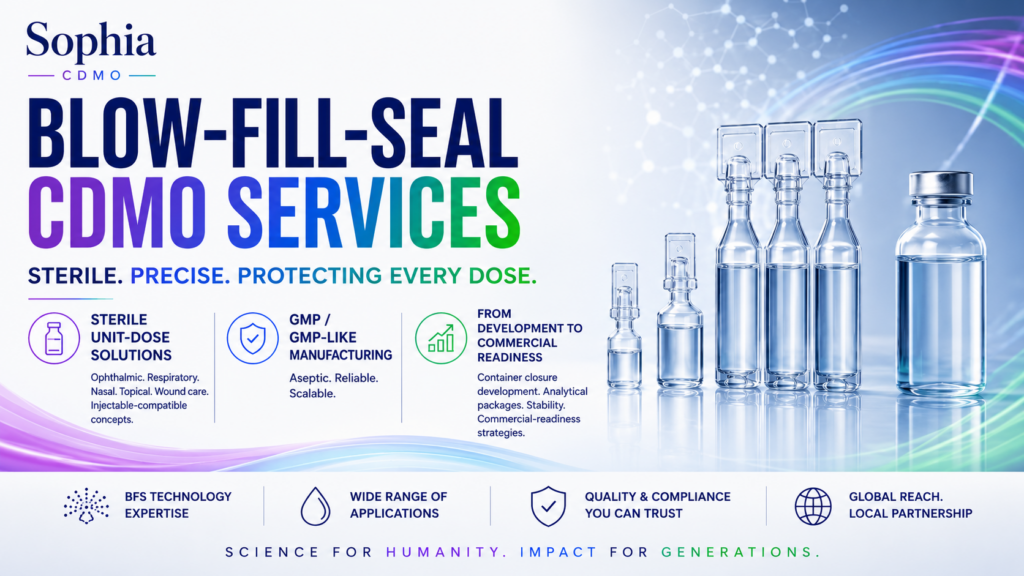
That is why Blow-Fill-Seal CDMO Services require sterile process development, polymer compatibility, container design, aseptic filling, thermal exposure assessment, extractables and leachables strategy, container closure integrity, analytical development, stability, GMP documentation, and disciplined technology transfer.
Sophia supports BFS programmes through product feasibility review, polymer and container assessment, unit-dose design, aseptic process strategy, filling parameter development, container closure integrity testing, extractables and leachables planning, stability studies, GMP/GMP-like production, and European execution through state-of-the-art facilities in Spain and Switzerland.
The objective is direct: develop BFS products that are sterile, stable, container-compatible, dose-accurate, documented, and suitable for serious global pharmaceutical development.
Why Blow-Fill-Seal Development Matters
Blow-fill-seal development matters because many sterile liquid products benefit from compact, sealed, unit-dose plastic containers. BFS can support high-throughput sterile production with reduced manual handling, especially for products where unit-dose convenience, preservative-free presentation, and container integrity are important.
BFS programmes may support:
- Ophthalmic unit-dose solutions
- Respiratory nebules
- Nasal saline and drug products
- Sterile topical liquids
- Wound irrigation products
- Preservative-free sterile liquids
- Veterinary sterile liquids
- Low-volume sterile containers
- Injectable-compatible feasibility concepts
- Complex generic sterile liquids
- Clinical trial supply
- Commercial-readiness planning
The technical challenge is that the container is manufactured at the same time as the product is filled. The process, container, polymer, fill volume, formulation, and closure integrity become one manufacturing system.
A serious Blow-Fill-Seal CDMO Services programme therefore develops product compatibility, container design, sterile process, analytics, and stability together.
History
Blow-fill-seal technology developed from the broader evolution of plastics processing, aseptic manufacturing, and sterile liquid packaging. As pharmaceutical manufacturing moved away from heavily manual sterile operations, integrated systems became attractive because they could reduce open handling and support more repeatable container formation and filling.
The basic industrial logic came from plastic extrusion and moulding. Molten polymer could be shaped into containers quickly and reproducibly. Pharmaceutical adaptation required an additional layer: the container had to be formed, filled, and sealed under conditions suitable for sterile products. This made BFS especially useful for small-volume liquid formats where the container itself could be created inline.
Ophthalmic and respiratory products became natural fits. Unit-dose ophthalmics reduced or removed the need for preservatives. Respiratory nebules benefited from convenient plastic ampoules. Nasal and topical sterile liquids used BFS where compact, sealed, disposable presentation made practical sense.
The technology also developed alongside modern aseptic expectations. Sterile manufacturing increasingly focused on contamination control, environmental monitoring, validated processes, container closure integrity, particulate control, and reduced operator intervention. BFS fit that direction because forming, filling, and sealing could occur in an enclosed automated sequence.
BFS is not universal. Some formulations cannot tolerate polymer interaction, oxygen exposure, light, heat, or container permeability. Some products require glass, prefilled syringes, vials, or lyophilised formats. But where the product fits the technology, BFS can offer a disciplined and efficient sterile manufacturing route.
That is the territory for Blow-Fill-Seal CDMO Services: sterile liquid products where container and process are created together.
The Science of Blow-Fill-Seal Manufacturing
BFS manufacturing depends on controlled extrusion, moulding, aseptic filling, and sealing. Polymer resin is melted and extruded as a parison, shaped into a container, filled with sterile liquid, and sealed. The process must control container geometry, fill accuracy, sterility, closure integrity, and product compatibility.
Important technical attributes include:
- Polymer resin selection
- Container geometry
- Wall thickness
- Fill volume
- Headspace
- Temperature exposure
- Product viscosity
- Sterile filtration compatibility
- Particulate control
- Container closure integrity
- Extractables and leachables
- Oxygen and moisture permeability
- Light protection
- Tip design
- Twist-off or snap-off function
- GMP documentation
BFS products are strongly shaped by polymer behaviour. Low-density polyethylene, polypropylene, and other selected materials may differ in flexibility, permeability, heat resistance, extractables profile, and compatibility. The formulation must remain stable in the container after filling, shipping, storage, and use.
Sophia builds Blow-Fill-Seal CDMO Services around this integrated container-product reality. She treats BFS as sterile process plus packaging science, not merely a filling format.
Technical Development Notes
BFS development often fails when container design is treated as secondary. In BFS, container geometry affects filling, cooling, sealing, squeeze behaviour, dose delivery, storage, and usability. A narrow neck may affect fill dynamics. A weak twist-off tab may create user problems. Wall thickness variation may affect permeability, stability, and container integrity. Headspace can influence oxidation or dose evacuation.
Thermal exposure also matters. Although product contact with molten polymer is controlled and brief, the process still introduces heat-related questions. Heat-sensitive APIs, proteins, peptides, surfactants, preservatives, buffers, and excipients may need careful evaluation. A product may pass initial release and then fail stability because polymer interaction, oxygen ingress, or leachable accumulation appears over time.
Sterile strategy must be built into the process. Many BFS products are sterile-filtered before filling, but the complete system must control bioburden, endotoxin, environmental conditions, filling path, sterilisation of product-contact surfaces, and container closure integrity.
Sophia’s BFS development model links formulation, polymer compatibility, container geometry, sterile filtration, filling dynamics, CCI, E&L, stability, and GMP documentation. This gives sponsors a top-tier European and global CDMO platform for sterile liquid products where the container is part of the medicine.
A BFS product succeeds when the liquid, plastic, seal, and dose remain controlled as one system.
Product Types Supported
Sophia supports Blow-Fill-Seal CDMO Services across feasibility, formulation review, container development, aseptic process strategy, analytical development, early clinical supply, GMP manufacturing, comparability, and technology transfer.
Product types may include ophthalmic unit-dose solutions, lubricating eye drops, preservative-free eye products, respiratory nebules, inhalation solutions, nasal saline products, nasal drug solutions, sterile topical liquids, wound irrigation products, veterinary unit-dose liquids, paediatric unit-dose liquids, low-volume sterile products, and selected injectable-compatible BFS feasibility programmes.
Programme types may include container design, resin selection, sterile filtration assessment, fill-volume development, sealing assessment, tip and opening design, extractables and leachables strategy, container closure integrity testing, stability, GMP batch manufacturing, regulatory documentation, and global tech transfer.
A respiratory nebule is not an ophthalmic dropper. A topical sterile liquid is not an injectable container. The use case must define the BFS system.
Best-Fit Programme Types
Sophia is especially suited for sponsors with BFS programmes requiring European execution, unit-dose sterile product development, preservative-free ophthalmic products, respiratory solutions, nasal solutions, container design, polymer compatibility, E&L strategy, CCI testing, clinical trial supply, GMP production, or global technology transfer.
The strongest fit is a programme where the product benefits from a sealed plastic unit-dose presentation and where formulation compatibility with BFS materials is technically plausible.
Sophia’s Blow-Fill-Seal CDMO Services are built for sponsors who need sterile product and container judgement, not only high-speed filling.
Container Design and Polymer Selection
Sophia supports container design and polymer selection for BFS products. This may include resin review, LDPE and polypropylene interface, container volume, wall thickness, tip design, twist-off design, ampoule shape, squeeze behaviour, headspace, oxygen barrier, light protection, and labelling surface considerations.
The container must fit the product and the user. Ophthalmic products may require precise drop formation and easy opening. Respiratory nebules require dose evacuation and compatibility with nebuliser workflows. Nasal and topical products may require different squeeze force, dose volume, or opening behaviour.
Polymer selection affects extractables, permeability, flexibility, heat exposure, and stability. The container is not neutral. It is a functional part of the product.
Aseptic BFS Processing
Sophia supports aseptic BFS processing strategy. This may include sterile bulk solution preparation, sterile filtration, product hold-time review, filling path control, machine parameter review, parison formation, moulding, filling, sealing, environmental monitoring, process simulation, and contamination control.
The BFS sequence requires controlled timing. The plastic must soften, open, receive the sterile liquid, close around it, and seal without hesitation. Product and container come into contact in a narrow, disciplined moment: the fill enters the forming space, pressure and heat shape the walls, and the seal closes while the product remains protected. The process must be firm enough to form the package and gentle enough to preserve the formulation inside.
This is why BFS is both elegant and unforgiving. The process has little patience for vague parameters.
Sterile control must be designed before the product reaches the filling zone.
Formulation Compatibility and Thermal Exposure
Sophia supports formulation compatibility and thermal exposure assessment for BFS products. This may include API compatibility, buffer selection, pH, osmolality, surfactants, preservatives where relevant, viscosity, oxygen sensitivity, light sensitivity, adsorption, polymer interaction, and heat exposure review.
BFS formulations must tolerate the container and process. Sensitive proteins, peptides, oxidisable small molecules, surfactant-rich systems, and oxygen-sensitive products may require additional work. Polymer adsorption, leachable accumulation, pH drift, water loss, or oxygen ingress can affect product quality.
Formulation compatibility should be tested early because BFS is hard to rescue after container selection is locked.
The product must be comfortable inside the plastic over its full shelf life.
Extractables, Leachables, and Container Closure Integrity
Sophia supports extractables, leachables, and container closure integrity strategy for Blow-Fill-Seal CDMO Services. This may include resin documentation, extractables study design, leachables study planning, toxicological risk interface, container closure integrity testing, dye ingress interface, vacuum decay interface, microbial ingress strategy, seal evaluation, and stability-linked leachables monitoring.
E&L risk depends on polymer, additives, processing conditions, sterilisation, formulation chemistry, storage time, and temperature. A formulation with surfactants or organic components may extract different species than a simple aqueous saline. Leachables must be assessed in the final container closure system.
CCI is equally central. A BFS container must protect sterility through storage, shipping, handling, and use. Seal defects, weak twist-offs, pinholes, wall thinning, or malformed containers can create risk.
Fill Volume, Dose Delivery, and User Function
Sophia supports fill volume, dose delivery, and user-function testing for BFS products. This may include fill accuracy, overfill strategy, delivered dose, residual volume, squeeze force, drop size, opening force, twist-off performance, nebuliser compatibility, dose evacuation, and in-use handling.
A BFS product must be usable. An ophthalmic container that creates inconsistent drops can fail user expectations. A respiratory ampoule that leaves excessive residual volume can affect dose. A twist-off tab that sheds particles or opens poorly can create risk.
Dose delivery is not only what is filled. It is what the user can actually administer.
The unit dose must behave as designed at the moment of use.
Analytical Development and Stability
Sophia supports analytical development and stability for BFS products. This may include assay, related substances, pH, osmolality, viscosity, particulate matter, sterility, endotoxin, bioburden, preservative content where relevant, delivered dose, container closure integrity, leachables, water loss, oxygen sensitivity, and stability-indicating methods.
Stability must evaluate both formulation and container. A BFS product may show changes from API degradation, pH shift, water vapour transmission, oxygen ingress, light exposure, extractables, leachables, adsorption, or closure weakness.
For respiratory and ophthalmic products, particulate control, sterility, dose delivery, and container function are especially important.
The analytical package must prove that the product remains sterile, stable, compatible, and usable.
GMP, Quality, and Regulatory Documentation
Sophia supports GMP and GMP-like documentation for Blow-Fill-Seal CDMO Services, including formulation records, resin records, container design records, sterile filtration records, aseptic processing records, BFS machine records, fill-volume records, CCI records, E&L records, analytical methods, stability protocols, specifications, CoA, deviation handling, CAPA, change control, environmental monitoring records, and tech transfer packages.
Documentation should explain product composition, polymer selection, container design, aseptic process, fill control, seal integrity, E&L strategy, stability, and manufacturing controls.
For BFS products, the regulatory file must defend both sterile liquid and plastic container system.
A strong BFS CDMO delivers a sealed sterile product, not just a plastic ampoule.
Technology Transfer and Global Supply
Sophia supports technology transfer for BFS programmes, including formulation transfer, resin transfer, container design transfer, sterile process transfer, machine parameter transfer, analytical transfer, CCI method transfer, E&L strategy transfer, stability transfer, batch record adaptation, and receiving-site readiness.
Technology transfer can expose hidden dependencies. A different resin grade can change leachables. A different mould can change wall thickness. A different fill path can change hold time. A different seal condition can change CCI. A different storage condition can change water loss.
Sophia’s European execution model supports sponsors seeking disciplined BFS development, reliable documentation, global supply readiness, and controlled transfer into clinical or commercial manufacturing networks.
European Facilities, Spain, and Switzerland
BFS programmes require sterile process development, polymer compatibility, container design, analytical depth, E&L strategy, CCI testing, GMP systems, stability, and regulatory credibility. Sophia’s European model, supported by state-of-the-art facilities in Spain and Switzerland, gives sponsors a serious platform for BFS product development and manufacturing.
Spain supports applied formulation development, BFS process coordination, aseptic manufacturing interface, fill-volume studies, analytical execution, stability, and scale-up. Switzerland adds precision analytics, documentation discipline, container-product characterisation, high-control product culture, and European pharmaceutical credibility.
This supports Sophia’s position as a top-tier European and global CDMO platform for sponsors who need BFS products developed with technical seriousness, not plastic packaging theatre.
No weak seal. No vague resin story. No sterile unit dose without container proof.
Why Sophia for Blow-Fill-Seal CDMO Services
Sophia supports BFS programmes through formulation review, polymer selection, container design, aseptic process strategy, fill-volume control, CCI, E&L, stability, European facility execution, and global technology transfer.
The service includes:
- BFS programme review
- Ophthalmic, respiratory, nasal, topical, veterinary, and preservative-free unit-dose support
- Polymer, resin, wall thickness, headspace, and container design strategy
- Sterile filtration, aseptic processing, forming, filling, and sealing interface
- Fill accuracy, delivered dose, opening force, squeeze behaviour, and user-function testing
- Extractables, leachables, CCI, sterility, endotoxin, and particulate strategy
- Stability, storage, shipping, and container compatibility evaluation
- GMP/GMP-like production support
- Spain and Switzerland-linked European execution
- Regulatory-ready documentation
- Global pharmaceutical tech transfer
The platform is suited to sponsors who need BFS development that is sterile-process-aware, container-controlled, analytically supported, documented, and internationally positioned.
Technical Service Summary
Sophia provides Blow-Fill-Seal CDMO Services for sterile unit-dose liquids, ophthalmic solutions, respiratory nebules, nasal solutions, topical sterile liquids, veterinary liquids, preservative-free products, low-volume sterile containers, GMP manufacturing, stability, documentation, and technology transfer.
Relevant technical needs include resin selection, container geometry, wall thickness, fill volume, headspace, sterile filtration, aseptic BFS processing, tip design, opening force, delivered dose, container closure integrity, extractables and leachables, particulate matter, sterility, endotoxin, water loss, oxygen permeability, GMP batch records, CMC support, and global tech transfer.
The service is intended for programmes where sterile liquid formulation, polymer compatibility, container design, aseptic manufacturing, analytics, stability, GMP quality, and scale-up must operate together.
Read More About Related Sophia Capabilities
Ophthalmic CDMO Services
BFS is widely suited to preservative-free ophthalmic unit-dose products requiring sterile processing, dose delivery, and container compatibility.
Nasal Spray CDMO Services
Nasal and respiratory liquid products may require container-function testing, dose delivery, sterility, and stability development.
Sterile Fill-Finish CDMO Services
BFS programmes connect directly with sterile manufacturing, aseptic process control, container closure integrity, and final drug product release.
Extractables & Leachables CDMO Services
Plastic container systems require E&L assessment, toxicological review, stability-linked leachables monitoring, and regulatory documentation.
Sophia CDMO는 멸균 단위용량 액제, 안과용 제품, 호흡기 네뷸, 비강 용액, 보존제 없는 BFS 제형을 개발하는 제약사를 지원합니다. 한국어권 스폰서를 위해 Sophia는 수지 선택, 용기 설계, 충전량, 밀봉 완전성, 추출물·침출물, 무균 공정, 입자 관리, 안정성 및 GMP 문서화를 통합한 유럽형 개발 플랫폼을 제공합니다. 핵심은 단순히 액체를 플라스틱 용기에 넣는 것이 아니라, 제품·용기·공정·사용성을 하나의 품질 시스템으로 제어하는 것입니다. Sophia는 스페인의 실행력과 스위스의 분석 정밀성을 결합해 글로벌 BFS 개발을 지원합니다.
FAQ: Blow-Fill-Seal CDMO Services
1. What are Blow-Fill-Seal CDMO Services?
Blow-Fill-Seal CDMO Services support development and manufacturing of sterile liquid products filled into plastic containers formed, filled, and sealed in one integrated aseptic process.
2. What products can Sophia support with BFS?
Sophia supports ophthalmic unit-dose products, respiratory nebules, nasal solutions, sterile topical liquids, wound care liquids, veterinary sterile liquids, and preservative-free sterile products.
3. Why use blow-fill-seal manufacturing?
BFS can reduce manual handling, support unit-dose sterile liquids, enable preservative-free formats, and integrate container formation, filling, and sealing in one automated process.
4. What are the main BFS development risks?
Key risks include polymer compatibility, extractables and leachables, fill accuracy, seal integrity, particulate matter, thermal exposure, oxygen permeability, water loss, and product stability.
5. Can Sophia support preservative-free BFS products?
Yes. Sophia supports preservative-free BFS development, especially where unit-dose presentation helps avoid the need for antimicrobial preservatives.
6. Why is resin selection important?
Resin affects flexibility, permeability, extractables, heat behaviour, seal quality, stability, and compatibility with the formulation.
7. What is container closure integrity?
Container closure integrity shows whether the container and seal protect the sterile product from leakage, contamination, and external ingress through storage and handling.
8. Why are extractables and leachables important for BFS?
Plastic containers may release chemical species into the product over time. E&L assessment helps evaluate compatibility and patient safety risk.
9. What should sponsors provide to begin a BFS project?
Useful starting information includes formulation, dose volume, route, target container size, preservative strategy, stability data, sterilisation concept, resin preference, clinical stage, and timeline.
10. Why can BFS technology transfer be difficult?
Transfer must reproduce resin, container geometry, machine parameters, sterile process, fill volume, seal quality, CCI, E&L behaviour, and stability. Small changes can affect product quality.
11. Can BFS be used for injectables?
Selected injectable-compatible BFS concepts may be assessed, but suitability depends on product, route, container requirements, regulatory expectations, sterility strategy, and compatibility.
12. Why can heat exposure matter in BFS?
BFS uses molten polymer during container formation. Although contact is controlled, heat-sensitive formulations may need evaluation for degradation, adsorption, or stability effects.
13. Why does opening design matter?
Twist-off or snap-off design affects user handling, particulate risk, dose delivery, sterility at use, and patient or caregiver convenience.
14. Why can water loss affect BFS products?
Plastic containers can allow some water vapour transmission. Water loss may change concentration, osmolality, pH, dose, and stability over shelf life.
15. Why is BFS more than packaging?
In BFS, the container is formed during filling and becomes part of the sterile product system. Product quality depends on formulation, polymer, process, seal, dose, and stability together.
Conclusion
Sophia provides Blow-Fill-Seal CDMO Services for programmes where sterile liquid formulation, container design, polymer compatibility, aseptic processing, E&L, CCI, stability, GMP quality, and scale-up must be developed together.
The work requires resin strategy, container geometry, sterile filtration, BFS process control, fill accuracy, delivered dose, documentation, and technology transfer.
Email our team at info@sophiacdmo.com