Choosing a Microbial CDMO Europe partner is not the same as buying fermentation capacity. Capacity matters, but litres alone do not manufacture a reliable product. A 10,000 L or 40,000 L vessel can look impressive on a slide, yet the real question is more delicate: can the process survive scale, impurity pressure, analytical scrutiny, GMP documentation, tech transfer, and sponsor timelines without collapsing into rework?
That is where many microbial programs fail. The science may work. The molecule may express. The strain may grow. The early data may look promising. Then the program moves from lab-scale confidence into manufacturing reality, and a different set of problems begins to appear. Oxygen transfer changes. Heat removal becomes harder. Broth viscosity increases. Raw material variation becomes visible. The impurity profile shifts. Downstream recovery loses performance. Analytical methods reveal too little, too late. Batch documentation starts to matter as much as the batch itself.
For sponsors evaluating a European microbial CDMO, the core issue is not whether a provider can run a fermentation. The core issue is whether the CDMO can build a controlled manufacturing system around the organism, product, process, impurity profile, analytical strategy, GMP pathway, and commercial objective.
Microbial manufacturing has a long history because fermentation itself has a long history. Humanity has used microbes for food, drink, preservation, medicine, and industrial production for centuries. Modern biotechnology transformed that ancient biological power into recombinant proteins, enzymes, vaccines, animal health products, probiotics, bioactives, live biotherapeutic products, and precision fermentation outputs. However, the underlying truth remains the same: microbes are powerful because they are alive, responsive, adaptive, and productive. They are also difficult because they respond to conditions in wild, nonlinear ways.
That is why choosing a Microbial CDMO Europe partner requires more than a procurement checklist. It requires technical judgment. A sponsor needs to ask whether the CDMO understands microbial biology, engineering scale, downstream constraints, analytical control, GMP expectations, and program governance as one connected system.
This guide gives sponsors a practical checklist for evaluating a microbial manufacturing partner in Europe. It covers what a microbial CDMO should provide, how to assess organism-specific competence, why scale claims require scrutiny, how to judge downstream and analytical readiness, and which red flags should make a sponsor pause before transferring a process.
What a Microbial CDMO in Europe Should Actually Provide
A microbial CDMO should not be understood as a simple fermentation vendor. That is too narrow, and for serious programmes, it is often the wrong starting point. A true microbial CDMO supports the full development and manufacturing pathway for products made by, expressed in, derived from, or dependent upon microorganisms. That includes the biological system, the process, the scale-up strategy, the downstream route, the analytical package, the quality framework, the documentation model, and the eventual transfer or supply pathway.
In practical terms, a sponsor is not only buying access to a fermenter. The sponsor is buying judgement around microbial behaviour. It is buying the ability to translate a living system into a controlled manufacturing process. That is a more demanding proposition.
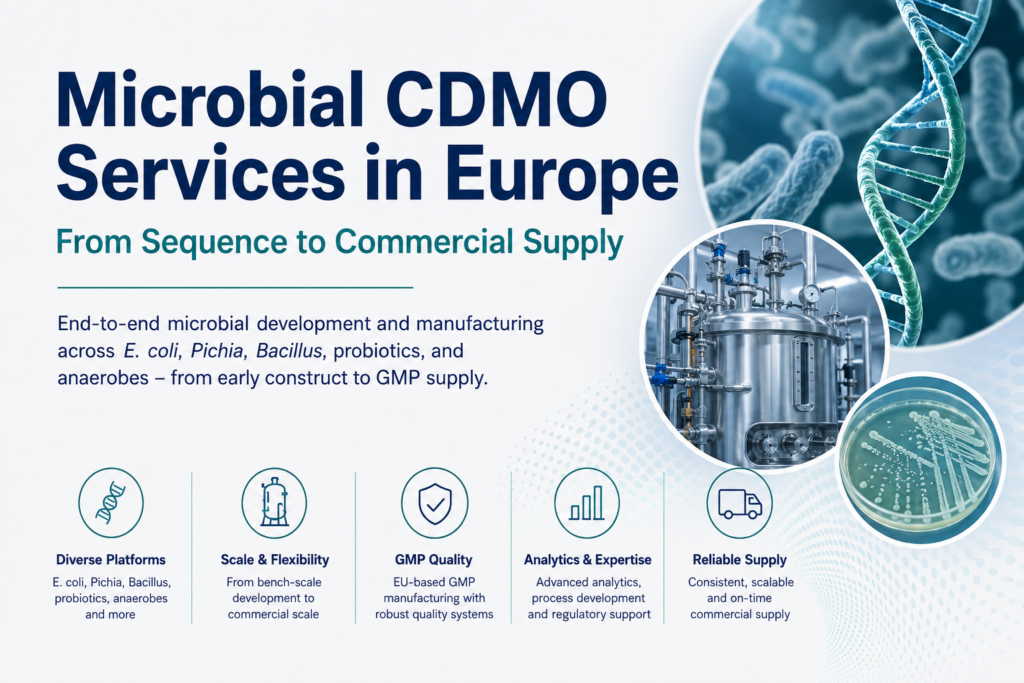
A capable Microbial CDMO Europe partner should understand how microbial systems behave across development and manufacturing conditions. This includes programmes involving E. coli, Pichia pastoris / Komagataella phaffii, Bacillus, Lactobacillus, Bifidobacterium, Saccharomyces and other yeast systems, strict anaerobes, engineered microbial strains, probiotics, bioactives, enzymes, recombinant proteins, animal health biologics, live microbial products, and precision fermentation outputs.
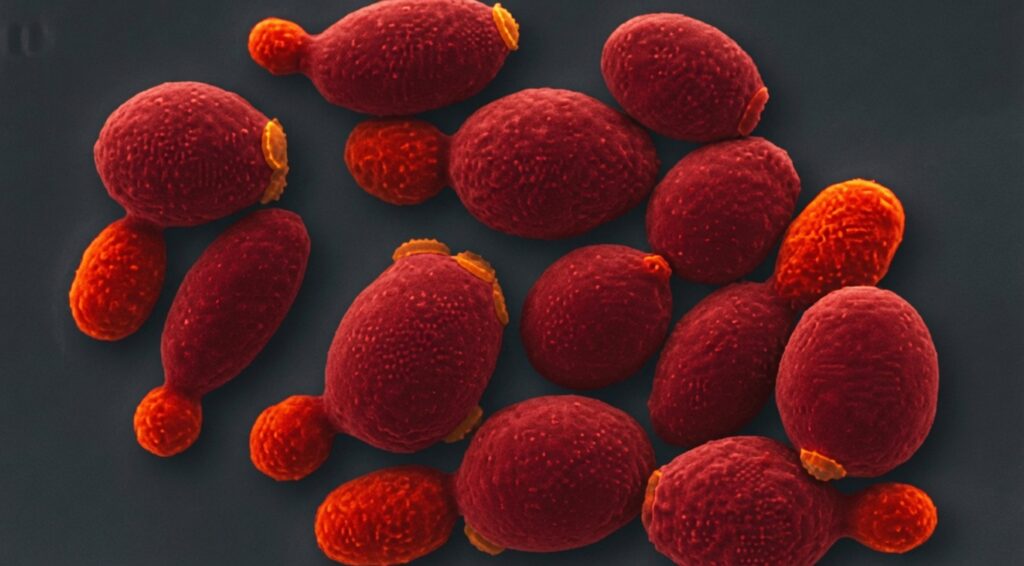
Each of these systems carries its own logic. E. coli can be fast, productive, and commercially attractive, but it may bring endotoxin, inclusion bodies, host cell proteins, residual DNA, refolding, aggregation, and demanding impurity clearance. Pichia can offer powerful high-density fermentation and secretion advantages, yet it also requires disciplined control of oxygen transfer, feed strategy, induction, proteolysis, product stability, and host-derived impurities. Bacillus may be useful for secreted proteins, enzymes, spores, animal health, and industrial bioactives, but protease activity, sporulation, and batch consistency must be controlled properly. Lactobacillus,
Bifidobacterium, and strict anaerobes require a different mindset again, because viability, identity, oxygen sensitivity, drying survival, and shelf-life may matter as much as classical yield.
That is why the word “microbial” cannot be treated casually. Microbial manufacturing is not one thing. It is a family of technically distinct manufacturing problems held together by shared themes: growth, metabolism, control, contamination risk, impurity management, process robustness, and biological variability.
A capable GMP microbial fermentation CDMO should provide connected capability across several core areas.
It should understand the strain or expression system. That means more than knowing the organism’s name. The CDMO should assess strain history, productivity, genetic stability, metabolic burden, plasmid or integration strategy where applicable, banking status, passage history, containment requirements, and known sensitivities. If the organism is the product, as in many probiotic or live microbial programmes, the CDMO must also understand how manufacturing affects identity, viability, purity, and biological performance.
It should support fermentation process development. This includes media selection, feed design, pH control, temperature strategy, dissolved oxygen control, antifoam use, induction timing, harvest criteria, biomass management, and process monitoring. The aim is not merely to make the organism grow. The aim is to create a process that behaves predictably enough to support the next stage of development.
It should manage feed strategy and process control with proper engineering awareness. Microbial systems can shift quickly when carbon source, oxygen transfer, nitrogen availability, trace elements, osmolality, heat generation, or metabolic by-products move outside the intended range. A serious CDMO should understand how these variables interact, rather than treating the fermentation as a black box.
It should provide scale-up and scale-down model development. This is where many programmes come unstuck. A bench-scale process may not translate neatly into a larger vessel. Mixing time, oxygen transfer, heat removal, shear, foaming, broth viscosity, and sensor response can all change with scale. A useful CDMO should explain how it will bridge those differences. It should also know when a scale-down model is needed to investigate large-scale behaviour without wasting expensive manufacturing capacity.
It should integrate downstream processing from the beginning. Downstream is not a tidy clean-up step that happens after fermentation. In many microbial programmes, downstream is the actual critical path. Clarification, centrifugation, lysis, filtration, chromatography, ultrafiltration/diafiltration, refolding, concentration, drying, encapsulation, and formulation can determine whether the upstream process has any commercial or clinical value. A strong CDMO connects upstream decisions to downstream consequences early.
It should build an impurity clearance strategy that reflects the product and organism. For recombinant proteins, this may include host cell proteins, residual host cell DNA, endotoxin, aggregates, fragments, misfolded product, media-derived impurities, process additives, and product-related variants. For live microbial products, the impurity question may involve contaminating organisms, non-viable cells, residual media, metabolic by-products, moisture, oxygen damage, or unwanted strain drift. The CDMO must know which impurities matter, how they will be measured, and how they will be controlled.
It should provide analytical method development that supports decisions, not just paperwork. Good analytics help the sponsor understand whether the process is working. They support identity, purity, potency, concentration, activity, viability, stability, impurity control, and comparability. The right methods depend on the product. An enzyme programme may need activity-focused analytics. An E. coli protein may require endotoxin and HCP methods. A probiotic programme may require strain identity, CFU, contaminants, moisture, water activity, oxygen sensitivity, and shelf-life testing.
It should define in-process controls that are actually useful. Sampling, monitoring, acceptance criteria, and decision points should not be decorative. They should help the team decide when to feed, induce, harvest, clarify, purify, hold, continue, pause, investigate, or reject. In-process controls are part of the nervous system of the programme.
It should execute GMP manufacturing where required, with batch records, trained operators, qualified equipment, controlled materials, deviation management, change control, and quality oversight. GMP execution is not simply cleaner manufacturing. It is a documented and disciplined way of proving that the process was run as intended and that departures from that intention were assessed properly.
It should manage batch records, deviations, investigations, and CAPA with maturity. Every credible manufacturing organisation encounters problems. The question is whether the CDMO can detect them, document them, understand them, correct them, and prevent recurrence. Sponsors should pay close attention to this. Deviation culture is often one of the clearest indicators of real quality culture.
It should support stability and formulation thinking. A microbial product is not finished when the batch is harvested or purified. The product must remain suitable for its intended use. Recombinant proteins may require control of aggregation, oxidation, degradation, concentration, excipients, freeze-thaw stress, and storage conditions. Probiotics and live microbial products may require protection against heat, moisture, oxygen, compression, drying stress, and time. A good CDMO should understand how process and formulation connect.
It should provide tech transfer planning, not just receive documents. A proper transfer includes gap assessment, process review, method review, raw material review, equipment-fit analysis, risk ranking, engineering batches where appropriate, and a clear path into GMP or larger-scale execution. A weak transfer process creates avoidable surprises.
It should support regulatory and CMC documentation. Even when a programme is not yet fully regulated, sponsors often need documentation for investors, partners, quality teams, future filings, or later development stages. A credible CDMO should generate information that can be used, reviewed, and defended. This may include development reports, process descriptions, analytical summaries, batch records, deviation summaries, method information, risk assessments, and control-strategy recommendations.
It should provide sponsor-facing programme governance. That means timelines, decision gates, risk registers, action owners, escalation routes, technical updates, quality updates, and clear deliverables. Good governance does not slow a programme down. Poor governance does. A well-run programme moves faster because decisions happen before ambiguity turns into delay.
The important word is connected. Many service providers can list fermentation, purification, analytics, GMP, and documentation as separate capabilities. Far fewer can operate them as one coherent manufacturing programme. For microbial products, disconnected execution creates risk. Upstream work that ignores downstream creates bottlenecks. Analytics that do not match product risk create blind spots. GMP planning without process understanding creates documentation strain. Tech transfer without gap analysis creates drift.
A sponsor may begin with a simple request: “Can you manufacture our microbial product?” That question is understandable, but it is not enough. A better question is: “Can you understand our organism, control our process, protect our product quality, clear the right impurities, generate decision-grade analytics, document the work properly, and scale the programme without forcing us into a full redesign?”
That second question separates a real microbial manufacturing partner from a facility with tanks. A facility may provide equipment. A true microbial CDMO provides control, interpretation, execution, documentation, and continuity. For sponsors choosing a European microbial CDMO, that distinction is not academic. It can decide whether a programme moves cleanly into reliable supply or becomes trapped in avoidable technical rework.
Why the European CDMO Decision Is Different
Europe is an attractive region for microbial manufacturing because it combines scientific depth, industrial discipline, regulatory maturity, and strong biomanufacturing infrastructure. For sponsors in biotech, animal health, nutrition, diagnostics, food technology, and precision fermentation, a European manufacturing route can provide strong quality expectations and access to experienced technical teams.
However, Europe also raises the bar. Sponsors often need documentation that satisfies sophisticated internal quality teams, potential partners, investors, auditors, and regulators. A process that looks acceptable at development scale may not survive European-style scrutiny if the control strategy remains vague.
Therefore, selecting a fermentation CDMO Europe partner should involve more than comparing prices, lead times, and vessel sizes. Sponsors should evaluate the CDMO’s ability to create a defensible CMC narrative. That means the CDMO must explain how the process works, what risks matter, how those risks are controlled, what the analytical methods reveal, and how the manufacturing record supports future use.
In microbial programs, CMC does not sit outside the science. It is the discipline that turns biological possibility into reliable supply.
Checklist: Choosing the Right Microbial CDMO in Europe
1. Does the CDMO Really Understand Your Organism?
Every microbe behaves differently — general fermentation experience isn’t enough.
- E. coli: Needs strong high-cell-density know-how, induction, inclusion bodies/refolding, endotoxin/DNA/HCP control, and impurity management.
- Pichia: Focus on oxygen transfer, secretion, proteolysis, methanol/non-methanol induction, glycosylation, foam, and heat.
- Bacillus: Secretion, proteases, sporulation, viscosity, and formulation.
- Lactobacillus/Bifidobacterium (probiotics/live microbes): Viability, purity, oxygen/moisture sensitivity, freeze-drying, and shelf-life — the organism is the product.
- Strict anaerobes: Specialized oxygen-free handling, sampling, and workflows.
- Engineered strains: Genetic stability, productivity drift, containment, and plasmid maintenance.
Key question: “Show us your track record with this exact organism class or risk profile.” Generic answers = proceed with caution.
2. Is the Scale Actually Relevant?
Don’t just ask about tank size. Ask which scales they truly control and how those match your needs (development → clinical → commercial/industrial).
Small-scale = learning. Pilot = process behavior & bottlenecks. GMP/clinical = documentation & quality. Large-scale = where small weaknesses explode.
Sophia CDMO offers microbial/precision fermentation up to 20,000 L in Pamplona, Spain, and up to 40,000 L in Basel, Switzerland. Scale only matters with real control, tech transfer, analytics, and governance.
Ask for: Scale-up philosophy, oxygen transfer/mixing/heat examples, and scale-down models.
Capacity opens doors. Control lets you walk through them.
3. Is Downstream Designed from Day One?
Upstream gets the glory (high titre!), but downstream determines success. A good CDMO builds it in early — not as an afterthought.
It must handle HCP, DNA, endotoxin, aggregates, proteolysis, clarification, chromatography, UF/DF, drying, formulation, and viability preservation (especially for live microbes).
Push them: What impurities matter? How will harvest clarify? Can the capture step handle the load? How sensitive is the product to pH/shear/hold time?
High upstream numbers mean nothing if recovery or purity collapses.
4. Are the Analytics Decision-Grade?
Analytics should drive decisions, not just fill reports. Weak methods hide problems until it’s expensive.
Cover identity, purity, potency, impurities, viability (for live products), activity (for enzymes), and stability. Methods must evolve: fast for early learning, robust/validated for GMP/release.
Key questions:
- Which attributes matter most?
- How will you measure impurity clearance and comparability?
- What gaps need closing before GMP?
If they can’t answer clearly, you’ll be flying blind.
5. Can They Handle GMP Documentation & Audits?
A batch is worthless without bulletproof documentation.
Look for strong batch records, deviation/CAPA/change control, data integrity, traceability, and audit readiness. Quality starts at scoping — not as last-minute paperwork.
Even for non-GMP (animal health, food, early phase), solid docs preserve future options.
Ask early: Deviation philosophy, document packages, and audit prep.
6. Do They Have Real Tech Transfer Discipline?
Tech transfer exposes hidden assumptions. A strong partner runs a structured gap assessment, not just file handoff.
They should review process description, media specs, analytical methods, risks, and run engineering batches + scale-down models for confidence.
Demand: Clear comparability plan across scales/sites and defined deliverables.
7. Does Governance Force Timely Decisions?
Great science and equipment still fail without discipline. Good governance means clear roles, risk registers, decision gates, escalation, and regular updates.
Biology moves fast — impurities shift, assays fail, deviations appear. Governance turns chaos into controlled decisions.
Ask: Who owns the plan? How are risks ranked and timelines protected?
Red Flags
- Vague scale claims without process control details.
- Upstream hype with weak downstream thinking.
- Generic or missing analytical strategy.
- Casual/deviation-dodging quality culture.
- Unclear deliverables or ownership.
- All speed/price talk, little risk discussion.
- Poor raw material or tech transfer discipline.
- Overconfidence without naming real risks.
Bottom line: Pick the CDMO that controls the biology, not just the equipment. Ask hard questions upfront — it saves time, money, and headaches later.
Send Sophia CDMO your details and we’ll show you how we handle it.
Sophia CDMO Fits This Checklist
Sophia CDMO was built around a straightforward premise: microbial manufacturing requires integrated execution. Sponsors do not need isolated service lines that only meet at handover points. They need process development, fermentation, downstream processing, analytical development, GMP manufacturing, quality systems, documentation, and programme governance moving together under one technical plan.
That is why Sophia’s positioning as a Microbial CDMO Europe platform matters. The company focuses on microbial and fermentation-driven programmes where scale, process control, impurity strategy, analytics, and documentation cannot be treated as afterthoughts. Its work is aligned with E. coli systems, Pichia and yeast-based expression, probiotics, animal health products, bioactives, precision fermentation, and complex microbial workflows that require disciplined technical translation from early development into reliable manufacturing.
The value of this model is not simply that Sophia can run fermentation. Many providers can run a fermentation. The more important question is whether a CDMO can interpret the biology, engineer the process, control the impurity burden, design the downstream route, generate useful analytics, and produce documentation that sponsors can actually use. Sophia’s model is designed around that wider manufacturing reality.
Sophia’s European capacity provides a substantial foundation. Its Pamplona, Spain site supports microbial and precision fermentation scale up to 20,000 L, while its Basel, Switzerland capacity supports large-scale biomanufacturing up to 40,000 L. For sponsors evaluating a GMP microbial fermentation CDMO or broader fermentation
CDMO Europe partner, those volumes are meaningful. However, Sophia’s advantage does not come from litres alone. Capacity only matters when it is matched with control strategy, quality discipline, and technical governance.
For microbial programmes, large scale makes small weaknesses visible. Oxygen-transfer assumptions, mixing constraints, heat-removal limits, foaming behaviour, broth viscosity, harvest timing, impurity shifts, and downstream throughput can all become more difficult as scale increases. Sophia’s microbial-first approach treats those issues as design inputs rather than late surprises. That is the point. The process is not considered real simply because it worked once at small scale. It becomes real when the team can explain how it will behave under manufacturing conditions.
Sophia evaluates microbial programmes through practical technical questions. What organism or expression system is being used? Is the programme based on E. coli, Pichia, Bacillus, Lactobacillus, Bifidobacterium, a strict anaerobe, a yeast platform, or an engineered strain? What is the product? Which product attributes matter? Where is the current process fragile? What impurity risks must be controlled? Which downstream steps are likely to become rate-limiting? What analytics are needed now, and which methods must mature before GMP?
The same thinking applies to documentation and quality. What evidence will the sponsor need later? Which records must be generated now to avoid reconstruction later? What change-control risks exist? Which deviations would affect comparability? How should scale-up be staged? Which risks must be resolved before GMP production? Which decisions must happen early to protect the timeline?
This type of questioning matters because microbial programmes rarely fail from one dramatic mistake. They more often fail through accumulated ambiguity. A vague transfer assumption here, an underdeveloped assay there, a postponed downstream concern, an unclear acceptance criterion, a late quality question, a poorly documented change. Each issue may look manageable on its own. Together, they can slow or damage the programme.
Practical Questions Sponsors Should Nail Before Asking for a Proposal
Before you request a formal proposal, put together a solid technical package. Better inputs = better proposals and fewer nasty surprises later. You don’t need every answer on day one — early programs are often half-baked by nature — but you do need to give the CDMO enough to understand the organism, the product, the process history, target scale, quality bar, and known risks. Otherwise you just get a commercial guess instead of a real technical plan.
What to prepare and share
- Organism / expression system: E. coli, Pichia, Bacillus, Lactobacillus, Bifidobacterium, strict anaerobe, other yeast, or engineered strain? Include strain history, origin, banking status, genetic stability, productivity track record, and any known sensitivities.
- Genetic construct details (if applicable): Expression cassette, plasmid/integration strategy, selection system, induction method, sequence or characterisation data. This stuff directly affects process robustness, containment, and regulatory path.
- Current & target scale: Shake flask? Bench? 5 L, 10 L, 30 L, 100 L, pilot, GMP, or commercial? Be clear what you’re actually aiming for — tox batch, clinical supply, animal health, food-grade, or industrial scale. A CDMO can’t design a path if you don’t know the destination.
- Expression / productivity data: Titre, biomass, specific productivity, viable count, activity, secretion, inclusion bodies, impurity profile, harvest timing, growth rate, feed performance, run-to-run variability. For probiotics/live microbes, viable count after downstream and stability often matter more than classic expression metrics.
- Media & feed info: Composition, timing, carbon/nitrogen sources, trace elements, pH control, antifoam, induction conditions, oxygen needs, raw material variability. Small media changes can wreck productivity and downstream performance.
- Known impurities: HCP, DNA, endotoxin, aggregates, fragments, proteases, residual media, product variants, contaminants, non-viable cells, metabolic by-products, moisture/oxygen damage, etc.
- Downstream process: Step-by-step — clarification, lysis, centrifugation, filtration, chromatography, UF/DF, precipitation, refolding, concentration, drying, formulation, storage. Flag any weak, inconsistent, low-yield, or hard-to-scale steps. Hiding problems only makes them more expensive later.
- Analytical methods: Research assays vs. development vs. in-process vs. release vs. stability. Call out limitations (e.g., “good for screening, useless for release” or “measures concentration but not activity”).
- Stability data: Thermal, freeze-thaw, hold times, storage conditions, accelerated, moisture/oxygen sensitivity, post-drying viability, potency retention. Stability often decides if the whole process is actually useful.
- Intended market & regulatory path: Research use, animal health, food, feed, cosmetics, clinical biologics, live biotherapeutic, or commercial pharma? Do you need GMP now, a future GMP route, or phase-appropriate non-GMP that keeps later options open?
- Quantities, timelines & consequences: How much material, when, and what it’s for. What happens if the date slips? A serious CDMO will pressure-test the timeline against technical reality instead of just nodding along.
- Past failures & technical concerns: Scale-up failures, contamination, inconsistent titre, tough impurities, viability loss on drying, analytical variability, poor stability — tell them. The most useful conversations start with what hasn’t worked.
Direct questions to ask in the first technical discussion
- Have you worked with this organism class before?
- What risks do you see right away?
- Which data gaps would you close first?
- How would you approach scale-up?
- What downstream bottlenecks do you expect?
- Which assays are essential before GMP?
- What documentation will we actually receive?
- How do you handle tech transfer?
- What would make this program fail?
- How would you prevent that failure?
That last question is gold. A credible CDMO will name the risks, rank them, and explain how to reduce them. A weak one will dodge or give generic reassurance. You’ll feel the difference immediately.
The proposal stage isn’t just procurement — it’s the first real test of technical alignment. A good one reflects the actual biology, the manufacturing path, the quality expectations, your goals, and the known unknowns. If it reads like a template with your name swapped in, it’s probably not good enough.
In microbial work, don’t just ask “Can you make this?” Ask: “Can you control this well enough for the next stage of our program?”
That’s the question that actually matters.
FAQ: Choosing a Microbial CDMO in Europe
1. What is a microbial CDMO?
A microbial CDMO is a contract development and manufacturing organization that develops, scales, manufactures, tests, and documents products made with or from microorganisms. These programs may involve E. coli, Pichia, Bacillus, Lactobacillus, Bifidobacterium, strict anaerobes, yeast, engineered microbes, probiotics, enzymes, recombinant proteins, bioactives, animal health products, and precision fermentation outputs.
A strong microbial CDMO supports more than fermentation. It helps sponsors manage upstream process development, downstream processing, analytical strategy, GMP manufacturing, quality systems, tech transfer, scale-up, and CMC documentation.
2. What is the difference between a fermentation CDMO and a microbial CDMO?
A fermentation CDMO may focus primarily on running fermentation processes. A microbial CDMO usually implies broader development and manufacturing support around microbial systems, including organism-specific process design, impurity management, downstream processing, analytics, documentation, and scale-up.
In practice, the terms often overlap. However, sponsors should look beyond labels. The real question is whether the provider can support the complete microbial manufacturing pathway from strain or process input through reliable supply.
3. What should I ask before transferring an E. coli process?
Sponsors transferring an E. coli process should ask about soluble versus insoluble expression, inclusion body handling, lysis strategy, endotoxin control, host cell protein clearance, host cell DNA clearance, aggregation, refolding if applicable, chromatography strategy, analytical methods, and scale-up risk.
They should also ask how the CDMO will confirm comparability after transfer. E. coli processes can move quickly, but they can also expose downstream weaknesses fast. A strong E. coli CDMO Europe partner should understand both the upstream productivity and the downstream burden.
4. How do I evaluate Pichia manufacturing readiness?
Sponsors evaluating Pichia manufacturing readiness should review expression level, secretion performance, oxygen demand, feed strategy, induction approach, proteolysis risk, product stability, glycosylation considerations, harvest timing, impurity profile, and downstream recovery.
A Pichia CDMO Europe partner should explain how it manages high-density fermentation, process control, and product-specific analytical requirements. Pichia can offer strong manufacturing advantages, but it still requires disciplined development.
5. What makes probiotic manufacturing different from recombinant protein manufacturing?
In recombinant protein manufacturing, the organism produces the product, and downstream processing usually removes the host system from the final material. In probiotic and live microbial manufacturing, the organism itself may be the product.
That changes the entire process. Viability, identity, purity, strain stability, concentration, drying survival, moisture control, oxygen sensitivity, formulation, packaging, and shelf-life become central. A process that grows cells well may still fail if it cannot preserve viable organisms through downstream processing and storage.
6. Why does downstream processing matter so much in microbial manufacturing?
Downstream processing determines whether material produced in fermentation can become usable product. It controls recovery, purity, impurity clearance, concentration, formulation, and stability.
Many microbial programs fail not because the organism cannot grow or express, but because the downstream process cannot handle the real manufacturing burden. Host cell proteins, DNA, endotoxin, viscosity, aggregates, proteases, filtration limits, chromatography throughput, drying stress, and hold-time instability can all damage the program. For that reason, sponsors should evaluate downstream strategy early, not after upstream development is complete.
Bottom line: Pick the CDMO that actually controls the system.
Choosing a microbial CDMO in Europe is about way more than tank size, price, or timelines. Biology is powerful—it can crank out complex stuff efficiently—but it’s tricky because living systems react to everything: scale, stress, raw materials, oxygen, temp, pressure, and time.
The right partner gets that. They evaluate your organism, design the process smartly, spot downstream issues early, build solid analytics, nail the docs, handle GMP, transfer tech cleanly, and make the tough calls before shit gets expensive.
Sponsors should go with the partner that doesn’t just list capabilities, but shows exactly how they’ll control the risks. Anyone can make a pretty brochure. Real execution is harder.
Sophia CDMO, she was built for this. We help sponsors turn microbial and fermentation programs from “technically possible” into reliable supply. Microbial-first mindset, European scale, downstream thinking, strong analytics, embedded quality, solid governance, and full CDMO Network coordination.
Just send us your strain, expression system, current stage, target scale, and any CMC risks. Our team will map out the right path.
Read more about –> Why Sophia is the Top European Microbial CDMO
Email our team at info@sophiaCDMO.com